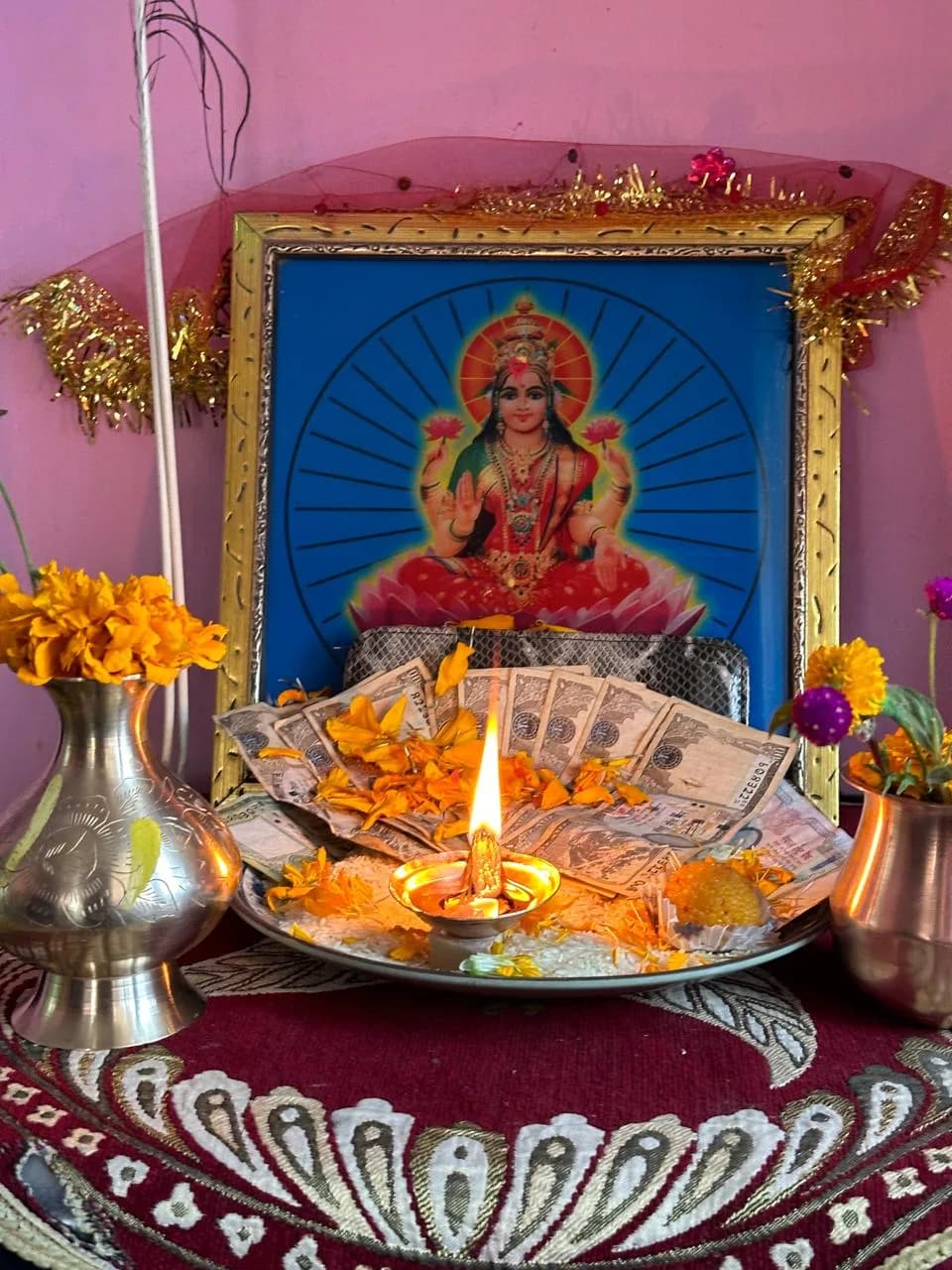
 Nov 8 – Nov 8, 2026
Kathamandu
Laxmi Puja 2026 in Nepal: Tihar Festival Guide
Festival
1 day
Festival
Free
Kathamandu1 day
Event Details
Loading...
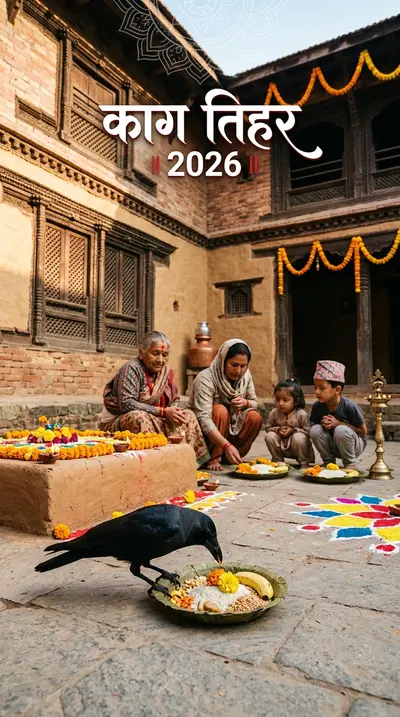
Kaag Tihar marks the opening day of Tihar, Nepal's five-day festival of lights, and it is unlike any other festival opener in the Hindu calendar because the first act of devotion is not directed at a deity in a temple but at a wild bird on the rooftop. Kaag Tihar Nepal traditions ask every household to feed crows before sunrise, an act rooted in the belief that these birds carry messages to Yama, the god of death, and can be persuaded through kindness to keep grief away from the home. For anyone searching when is Kaag Tihar 2026, planning a Nepal trip around the festival, or simply trying to understand what is Kaag Tihar in Nepal and why an entire nation pauses to honour a crow, this guide covers the exact date, the mythology, the step-by-step rituals, and how the celebration differs from the hills to the Kathmandu Valley to the Terai plains.
The Kaag Tihar date 2026 falls on Saturday, November 7, 2026, corresponding to Kartik 21, 2083 BS in the Nepali calendar, on the lunar day known as Kartik Krishna Trayodashi. Because Tihar follows the lunar Bikram Sambat calendar rather than the fixed Gregorian calendar, the English date shifts by roughly ten to twenty days every year, which is why older articles and calendar apps sometimes list conflicting dates for Tihar 2026 Nepal. Always cross-check with an official Nepal Panchang or a current-year Nepali calendar close to the festival, since the auspicious hour (sait) for rituals is typically confirmed only a few weeks in advance by religious authorities in Kathmandu.
Kaag Tihar 2026 opens the broader Tihar festival dates Nepal sequence, which runs across five consecutive days: Kaag Tihar on November 7, Kukur Tihar (dog worship) on November 8, Laxmi Puja on November 9, Gai Tihar and Govardhan Puja on November 10, and Bhai Tika, the festival's finale celebrating the bond between brothers and sisters, on November 11. This sequence makes Kaag Tihar the natural entry point into one of the most important Nepal Hindu festivals of the year, second in scale only to Dashain, and it arrives just weeks after that fifteen-day celebration concludes.
Travellers and researchers tracking Nepal festivals 2026 should note that Tihar, unlike Dashain, is celebrated wherever a person happens to be rather than requiring travel to an ancestral hometown, which makes Kaag Tihar an accessible cultural experience for visitors already in Kathmandu, Pokhara, or anywhere else in the country during the first week of November.
Kaag Tihar, literally translated as the Crow Festival Nepal celebrates each year, is the ceremonial opening chapter of the larger Tihar festival, also known as Swanti among Newar communities and considered Nepal's regional variation of Diwali. Where Diwali across the border in India centres almost entirely on Goddess Lakshmi and the triumph of light over darkness, Tihar dedicates its first four days to specific animals before turning to Lakshmi worship and finally to human relationships, and the crow earns the honour of going first.
In Hindu belief, the crow occupies a unique symbolic position. It is neither purely auspicious like the cow nor purely loyal like the dog; instead, it is regarded as a messenger, a liminal creature that moves between the world of the living and the realm of Yama, the god of death. This is the foundation of Kaag Tihar Nepal customs: by feeding and honouring the crow, families believe they are sending a peaceful message ahead, one that might soften misfortune or delay the arrival of grief into the household for another year.
Unlike temple-based festivals that require priests, elaborate idols, or pilgrimage, Kaag Tihar is refreshingly simple and domestic. It requires no special venue, no purchased offerings beyond household food, and no formal religious training to perform. This simplicity is part of why the tradition has survived largely unchanged for generations and remains one of the most widely practiced Nepal festivals even in fast-urbanising neighbourhoods of Kathmandu.
The mythological backbone of Kaag Tihar traces back to the figure of Yama, the god of death and dharma, and the belief that he dispatches crows as scouts and messengers across the mortal world. According to popular tradition, a cawing crow near a home was historically interpreted as an omen, sometimes a warning of impending news, sometimes a signal that death or misfortune was approaching a family member. Rather than fearing or driving the bird away, Hindu households in Nepal developed the opposite response: welcome the messenger, feed it generously, and hope that its report back to Yama would be a kind one.
This reflects a broader theological principle found throughout Tihar and much of Nepali Hindu practice, namely that reverence, gratitude, and hospitality extended to animals is repaid in cosmic terms. The crow is not worshipped as a god itself, but as an intermediary whose goodwill is worth cultivating. Some regional folk stories go further, describing crows as ancestral spirits or as carriers of messages from deceased relatives, which adds a layer of remembrance and continuity to the ritual that many families quietly hold onto even today.
The significance of Kaag Tihar therefore operates on two levels simultaneously: a protective function, warding off death and disaster by pleasing Yama's messenger, and a moral function, reminding practitioners that even a bird often dismissed as a scavenger deserves compassion and a share of the household's food. This dual meaning is frequently cited by scholars of Nepal Hindu festivals as an example of how ecological respect and religious duty are woven together in everyday ritual practice.
Ask most Nepali families why do Nepali people celebrate Kaag Tihar and the answer usually returns to the same core belief: appeasing the messengers of death protects the household from the death itself, at least symbolically, for the coming year. This is not treated as superstition to be dismissed lightly; it is woven into the same worldview that governs the rest of Tihar, where each day systematically thanks a different guardian or companion of human life, from crows and dogs to cows, oxen, and finally siblings.
There is also a practical, almost ecological logic embedded in the custom. Crows are highly visible, vocal, and intelligent birds that live in close proximity to human settlements across Nepal, from the terraced hills to the dense lanes of Kathmandu. A festival that formally instructs an entire population to feed these birds once a year reinforces a habit of coexistence with urban and rural wildlife that many other festival traditions do not explicitly encourage. Whether or not the mythological explanation is taken literally, the behavioural outcome, a day of deliberate kindness toward a wild species, has quietly persisted for centuries.
Finally, Kaag Tihar functions as a gentle, low-effort entry point that eases families into the more elaborate rituals of the days that follow. Kukur Tihar requires garlands and tika for household and street dogs, Laxmi Puja involves cleaning and lighting entire homes, and Bhai Tika demands an elaborate multi-hour ceremony between siblings. Starting with a rooftop offering of rice and sweets to crows sets a contemplative, unhurried tone before the festival's intensity builds across the following four days.
The core Kaag Tihar rituals and traditions are consistent across most Nepali households, even though small regional and family variations exist. Early in the morning, often before sunrise, family members prepare a plate or small portion of food specifically intended for crows. This typically includes cooked rice, roti or bread, seasonal fruits, and homemade sweets, sometimes formed into small balls or portions that are easy for birds to eat. The food is placed on the rooftop, a windowsill, a courtyard wall, or another open outdoor space where crows are likely to gather.
Many households also perform a brief puja before or alongside the offering, lighting incense and sometimes a small oil lamp near the food, treating the moment with the same seriousness given to worship of a deity, even though the recipient is an ordinary bird. In some communities, a short prayer or mantra is recited asking Yama and his messengers for protection from untimely death, illness, or grief in the year ahead. The Kaag Puja performed this way is understated compared to temple rituals elsewhere in Nepal, but its symbolic weight is considerable within the household.
The moment a crow actually arrives and eats the offering is considered a good sign; the cawing of the bird as it approaches or departs is interpreted as an acceptance of the family's goodwill and, by extension, a positive message being carried onward. Children in particular are often encouraged to watch for this, turning what could be an abstract ritual into a small, memorable family event, especially in neighbourhoods where crows are plentiful and the birds descend on rooftops within minutes of the food being set out.
While the essential Kaag Tihar rituals remain the same nationwide, how Kaag Tihar is celebrated varies noticeably depending on region and community. In the Kathmandu Valley, where Newar culture strongly shapes the festival calendar, Kaag Tihar is treated as the formal opening of the five-day Swanti celebration, and it is common to see rooftops across Kathmandu, Patan, and Bhaktapur dotted with small offerings each morning, with crows moving from house to house across densely packed neighbourhoods.
In the hill regions outside the valley, including areas frequented by trekkers such as the Annapurna region, Kaag Tihar tends to be a quieter, more agrarian affair, often folded into morning farm routines, with offerings placed near barns, courtyards, or open fields rather than urban rooftops. Because crows are especially common around agricultural land, the ritual here retains a strong practical link to daily rural life, where the birds are a familiar, near-constant presence around harvested grain.
In the Terai plains, where Hindu traditions sometimes blend with practices closer to those found across the border in parts of India, some households extend the same day's spirit of animal reverence to other birds as well, though the crow remains the central focus. Across all regions, however, the underlying message stays constant: the day belongs to gratitude toward a messenger species, performed quietly at home rather than through public processions, which distinguishes Kaag Tihar sharply from louder, parade-driven Nepal festivals such as Indra Jatra or the Phulpati procession during Dashain.
Understanding Kaag Tihar fully requires seeing it within the structure of the entire Tihar festival Nepal celebrates each year, sometimes called Yamapanchak, or "the five days of Yama." Day one is Kaag Tihar, honouring crows as messengers of death. Day two is Kukur Tihar, dedicated entirely to dogs, who are worshipped with garlands, tika, and special meals in recognition of their loyalty and their mythological role as guardians at the threshold of the afterlife.
Day three brings Laxmi Puja, the festival's best-known night, when homes are cleaned, decorated with oil lamps and rangoli, and opened to welcome Goddess Lakshmi, the goddess of wealth and prosperity, into the household. Day four is typically observed as Gai Tihar and Govardhan Puja, honouring cows and oxen for their role in agriculture and daily sustenance, and in Newar communities this day doubles as Mha Puja, a ritual of self-worship marking the Nepal Sambat New Year. The festival concludes on day five with Bhai Tika, an elaborate ceremony in which sisters apply a multicoloured tika to their brothers' foreheads and pray for their long life, considered the emotional and social high point of the entire celebration.
Seen this way, Kaag Tihar is not an isolated curiosity but the deliberate first note in a five-day composition that moves systematically from wild bird, to loyal companion, to farm animal, to goddess, and finally to human family, a progression that reflects a broader Hindu Nepali worldview in which gratitude radiates outward from the natural world before settling on human relationships.
Crow worship in Nepal deserves attention beyond its religious framing because of what it reveals about the cultural relationship between Nepali society and the animals that share its cities, villages, and farmland. Very few cultures worldwide formally dedicate a festival day to a species as ordinary and, in many places, as maligned as the crow. Nepal's tradition instead frames the bird as intelligent, purposeful, and worthy of respect, a framing that aligns closely with what modern ornithologists have documented about corvid intelligence and social behaviour.
From a cultural preservation standpoint, Kaag Tihar also functions as an informal, annually renewed lesson in coexistence, teaching successive generations that even a creature typically associated with scavenging or bad omens elsewhere in world folklore can be treated with dignity rather than fear. This stands in interesting contrast to crow symbolism in many Western traditions, where the bird is more often linked exclusively to death and misfortune without the accompanying ritual of care that Nepali practice provides.
Researchers examining Nepal Hindu festivals frequently point to Kaag Tihar as a strong example of syncretic thinking, where a practical ecological habit, feeding wild birds during a season when natural food sources can be scarcer, has been reinforced and preserved through religious meaning rather than left to individual discretion. Whether the original motivation was spiritual, ecological, or both, the outcome after centuries of continuous practice is a genuinely distinctive cultural fixture unlike almost anything else in the global festival calendar.
The specific foods used in Kaag Tihar offerings carry their own layer of meaning and tend to reflect whatever is seasonally abundant in Nepali households during early November. Freshly cooked rice is among the most common offerings, often shaped into small mounds or balls for easy feeding, alongside pieces of roti or bread. Sel roti, the traditional Nepali ring-shaped rice doughnut closely associated with Tihar as a whole, frequently appears in Kaag Puja offerings as well, since households are usually already preparing it in bulk for the days ahead.
Fruits such as bananas, along with seasonal produce and homemade sweets like laddoo or other simple confections, round out a typical offering plate. Some families also include small amounts of milk or curd, and a few add a pinch of salt or spice, believing that a varied plate is more likely to be accepted quickly by visiting crows. None of these items are purchased specially for the occasion in most households; instead, families use whatever they already have prepared for the broader Tihar celebration, which reinforces how deeply Kaag Tihar is embedded into the flow of the festival rather than treated as a separate errand.
The placement of the offering matters as much as its contents. Rooftops, open courtyards, and window ledges are preferred because they are visible and accessible to birds while remaining separate from the areas where family meals are eaten. This spatial distinction subtly reinforces the ritual's symbolic function: the food is not simply scraps, but a deliberate, elevated offering meant to be seen as an invitation rather than leftovers.
Placing Kaag Tihar alongside the other days of Tihar helps clarify what makes it distinct. Kukur Tihar, the second day, shares a similar animal-worship structure but focuses on domesticated, loyal companions rather than wild birds, and its rituals are far more visually elaborate, involving garlands, vermillion tika, and special meals presented directly to individual dogs, including street dogs in urban areas. Laxmi Puja, by contrast, shifts the festival's focus entirely away from animals and toward a goddess, with rituals centred on wealth, prosperity, and the illumination of the home itself.
Gai Tihar and Govardhan Puja return to animal worship but honour cows and oxen specifically for their agricultural and economic contributions, giving that day a more practical, livelihood-oriented character compared to the more mythological framing of Kaag Tihar. Bhai Tika, the finale, abandons animal symbolism altogether in favour of an intricate human ritual between siblings, arguably the most emotionally significant day of the entire festival for most families.
Within this progression, Kaag Tihar stands out as the most understated and reflective of the five days. It requires no decoration, no purchased garlands, and no extended family gathering, making it an accessible, meditative opening act before the festival's visual and emotional intensity builds toward Laxmi Puja and Bhai Tika later in the week.
Travellers planning a trip around Kaag Tihar 2026 and the broader Tihar season should expect a noticeably different atmosphere compared to Dashain, since Tihar does not trigger the same nationwide exodus to hometowns and instead keeps cities and towns lively with visible, ongoing celebration. Early mornings on November 7 are an excellent time to observe Kaag Puja in residential neighbourhoods of Kathmandu, Patan, or Bhaktapur, where rooftop offerings and the sound of gathering crows can often be witnessed simply by walking through older residential lanes shortly after sunrise.
Because the festival unfolds over five consecutive days, visitors have the opportunity to witness a genuinely complete cultural arc within a single trip, from the quiet crow offerings of the first morning through the elaborate oil-lamp displays of Laxmi Puja two days later. Accommodation in Kathmandu and Pokhara can fill quickly around major Tihar dates, so booking in advance is advisable, and travellers interested in trekking regions should note that early-to-mid November generally offers clear skies and stable weather across popular routes, making it a favourable window for combining cultural observation with outdoor activity.
Visitors are welcome to observe Kaag Tihar rituals respectfully from a distance, though it is worth remembering that the offerings themselves are a private, household-level act rather than a public performance, so photography should be handled with the same courtesy one would extend to any quiet family ritual glimpsed from a public street.
As Nepal urbanises rapidly and rooftop spaces shrink into small apartment balconies, some families in fast-growing parts of Kathmandu have adapted rather than abandoned Kaag Tihar, moving offerings to shared building terraces or nearby open ground where crows still gather. This adaptability is often cited as evidence that Kaag Tihar rituals and traditions are resilient precisely because they demand so little infrastructure, unlike festivals that depend on temple access, large courtyards, or extended family presence in one physical location.
Cultural researchers and Nepali elders alike frequently note that younger generations, even those with limited interest in the theological explanation involving Yama, still participate in Kaag Tihar simply because it is enjoyable, low-pressure, and visibly rewarding when crows arrive to eat. This generational continuity, driven as much by habit and family memory as by strict religious belief, suggests that Kaag Tihar in Nepal is likely to remain a fixture of the festival calendar for a long time to come, even as other, more resource-intensive customs face pressure from modern urban living.
When is Kaag Tihar 2026? Kaag Tihar 2026 falls on Saturday, November 7, 2026, corresponding to Kartik 21, 2083 BS in the Nepali lunar calendar.
What is Kaag Tihar in Nepal? Kaag Tihar is the first day of the five-day Tihar festival, dedicated to worshipping crows as messengers of Yama, the god of death, in the belief that honouring them wards off misfortune and grief.
How is Kaag Tihar celebrated? Families place offerings of rice, sweets, fruit, and sel roti on rooftops or open courtyards early in the morning, often accompanied by a brief prayer, inviting crows to eat as a symbol of goodwill sent toward Yama.
Why do Nepali people celebrate Kaag Tihar? The tradition stems from the belief that crows act as scouts for Yama, and that feeding them respectfully can soften or delay misfortune, while also reinforcing a broader cultural value of gratitude toward animals that coexist with humans.
What is the significance of Kaag Tihar within Tihar as a whole? It opens a five-day sequence that moves from crows to dogs, cows and oxen, Goddess Lakshmi, and finally to the bond between siblings, framing the festival as a broad expression of gratitude toward the natural and social world.
Is Kaag Tihar the same as Kag Puja? Yes, Kaag Puja and Kag Puja are alternate spellings used interchangeably to describe the same ritual of crow worship performed on the first day of Tihar.
Kaag Tihar endures not because it is loud or visually spectacular, but precisely because it is not. In a festival season otherwise filled with fireworks, elaborate lamp displays, and multi-day family gatherings, the first morning of Tihar asks for nothing more than a small plate of rice on a rooftop and a moment of genuine respect for a bird most other cultures overlook. That simplicity is exactly what has allowed Kaag Tihar Nepal traditions to survive largely unchanged across generations, carrying forward a worldview in which even a messenger of death deserves kindness rather than fear.
For anyone tracking Kaag Tihar 2026, researching Nepal Hindu festivals, or planning a visit during Tihar festival Nepal season, understanding this first day offers a genuinely useful lens into how the entire festival, and much of Nepali religious life more broadly, treats gratitude as something owed not just to gods and family, but to the natural world that surrounds and sustains daily life.
Key experiences and features
Kaag Tihar
Hindu calendar
Kaag Tihar in Nepal
Kartik Krishna Trayodashi
Bikram Sambat
Kukur Tihar
Bhai Tika
Gai Tihar
Laxmi Puja
Swanti
Recommended packing list
Kathmandu, Kathmandu, Bagmati, Nepal
Got questions about this event?
Kaag Tihar 2026 is observed during the Tihar festival in Nepal. The exact date should be confirmed with the official Nepali calendar before the event.
Kaag Tihar is the first day of Tihar, dedicated to crows. People offer food to crows as part of a traditional religious practice associated with Yama.
In traditional Hindu belief, crows are regarded as messengers of Yama. Offering them food is considered a way of showing respect and seeking protection from misfortune.
Families prepare food offerings and place them where crows can eat. People observe the ritual at home and may also participate in local cultural activities.
Yes. Visitors can experience Kaag Tihar as part of Nepal's cultural tourism, provided they respect religious practices, local communities, and the animals involved.
Nov 6, 2026
1 day
Quick Info
More festival experiences
Nov 8 – Nov 8, 2026Kathamandu
 Aug 17 – Sep 16, 2027
Godavari Kunda
 Jan 15 – Jan 16, 2027
Swayambhu Bhuikhhel