 Nov 8 – Nov 8, 2026
Kathamandu
Laxmi Puja 2026 in Nepal: Tihar Festival Guide
Festival
1 day
Festival
Free
Kathamandu1 day
Event Details
Loading...
Event starts in
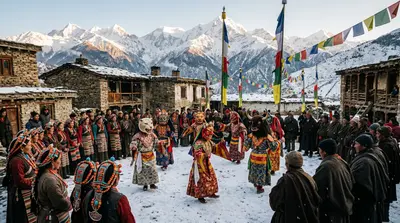
The Mane Festival in Humla is one of the lesser-known cultural celebrations of Nepal, taking place in the remote Himalayan settlement of Buraunse in Nyin Valley. Unlike the large festivals that fill Kathmandu with crowds, this celebration remains closely connected with village life, local beliefs, traditional music, family gatherings and ancient forms of dance. The festival is particularly associated with the Nyinba community, and its main celebration includes religious rituals, colorful clothing, traditional mask dances, music, food and community hospitality. A recent source on Nyin Valley identifies Buraunse as the village that hosts the Mane Festival and reports January 21, 2027 as the next celebration date, while other descriptions explain that the main festival activities traditionally continue for several days and that social gatherings may continue for weeks afterward. For travelers searching for a different side of Nepal cultural tourism, the festival offers a chance to experience a Himalayan community where traditions are still closely tied to village life. Visitors planning a wider journey can begin with Nepal cultural experiences, explore Nepal festival events, discover Himalayan destinations, and check the Nepal tour collection when building a route around Humla.
The Mane Festival is a traditional winter celebration associated with the Himalayan communities of Humla. In Buraunse, it is especially connected with the Nyinba community and is expressed through religious observances, traditional dances, music, costumes, feasting and visits between families. Sources describe the festival as a deeply local celebration rather than a modern tourism event created specifically for visitors.
The name is sometimes written as Mane and sometimes as Mani, depending on the source and local spelling. Some tourism sources connect the name with Mani, a term associated with the Buddhist mantra Om Mani Padme Hum, reflecting the wider Tibetan Buddhist cultural influence of the Himalayan region. For travelers interested in Himalayan spiritual culture, the festival provides a useful way to understand how religion, family, seasonal life and traditional performance can exist together in one community.
Unlike a large urban festival, Mane is closely connected with the village itself. Homes, local gathering places and religious spaces become part of the celebration. That makes remote Nepal destinations particularly meaningful for travelers who want to move beyond the country's better-known tourism routes.
For 2027, a recent travel source identifies January 21, 2027 as the next Mane Festival in Buraunse, Nyin Valley, Humla. The festival follows a traditional lunar calendar, which means the Gregorian date can change from year to year. Historical reporting has described the celebration as beginning around the 13th day of the waxing moon in the Nepali month of Magh, with the Buraunse celebration beginning before the corresponding celebration in Simikot.
For a tourism listing, it is therefore safest to publish January 21, 2027 as the confirmed starting date currently reported, while explaining that the local program should be reconfirmed with community representatives before final travel arrangements. This is especially important for Himalayan festival travel, because remote mountain celebrations do not always follow the same scheduling style as major city festivals.
The main public celebration is commonly described as lasting three to four days, depending on the source and the local program. One recent tourism itinerary describes three principal days of traditional mask dancing, while Republica describes a four-day festival beginning in Buraunse. Therefore, visitors should allow several days rather than arriving for only a few hours. A flexible Humla cultural journey is more suitable than a tightly timed city-style excursion.
For your event page, the most useful information is:
Festival: Mane Festival
Year: 2027
Main reported date: January 21, 2027
Location: Buraunse, Nyin Valley, Humla
Province: Karnali Province
Main cultural community: Nyinba community
Season: Winter
Main activities: Religious rituals, mask dances, traditional music, singing, dancing, feasting and community gatherings
Main public celebration: Approximately three to four days, depending on the local program
Post-festival gatherings: May continue for around two weeks in some local traditions
Travelers can use the Nepal events calendar to compare the Mane Festival with other cultural celebrations and explore Nepal's destinations when planning additional stops.
The best-known Mane Festival associated with the Nyinba community is held in Buraunse, also spelled Burause or Burausne, in Nyin Valley of Humla District. Buraunse is described as the first major village reached from Simikot and one of the largest settlements in the valley.
The surrounding Nyin Valley includes villages such as Bargaun, Torpa, Langdu, Hutik and Nimatang. These communities preserve a mixture of cultural practices influenced by shamanism, Bon and Nyingma Buddhist traditions. That cultural diversity makes Himalayan cultural destinations especially interesting for visitors who want to understand Nepal through its communities rather than only through its landscapes.
Simikot is the administrative center and the main gateway for travelers reaching Humla. From Simikot, Buraunse can be reached by a short road journey according to recent regional travel information. Travelers arranging a remote Nepal tour should allow additional time because weather and mountain transportation can affect schedules.
The Mane Festival is not simply a public show. It is part of the social and spiritual life of the community. Sources describe the festival as an opportunity to worship deities, perform traditional dances, wear special clothing, share food and strengthen relationships between families.
One reason the festival remains important is that it provides an opportunity for older generations to pass traditional knowledge and performance skills to younger people. A Buddha Air feature on the festival describes it as an old cultural tradition through which elders teach younger generations traditional skills and knowledge.
This makes Nepal's living heritage an important part of the tourism story. Visitors are not simply looking at costumes or dances; they are seeing a community use a festival to maintain relationships with its history.
Humla is one of Nepal's most remote Himalayan districts, and its cultural traditions have developed within a landscape where communities historically had limited contact with the outside world. The result is a rich mixture of local customs, architecture, religious traditions, clothing and oral knowledge.
The Mane Festival provides a moment when many of these elements become visible together. The music, dance, masks, clothing and food create a shared cultural space where different generations participate.
For responsible cultural tourism in Nepal, this is important. Tourism can introduce visitors to communities while also creating opportunities for local accommodation, guides, transport providers and homestays.
One of the most recognizable features of the Mane Festival is its traditional mask dance. Recent descriptions of the Buraunse celebration mention several traditional dances, including Shikthukpa, Thapakerya, Shingkhy, Omphak, Juilampha, Tuthut and Chhiring Chhenga.
These dances are not simply entertainment. Some are connected with religious stories, local deities and ideas of protection and purification. According to a recent description, the first day includes the Shikthukpa dance, described as a ritual connected with purification.
For travelers interested in Nepal's traditional festivals, these performances can be one of the most memorable parts of the trip. Photography may also be possible, but visitors should always ask permission before photographing performers closely.
The first day traditionally introduces the main public celebration. A recent festival itinerary describes the first day beginning in the evening, when mask dancers representing different sides of the village perform Shikthukpa.
The performance is connected with purification and religious meaning. For visitors, it can be tempting to focus only on the colorful masks and costumes, but understanding the spiritual purpose makes the experience much richer.
The first day is therefore best approached as a cultural observation rather than a stage show. A Himalayan cultural tour should give visitors enough time to learn about the meaning of the performance before photographing or joining any public activity.
The second day continues the community's religious and cultural activities. A recent itinerary describes villagers gathering at the temple of the village's protective deity Tungma, where a large tree trunk is raised with prayer flags.
This combination of religious space, natural materials and community participation reflects the wider cultural landscape of Nyin Valley.
For visitors, the second day can provide a quieter opportunity to observe the relationship between the festival and the village itself. Travelers can explore Himalayan places in Nepal while allowing enough time for the festival program.
The later part of the festival includes additional traditional performances and social gatherings. A recent tourism source describes the final day as featuring a dance called Ghar, performed by men and women wearing traditional clothing.
The final performances are important because they bring together different generations and members of the village. The festival becomes both a religious occasion and a social celebration.
After the main program, families may continue inviting guests into their homes. One source describes these gatherings as continuing for up to two weeks after the formal festival. Travelers interested in community-based tourism may find this extended period particularly meaningful if they are welcomed by local families.
There is some variation in descriptions of the festival's duration. Republica reports that the Mane Festival in Burause is a four-day celebration, while another tourism itinerary structures the main festival program around three principal performance days.
This difference does not necessarily mean that one account is wrong. Local festivals can have different definitions of when the celebration begins and ends, especially when religious preparation and social gatherings are counted differently.
For an event listing in Nepal, the safest wording is that the Mane Festival has a three-to-four-day main celebration, with additional community gatherings potentially continuing afterward.
Traditional clothing is an important visual part of Mane Festival. Participants dress in special garments and decorations, creating a strong sense of identity during the procession and dance performances. Republica describes participants wearing unique outfits and decorations during the festival.
The clothing is more than decoration. It helps communicate community identity and cultural continuity.
Travelers should not assume that traditional clothing is a costume prepared for tourists. It is part of the community's cultural expression. When photographing people, asking permission is a simple but important way to show respect.
Visitors looking for authentic Nepal experiences should focus on learning rather than simply collecting photographs.
Music is another central part of Mane Festival. Traditional drums accompany dances, while singing forms part of the social atmosphere. Reports describe the festival as including drumming, dancing, singing and feasting.
The rhythm helps bring the community together. Performances are often learned through participation and passed between generations.
For visitors, the soundscape may be as memorable as the visual side of the celebration. A quiet Himalayan village can suddenly become filled with drums, voices and movement.
This makes Nepal festival travel particularly different from ordinary sightseeing.
Food is an important part of the festival because Mane is also a time for families and guests to gather. Local reports describe traditional food, sweets and local drinks being shared during the celebration.
Food helps turn the festival into a community event rather than a series of religious rituals. Guests are welcomed into homes, relatives visit each other and meals become a way of strengthening social relationships.
For tourism businesses, this provides an opportunity to promote local food experiences responsibly, provided that community participation is voluntary and visitors respect local customs.
Hospitality is one of the most interesting aspects of the Mane Festival. A recent description of the Nyinba celebration explains that families invite relatives and guests to their homes and may offer traditional shawls as a sign of respect and welcome.
This creates an experience that feels very different from staying in a conventional hotel. A visitor may learn about the community through conversation, food and everyday family life.
That is why community tourism in Nepal can be particularly valuable in remote regions.
Mane Festival is strongly connected with family. People who live elsewhere may return to their village, relatives gather and homes become centers of hospitality.
The festival therefore provides a reason for people to reconnect after the agricultural season. Republica reports that the winter celebration follows months of farming and harvesting, giving local farmers an opportunity to relax and gather.
This family connection is one of the reasons the festival remains meaningful even as younger generations increasingly travel outside the region.
The timing of Mane Festival is connected with the winter period following the agricultural cycle. Local reporting describes it as a time when farmers have completed major cultivation and harvesting activities and have more time for celebration.
This relationship between agriculture and festival life is common across Nepal. Seasonal celebrations often develop around the rhythm of planting, harvesting, migration and weather.
Visitors exploring Nepal's cultural destinations can see how different communities maintain their own seasonal calendars.
Religious observances are central to the festival. Sources describe worship of local deities and mention Tungma and Sungma among the protective deities connected with Buraunse.
The festival therefore combines performance with religious practice. The masks, prayers, processions and dances have meaning within the community's spiritual worldview.
Visitors should remember that these are living religious practices, not theatrical productions. That distinction should guide photography, movement around sacred spaces and interactions with participants.
One of the most important roles of Mane Festival is the transmission of cultural knowledge. Older people teach traditional dances and practices to younger members of the community, helping preserve knowledge that could otherwise become difficult to maintain.
Modernization creates both opportunities and challenges for remote communities. Younger people may leave villages for education, work or other opportunities. Festivals such as Mane create occasions for them to return and reconnect with their cultural roots.
For responsible tourism in Nepal, supporting local communities without turning their traditions into performances for outsiders is an important principle.
From a tourism perspective, Mane Festival offers a rare combination of culture, remoteness and community life. Visitors are not simply seeing another large festival in a city square. They are traveling into a Himalayan valley where the festival remains embedded in village society.
The experience can support a broader Nepal cultural itinerary, especially for travelers who have already visited Kathmandu, Pokhara or the Everest region and want to see a less familiar part of the country.
Humla is remote, and reaching the festival requires more preparation than visiting a Kathmandu festival. Travelers generally use Simikot as the gateway, with flights from Nepalgunj forming a key part of many itineraries. A recent Mane Festival itinerary describes travel from Kathmandu to Nepalgunj, followed by a flight to Simikot and then onward travel toward Buraunse.
Weather can affect flights in the mountains, so travelers should avoid planning connections with no spare time.
A well-organized Nepal tour itinerary should include buffer days for weather and transportation.
For international visitors, the journey normally begins in Kathmandu. Nepalgunj acts as an important gateway toward western Himalayan destinations.
Travelers may spend a night in Nepalgunj before taking the flight toward Simikot. This creates a useful buffer if weather affects the mountain flight.
The Nepal travel guide can be used as the starting point for organizing the broader journey.
The flight from Nepalgunj to Simikot is one of the most important parts of the journey. Mountain weather can change quickly, and flights are often dependent on visibility and wind.
A recent Mane Festival itinerary describes an early morning flight to Simikot, followed by a short trek toward Buraunse.
Travelers should therefore keep their schedule flexible and avoid booking an international departure immediately after returning from Humla.
Recent regional information indicates that the route from Simikot to Buraunse has become easier with road access, with Buraunse now reachable by a relatively short vehicle journey.
This is an example of how infrastructure is changing remote Himalayan travel.
Even when road access improves, the journey remains very different from traveling in the Kathmandu Valley. Roads can be rough, weather can affect movement and services are more limited.
Travelers exploring remote destinations of Nepal should therefore prepare for a slower travel rhythm.
Mane Festival takes place during winter, making weather preparation important. Humla can be extremely cold, especially in the early morning and evening.
Warm layers, gloves, a hat, thermal clothing and appropriate footwear are useful.
A winter Himalayan tour should also include accommodation with reliable heating or appropriate bedding where available.
Visitors should pack for both winter weather and cultural participation. A warm jacket is essential, but so are comfortable walking shoes and modest clothing.
A useful packing list includes:
Warm down or insulated jacket
Thermal base layers
Warm hat and gloves
Comfortable walking shoes
Sunglasses
Sunscreen
Reusable water bottle
Personal medication
Small daypack
Camera or smartphone
Power bank
Personal hygiene items
Passport and required travel documents
Visitors should keep their luggage practical because the journey includes flights and mountain transportation.
The Mane Festival is a community celebration, so visitors should behave like guests rather than spectators.
Dress modestly, ask permission before photographing individuals, avoid touching religious objects without permission and follow instructions from local hosts.
When entering a home, remove shoes if requested. When offered food, respond politely even if you cannot accept everything.
These small acts of cultural respect can make a major difference.
Travelers can read more about respectful cultural travel in Nepal before leaving Kathmandu.
The festival offers excellent photographic opportunities, particularly during traditional mask dances and processions. The combination of Himalayan scenery, traditional clothing and ceremonial movement can create powerful images.
However, photographers should avoid treating sacred moments as staged performances.
Ask before taking close portraits. Avoid intrusive flash photography during religious rituals and follow local instructions about where photographers may stand.
A good Nepal photography journey should prioritize relationships and respect over simply collecting images.
The festival can be interesting for families, particularly older children and teenagers who enjoy culture and traditional performances.
However, the journey to Humla is considerably more demanding than traveling to major tourist centers.
Families should consider the cold weather, remote transportation and limited facilities before planning the trip.
A family cultural tour in Nepal should be designed around the family's comfort and the local conditions.
The festival itself is not necessarily physically demanding, but reaching Humla can involve flights, road travel and walking in a remote mountain environment.
Senior travelers should therefore consider their comfort with altitude, cold and changing transportation conditions.
A carefully planned Himalayan cultural journey with additional rest days can make the experience more comfortable.
Mane Festival is primarily a cultural and religious festival, not a trekking competition or adventure race.
However, reaching the festival can involve walking and mountain travel, depending on the route and road conditions.
This distinction is useful for tourism marketing. The main attraction is culture, while the Himalayan landscape and journey provide the setting.
Visitors can combine the festival with Nepal trekking destinations if they want a longer Himalayan experience.
Community tourism is particularly relevant in Humla because visitors can spend money directly on local accommodation, transport, guides, food and handicrafts.
Homestays can give travelers an opportunity to meet families and learn about daily life.
Tourism businesses should ensure that local communities benefit from visitor spending and that cultural practices are not changed simply to satisfy tourist expectations.
This approach fits naturally with responsible Nepal tourism.
The Mane Festival also provides opportunities to observe traditional clothing, ornaments and local handicrafts. Reports describe ancient jewelry and handicrafts being displayed during the festival procession.
For visitors, purchasing locally made crafts can provide direct economic support to artisans.
However, travelers should ask about the origin and cultural meaning of objects before buying them.
A Nepal cultural tour can include time for local craft experiences without turning them into a forced shopping activity.
Buraunse and the surrounding Nyin Valley have traditional stone-built houses and other Himalayan architectural features. Recent regional reporting notes that traditional flat-roof stone architecture is gradually changing toward inclined metal roofing.
Architecture therefore becomes another part of the festival experience.
Travelers can see how traditional buildings, village paths, religious sites and mountain landscapes create the physical environment in which the celebration takes place.
This is one reason Nepal's remote places are valuable for cultural tourism.
The Nyin Valley is surrounded by high Himalayan landscapes, rivers, forests and mountain peaks. Recent regional information highlights Panchamukhi Himal, local high-altitude lakes and the Ghatte Khola area among the surrounding features.
The landscape adds another dimension to the journey.
Visitors who come for Mane Festival can spend additional time exploring the valley rather than immediately returning to Simikot.
A Himalayan destination itinerary can combine cultural and landscape experiences.
Panchamukhi Himal is identified as one of the notable natural features of the Nyin Valley. The surrounding area also includes two high-altitude lakes known locally as Dudhe Daha and Ladhe Daha.
These places may be suitable for travelers with additional time and appropriate local guidance.
Because the festival is the main cultural reason for visiting, visitors should avoid turning the entire journey into a rushed checklist of sights.
Raling Gompa is another cultural feature identified in descriptions of Nyin Valley, with links to Guru Padmasambhava and Milarepa.
For travelers interested in Himalayan Buddhism, this provides an opportunity to understand the religious landscape beyond the Mane Festival itself.
Visitors should remember that monasteries and religious sites remain active places of worship.
The spiritual side of Nepal can be explored further through cultural and pilgrimage journeys.
The cultural environment of Humla includes several overlapping religious traditions. Recent regional research describes Nyin Valley as having a mixture of shamanism, Bon and Nyingma Buddhist traditions.
This mixture is one reason the festival should not be described too simply.
The term Mane may have Buddhist associations, but local practices also reflect the unique history of the communities that live in Humla.
For travelers, this complexity is part of the attraction of Nepal's Himalayan culture.
Mane Festival should not automatically be confused with Mani Rimdu, the well-known Sherpa Buddhist festival of the Everest region.
Mani Rimdu is associated particularly with monasteries such as Tengboche and has its own monastic rituals, prayers and masked dances. Mane Festival in Humla belongs to a different local cultural setting.
This distinction matters for tourism businesses because using the wrong festival name can confuse travelers.
A clear Nepal festival listing should identify the festival as Mane Festival of Humla and specify Buraunse/Nyin Valley.
The festival gives people an opportunity to express their identity through dress, dance, music, ritual and hospitality.
For communities in remote areas, festivals can become important moments for younger people to learn traditions from elders.
The continuation of the festival therefore has significance beyond tourism.
Visitors who participate respectfully can contribute to the visibility and economic value of the culture without taking ownership of it.
Humla has considerable potential for cultural tourism, but development needs to be carefully managed.
The attraction of Mane Festival comes partly from its small scale and local character. If tourism grows too quickly, the atmosphere could change.
A sustainable approach would focus on small groups, local guides, homestays, cultural interpretation and community-led experiences.
This model fits the idea of responsible Himalayan travel.
A tourism itinerary can begin in Kathmandu, continue to Nepalgunj, fly to Simikot, travel to Buraunse, spend several days experiencing the festival and then return through Simikot and Nepalgunj.
A longer itinerary can add extra days in Nyin Valley.
A possible structure is:
Day 1: Arrive in Kathmandu and prepare for the journey.
Day 2: Travel from Kathmandu to Nepalgunj and overnight.
Day 3: Fly to Simikot and continue toward Buraunse.
Day 4: Explore Buraunse and learn about the local community.
Day 5: Experience the first major Mane Festival activities.
Day 6: Observe the second day of performances and religious activities.
Day 7: Experience the later festival performances and community gatherings.
Day 8: Rest and participate in permitted village activities.
Day 9: Return toward Simikot and fly to Nepalgunj, subject to weather.
Day 10: Return to Kathmandu.
This structure is based on the type of itinerary published by specialist Humla operators, but the actual 2027 program should be adjusted according to local festival announcements and flight conditions. Travelers can browse the Nepal tour list when comparing broader itineraries.
For the Mane Festival itself, the most relevant period is January and February, with 2027's Buraunse festival currently reported for January 21.
Winter brings cold conditions, but it also creates the setting for the festival.
Travelers should not choose their dates only according to general tourism-season advice. The festival calendar is more important.
The Nepal events collection can be used alongside local confirmation before booking.
Humla offers something different from Nepal's more developed tourism regions.
The landscape is remote, the villages are culturally distinctive and the journey itself becomes part of the experience.
The Mane Festival adds a specific cultural reason to visit.
Travelers who have already explored Kathmandu Valley and popular Himalayan routes may find Humla an opportunity to experience a quieter side of Nepal.
For photographers, the festival can combine portraits, traditional masks, dance, mountain landscapes, village architecture and winter light.
The best approach is to spend enough time in the village to build familiarity with local people.
Instead of arriving, photographing and leaving immediately, stay longer and learn about the celebration.
A Nepal photography tour can be designed around this slower approach.
Tourism businesses should market Mane Festival around its culture and community, not simply its visual appeal.
Useful themes include traditional mask dances, Nyinba heritage, winter village life, local hospitality, Himalayan scenery and cultural learning.
Marketing should avoid exaggerated claims such as calling the festival the “biggest” or “most famous” festival in Nepal.
The festival's real strength is its distinctive local character.
A tourism listing on Nepal's event platform can focus on accurate information and responsible visitor expectations.
Visitors can support local communities by using locally operated transport, staying in homestays, eating local food and purchasing locally produced crafts.
The goal should be to ensure that tourism income reaches the people who maintain the cultural landscape.
This makes community-based Nepal travel particularly relevant.
Visitors should not enter restricted religious areas without permission, touch sacred objects, interrupt ceremonies, mock traditional dances or photograph people without consent.
They should also avoid littering and should carry personal waste out of remote areas when appropriate.
A remote destination depends heavily on visitor behavior.
Respect is therefore one of the most important things to bring to Mane Festival.
Sustainable tourism in Humla should balance visitor interest with community needs.
The festival should remain primarily a celebration for the local people.
Tourism can provide additional income, but the community should remain in control of how its traditions are presented.
Small groups and longer stays can be more useful than large crowds.
This approach can help protect the authentic character of the festival while creating tourism opportunities.
The Mane Festival 2027 in Humla offers travelers an opportunity to experience a part of Nepal that remains far removed from the country's busiest tourist routes. Centered around Buraunse in Nyin Valley, the celebration brings together religious traditions, traditional masks, music, dancing, clothing, food, family gatherings and community hospitality. The currently reported 2027 date is January 21, although the detailed program and duration should be confirmed with local organizers because the festival follows a traditional calendar and different sources describe the main celebration as three or four days.
For tourism, Mane Festival is valuable because it connects visitors with living Himalayan culture rather than a festival created only for tourists. The traditional dances are learned and performed by community members, families return home, elders pass knowledge to younger generations and local homes become places of hospitality. That gives the festival a depth that cannot be understood simply by watching a procession for an hour.
The journey itself is also part of the experience. Traveling from Kathmandu toward Nepalgunj, flying to Simikot and continuing into Nyin Valley gives visitors a strong sense of how geography shapes life in the far western Himalaya. The surrounding mountains, traditional villages and local religious sites add another layer to the journey.
Travelers planning the experience can begin with Nepal travel inspiration, explore cultural events in Nepal, discover Himalayan places, and review the Nepal tour collection. The most important thing is to travel slowly, respect the community and understand that Mane Festival belongs first to the people who have maintained it for generations.
The Mane Festival is not simply a colorful event in a remote mountain village. It is a meeting point between tradition and modern life, between elders and younger generations, between religious practice and community celebration, and between the Himalayan landscape and the people who call it home. For visitors willing to make the journey, that combination can turn a trip to Humla into a meaningful cultural experience rather than another ordinary sightseeing tour.
Key experiences and features
Mane Festival in Humla
Buraunse in Nyin Valley
Nepal cultural tourism
Om Mani Padme Hum
Traditional mask dance
Tungma
Simikot as the gateway
Himalayan scenery
Recommended packing list
simkot, Humla, Karnali Province, Nepal
Got questions about this event?
Mane Festival 2027 in Buraunse, Humla, is currently reported for January 21, 2027. The final local program should be confirmed before travel.
The main Mane Festival associated with the Nyinba community is celebrated in Buraunse Village, Nyin Valley, Humla.
Visitors may experience traditional mask dances, music, singing, religious rituals, traditional clothing, local food and community gatherings.
Travelers generally reach Humla through Nepalgunj and Simikot, followed by road travel or walking toward Buraunse depending on current conditions.
Jan 21 – Jan 24, 2027
4 days
Quick Info
More festival experiences
Nov 8 – Nov 8, 2026Kathamandu
 Aug 17 – Sep 16, 2027
Godavari Kunda
 Jan 15 – Jan 16, 2027
Swayambhu Bhuikhhel