Lumbini Day by Day: A Practical Pilgrimage and Monastery Itinerary to the Buddha's Birthplace
Every year hundreds of thousands of visitors walk the shaded paths of Lumbini, the peaceful pocket of Nepal's Terai where Prince Siddhartha Gautama was born in 623 BC. Yet most arrive with only a vague plan and leave feeling they missed half of what this UNESCO World Heritage Site holds. This guide is built differently. It is a day by day walk through the Sacred Garden, the Maya Devi Temple, the Ashoka Pillar and the remarkable international monastery zone, written so you can arrive, slow down and actually feel the place rather than rush past it with a camera.
Lumbini is not a single monument. It is a carefully planned spiritual park spread across several square kilometers, divided into the Sacred Garden at its heart and the Monastic Zone where dozens of countries have built temples in their own architectural language. Knowing the layout before you go turns a confusing wander into a meaningful journey. Enticing Himalayas designs Lumbini journeys as part of a wider Nepal cultural pilgrimage, and the structure below reflects how our local guides actually move through the site.
Why Lumbini Matters Beyond Buddhism
The birthplace of the Buddha is, first, a story about a human being who questioned suffering and dedicated his life to understanding it. The archaeological record here is genuinely extraordinary. A series of excavations has uncovered brick structures dating back more than two millennia, including a timber shrine beneath the present Maya Devi Temple that scholars associate with the earliest commemorations of the birthplace. When you stand in the protected trench and look down at those ancient foundations, you are looking at one of the oldest continuously venerated sites in the Buddhist world.
For travelers who are not religious, Lumbini still earns its place on any Nepal itinerary. The gardens are immaculately kept, the monastic architecture is a free open air museum of Asian design, and the absence of commercial noise is a relief after the bustle of Kathmandu. It is also remarkably safe, flat and walkable, which makes it ideal for families, older travelers and anyone recovering from a trek.
Day One: The Sacred Garden and the Birthplace
Begin your pilgrimage at the eastern gate and head straight for the heart of the site, the Sacred Garden. This is the zone where the birth actually took place, and where the most important monuments sit within a short loop.
Maya Devi Temple
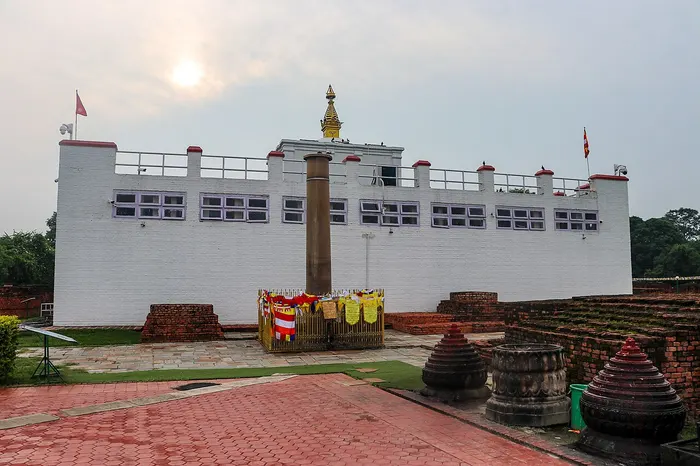
The Maya Devi Temple enshrines the exact spot of the birth, marked by a carved nativity stone and the protective archaeological trench mentioned above. Inside, the atmosphere is hushed. Visitors remove their shoes, queue respectfully, and many place a flower or light a butter lamp at the marker. Photography is not permitted inside the inner sanctum, which helps preserve the reverence of the space. Spend at least thirty minutes here rather than treating it as a photo stop.
The Ashoka Pillar
A few steps from the temple stands the Ashoka Pillar, erected by the Indian emperor Ashoka in 249 BC during his pilgrimage to the site. The inscription is the first known physical evidence that identifies Lumbini as the Buddha's birthplace, and it is a powerful reminder that this place has drawn pilgrims for more than two thousand years. The pillar's lotus capital and weathered surface make it one of the most photographed objects in Lumbini, and rightly so.
The Sacred Pond and the Gardens
Just beside the temple is Puskarni, the sacred bathing pond where Queen Maya Devi is said to have bathed before the birth. Today it is a still, green pool fringed by trees, and it is a lovely place to sit. The surrounding gardens were designed with input from Japanese architect Kenzo Tange, and the layout uses water channels and groves to create a contemplative rhythm. Plan to walk the garden slowly in the cooler hours of early morning or late afternoon.
Day Two: The Monastic Zone and International Temples
The Monastic Zone occupies the western side of Lumbini and is where the real surprise lives. More than twenty five monasteries, built by Buddhist communities from Sri Lanka, Thailand, Myanmar, China, Korea, Japan, Germany, France and many others, line a central canal. Each is an act of devotion expressed in architecture, and walking the zone is like touring Asia in a single afternoon.
The Burmese Golden Temple
Myanmar's temple is among the first you meet and one of the most distinctive, with its gilded stupa glowing in the sun. The Burmese community was among the earliest to build here, and the craftsmanship reflects centuries of temple tradition. It is a calming opening to the monastic walk.
The Thai Monastery and the Tall Stupa
The Royal Thai Monastery is impossible to miss. Its central stupa rises in gleaming white and gold, a precise example of Thai Buddhist design. Climb the steps, remove your shoes, and look up: the interior murals and the scale of the structure make it a highlight for most visitors. Monks here often welcome quiet conversation.
Sri Lankan, Tibetan, Korean and Chinese Temples
Further along you reach the white peace pagoda of the Sri Lankan temple, the vividly colored Tibetan monasteries with their prayer wheels and murals, and the Korean and Chinese pavilions, each rendered in its own national style. The contrast is the point. Lumbini was conceived as a world peace center, and the monasteries are its proof that different traditions can sit side by side in shared reverence.
The Eternal Peace Flame and World Peace Pagoda
Near the northern end of the canal sits the Nepal Peace Pagoda, built by Japanese monks, and the Eternal Peace Flame that has burned since the site's modern dedication. These are natural places to close day two, watching the light change and the pilgrims circle the stupa.
Day Three Options: Tilaurakot and Slow Mornings
If you have a third day, two rewarding options present themselves. The first is a morning of sunrise meditation inside the Sacred Garden before the gates open to day trippers, arranged through a local guide. The second is a half day trip to Tilaurakot, the archaeological remains of ancient Kapilavastu, where the young prince grew up before renouncing palace life. The ruins are modest compared with the garden, but for anyone following the Buddha's story they close a circle.
Getting to Lumbini
Lumbini sits in Nepal's Rupandehi district, close to the Indian border. The two main arrival routes both work well. Flying from Kathmandu to Siddhartha Airport in Bhairahawa takes about thirty five minutes, followed by a scenic thirty minute drive to the pilgrimage park. Overland, a comfortable tourist bus or private vehicle covers the roughly 280 kilometer journey in seven to nine hours, often paired with a stop in Pokhara. For travelers who want the whole arc of the country, our Golden Triangle with Lumbini tour links Kathmandu, Pokhara and Lumbini in one seamless circuit.
Where Lumbini Fits in a Broader Nepal Pilgrimage
Lumbini is one of four principal Buddhist pilgrimage sites in the Buddha's life, and in Nepal it pairs naturally with other sacred places. A short flight or drive north brings you to the Kathmandu spiritual circuit of Pashupatinath, Boudhanath and Swayambhunath, where Hindu and Buddhist practice intertwine. For a deeper immersion, the Nepal cultural pilgrimage Himalayan experience strings several sacred sites together under one itinerary. And if your interest is heritage at large, the seven UNESCO wonders of Kathmandu tour shows the wider World Heritage fabric of the country.
For context on how Lumbini sits inside Nepal's spiritual landscape, our pillar guide to cultural and spiritual tours in Nepal maps the full range of sacred journeys, from Lumbini to Muktinath to the high Himalayan monasteries. You can also read the dedicated Lumbini birthplace overview and the Muktinath pilgrimage guide to build a multi faith itinerary.
Practical Tips for a Meaningful Visit
Dress modestly. Shoulders and knees covered are expected inside temples, and shoes come off at every threshold. Carry a scarf, water and a hat, because the Terai sun is strong even in winter. Hire a licensed local guide at the entrance; the stories they tell about each monastery turn carved stone into living history. Finally, build in empty time. Lumbini rewards stillness more than checklist tourism, and the best moments are the unplanned ones, a monk sweeping a courtyard, a line of pilgrims circling a stupa at dusk, the call of birds over the lotus pond.
The Archaeology: What the Excavations Revealed
Lumbini's modern identity rests on patient archaeology. The site was rediscovered in the late nineteenth century when the Ashoka Pillar was identified, but systematic excavation began in the decades that followed. The most revealing work came from a joint effort in the 1990s that dug beneath the Maya Devi Temple and found a timber shrine and a brick structure dated to the third century BC, contemporary with Ashoka's visit. Below that lay even older levels. The finding strongly supports an unbroken tradition of veneration at the birthplace stretching back more than two thousand years. For a traveler, this means the marker you bow to is not a replica but the focus of a devotion older than most religions on earth.
What to Eat in Lumbini
The pilgrimage town is vegetarian friendly by default, and that suits most visitors. Around the main gate and through the monastery zone you will find simple Nepali dal bhat, Tibetan momos, Thai curries near the Royal Thai Monastery, and Korean and Japanese cafes serving noodles and tea. The Sri Lankan temple kitchen sometimes offers a lentil and coconut meal on festival days. Prices are gentle, hygiene is generally good near the established monasteries, and a thali rarely costs more than a few dollars. Carry your own refillable bottle, because the heat makes hydration essential and plastic waste is discouraged inside the heritage area.
Where to Stay
Lumbini has grown a spread of accommodation from basic guesthouses to comfortable resorts. The Buddhist monasteries themselves often host visiting pilgrims in simple rooms for a donation, which is the most atmospheric choice if you can arrange it through a guide. For more comfort, the heritage zone perimeter has mid range hotels with gardens and pools, and a few upscale properties sit a short drive away. Book ahead during the Buddha Jayanti festival in May and the October to November peak season, when rooms fill quickly.
A Sample Four Day Combined Itinerary
Travelers with extra time can blend Lumbini with the capital's sacred sites. Day one: arrive Kathmandu and walk the Kathmandu Valley UNESCO circuit. Day two: fly or drive to Lumbini and settle in. Day three: the full Sacred Garden and monastery loop described above. Day four: sunrise meditation, Tilaurakot optional, and departure. This rhythm keeps travel light and meaning high, and it is the shape of many Enticing Himalayas private journeys.
Festivals and the Best Weeks to Be There
The single biggest event is Buddha Jayanti, the celebration of the Buddha's birth, enlightenment and passing, usually falling in May on the full moon. The garden fills with chanting, lighting of thousands of lamps, and processions of monks and nuns from every tradition. It is crowded but unforgettable. The colder months from October to March are calmer and better for walking, while the monsoon from June to September is best avoided for comfort. If your interest is quiet reflection rather than spectacle, aim for late February or early December.
Photography Ethics in a Living Shrine
Lumbini is both a heritage park and a working place of worship, and the two need balancing. Inside the Maya Devi Temple, no photography is allowed, and that rule should be honored without argument. In the monastery zone, outdoor photography is welcome, but ask before photographing monks, nuns or fellow pilgrims at prayer. Drones are restricted near the heritage core, so check with your guide before flying anything. The reward for this respect is access to moments that a careless shutter would scare away.
Responsible and Community Minded Travel
Lumbini's economy leans on pilgrimage, and small choices matter. Eat at locally run cafes, hire licensed guides from the community, and buy handicrafts from the cooperatives near the gate rather than imported trinkets. The site management asks visitors to carry waste out, stay on marked paths in the garden, and keep noise low near meditation areas. Enticing Himalayas builds these principles into every Lumbini itinerary, because a sacred place survives only if the people who visit treat it as one.
Why Travel With Enticing Himalayas
We are a Nepal based, government licensed operator with deep roots in the communities around Lumbini and the Kathmandu Valley. Our guides are local, our vehicles are maintained, and our itineraries are built to respect both the place and your time. Whether you want a focused three day Lumbini Buddhist pilgrimage or a month long sweep of the country's sacred sites, we handle the logistics so you can travel with an open mind.



Our Services
- Custom cultural and spiritual tours across Nepal
- Licensed trekking and pilgrimage packages
- Hotel, transport and flight arrangements
- Multilingual local guides and 24/7 on trip support
About the Author
This guide was prepared by the Enticing Himalayas content and guiding team, drawing on years of leading pilgrims and travelers through Lumbini and the wider Kathmandu Valley. We write from the ground, not from a desk.
Why Trust Us
Enticing Himalayas is a licensed Nepali tour operator, a Nepal Tourism Board registered company, and a GetYourGuide partner. Every itinerary is built and verified by locals who live the journeys they sell.
Frequently Asked Questions
How many days do I need for a Lumbini pilgrimage?
Most travelers spend two full days in Lumbini. Day one covers the Sacred Garden, Maya Devi Temple and Ashoka Pillar, while day two explores the international monastery zone. Add a third day if you want sunrise meditation, a Thai Monastery cooking session or a side trip to Tilaurakot, the ancient Kapilavastu ruins.
Which monasteries in Lumbini are worth visiting?
The standouts are the Burmese (Myanmar) Golden Temple, the towering Thai Monastery, the white peace pagoda of the Sri Lankan temple, the Tibetan Lhomon and Dharmaswami monasteries, and the Korean, Chinese and Japanese pavilions. Each represents a different Buddhist architectural tradition and is free to enter.
What is the best time of year to visit Lumbini?
October through March offers clear skies and comfortable temperatures between 12 and 28 degrees Celsius. The Buddha Jayanti festival in May draws large devotional crowds. Avoid the June to September monsoon, when humidity is high and the gardens can flood.
How do I reach Lumbini from Kathmandu?
You can fly from Kathmandu to Bhairahawa and drive 30 minutes to Lumbini, or take a tourist bus and private transfer of roughly seven to nine hours. Enticing Himalayas also runs the Golden Triangle with Lumbini tour that links Kathmandu, Pokhara and Lumbini in one itinerary.
Is Lumbini suitable for non Buddhist travelers?
Absolutely. Lumbini is a UNESCO World Heritage Site and a place of universal heritage. Visitors of every background come for the history, the garden design, the global monastery architecture and the rare quiet that the pilgrimage town offers.