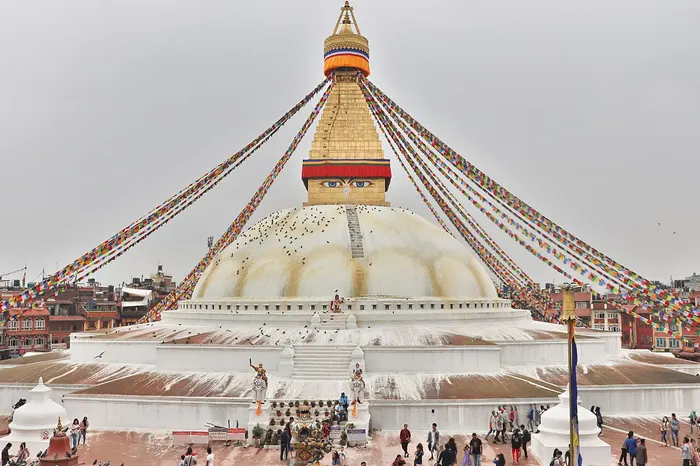
Treks with a Spiritual Side: Monasteries, Stupas and Pilgrimage on the Trail
Some treks in Nepal are about summits. Others are about the quiet that settles when you round a ridge and find a monastery bell ringing above the clouds. Spiritual treks in Nepal belong to the second kind. They take you on foot to the places where Himalayan Buddhists have prayed for centuries, where stone stupas mark the turn of a pilgrimage route, and where the line between a walking holiday and a journey of the soul thins to almost nothing. This is a land where the trail itself is a form of devotion.
This guide maps the sacred side of trekking in Nepal. It covers what makes a trek spiritual rather than merely scenic, the monasteries and stupas that anchor the great routes, and the specific pilgrimage journeys our Kathmandu based guides run through Langtang, Mustang, and the temple of Muktinath. Whether you want a Buddhist trek past fluttering prayer flags or a Hindu pilgrimage to a shrine at 3,800 meters, the structure below reflects how these routes actually feel on the ground, and how you can weave them into one meaningful trip.
What Makes a Trek Spiritual
A spiritual trek is not defined by religion alone. It is defined by intention. You can be a committed believer, a curious traveler, or someone simply chasing quiet, and still find that a Himalayan pilgrimage route changes your pace. The mountains strip away distraction. The rhythm of putting one foot in front of the other, day after day, becomes its own meditation, and the sacred sites along the way give that rhythm a shape.
In Nepal the sacred and the scenic are rarely separate. A Buddhist trek might climb to a gompa, a monastery, that has stood for four hundred years on a ledge above a river gorge. A pilgrimage trek to Muktinath ends at a temple where 108 waterspouts pour freezing Himalayan spring water over devotees who have walked for days to be cleansed. The landscape is the scripture here. The stupas, mani walls, and prayer wheels are not decoration. They are instructions for how to move through the world with attention.
For Enticing Himalayas, spiritual travel sits at the heart of our Nepal cultural pilgrimage Himalayan experience, which links living rituals with high country walking. It is also the connective tissue between our two brand pillars, the urge to Explore and the space to Heal, and it is why so many of our guests describe these routes as the most memorable part of their time in the country.
Monasteries, Stupas and the Language of the Trail
Before walking the routes, it helps to know what you are looking at. The sacred objects on a Nepal trek are a visual language, and learning a few of its symbols turns a scenic walk into a conversation with the culture around you.
The Gompa and the Stupa
A gompa is a Buddhist monastery or temple, often painted in bands of ochre and white with a flat roof and a courtyard where monks gather to debate and chant. A stupa is a dome shaped reliquary, a monument that represents the enlightened mind. The most famous in Nepal are the great chortens of Boudhanath and Swayambhunath, but on the trail you will meet smaller village stupas, each one a place to pause, circle clockwise, and let your thoughts settle.
Prayer Flags, Mani Walls and Wheels
Strings of prayer flags carry printed sutras on the wind, sending blessings outward with every gust. Mani walls are low stone barriers carved with the mantra Om Mani Padme Hum, and you always pass them on the left, keeping the sacred stones to your right. Prayer wheels, spun clockwise, accumulate merit with every turn. None of these require belief to appreciate. They ask only that you move through the landscape with care.
Why the Trail Itself Is Sacred
Many of Nepal's great walking routes are old trade and pilgrimage corridors. The salt caravans of Mustang, the herders of Langtang, and the devotees climbing to Muktinath all wore the same paths smooth over centuries. When you walk them, you are not the first to feel small beneath these peaks, and that continuity is precisely what makes a monastery trek in Nepal feel different from a hike anywhere else.
Langtang: The Valley Where Monasteries Guard the Snow
The Langtang Valley is the closest Himalayan sanctuary to Kathmandu, yet it feels like another world. A day's drive north of the capital brings you to a broad river valley ringed by snow peaks, where Tamang and Tibetan Buddhist communities have kept their monasteries alive for generations. For anyone seeking a Buddhist trek within reach of the city, Langtang is the natural starting point.
Kyanjin Gompa and the Higher Monasteries
The trail climbs through villages like Syabrubesi, Lama Hotel, and Langtang village before reaching Kyanjin Gompa, a cluster of monasteries and lodges at around 3,800 meters beneath the flanks of Langtang Lirung. The gompa here is small but active, and the morning chant carries across the valley in a way that stays with you. Beyond Kyanjin, the climb to Tserko Ri at over 5,000 meters is as much a pilgrim's ascent as a trekker's challenge, with prayer flags marking the high ridge.
Our Langtang Valley trek and Tserko Ri summit challenge builds this exact shape, pairing the cultural warmth of the valley's monasteries with the high altitude reward of the ridge. For trekkers who want the valley without the summit push, the Langtang Gosaikunda lake trek links the monasteries of Langtang with the sacred lakes further south.
The Tamang Heritage Layer
What sets Langtang apart as a spiritual trek is its people. The Tamang communities here practice a Buddhism woven with older Himalayan beliefs, and their festivals, butter lamp offerings, and monastery dances are open to respectful visitors. A Langtang Gosaikunda trek therefore reads as a cultural pilgrimage as much as a physical one, and our guides are careful to frame each monastery visit as participation rather than spectacle.
Gosaikunda: The Sacred Alpine Lake Pilgrimage
High in the Langtang National Park sits Gosaikunda, a cluster of glacial lakes held sacred by both Hindus and Buddhists. At around 4,380 meters the air is thin and the water is a deep, cold blue ringed by rock and prayer flags. During the August full moon of Janai Purnima, thousands of Hindu pilgrims trek up to bathe in the lake, while Buddhist herders circle it in quiet reverence. Few places in Nepal show the two faiths sharing one sacred site so openly.
A Lake Born of Myth
The legend holds that Shiva, the great ascetic god, drove his trident into the mountain to create the lake and quench his thirst after drinking poison to save the world. For pilgrims the water is therefore both cleansing and potent. The trek to reach it passes through rhododendron forests, high pastures, and a final rocky ascent where the first glimpse of the lake is genuinely startling.
Two Ways to Walk to Gosaikunda
We offer Gosaikunda both as a focused pilgrimage and as part of a longer route. The Gosaikunda sacred Himalayan pilgrimage alpine lakes trek is a five day journey built around the lake itself, ideal for travelers who want the spiritual core without a long approach. The Langtang Gosaikunda lake trek combines the monastery rich Langtang Valley with the sacred lakes in a single, deeper circuit. Either way, the moment of standing at the shore with pilgrims who have walked for days is the kind of memory that outlasts any summit photo.
Mustang: The Last Forbidden Kingdom of Buddhist Culture
If Langtang is the gentle introduction to a Buddhist trek, Mustang is the deep immersion. Tucked behind the Annapurna and Dhaulagiri ranges, the former Kingdom of Mustang was closed to outsiders until 1992 and still carries the feel of a preserved Tibetan Buddhist enclave. Its arid, moonlike valleys hide cave monasteries, centuries old murals, and a royal capital at Lo Manthang that seems lifted from another century.
Lo Manthang and the Cave Monasteries
The walled city of Lo Manthang holds the king's palace and several working monasteries, including Thubchen and Jampa, whose murals are considered among the finest in the Himalayan Buddhist world. Beyond the capital, the cliff face of nearby valleys is pocked with meditation caves used by practitioners for hundreds of years. A Nepal cultural adventure Mustang experience takes you through this landscape with time to sit in the monasteries rather than simply photograph them.
Upper Mustang as a Living Pilgrimage
Mustang is more than scenery. It is a functioning Buddhist society where the annual Tiji festival reenacts the triumph of good over a destructive demon, drawing pilgrims and travelers alike. The Mustang cultural adventure can be timed to these rituals, turning a trek into a front row seat at a living tradition. For those who want to go even further into the forbidden kingdom's spiritual geography, the Upper Dolpo Shey Gompa journey extends the same sensibility into the remote crystal mountain country to the west.
Muktinath: Where Hindu and Buddhist Pilgrimage Meet
Muktinath sits at 3,800 meters on the Mustang side of the Thorong La pass, and it is one of the rare shrines that Buddhists and Hindus revere in common. For Hindus it is one of the 108 Divya Desams, a place of liberation. For Buddhists it is a site associated with Dakinis, the sky dwelling deities. The temple complex is famous for its 108 waterspouts, where devotees take a ritual shower in freezing spring water as an act of purification.
The 108 Sacred Waters
The image of pilgrims, shivering and smiling, moving through all 108 spouts is one of the most moving sights on any Nepal pilgrimage. The water is glacial cold year round, and the act is understood as washing away accumulation, not merely dirt. Around the Hindu temple stands a Buddhist gompa and an eternal flame fed by natural gas, so the site holds both faiths in a single courtyard.
Reaching Muktinath
Traditionally Muktinath is the high point of the Annapurna Circuit, reached on foot over the Thorong La. For travelers short on time or unable to attempt the pass, the Muktinath helicopter pilgrimage from Kathmandu delivers you to the 108 sacred waters in a single morning, with the Himalayan flight itself becoming part of the spiritual experience. Either approach ends at the same shrine, and our Nepal cultural pilgrimage Himalayan experience can fold Muktinath into a wider circuit that also takes in the Kathmandu Valley's great stupas.
Spiritual Treks at a Glance
Each of the routes above offers a different balance of walking, culture, and devotion. The table below is the quick comparison our guests ask for when deciding where to begin.
| Trek or Pilgrimage | Faith focus | Typical duration | Best for |
|---|---|---|---|
| Langtang Gosaikunda Lake Trek | Buddhist and Hindu | 10 to 14 days | Monasteries plus a sacred lake near Kathmandu |
| Langtang Valley and Tserko Ri | Buddhist (Tamang) | 9 to 11 days | A summit challenge with gompa visits |
| Gosaikunda Sacred Pilgrimage | Hindu and Buddhist | 5 days | A focused alpine lake pilgrimage |
| Mustang Cultural Adventure | Buddhist (Tibetan) | 10 to 14 days | Cave monasteries and the walled city of Lo Manthang |
| Upper Dolpo Shey Gompa | Buddhist (Bon and Tibetan) | 18 to 24 days | Remote pilgrimage into the last forbidden kingdom |
| Muktinath Helicopter Pilgrimage | Hindu and Buddhist | 1 day | The 108 sacred waters without the high pass |
| Kathmandu Spiritual Circuit | Hindu and Buddhist | 2 days | Two of the greatest stupas before or after a trek |
If you are deciding between them, think about altitude, time, and appetite for remote travel. Langtang and Gosaikunda are the most accessible. Mustang and Upper Dolpo demand more commitment but reward it with a rare sense of stepping outside time. The full tours page lays out every option we run.
The Pilgrimage Ethos: How to Walk with Intention
A spiritual trek asks something different from a standard hike. You do not need to convert to anything. You only need to walk as a guest. A few habits make the difference between passing through and truly arriving.
- Circle stupas and mani walls clockwise. It is the respectful direction and the one locals observe without thinking.
- Ask before photographing monks, rituals, or fellow pilgrims at prayer. Some moments are not for cameras, and a quiet no is a gift of trust.
- Remove your shoes at every monastery threshold. Carry a pair you can slip on and off easily.
- Learn a few words. A spoken Tashi Delek, the Tibetan greeting meaning may all be auspicious, opens more doors than any permit.
- Leave offerings lightly. A butter lamp, a few rupees, or simply sitting in silence is received more warmly than grand gestures.
- Build in empty time. The best spiritual moments on these treks are unplanned: a monk sweeping a courtyard, a line of prayer flags snapping in the wind, dawn light on a whitewashed gompa.
Combining Spiritual Treks into One Journey
The routes above are not isolated. Many of our guests build a single trip that begins with the Kathmandu spiritual circuit of Pashupatinath, Boudhanath, and Swayambhunath, walks into the monasteries of Langtang, and then flies west to the temples of Mustang or the waters of Muktinath. The Nepal cultural pilgrimage Himalayan experience is designed exactly for this, stringing sacred sites into one coherent arc.
For travelers who want the whole frame before committing, the tour list shows every pilgrimage and trek we operate, and our tours page groups them by region and theme. Because we are based in Kathmandu, we can adjust an itinerary around festival dates, weather windows, and your own sense of pace, something that is hard to do from a distance.
About Enticing Himalayas

Enticing Himalayas (legal name Enticing Himalayas Travels) is a Kathmandu based, Nepal licensed travel operator under the brand Explore, Heal, Thrive. We run cultural tours, spiritual and pilgrimage journeys, heritage city experiences, wellness retreats, and trekking across Nepal.
Our services
- Cultural and heritage tours of the Kathmandu Valley and beyond
- Spiritual and pilgrimage journeys (Lumbini, Muktinath, Gosaikunda, Mustang)
- Wellness and yoga retreats (Heal)
- Community exchange and responsible tourism trips
- Scenic flights and adventure experiences (Explore)
Accreditations

We are a recognized partner of the Nepal Tourism Board and list experiences through established global platforms. Every guide and porter we send guests with is insured, fairly paid, and vetted on our three standards: verifiable training, resident local knowledge, and a track record with international guests.
About the author
Written by the Enticing Himalayas editorial team in Kathmandu, with input from our resident guides and cultural partners. We update this guide as our programs develop.
Why trust Enticing Himalayas
We are based in Kathmandu and our guides run these routes every season. We vet every provider on three things: verifiable training, a resident qualified practitioner, and a track record with international guests. If a provider cannot clear that bar, we do not send you there.
Frequently Asked Questions
What are spiritual treks in Nepal?
Spiritual treks in Nepal are walking journeys that visit monasteries, stupas, and pilgrimage sites along the trail, often combining physical challenge with cultural and devotional experience. They range from Buddhist monastery treks in Langtang and Mustang to Hindu pilgrimages to the sacred lake of Gosaikunda and the temple of Muktinath.
Which is the best monastery trek in Nepal for beginners?
The Langtang Valley trek is the most accessible Buddhist trek near Kathmandu, with active monasteries like Kyanjin Gompa and a moderate altitude profile. The Langtang Gosaikunda lake trek adds the sacred lake, while the Tserko Ri summit challenge suits those who want a higher goal.
What is Gosaikunda and why is it sacred?
Gosaikunda is a cluster of glacial lakes at about 4,380 meters in Langtang National Park, sacred to both Hindus and Buddhists. Hindu legend ties its creation to Shiva, and during Janai Purnima in August thousands of pilgrims trek up to bathe in its waters. The Gosaikunda sacred pilgrimage trek is built around this tradition.
Is a Buddhist trek suitable for non Buddhists?
Yes. A Buddhist trek in Nepal is a cultural and scenic journey first, and belief is never required. Visitors of every background come for the monastery architecture, the mountain setting, and the rare quiet these routes offer. Our guides frame monastery visits as respectful participation rather than spectacle.
What makes Mustang a spiritual destination?
Mustang was closed to outsiders until 1992 and remains a preserved Tibetan Buddhist enclave. Its walled capital Lo Manthang holds centuries old murals, working monasteries, and the Tiji festival, while cliff face meditation caves date back hundreds of years. The Mustang cultural adventure and the Upper Dolpo Shey Gompa journey explore this terrain.
How do you reach Muktinath and the 108 sacred waters?
Muktinath is traditionally reached on foot over the Thorong La as part of the Annapurna Circuit, but the Muktinath helicopter pilgrimage from Kathmandu reaches the 108 waterspouts in a single morning. Both end at the same shrine, revered by Hindus and Buddhists alike.
What is the Kathmandu spiritual circuit?
The Kathmandu spiritual circuit links Pashupatinath, Boudhanath, and Swayambhunath, two of the largest stupas in the Himalayas and a major Hindu temple, in about two days. It is a perfect bookend to a trek and is offered as the Kathmandu spiritual circuit tour.
When is the best time for a spiritual trek in Nepal?
October through November and March through May offer the clearest skies and most stable conditions. August brings Janai Purnima at Gosaikunda, and spring carries the Tiji festival in Mustang. Avoid the June to September monsoon, when trails are slippery and high passes risky.
Do I need a special permit for these treks?
Langtang and Gosaikunda require a Langtang National Park permit and a TIMS card. Mustang and Upper Dolpo require restricted area permits that must be arranged through a registered Nepali operator, which is why a guided Mustang cultural adventure is the practical way in. Enticing Himalayas handles all permits as part of its packages.
How fit do I need to be for a pilgrimage trek?
A moderate fitness level suffices for Langtang, Gosaikunda, and the Kathmandu circuit. Mustang and Upper Dolpo involve longer remote days and higher commitment. The Muktinath helicopter option removes the high altitude walking entirely for those who cannot attempt the pass.
Can spiritual treks be combined into one trip?
Absolutely. Many guests begin with the Kathmandu spiritual circuit, walk the monasteries of Langtang, then fly west to Mustang or Muktinath. The Nepal cultural pilgrimage Himalayan experience strings these into one coherent journey.
What should I wear and carry on a monastery trek?
Dress modestly with shoulders and knees covered, and carry shoes you can slip off easily for monastery thresholds. A scarf, hat, refillable bottle, and layers for altitude are essential. Ask before photographing rituals, and keep noise low near meditation areas.
Are these treks safe for solo travelers?
With a licensed guide and a reputable operator, spiritual treks in Nepal are safe and well supported. Our guides run these routes every season and are insured, fairly paid, and vetted on training, local knowledge, and a track record with international guests. Solo travelers are paired into small groups where they prefer company.
How do I book a spiritual trek with Enticing Himalayas?
Browse the tours page or the tour list to see every pilgrimage and trek we operate, then reach out to our Kathmandu team to shape an itinerary around your dates, fitness, and interests. Because we are local, we can adjust plans around festivals and weather windows.