 Mar 23 – Mar 7, 2027
Kathmandu
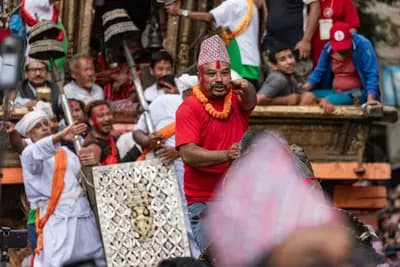
Seto Machindranath Jatra 2027: Kathmandu’s Sacred Festival
Culture
5 días
Festival
Free
Kathmandu 5 días
Event Details
Loading...
Event starts in
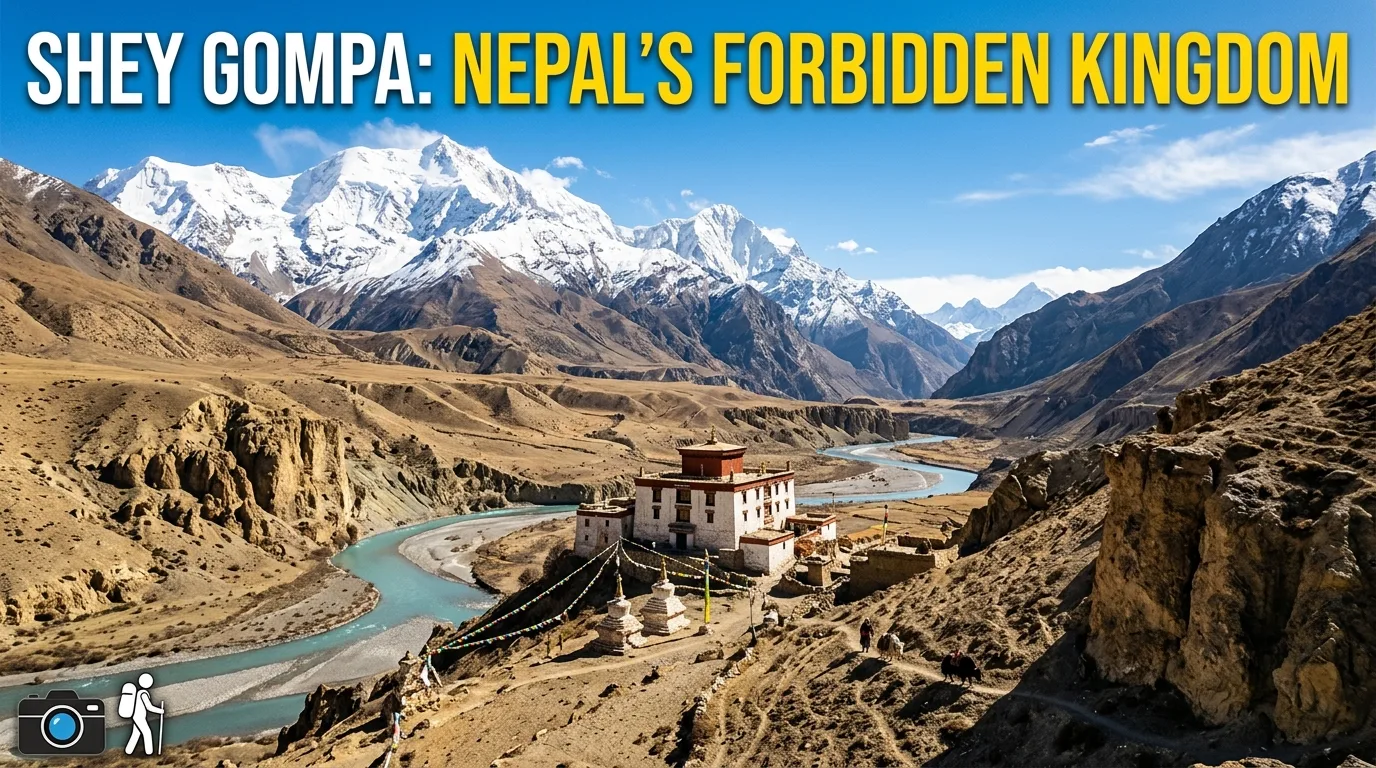
Somewhere in the high, wind-scoured plateau of Upper Dolpo, beneath a mountain locals call the "younger brother of Kailash," a festival takes place so rarely that most people who witness it will only see it once in their lifetime. That festival is Shey Mela, held just once every twelve years at the remote Shey Gompa monastery, and it is arguably the single hardest-to-witness major festival anywhere on Nepal's cultural calendar. For travelers who've already explored Nepal's more accessible celebrations and are now searching for something genuinely rare the kind of event that belongs at the top of any serious Himalayan events list Shey Mela is very likely the answer. This guide covers what the festival actually is, the religious tradition behind it, where and for how long it runs, and critically why it happens on such an unusually long twelve-year cycle rather than annually like most of Nepal's other festivals.
Shey Mela, also known as the Shey Gompa Festival, the Shelri Dugdra Festival, or simply the Crystal Mountain Festival, is a major Tibetan Buddhist gathering centered on the sacred circumambulation, or kora, of Crystal Mountain (Shey Ribo Dugdra), which rises above the remote Shey Gompa monastery in Upper Dolpo, one of Nepal's most isolated regions. Unlike most of Nepal's festivals, which recur every year on the lunar or solar calendar, Shey Mela is held only once every twelve years, specifically timed to the Tibetan Dragon Year a detail that places it in the same rare category as a handful of other major Himalayan Buddhist pilgrimage cycles.
At its center is a belief unique to this particular mountain and this particular year: that completing the kora around Crystal Mountain during a Dragon Year carries spiritual merit equivalent to visiting eleven other major Buddhist pilgrimage sites combined a list that traditionally includes destinations as significant as Mount Kailash in Tibet and Swayambhunath in Kathmandu. That single belief is what transforms Shey Mela from a local monastic gathering into a genuine, if remote, pilgrimage destination, drawing monks, lamas, and devotees from across the Himalayan Buddhist world for a few intense days once every twelve years.
Shey Mela sits at the intersection of two closely related but distinct spiritual traditions that have coexisted in Dolpo for centuries: Tibetan Buddhism, specifically the Kagyu lineage associated with Shey Gompa itself, and Bon, the indigenous pre-Buddhist religion of the Tibetan plateau, which still maintains an active presence throughout the Dolpo region. This blending is part of what makes Dolpo's spiritual landscape so distinctive within Nepal while most of the country's Buddhist heritage leans heavily toward either Newar Buddhism in the Kathmandu Valley or Tibetan Buddhist traditions among Sherpa and Tamang communities, Dolpo represents one of the last places where Bon traditions, some traced back roughly 18,000 years in local oral history, continue to shape religious life alongside Tibetan Buddhism rather than having been fully absorbed by it.
For the Dolpo people specifically, Shey Mela functions as far more than a religious observance it is the primary occasion on which a scattered, remote population, spread across some of the highest and most difficult-to-access settlements in Nepal, comes together as a single community. Pilgrims travel from Shey Phoksundo, Dunai, and villages across both Upper and Lower Dolpo, and increasingly from other parts of Nepal and abroad, to take part. Because the region is so remote and so sparsely connected to the rest of the country, Shey Mela carries a cultural weight that goes beyond individual devotion it is one of the few times the full breadth of Dolpo's community and its diaspora reassembles in one place.
Shey Gompa's origins trace back roughly a thousand years, to the 11th century, when a Tibetan Buddhist monk named Drutob Senge Yeshi is said to have traveled to the site and subdued a powerful local mountain spirit that had long troubled the region. Having tamed this spirit, Senge Yeshi established the monastery at the foot of the mountain now revered as Crystal Mountain, laying the foundation for what would become one of Upper Dolpo's most significant religious sites. Today, the gompa itself is a modest two-story, red-colored building set beneath the mountain near the Kang La pass, at an elevation of roughly 4,200 meters an altitude and setting so remote that reaching it at all requires a serious, multi-day trekking expedition.
Crystal Mountain itself, known in the Tibetan language as Shey Ribo Dugdra, holds a status locally comparable to a smaller-scale Mount Kailash, and it is this comparison "the younger brother of Kailash" that local tradition uses to explain the mountain's spiritual rank. Just as pilgrims circumambulate Kailash in Tibet as one of the most significant acts of devotion in the Buddhist and Bon worlds, pilgrims circle Crystal Mountain during Shey Mela, with some completing the kora barefoot as an additional act of devotion and endurance. Spiritual leadership at the festival has historically been carried by the lineage of Tuptup Singe Yeshe, with religious teachings and blessings at recent editions delivered by figures including the reincarnate lineage associated with the monastery's founding and other senior lamas invited for the occasion.
Where Shey Mela Is Celebrated
Shey Mela takes place at a single, fixed location: Shey Gompa, in Upper Dolpo, part of Dolpa District in Nepal's Karnali Province the country's most remote and geographically challenging administrative region. Upper Dolpo sits within the rain shadow of the Dhaulagiri and Annapurna ranges, giving it a stark, high-altitude, Tibetan-plateau character that feels markedly different from the greener, more heavily trekked regions of Nepal such as the Everest or Annapurna circuits. The area falls within Shey Phoksundo National Park, home to Nepal's deepest lake, and the region as a whole remains one of the least visited parts of the country specifically because of how difficult it is to reach.
This remoteness is not incidental to the festival's character it is central to it. Because Upper Dolpo is a restricted area requiring a special trekking permit, and because reaching Shey Gompa involves a demanding multi-day trek across high passes with no road access, Shey Mela remains, by simple geography, one of the least accessible major festivals anywhere in Nepal. Unlike Kathmandu Valley festivals that a visitor can reach by taxi within the hour, experiencing Shey Mela requires committing to a genuine Himalayan trekking expedition, timed years in advance around the festival's rare occurrence.
Traditionally, Shey Mela is centered on the full moon of the seventh month of the Tibetan lunar calendar, with the core festival period running for approximately one week around that date. In practice, the most recent editions have concentrated the main events into a tighter window of roughly four days: the 2024 edition, the festival's 67th occurrence, ran across the first days of September, with an official four-day program of teachings, rituals, and cultural performances, following an opening ceremony on the first day that set the tone for the days that followed.
Within that window, each day typically carries its own structure opening ceremonies and initial prayers on the first day, followed by teachings from visiting lamas and Rinpoches, cultural performances known locally as Syabros, and the central kora ritual around Crystal Mountain, with horse racing, archery, and mask dances woven throughout the festival's several days rather than concentrated on a single date. For a traveler planning a visit, this means Shey Mela is not a single-day event to time perfectly, but a short, multi-day window worth allocating several days to experience in full itself a small mercy given how difficult and lengthy the journey to reach Dolpo already is.
This is the question at the heart of understanding Shey Mela, and the answer connects directly to the structure of the Tibetan lunar calendar itself. The Tibetan zodiac operates on a twelve-year cycle, with each year represented by a different animal mouse, bull, tiger, rabbit, dragon, snake, horse, sheep, monkey, bird, dog, and pig mirroring the broader East Asian zodiac tradition. Shey Mela is specifically tied to the Dragon Year, the fifth year in that twelve-year rotation, which is why the festival recurs only once per full cycle rather than annually.
The religious reasoning behind this timing is rooted in a specific belief about the spiritual potency of Crystal Mountain during a Dragon Year: local tradition holds that circumambulating the mountain during this particular year in the cycle carries merit equivalent to completing eleven other major Buddhist pilgrimages combined, effectively making a single kora at Shey during a Dragon Year worth an entire pilgrimage circuit undertaken in any other year. This is conceptually similar to the astrological reasoning behind Kumbha Mela's own multi-year cycle in India, where a specific planetary alignment rather than a fixed calendar date determines when the most spiritually potent moment for pilgrimage occurs. In both cases, the long gap between festivals isn't an administrative choice; it's the direct result of a belief that the surrounding astrological or zodiacal moment matters as much as the ritual itself, and that moment simply doesn't recur every year.
There is likely also a practical dimension reinforcing this religious logic. Given Upper Dolpo's extreme remoteness, the difficulty of travel, and the sheer physical demands of reaching Shey Gompa, an annual festival on this scale would be logistically unsustainable for both the local community and visiting pilgrims. The twelve-year rhythm, whatever its precise spiritual origin, also functions as a natural pacing mechanism for a region with genuinely limited infrastructure and a small resident population.
Because the festival is tied specifically to the Tibetan Dragon Year, and the most recent edition the 67th occurrence of the festival took place in 2024, the next Dragon Year, and therefore the next Shey Mela, falls in 2036. This twelve-year gap is fixed by the zodiac cycle itself rather than any administrative decision, meaning there is no intermediate or partial edition of the festival in the years between unlike Nepal's other major long-cycle festivals, Shey Mela does not have an annual "mini" version comparable to the Magh Mela within the Kumbha Mela cycle. If your interest in experiencing Shey Mela is genuine, 2036 is the realistic target to plan toward, giving prospective visitors a considerable but not unreasonable runway to plan a Dolpo trekking expedition years in advance.
The festival's program blends deep religious ritual with the kind of physical, community-oriented activities that have long defined life in the high Himalaya.
Costume plays a significant visual role throughout Shey Mela, with attendees dressing in traditional and, in many cases, genuinely antique clothing passed down through generations specifically for occasions of this rarity and significance. This is part of what distinguishes Shey Mela's visual character from more frequently observed Nepali festivals because the event happens only once every twelve years, families in Dolpo often preserve specific ceremonial garments and jewelry expressly for the festival, giving the gathering a distinctly historical, almost living-museum quality that regular annual festivals rarely carry to the same degree. Combined with the high-altitude, stark landscape surrounding Shey Gompa, the effect is a festival that feels genuinely suspended outside of ordinary time a fitting atmosphere for an event whose entire premise is built around rarity.
Shey Gompa does not exist in isolation it sits within a wider network of monasteries, hermitages, and sacred sites scattered across Upper and Lower Dolpo, many of which maintain their own smaller, annual observances even in the eleven years between Shey Mela editions. Villages such as Saldang, Bhijer, and Tinje each carry their own monastic traditions, some aligned with the Kagyu school associated with Shey Gompa itself, others tied to different Tibetan Buddhist lineages or to Bon practice specifically. What makes Shey Mela distinct within this landscape is its role as the one occasion when this otherwise dispersed religious geography converges on a single point. Community members who might otherwise interact only within their own valley or village cluster travel together toward Shey Gompa, turning the festival into a rare moment of region-wide religious and social cohesion rather than the more localized worship that characterizes most of the calendar year in Dolpo.
This dispersed structure also explains why outside knowledge of Shey Mela has historically remained so limited compared to Nepal's more publicized festivals. Dolpo's isolation reinforced for decades by its status as a restricted area only opened to limited trekking permits in relatively recent history meant that Shey Mela functioned for generations as an almost entirely internal community event, largely undocumented outside the region itself. It is only in the past few festival cycles, as trekking access to Upper Dolpo has gradually expanded and travel documentation of the region has grown, that Shey Mela has begun to receive meaningful attention from outside visitors and travel writers, even as it remains far less known than Nepal's headline festivals.
Because the journey to Shey Gompa is already a significant undertaking, most visitors who plan around the festival extend their trip well beyond the four core festival days. A typical approach involves flying into Nepalgunj and then Juphal, the regional airstrip serving Dolpa District, before beginning a trek that typically spans two to three weeks round-trip depending on the exact route chosen. Many itineraries incorporate Shey Phoksundo Lake Nepal's deepest lake, known for its striking turquoise color set against the stark, dry landscape of the trans-Himalayan region as well as the wider Shey Phoksundo National Park, before continuing north toward Shey Gompa itself via the Kang La or Se La passes.
This extended structure means that even a visit specifically timed around the rare festival window still delivers weeks of genuine high-altitude trekking through one of Nepal's least-visited landscapes, rather than a short, single-purpose visit. For travelers weighing whether the considerable planning and physical demands of reaching Shey Mela are worthwhile, this broader context matters: the festival itself may last only a handful of days once every twelve years, but the journey required to reach it offers a far longer, richer experience of a part of Nepal that very few travelers, Nepali or international, ever have reason to see firsthand.
Given how remote and infrequent Shey Mela is, a traveler seriously considering attending whether in 2036 or simply researching for future planning needs to understand several practical realities well in advance.
For travelers who have already experienced Nepal's more accessible festivals Dashain, Tihar, Indra Jatra, or even less common annual events — Shey Mela represents something categorically different: an event you cannot simply decide to attend next year if you miss it this time. Its twelve-year cycle, its extreme geographic remoteness, and its genuinely small attendee base compared to festivals like Kumbha Mela or Gadhimai Mela combine to make it one of the most exclusive cultural experiences available anywhere in the Himalayas. Where other festivals scale toward millions of attendees, Shey Mela remains, by virtue of its location and access requirements, a gathering of genuinely modest size pilgrims, monks, and a small number of serious trekkers and cultural travelers, rather than mass tourism.
This is precisely the kind of event worth building an entire Himalayan itinerary around rather than fitting into a broader Nepal trip as an afterthought. Because reaching Shey Gompa already requires a dedicated multi-day trek through Upper Dolpo's restricted zone, most visitors combine the festival itself with a longer exploration of the wider Dolpo region, including Shey Phoksundo Lake and the surrounding national park, turning the journey into a comprehensive high-altitude cultural expedition rather than a single-event visit.
If you're the kind of traveler drawn specifically to rare, once-in-a-lifetime Himalayan events like this, it's worth reviewing how a Dolpo-focused itinerary might be structured well ahead of the 2036 festival window. You can browse relevant trekking and cultural route options on our Tour List page to see how a journey into Upper Dolpo might be planned.
Shey Mela stands apart even among Nepal's collection of unusual, long-cycle religious festivals a twelve-year gathering tied to the Tibetan Dragon Year, held at one of the most physically remote monasteries anywhere in the Himalayas, blending Bon and Tibetan Buddhist tradition in a setting most travelers will never otherwise have reason to visit. Its rarity isn't a limitation to work around; it's the entire point. For anyone building a serious list of Himalayan cultural events worth experiencing once in a lifetime, Shey Mela deserves a place near the very top, with 2036 standing as the next realistic window to plan toward. For more on Nepal's rare and remote cultural festivals, explore our ongoing coverage on the Enticing Himalayas Blog.
Key experiences and features
12-year Buddhist festival
Crystal Mountain pilgrimage
Sacred mountain kora
Tibetan Buddhist rituals
Horse racing and archery
Dolpo cultural traditions
Remote Himalayan experience
Recommended packing list
Kathmandu, Kathmandu, Bagmati, Nepal
Got questions about this event?
What is Shey Mela in Nepal?
The next Shey Mela is expected in 2036, following the traditional 12-year cycle.
Shey Mela is celebrated at Shey Gompa in Upper Dolpo, Dolpa District, Karnali Province, Nepal.
The festival follows the Tibetan Dragon Year, which occurs every 12 years and is considered especially auspicious for pilgrimage.
Visitors generally fly to Juphal via Nepalgunj and continue with a multi-day trek to Shey Gompa with the required permits.
Sep 1 – Sep 4, 2036
4 days
Quick Info
More culture experiences
Mar 23 – Mar 7, 2027Kathmandu
 Dec 13 – Dec 17, 2026
Janaki Mandir, Janakpur
 Nov 15 – Nov 16, 2026
Tsum Valley