Festivals of Nepal: Dashain, Tihar, Holi and Indra Jatra - A Month by Month Celebration Calendar
Nepal does not simply mark time. It celebrates it. Across a single year the country moves through more than fifty nationally observed festivals, and hundreds more at the village, caste and temple level, each one tied to the agricultural rhythm of the hills, the lunar calendar of the Kathmandu Valley, and the deep layering of Hindu, Buddhist, Kirat and animist traditions that have coexisted here for more than two thousand years. For a traveler, this is the single best reason to plan a trip around a date rather than a destination. Show up during the right week and an ordinary street corner in Bhaktapur or Patan can become a moving sea of incense, drumbeats and flower offerings.
This guide walks through the four festivals most travelers ask about, Dashain, Tihar, Holi and Indra Jatra, and then lays out a practical month by month calendar so you can decide exactly when to visit. It is written for people who want to understand the meaning behind the colour and noise, not just photograph it. If your wider interest is temple trails and living heritage, our Cultural and Spiritual Tours in Nepal guide pairs naturally with the calendar below.
Why Nepal's festival calendar works the way it does
Before the individual festivals, it helps to understand the skeleton they hang from. Most Nepali festivals follow either the Vikram Sambat lunar calendar or one of several local solar calendars. That is why the dates shift by roughly three weeks against the Gregorian calendar each year. Dashain might fall in October one year and late September the next. Tihar follows about two weeks after Dashain. Holi lands at the tail end of winter. Indra Jatra is locked to the lunar month of Bhadra, usually September.
The practical effect is simple: if you want to catch a specific festival, do not book blind. Check the exact Nepali calendar date for your travel year, then build the rest of the trip around it. The good news is that Nepal is a year round destination, so anchoring your visit to a festival rarely means compromising on weather. Our month by month travel guide shows how festival weeks overlap with the best touring seasons.
Dashain: the longest and most important festival
Dashain, also called Vijaya Dashami, is the grande dame of Nepali festivals. It runs for fifteen days, usually in late September or October, and is observed by Hindus across the country as the victory of the goddess Durga over the buffalo demon Mahishasura. For many Nepali families it is the one time of year when adult children working in Kathmandu, Dubai or Sydney make the long journey home.
The arc of the festival has its own choreography. Day one, Ghatasthapana, sees a pot of sacred soil planted with barley seeds that will grow into the jamara, the yellow grass offered to elders later in the festival. The middle days build toward Maha Ashtami and Maha Navami, when thousands of animals are sacrificed at temples to honour the fierce forms of Durga, and the army holds public rituals at Hanuman Dhoka. The climax is Vijaya Dashami, the tenth day, when elders place tika, a mixture of yoghurt, rice and vermillion, on the foreheads of younger relatives and hand them the grown jamara along with blessings and cash.
For travelers, Dashain is a double edged sword. The atmosphere in the Kathmandu Valley and across the hills is warm, family centred and visually rich. But it is also the busiest travel period of the year. Government offices, banks and many shops close for a week or more. Buses and domestic flights sell out weeks ahead. The trekking routes thin out because guides and porters have gone home to their villages. If you want to trek, plan to start before Dashain or after it ends. If you want to experience Nepali family culture at its most open, this is the week to be invited to a home.
Our five day Kathmandu Valley tour is structured to catch the Durbar Square rituals and the evening aarati during festival weeks, with flexibility built in for the closures that come with the holiday.
Tihar: the festival of lights, lamps and sisters
If Dashain is about family hierarchy and blessing, Tihar, which follows about two weeks later, is about light, animals and affection. Spread across five days, Tihar honours different living beings in turn: crow on the first day, dog on the second, cow on the third, oxen on the fourth, and brothers on the fifth.
The dog day is a favourite with visitors. Streets fill with dogs, both stray and owned, wearing marigold garlands and tika, honoured as messengers of Yama, the god of death, and as loyal companions. The cow day celebrates the animal that gives milk and ploughs the fields. On the final day, Bhai Tika, sisters place a multi coloured tika on their brothers' foreheads and perform a ritual to wish them long life, while brothers give gifts in return.
What travelers remember most, though, is the visual layer. Every home outlines its windows and doorways with rows of diyo, small clay oil lamps, and strings of electric bulbs. Women draw elaborate rangoli patterns called rangoli or mandala on the floor with coloured powders. The result, especially in the old cities of Patan and Bhaktapur, is a glowing, almost theatrical beauty after dark. Tihar is also the season of deusi and bhailo, groups of singers who move from house to house exchanging songs for small donations, much like carolling.
Because Tihar is less disruptive to transport than Dashain and falls in reliably clear autumn weather, it is one of the easiest major festivals for a first time visitor to enjoy. Pair it with a Kathmandu Valley cultural circuit and you get temples, light and excellent evening photography in the same trip.
Holi: the festival of colour
Holi arrives at the opposite end of the year, in February or March, marking the end of winter and the arrival of spring. In the lowlands of the Terai it is boisterous and sprawling. In the Kathmandu Valley the most famous celebration is the day after the valley's own Holi, when the historic cities throw a separate, slightly later party.
The core ritual is simple and joyful: people smear each other with abir, coloured powders, and drench one another with water balloons and pichkari squirt guns. Streets become rivers of pink, yellow and blue. Music plays from every doorway. Strangers become friends for the morning. For photographers it is irresistible. For travelers who dislike being targeted with colour, it is wise to wear clothes you do not mind ruining and to protect cameras and phones.
Holi is a wonderful bookend to a winter visit, but it is also a reminder that Nepal's festival life is not confined to the hills. If you are combining a cultural tour with a Lumbini heritage journey in the south, the Terai celebration has its own intensity and is worth timing for.
Indra Jatra: the living goddess and the chariot of Kathmandu
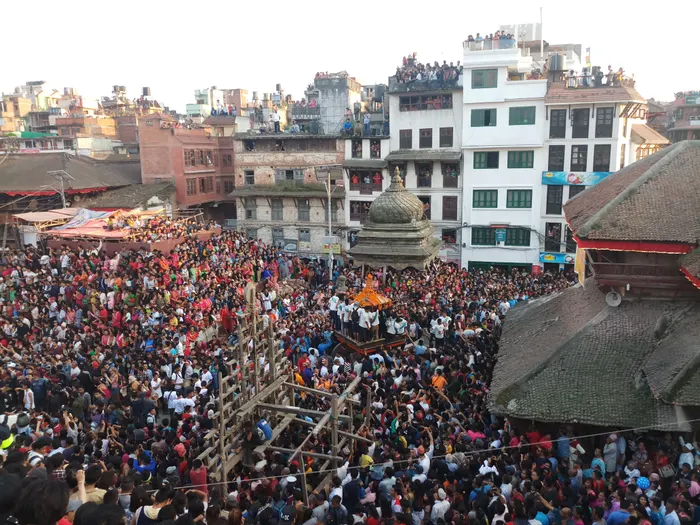
Indra Jatra is the most distinctly Kathmandu festival on this list, and the one that rewards a traveler who wants spectacle fused with living mythology. Held over eight days in August or September, it honours Indra, the god of rain, and celebrates the end of the monsoon. Its centre is Hanuman Dhoka and Kathmandu Durbar Square, where three towering wooden chariots are pulled through the narrow lanes.
The most photographed moment is the appearance of the Kumari, the living goddess, a prepubescent girl selected from the Newar community and worshipped as the embodiment of divine female energy. During Indra Jatra she is borne through the square in her chariot, and thousands gather for a glimpse. Alongside her travel the chariots of Ganesh and Bhairav. The festival also features the masked dances of the Lakhey, protective demon deities who leap through the streets to the beat of drums, and the erection of a tall wooden pole, the lingo, that symbolises Indra's standard.
Indra Jatra falls in the wet season, which means clouds and occasional rain, but the energy in the old city more than compensates. It is best experienced on foot, moving with the crowd, and it pairs naturally with a deeper dive into Newar culture such as our Nepal cultural heritage tour guide.
A month by month festival calendar
The four festivals above are the headliners, but they are far from the whole story. Here is a practical calendar of what you can expect across a normal year. Dates are approximate because of the lunar calendar; always confirm the exact year's dates before booking.
January to February
Maghe Sankranti opens the year, a harvest festival marked by sesame seed treats and ritual baths in rivers. In February, Sonam Lhosar celebrates the Tibetan New Year among the Tamang and Hyolmo communities, with dance and feasting around Boudhanath. Late February or March brings Holi, the festival of colour described above.
March to April
Chaitra Dasain, a smaller spring version of Dashain, appears in March. In April, the Buddhist communities observe Buddha Jayanti near May, honouring the birth, enlightenment and death of the Buddha, with the largest gatherings at Lumbini and at Swayambhunath and Boudhanath in the valley.
May to June
Gai Jatra, the festival of cows that honours those who died in the past year, fills Kathmandu with humour, satirical processions and masked comedy, a uniquely Nepali way of processing grief. In June the Rato Machhindranath chariot festival, one of the longest running in the valley, seeks to bring the rains.
July to August
The monsoon brings Gunla, the Buddhist holy month, with daily processions to Swayambhunath. August or September holds Indra Jatra in Kathmandu and Gai Jatra's cousin festivals in Patan and Bhaktapur. This is also the season of Teej, when women fast and dance for the long life of their husbands, a striking all female celebration.
September to October
The big one. Dashain runs for fifteen days, followed immediately by the five days of Tihar. This is the cultural peak of the year and the busiest travel window. Plan transport and accommodation well in advance.
November to December
After the festival rush, November is calm, clear and perfect for touring and trekking. December brings the start of winter and the lead up to Maghe Sankranti, closing the loop. It is also a good time for the spiritual and wellness tours that draw travelers seeking quiet rather than spectacle.
Practical tips for festival travel in Nepal
A few rules of thumb will make your festival trip smoother. First, book domestic flights and tourist buses at least three weeks ahead for Dashain and Tihar, because the entire country is on the move. Second, dress modestly when entering temple precincts during rituals; festivals are devotional before they are decorative. Third, ask before photographing people up close, especially during Tihar tika ceremonies and Kumari appearances, where reverence matters more than the shot. Fourth, expect some government offices and banks to be closed for a week during Dashain, so handle cash and permits early.
If you are combining festivals with trekking, the safest pattern is to tour the valley during the festival and trek in the weeks before or after. Our trekking agency guide explains how local operators structure permits and logistics around the holiday closures.
Choosing the right festival for your trip
There is no wrong answer, only a better fit. Travelers who want warmth, family invitation and the deepest cultural immersion should aim for Dashain. Those who want beauty after dark and easy logistics should pick Tihar. Photographers and the young at heart will love Holi. And anyone fixated on Kathmandu's living heritage should plan around Indra Jatra. The beauty of Nepal is that whichever window you choose, you are almost never more than a few weeks from the next celebration.
Whatever you choose, let the festival be the anchor and let the rest of the country surprise you. The temples, the food, the mountain views and the kindness of strangers are constant. The festivals are simply Nepal at full volume.


Plan your festival journey with Enticing Himalayas
Enticing Himalayas is a Nepal based travel company registered with the Nepal Tourism Board and a trusted partner for cultural tours, trekking and spiritual journeys across the Himalayas. Our services include:
- Custom cultural and festival tours of the Kathmandu Valley and beyond
- Guided trekking with experienced local guides and full permit handling
- Spiritual and wellness retreats including yoga, sound healing and pilgrimage
- Helicopter tours, luxury itineraries and family friendly travel planning
About the author: This guide was prepared by the Enticing Himalayas content team, a group of Nepal based travel specialists who plan and lead tours year round. We write from the field, not from a desk.
Why trust us: We are a licensed Nepali operator with verified partnerships, on the ground knowledge, and a track record of responsible, community minded travel. Every itinerary is built by people who live the festivals we describe.
Frequently asked questions
When is the best time to visit Nepal for festivals?
The richest festival window is September to October, when Dashain and Tihar fall back to back. If you prefer cooler, clearer weather with lighter crowds, Tihar in October and the Indra Jatra period in August or September are excellent. Holi in February or March suits travelers who want colour and spring energy.
What is the difference between Dashain and Tihar?
Dashain is the longer, family centred festival of fifteen days honouring the goddess Durga, focused on blessings from elders. Tihar is the five day festival of lights that honours animals and the bond between brothers and sisters, famous for lamps, rangoli and decorated dogs and cows.
Is Holi safe and fun for foreign travelers in Nepal?
Yes. Holi in Nepal is joyful and welcoming, but wear old clothes and protect your phone and camera from coloured powder and water. The Kathmandu Valley celebration and the Terai celebrations are both popular with visitors.
Can I see the Kumari living goddess during Indra Jatra?
The Kumari appears in her chariot during Indra Jatra at Kathmandu Durbar Square, and crowds gather for a glimpse. Arrive early, stay on the marked routes, and be respectful, as this is a living religious observance rather than a performance.
Do shops and transport close during Nepali festivals?
During Dashain many government offices, banks and some shops close for a week or more, and buses and flights sell out. Tihar causes shorter disruptions. Book transport ahead and carry enough cash for festival week.