 Mar 23 – Mar 7, 2027
Kathmandu
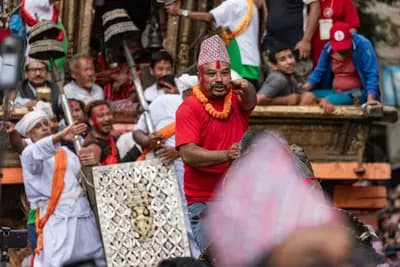
Seto Machindranath Jatra 2027: Kathmandu’s Sacred Festival
Culture
5 Tage
Festival
Free
Kathmandu 5 Tage
Event Details
Loading...
Event starts in
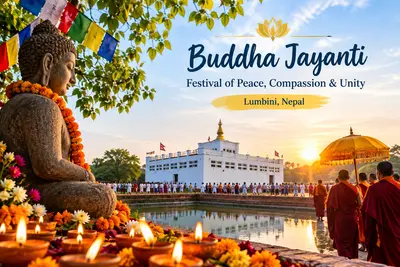
There is exactly one day on the Buddhist calendar when the birth, the awakening, and the death of a single man are all remembered at once, and that day is Buddha Jayanti. For a festival this significant, it is remarkably quiet compared to Nepal's louder, more chaotic celebrations no chariots crashing through narrow streets, no tug-of-war between neighborhoods, no dramatic possession rituals. Instead, Buddha Jayanti unfolds as thousands of butter lamps flickering against stone stupas, robed monks chanting in low unison, and pilgrims walking slow, deliberate circles around monuments that have stood for over two thousand years. If you are researching Nepalese festivals with the intention of actually experiencing one, Buddha Jayanti deserves a serious look not just because of its religious weight, but because it is one of the few Nepali festivals genuinely built to welcome outside visitors into its sacred spaces. This guide covers who celebrates it and why, where in the world (and within Nepal) it happens, how many days the observance actually spans, and the practical details a first-time visitor needs before showing up at a stupa with no idea what they're looking at.
Buddha Jayanti is, at its core, a Buddhist festival, observed across all three of the religion's major traditions Theravada, Mahayana, and Vajrayana though each brings a slightly different flavor to the day. It commemorates the Triple Blessed Occasion: the birth of Siddhartha Gautama, his attainment of enlightenment under the Bodhi tree, and his passing into Mahaparinirvana (the final release from the cycle of rebirth). What makes this genuinely unusual as a matter of religious history is that Buddhist tradition holds all three of these events happened on the exact same date the full moon day of the lunar month of Baisakh (also spelled Vaisakh or Vesakha) separated by decades but bound together on the calendar.
In most of the Buddhist world, this day is known as Vesak (also spelled Wesak), a name derived from the Pali word for the lunar month in which it falls. Sri Lanka, Thailand, Myanmar, Cambodia, Laos, Singapore, and Malaysia all use this term, and it was formally recognized by the United Nations General Assembly in 1999 as the International Day of Vesak, commemorating Buddhism's contribution to spirituality, and observed at UN Headquarters and other UN offices where appropriate. In Nepal and India, however, the same day is more commonly called Buddha Jayanti or Buddha Purnima "jayanti" meaning birth anniversary in Sanskrit, and "purnima" simply meaning full moon.
What's less widely known outside Nepal is that Buddha Jayanti is not observed by Buddhists alone. Because Siddhartha Gautama is regarded within Hindu theology as the ninth avatar of Vishnu, many Hindu Nepalis also participate in the day's rituals, visiting stupas, lighting lamps, and observing the same customs of non-violence and charity. This dual religious ownership is fairly unique among major world festivals it isn't a case of two separate communities marking the same date for different reasons, but of two religious traditions genuinely sharing reverence for the same figure and the same day. In a country where Hinduism and Buddhism have coexisted and blended for centuries, Buddha Jayanti is arguably the clearest visible expression of that shared spiritual heritage.
Buddha Jayanti's geographic footprint mirrors the spread of Buddhism itself, stretching from South Asia through Southeast Asia and into East Asia, with each region adapting the observance to its own customs, though the underlying meaning stays constant.
Despite this wide geographic spread, Nepal occupies a category of its own for one simple reason: it is not just a country that reveres Buddha, but the literal ground he was born on. For a growing number of international pilgrims and culturally curious travelers, that distinction makes experiencing Buddha Jayanti in Nepal fundamentally different from experiencing Vesak anywhere else — you're not commemorating the day in a place connected to the story; you're standing inside the story itself.
Within Nepal, three locations anchor the national observance, each offering a distinctly different experience of the same day.
Lumbini, in Nepal's western Terai plains, is where the observance carries the most historical and spiritual weight. This UNESCO World Heritage Site marks the exact spot where Queen Maya Devi is said to have given birth to Siddhartha Gautama in 623 BCE while resting in a garden between two kingdoms. The Maya Devi Temple, the sacred Puskarini pond where the newborn prince was believed to have been bathed, and the Ashoka Pillar erected by Emperor Ashoka in the 3rd century BCE to mark his own pilgrimage here all sit within the same compound. On Buddha Jayanti, Lumbini draws monks, diplomats, and pilgrims from across the Buddhist world for formal ceremonies, chanting, and processions that unfold across the wider Lumbini Development Zone.
Swayambhunath, the hilltop stupa overlooking Kathmandu often nicknamed the "Monkey Temple" by visitors, is arguably the most visually striking place to witness the day within the valley. Its whitewashed dome and painted Buddha eyes, watching in all four cardinal directions, are ringed with prayer wheels and prayer flags that flutter constantly in the valley wind. On Buddha Jayanti, the entire complex is decorated with additional flags and lights, and devotees circle the stupa clockwise in a continuous, unhurried stream from early morning well into the night.
Boudhanath, one of the largest stupas in the world and the spiritual center for Nepal's substantial Tibetan Buddhist community, transforms into arguably the most atmospheric site in the valley on this day. Thousands of butter lamps are lit around its base, maroon-robed monks from the surrounding monasteries lead chanting sessions, and the enormous circular plaza around the stupa fills with pilgrims performing kora the ritual clockwise circumambulation often while spinning handheld prayer wheels or counting mantras on prayer beads.
Beyond these three major sites, monasteries throughout the Kathmandu Valley and the wider Himalayan region including areas with strong Sherpa, Tamang, and Gurung populations who follow Tibetan Buddhist traditions hold their own smaller ceremonies, making Buddha Jayanti genuinely present across the country rather than confined to a handful of famous landmarks.
 Lumbini, the birthplace of the Buddha, remains the most significant Buddha Jayanti site in the world. Explore more of Nepal's sacred sites on our Places page.
This is one of the most commonly misunderstood aspects of the festival, and the honest answer depends on which observance you're talking about.
The core religious observance is a single day the full moon day of Baisakh. In Nepal, Buddha Jayanti is a one-day national public holiday, and the formal rituals lamp-lighting, chanting, monastic ceremonies, the main processions at Lumbini, Swayambhunath, and Boudhanath are all concentrated into that single 24-hour window, from before dawn until well after dark.
However, several countries build a wider window of celebration around that single sacred date, and it's worth understanding this distinction if you're planning travel around the festival:
For a traveler specifically targeting Nepal, the practical takeaway is this: plan to be in the country on the exact full moon date itself, since that is when the formal ceremonies at Lumbini, Swayambhunath, and Boudhanath actually take place arriving a few days early or late means missing the lamp-lighting, the processions, and the concentrated atmosphere that defines the day. Because the date shifts every year with the lunar calendar, this single-day window has to be confirmed against the current year's calendar rather than assumed from memory.
Because Buddha Jayanti follows the lunar calendar rather than a fixed Gregorian date, the exact day moves each year, typically landing somewhere in April, May, or in leap years occasionally June.
The nearly three-week gap between these two dates is a useful reminder of just how much the lunar calendar can shift the festival from one year to the next travelers planning ahead for Buddha Jayanti 2027 in particular should treat May 20 as a working target date but confirm it against the official Nepali Patro (calendar) as the year approaches, since minor adjustments are occasionally made based on final lunar calculations. If you're building a trip itinerary around this festival, it is worth checking the date roughly six to twelve months out and again a few weeks before departure.
Buddha Jayanti follows a fairly consistent ritual structure across Nepal's major sites, even though the scale and intensity vary by location. Understanding these customs in advance turns the day from a confusing crowd of unfamiliar activity into something genuinely legible and moving.
Butter lamp lighting. Small oil or butter lamps, often set in clay or metal holders, are lit by the hundreds or thousands around stupas and temple courtyards. The lamp is a near-universal Buddhist symbol of dispelling ignorance with wisdom, and lighting one even as a visitor, where permitted is generally treated as a respectful, welcome gesture rather than an act reserved only for practitioners.
Circumambulation (kora). Devotees walk clockwise around stupas, monuments, and shrines, often multiple times, sometimes while spinning handheld prayer wheels or reciting mantras under their breath. This isn't a formal procession with a fixed start or end time it's a continuous, informal flow of movement that visitors can quietly join as long as they follow the correct clockwise direction.
Group chanting and meditation. Monks lead extended chanting sessions throughout the day at major monasteries, often centered on core Buddhist texts and mantras, with lay devotees joining in seated meditation nearby.
Flag and flower offerings. Stupas and monasteries are decorated with additional prayer flags, marigold garlands, and fresh flowers for the occasion, adding a layer of color against the whitewashed and gold-topped architecture typical of Nepali Buddhist sites.
Acts of charity (dana). Giving whether food, clothing, or money to those in need is considered a core practice on this day, reflecting Buddhist teachings on generosity and compassion. It's common to see organized almsgiving near major sites, with monks and lay volunteers distributing food to anyone present.
Vegetarian observance. Many Nepalis, both Buddhist and Hindu, avoid meat and alcohol on Buddha Jayanti as a mark of respect for the Buddhist principle of non-violence (ahimsa).
Kheer preparation. A sweet rice pudding known as kheer is traditionally prepared and shared on this day, tied to the legend of Sujata, a village girl who is said to have offered Siddhartha a bowl of rice milk shortly before his enlightenment, restoring his strength after years of extreme fasting.
 Monastery ceremonies and guided meditation sessions are among the most meaningful ways to experience Buddha Jayanti. Browse guided cultural and spiritual experiences on our Activities page.
To really understand why this single date carries so much weight, it helps to know the three events it commemorates.
Birth. According to tradition, Queen Maya Devi, wife of King Suddhodhana of the Shakya clan, was travelling to her parental home to give birth when she went into labor in the gardens of Lumbini, supporting herself against the branch of a sal tree. The newborn Siddhartha is said to have taken seven steps immediately after birth, with a lotus blooming under each footprint an episode commemorated today by the Ashoka Pillar and sacred pond still standing at the site.
Enlightenment. Decades later, after leaving behind his privileged royal life at the age of 29 to confront the reality of suffering, old age, sickness, and death, Siddhartha spent years in ascetic practice before ultimately sitting beneath a Bodhi tree in Bodh Gaya, India, vowing not to rise until he had understood the root cause of suffering. On the full moon night of Baisakh, he achieved enlightenment, becoming the Buddha "the awakened one."
Mahaparinirvana. At the age of around 80, the Buddha passed away in Kushinagar, India, entering what Buddhist tradition calls Mahaparinirvana final liberation from the cycle of birth and rebirth. Tradition holds this, too, occurred on the same Baisakh full moon date, closing the circle between the day of his birth and the day of his ultimate release.
This triple significance is precisely why Buddhists often refer to the day as the "Thrice Blessed" or "Triple Blessed" occasion, and why the observance carries a weight that goes beyond a simple birthday celebration it is simultaneously a celebration of arrival, a celebration of awakening, and a solemn remembrance of departure, all held in the same set of rituals.
If you're planning to experience Buddha Jayanti firsthand rather than simply reading about it, a handful of practical details make a real difference to how the day unfolds for you.
 A Buddhist heritage circuit through Lumbini, Swayambhunath, and Boudhanath makes for one of Nepal's most meaningful pilgrimage journeys. See our curated Buddhist and cultural tour packages on the Tour List page.
It's worth stepping back from the logistics for a moment to consider why this day continues to hold such weight, both for Nepal and for the wider Buddhist world. Buddha Jayanti isn't simply a religious anniversary marked out of obligation it functions as an annual, tangible reminder of a set of teachings that remain strikingly relevant: compassion over cruelty, generosity over accumulation, and awareness over ignorance. For a country like Nepal, still shaped by both its Hindu majority and its deep Buddhist roots, the day also serves as a visible reminder of shared heritage rather than religious division, with Hindus and Buddhists observing the same rituals at the same sites side by side.
For the international community, the UN's formal recognition of Vesak in 1999 elevated the day from a regional religious observance into a globally acknowledged occasion for reflecting on peace, tolerance, and non-violence values the UN explicitly cited in its resolution. That international dimension adds another layer to why Lumbini, specifically, carries such significance: it is not just a pilgrimage site for practicing Buddhists, but a place of interest for anyone curious about the roots of one of the world's major religious and philosophical traditions.
For travelers building a trip around Buddha Jayanti, the practical shape of a visit usually falls into one of two patterns: a single, immersive day centered on one major site most commonly Boudhanath or Swayambhunath if you're already based in Kathmandu or a longer circuit that includes Lumbini itself, ideally paired with nearby sites connected to the Buddha's early life. Both approaches offer a genuinely different experience of the same festival, and neither requires prior religious knowledge to appreciate; the rituals are visually and atmospherically striking even to a first-time observer, and the openness of Nepali Buddhist communities to respectful visitors makes it one of the more accessible major festivals in the country's calendar.
Buddha Jayanti sits in an unusual category among the world's religious festivals: a single date carrying three separate milestones in one man's life, observed across multiple religious traditions, in a country that happens to be the literal birthplace of the figure being honored. Whether you experience it through the quiet chanting of Boudhanath, the golden eyes of Swayambhunath watching over the valley, or standing at the exact spot in Lumbini where the story is said to have begun, Buddha Jayanti offers something genuinely rare in modern travel access to a living religious tradition, on its own terms, in the place where it started. With the date landing on May 1, 2026, and May 20, 2027, there is a clear window to plan ahead, confirm the details closer to the date, and experience one of Nepal's most meaningful days firsthand. For more on Nepal's festival calendar and cultural travel guides, explore our ongoing coverage on the Enticing Himalayas Blog.
Key experiences and features
Buddha Jayanti
Buddha Purnima
Vesak
Buddha Jayanti in Nepal
Swayambhunath
Buddha’s enlightenment
Mahaparinirvana
Meditation
Buddhist traditions
Recommended packing list
Kathmandu, Kathmandu, Bagmati, Nepal
Got questions about this event?
Buddha Jayanti is celebrated on the full moon day of Baisakh, usually in April or May. The exact date changes every year according to the lunar calendar.
Buddha Jayanti commemorates the birth, enlightenment, and Mahaparinirvana of Gautama Buddha. It is also known as Buddha Purnima or Vesak.
Major celebrations take place in Lumbini, Boudhanath, and Swayambhunath. Monasteries and stupas across Nepal also hold prayers and religious activities.
Yes, Buddha Jayanti is a public holiday in Nepal. People visit monasteries and stupas, offer prayers, light butter lamps, and participate in religious processions.
People celebrate by visiting sacred sites, chanting prayers, lighting butter lamps, offering flowers, walking around stupas, meditating, and practicing charity.
May 20, 2027
1 day
Quick Info
More culture experiences
Mar 23 – Mar 7, 2027Kathmandu
 Dec 13 – Dec 17, 2026
Janaki Mandir, Janakpur
 Nov 15 – Nov 16, 2026
Tsum Valley