 Mar 23 – Mar 7, 2027
Kathmandu
Seto Machindranath Jatra 2027: Kathmandu’s Sacred Festival
Culture
5 Tage
Festival
Free
Kathmandu 5 Tage
Event Details
Loading...
Event starts in
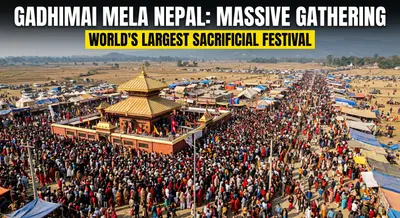
Few festivals anywhere in the world operate on a five-year clock, and fewer still draw the kind of scale and scrutiny that Gadhimai Mela does. Held in the small town of Bariyarpur in Nepal's southern Terai, close to the Indian border, this quinquennial gathering pulls in millions of devotees from Nepal and India in a single concentrated window, making it one of the largest religious gatherings anywhere in South Asia. It is also, by most accounts, the world's largest event involving mass animal sacrifice a fact that has turned Gadhimai Mela into one of Nepal's most-discussed and most-debated festivals, both at home and internationally. If you've come across this festival while researching Nepalese festivals to experience or write about, it deserves a genuinely thorough explanation not just of its religious roots and rituals, but of the controversy surrounding it, the reasoning behind its unusual five-year interval, and what it actually looks like to witness in person. This guide covers all of it in detail.
Gadhimai Mela is a Hindu festival centered on the worship of Gadhimai Devi, a regional goddess regarded as a manifestation of Kali, the fierce aspect of the Hindu divine feminine associated with power, protection, and the destruction of evil. The festival takes place at the Gadhimai Temple in Bariyarpur, a village in the Mahagadhimai Municipality of Bara District, roughly 160 kilometers south of Kathmandu and just a few kilometers from the Indo-Nepal border. Devotees travel from across Nepal and, in especially large numbers, from the neighboring Indian state of Bihar, to seek the goddess's blessings for prosperity, protection from misfortune, the birth of children, and the fulfillment of personal vows known as manauti.
What sets Gadhimai Mela apart from nearly every other festival on Nepal's calendar is its scale and its rhythm. Where most Nepali festivals recur annually, Gadhimai Mela is held only once every five years, drawing estimated crowds in the millions during its main observance days. That combination rarity, scale, and religious intensity has made it both a subject of deep devotion for its followers and a lightning rod for international criticism, largely because of the central ritual at its heart: the mass sacrifice of animals, offered to the goddess in fulfillment of vows made by devotees seeking her favor.
Gadhimai Mela is a Hindu festival, rooted specifically in Shakta tradition the branch of Hinduism centered on worship of the divine feminine (Shakti) in her many regional and fierce forms. Gadhimai Devi is understood locally not as an abstract deity but as a living, responsive protector: a goddess who hears specific requests, grants specific favors, and expects specific offerings in return. This transactional, vow-based relationship between devotee and deity promise an offering, receive a blessing, return five years later to fulfill the promise is central to why the festival functions the way it does.
The devotee base draws heavily from the Terai region straddling the Nepal-India border, an area with deep Bhojpuri and Tharu cultural roots, and from Bihar specifically, where Gadhimai worship carries similar weight. Because the temple sits so close to the border, Gadhimai Mela functions as something genuinely cross-border and cross-national a shared religious pilgrimage that draws Nepali and Indian Hindus into the same physical space, following the same rituals, in pursuit of the same goddess's favor. This is part of what makes the festival logistically enormous: organizers and Nepal's security forces are effectively managing an international pilgrimage rather than a purely domestic one.
Every account of Gadhimai's origins traces back to a single, oft-repeated legend centered on a man named Bhagwan Chaudhary, a landlord living in the Bariyarpur area roughly 250 to 265 years ago placing the story's origins somewhere around the mid-18th century.
According to the legend, a thief broke into Chaudhary's home one night. Villagers caught the intruder and, in their anger, beat him to death. Fearing that his fellow villagers would be punished for the killing, Chaudhary took the blame upon himself and was imprisoned at Makwanpur Fort. While in custody, Chaudhary a devout worshipper of the goddess Kali spent his time in fervent prayer and meditation. One night, the goddess appeared to him in a dream, identifying herself as the goddess of Makwanpur Gadhi, and continued appearing on successive nights, instructing him to carry her to Bariyarpur, back to the very scene of the crime that had landed him in prison. Through what the legend describes as the goddess's occult power, Chaudhary was mysteriously freed from the jailhouse, and a pinch of sacred soil from her feet placed in his turban granted him safe passage home.
In exchange for his freedom, the goddess initially demanded an extraordinary price: the sacrifice of five human lives every year. Chaudhary, unwilling to take human life, offered his own life instead but the goddess refused this too, and the two ultimately settled on an alternative: a pancha bali, or quintuple sacrifice, of five different animals a rat, a pig, a rooster, a goat, and a water buffalo offered not annually, but once every five years. This single negotiated compromise, according to tradition, is the direct origin of both the animal sacrifice at the center of the festival and its unusual five-year interval. When the first attempt at this ritual reportedly failed to protect the village with local children and young people falling ill and dying Chaudhary appealed to the goddess again and was told a human sacrifice would still be required alongside the animal offerings. Unable to find a willing human sacrifice, the story concludes with a devotee from the nearby village of Simri offering five drops of his own blood instead, drawn symbolically from his chest, mouth, eye, thigh, and arm an offering the legend says was accepted in place of a life, closing the loop on the ritual's founding story.
Whatever the precise historical accuracy of this centuries-old oral tradition, it remains the account most commonly cited by temple authorities, local devotees, and cultural researchers alike, and it directly explains two things central to understanding the festival: why animals are sacrificed at all, and why the observance happens only once every five years rather than annually like most of Nepal's other major festivals.
The heart of Gadhimai Mela is geographically fixed and does not move from one edition of the festival to the next. All major rituals take place at and around the Gadhimai Temple in Bariyarpur, a town in the Mahagadhimai Municipality of Bara District, in Nepal's Madhesh Province. The location sits approximately 160 kilometers south of Kathmandu and roughly 7 kilometers east of Kalaiya, close enough to the Indo-Nepal border that the temple carries deep religious significance on both sides of the frontier.
During the festival, the area transforms dramatically. A three-to-five-kilometer radius around the temple compound becomes a sprawling temporary settlement, with hundreds of large tents set up to accommodate the scale of arriving pilgrims, alongside temporary markets, food stalls, and fairground-style attractions that give the event the feel of a massive religious trade fair as much as a purely devotional gathering. Nepal Police and Armed Police forces are mobilized in significant numbers to manage crowd control, traffic, and security across the temporary settlement, reflecting just how large and logistically demanding the event has become.
The temple itself is also said to have several associated "sister" shrines scattered across the wider region including sites known locally as Virta Mai in Birganj, Boudhi Mai in Madhuwan, Sansari Mai in Shiva Nagar, and several others each tied to the same Gadhimai worship tradition, though the Bariyarpur temple remains the unambiguous center of the festival itself.
How Many Days Does Gadhimai Mela Last?
Like Buddha Jayanti and several other Nepali festivals, Gadhimai Mela involves a distinction between the wider fair and the core ritual days, and understanding the difference matters if you're trying to plan around the event.
The broader mela the fair-like gathering of markets, food stalls, lodging, and general pilgrimage activity typically runs for roughly a month, opening in mid-to-late November and continuing through mid-December in most recent editions. Within that extended window, however, the actual animal sacrifice rituals the event's most intense and most controversial component are concentrated into a much shorter period, generally just two to three specific days timed around the start of the fair, historically observed around Nepal's Dashain festival period in earlier decades and, in more recent editions, scheduled in early-to-mid December.
For the 2024 edition specifically, the wider fair ran from November 17 through December 16, while the core sacrificial rituals were concentrated around December 7 to 9, 2024. This structure a long general pilgrimage and market period wrapped around a short, intense ritual core is fairly typical of how the festival has unfolded in its more recent five-year cycles, though exact dates shift somewhat from edition to edition based on the temple committee's own scheduling decisions.
This is one of the most distinctive features of Gadhimai Mela, and one worth unpacking properly, since it separates this festival from almost everything else on Nepal's religious calendar.
The most direct explanation traces back to the founding legend itself: Bhagwan Chaudhary's negotiated pancha bali the quintuple sacrifice of five animals was specifically offered in exchange for the goddess accepting a five-year interval rather than the annual human sacrifice she originally demanded. In other words, the number five is baked directly into the origin story on two levels at once: five animals, offered once every five years. Religious tradition, rather than any purely practical calendar logic, is the primary reason cited by temple authorities and devotees for the interval.
That said, several practical factors likely reinforce why this five-year rhythm has persisted for roughly 250 years rather than shifting to a more frequent schedule. Organizing a gathering of several million pilgrims, with the accompanying security, sanitation, lodging, and transportation demands, is an enormous undertaking for a rural municipality a burden that would be far harder to sustain on an annual basis. The five-year gap also allows time for local livestock economies in the surrounding Terai region to recover between events, since a significant number of the animals sacrificed are purchased specifically for the occasion from regional markets. And from a purely devotional standpoint, the rarity of the event itself appears to intensify its pull devotees frequently describe the promise of "if my wish is granted, I will return in five years to fulfill my vow" as part of what makes the festival so spiritually significant to its followers, turning the long wait itself into part of the religious practice.
Given how often this question comes up in search, it's worth addressing directly: there is no Gadhimai Mela scheduled for 2027. The festival's documented modern cycle runs 2009, 2014, 2019, and most recently December 2024 meaning the next edition of Gadhimai Mela, following its established five-year rhythm, falls in 2029, not 2027. Anyone searching for "Gadhimai Mela 2027" is most likely encountering date confusion with other Nepali festivals that do fall in that year, or simply miscalculating the interval from the last event.
This is a useful detail to keep in mind if you're building any kind of travel plan around the festival: because Gadhimai Mela is not an annual event, there is no version of it to attend in years between its scheduled editions, unlike Nepal's more frequent festivals such as Dashain, Tihar, or Buddha Jayanti. If your interest in Nepalese festival travel is time-sensitive, Gadhimai Mela is one to plan years ahead for, with 2029 as the next realistic target date, subject to confirmation as the temple committee finalizes its schedule closer to the event.
Beyond the central sacrificial ritual, Gadhimai Mela carries a full structure of devotional activity spread across its month-long window.
No honest account of Gadhimai Mela can avoid its central controversy, and any serious travel or cultural publication owes readers a clear-eyed explanation of both sides.
Gadhimai Mela has been described by international observers, including major news organizations and animal welfare groups, as the world's largest single event of animal sacrifice. At its peak, in 2009, an estimated 500,000 animals buffaloes, goats, pigs, chickens, pigeons, and rats were reportedly killed over the course of the ritual, according to figures cited by Humane Society International (HSI). That number has declined significantly in subsequent editions: an estimated 250,000 animals in both 2014 and 2019, and a considerably smaller figure in 2024, with HSI/India reporting roughly 4,200 buffaloes along with thousands of goats and pigeons killed that year.
For devotees, the ritual is understood as a sacred fulfillment of religious vows, rooted in a centuries-old tradition and carried out with full religious sincerity a practice they consider a legitimate expression of Hindu Shakta worship, protected as a matter of religious freedom. For animal welfare organizations including Humane Society International, People For Animals, the Animal Welfare Network Nepal (AWNN), World Animal Protection, and PETA the scale and method of killing at Gadhimai Mela represent one of the most significant instances of mass animal cruelty tied to any religious event anywhere in the world, and these groups have campaigned actively for over a decade to see the practice ended.
This tension has played out directly in the courts of both Nepal and India. In 2014, India's Supreme Court directed the Indian government to prevent the illegal cross-border transport of animals from India into Nepal specifically for sacrifice at Gadhimai. In 2016, Nepal's Supreme Court ordered a gradual phasing out of animal sacrifice at the festival. In 2019, the same court went further, directing Nepali government agencies to formulate a concrete action plan to end the practice entirely. Despite these rulings, subsequent editions of the festival including 2019 and 2024 have continued to involve mass animal sacrifice, with animal welfare groups reporting frustration that government enforcement has fallen well short of the court's directives. Sneha Shrestha, founder of Sneha's Care and president of the Federation of Animal Welfare of Nepal, publicly stated after the 2024 event that local and central government authorities had failed to support the campaign against sacrifice as previously promised, while the festival's organizing committee had instead increased security infrastructure around the sacrificial compound.
There has also been a notable moment of apparent reform that didn't fully hold: in 2015, the Gadhimai Temple Trust publicly declared an indefinite ban on buffalo sacrifice specifically, a decision welcomed by animal welfare organizations as a landmark victory at the time. Yet the 2019 festival went on to see an estimated 3,500 buffaloes sacrificed regardless, illustrating the gap that has repeatedly opened between formal declarations and what actually occurs on the ground during the festival itself.
The campaign to end animal sacrifice at Gadhimai has been sustained and organized rather than sporadic. Since 2014, HSI/India and the Animal Welfare Network Nepal have worked jointly on multiple fronts: petitioning courts in both countries, running public awareness campaigns in villages near the Indo-Nepal border, distributing informational pamphlets in local languages, and during the festival itself stationing teams at border crossings to intercept and, where possible, rescue animals being illegally transported toward Bariyarpur for sacrifice. In the 2024 edition, these border efforts reportedly saved more than 750 buffaloes, goats, pigeons, and chickens from being brought across the border for the ritual, even as the broader sacrifice proceeded elsewhere.
Ahead of the 2024 festival specifically, animal protection organizations held press conferences in Patna, joined by spiritual figures such as Acharya Prashant of the PrashantAdvait Foundation, publicly urging devotees to refrain from animal sacrifice and to consider symbolic, non-violent offerings instead. Whether these efforts will eventually shift the practice meaningfully ahead of the 2029 edition remains an open question, but the trend across the last three cycles from roughly 500,000 animals in 2009 down to a much smaller, though still significant, figure in 2024 does suggest gradual change, even if far short of the outright end that reform advocates and Nepal's own courts have called for.
Major Things You Need to Know Before Considering a Visit
For readers specifically weighing whether to experience Gadhimai Mela firsthand whether out of religious interest, cultural curiosity, or journalistic purpose a few things are worth understanding clearly before making that decision.
For travelers specifically drawn to Nepal's Terai region and its religious landscape beyond Gadhimai Mela itself, Bara District and the surrounding Madhesh Province sit within reach of several other culturally significant sites, including temple circuits tied to the region's Bhojpuri and Maithili communities, and the broader pilgrimage geography that links southern Nepal to neighboring Bihar. Because Gadhimai Mela itself is such an intense and singular event, many visitors with a genuine interest in Nepal's religious diversity choose to frame it as one stop within a longer Terai cultural itinerary rather than a standalone destination trip, pairing it with other regional sites and experiences across the wider south-central lowlands.
If you're mapping out a longer Nepal itinerary that includes lesser-visited regional festivals and pilgrimage sites like Gadhimai, it's worth browsing curated route options built around Nepal's cultural calendar rather than its more commonly covered trekking routes. You can review available options on our Tour List page to see how a Terai-focused cultural circuit might fit alongside a broader Nepal trip.
Gadhimai Mela occupies a genuinely singular place among Nepal's festivals a five-year religious cycle rooted in a centuries-old legend, drawing millions of devotees across an international border, and sitting at the center of one of the most persistent and legitimate controversies in Nepal's religious calendar. Understanding it properly means holding two things at once: the deep, sincere devotion it represents for the communities who observe it, and the real, sustained opposition it has drawn from animal welfare advocates, courts in two countries, and international observers who see the scale of killing involved as incompatible with modern animal welfare standards. With the next edition not due until 2029, there is time for further change, further advocacy, and further scrutiny before Bariyarpur once again fills with pilgrims, offerings, and the questions this festival continues to raise. For more on Nepal's religious and cultural festivals, explore our ongoing coverage on the Enticing Himalayas Blog.
Key experiences and features
Hindu festival of Gadhimai Devi
Held every five years
Major pilgrimage in Bariyarpur
Devotees from Nepal and India
Traditional prayers and offerings
Large cultural fair
Religious and cultural heritage
Recommended packing list
Kathmandu, Kathmandu, Bagmati, Nepal
Got questions about this event?
Gadhimai Mela is a major Hindu religious festival held at Gadhimai Temple in Bariyarpur, Bara District, Nepal.
Gadhimai Mela is traditionally celebrated once every five years. The latest major edition was held in 2024, with the next expected in 2029.
No. Gadhimai Mela does not follow an annual schedule. Based on its five-year cycle, the next major festival is expected in 2029.
Gadhimai Mela is held at Gadhimai Temple in Bariyarpur, Mahagadhimai Municipality, Bara District, Madhesh Province, Nepal, near the India–Nepal border.
Gadhimai Mela is known for its huge religious gathering, five-year cycle, pilgrimage traditions, cultural fair, and the long-standing controversy surrounding animal sacrifice.
Nov 2, 2029
1 day
Quick Info
More culture experiences
Mar 23 – Mar 7, 2027Kathmandu
 Dec 13 – Dec 17, 2026
Janaki Mandir, Janakpur
 Nov 15 – Nov 16, 2026
Tsum Valley