 Aug 17 – Sep 16, 2027
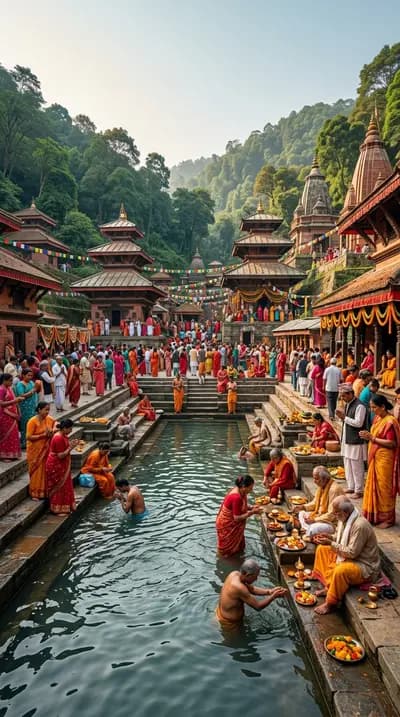
Godavari Kunda
Godavari Mela 2027 Nepal: Dates & Complete Guide
Festival
31 Tage
Festival
Free
Godavari Kunda31 Tage
Event Details
Loading...
If there is one evening in the Nepali year when the whole country glows, it is the night of Laxmi Puja. On the third day of Tihar, families clean their homes, draw bright rangoli at the doorstep, light hundreds of small diyo lamps and open their doors wide to welcome the goddess of wealth. In 2026 the main night falls on Sunday, 8 November, in most calendars, and the whole of Kathmandu turns gold after sunset. For a traveller, it is the most beautiful and the most welcoming night of the Nepal festival season. This guide follows the day from the first sweep of the broom in the morning to the last lamp at midnight, and it explains the rituals, the food, the songs and the best places to watch, with helpful links to festival tours and places to visit from Enticing Himalayas.
Laxmi Puja is the prayer to Laxmi, the goddess of wealth, luck and light, and it is the centre of the five-day Tihar festival. The word puja means worship, and on this night every home becomes a small temple. People believe that Laxmi walks through the streets on the darkest night of the month, looking for a clean, bright and welcoming house, and that she stays where she is invited with love.
The idea behind the festival is simple and warm. Wealth is not only money, it is also health, harmony, food on the table and a family that sits together. That is why the worship is done at home, with the whole household, and not only in a temple. Children, parents and grandparents all take part, and even neighbours visit one another to share sweets and blessings. It is a gentle and joyful night that every visitor to the festivals of Nepal remembers.
The night also belongs to the whole country. In big towns, in hill villages and in the plains of the Terai, lamps shine from windows, roofs and gates, and strings of coloured bulbs hang over the streets. If you climb to a high point such as Swayambhunath, the valley below looks like a sky full of stars, and that sight alone is worth the trip.
Laxmi is one of the best loved goddesses of the Hindu faith. She is the wife of Vishnu, and she is usually shown sitting or standing on a pink lotus, with gold coins pouring from her hand, and sometimes with an owl beside her. An old story says that she rose from the cosmic ocean, when gods and demons stirred the waters to find the nectar of life, and from that day she brought fortune to the world.
Another tale says that she visits each house on the night of the new moon and looks for light. A home that is dirty, dark or full of quarrels is passed by, while a clean house with lamps and open doors is blessed. That is why the cleaning, the lights and the open door are the three most important parts of the evening. People also say that she does not like laziness and loves honest work, so families often pray for success in their jobs and fields.
Many visitors enjoy hearing these stories from a local family or a guide. A short talk about the goddess adds meaning to everything that you see in the street, and our cultural tours always include time for questions in a relaxed setting. In the Newar towns, the same goddess is also honoured in the old Newar traditions of Swanti, which makes the night even richer.
In 2026 the Tihar festival runs from Saturday, 7 November to Wednesday, 11 November. Laxmi Puja is held on the evening of Sunday, 8 November in most Nepali calendars, which is Kartik 22, 2083. Some years the cow worship of Gai Tihar and the Laxmi Puja share one day, and some years they are split across two, so it is wise to confirm with your host or the local patro.
The main prayer usually starts after sunset, when the sky is dark enough for the lamps to shine. In Kathmandu, the sun sets at about a quarter past five in the afternoon in early November, so the lamps begin to appear around that time and the puja follows in the next hour or two. Families who follow the calendar closely choose a lucky hour for the worship, and priests announce it a few days before. If you are a guest, ask what time your host will start, and plan your evening around it.
Public offices and many shops close for the festival, and some businesses open late in the evening for their own puja. The days around Laxmi Puja are the busiest of the year for travel and shopping, so book your hotels and transport early. Our Tihar tour packages include flexible timings, and our Tihar festival guide explains the whole five days.
Laxmi Puja is not only an evening event. It is a whole day of preparation, and every part has a purpose. Here is how the day usually flows in a Kathmandu Valley home, from the first hours of the morning until the last lamp is blown out.
Because the day is so full, visitors who want to see it all should plan carefully. A good idea is to start with a morning walk in an old neighbourhood, rest in the afternoon, and then join a family or a tour for the evening. Our day by day festival plan is built around this rhythm.
Laxmi Puja begins at dawn with a simple act of cleaning. Doors and windows are opened, floors are swept and washed, and every corner is cleared of dust. Some families have already started in the days before, but the final cleaning is done on the morning of the puja. In many homes the doorstep is rubbed with a mix of red mud and cow dung, a traditional way to purify it, and the front step becomes a fresh canvas for the evening.
The reason is not just tidiness. Cleanliness is treated as a form of respect for the goddess, and a clean home is seen as a sign of a healthy and happy family. People also throw out old things, mend broken lamps and repair small cracks in the walls. The whole neighbourhood seems to wake up at the same time, with the sound of brooms and buckets filling the lanes of Patan and Bhaktapur.
If you are a guest in a home stay, you will probably be welcomed into this work, and children may hand you a small broom with a laugh. It is a lovely way to feel part of the family. Our homestay tours in the valley can place you with a host who is happy to share this first part of the day.
By the afternoon, the colour begins. Women and girls sit on the doorstep with powders, rice flour and flower petals and draw rangoli, the floor art of Tihar. Common designs include the lotus, the footprints of the goddess, the sun, the swastika and the mandala. The lines are drawn with the fingers, and the colours are red, yellow, green, white and blue. A good rangoli takes an hour or more and is often a family project.
Next, the house is decorated. Garlands of marigold and globe amaranth are hung around the door, window frames and shrine, and strings of lights are added to the roof. Small clay lamps are set in neat rows along the steps and the gate. The home slowly turns from an ordinary house into a festival palace, and the smell of fresh flowers fills the air.
The best way to see this is to walk through a Newar neighbourhood in the early afternoon, when the doorsteps are being drawn. In Kathmandu Durbar Square and the lanes around it, you will find rangoli on almost every step, and many families are happy to let a quiet guest watch. Our rangoli workshops are a gentle way to try the art yourself, with a local teacher.
In many calendars, the morning of Laxmi Puja is also the time of Gai Tihar, the worship of the cow. The cow is seen as the living form of Laxmi, because she gives milk, helps the farmer and keeps the home pure. She is washed, fed with fresh grass and sweets, and given a red tika and a thick garland of marigold. The family walks around her and offers a small lamp.
This morning ritual is a perfect partner for the evening prayer. It shows that the festival of wealth is also a festival of gratitude, and that the real source of wealth is the land and its animals. In village life, the cow is very close to the household, and many families treat her like a member of the family. The same respect is shown in the Kukur Tihar worship of dogs on the day before.
In towns, you can still see this ritual in the old lanes and near temples. Children lead cows through the streets, asking for small gifts, and shop owners put flowers on the animals. A quiet morning walk with a guide in Thamel or Boudhanath can show you this tradition in a gentle way, and it can be part of a short Gai Tihar tour.
The afternoon of Laxmi Puja is the busiest time in the market. People rush to buy last minute things, and the lanes around Asan, Indra Chowk and the bazaars of Bhaktapur are packed. The stalls are full of marigold, clay lamps, candles, sweets, fruits, coloured powder, incense and small brass bowls. The smell of flowers and oil is strong, and the noise is joyful.
This is a good time to buy small souvenirs, such as a clay lamp, a string of flower garlands or a packet of rangoli powder. Ask the price before you buy, and bargain gently, because the sellers are busy and happy. Many families also buy a small silver coin or a new notebook for the puja, because new things are linked with new fortune.
For a visitor, a walk through these markets is like a festival in itself. It is crowded, but it is also friendly, and many guests say that it is their favourite part of the day. A short market walk with a local guide helps you find the best stalls and avoid the biggest crowds, and it ends well with a cup of milk tea.
As the sun sets, the first lamps are lit. Usually the youngest or the oldest member of the family starts the ritual, with a short prayer, and then the rest follow. Lamps are placed on the doorstep, along the stairs, on the window ledges, on the roof and on the wall of the courtyard. Candles and electric lights are added, and in a few minutes the whole house shines.
Traditional lamps are called diyo, and they are made of clay, filled with mustard oil and lit with a cotton wick. Many families still prefer them to electric lights, because they believe that the old flame is purer and calmer. The warm glow is soft, and the shadows move slowly on the wall. The sight of thousands of tiny flames along a lane is something you will never forget.
If you want to see the first lamps, be on a rooftop in the old city by quarter past five. From Swayambhunath or a hotel terrace near Patan Durbar Square, you can watch the valley slowly light up, house by house. Many of our evening tours are planned to give you a good view at this magic hour.
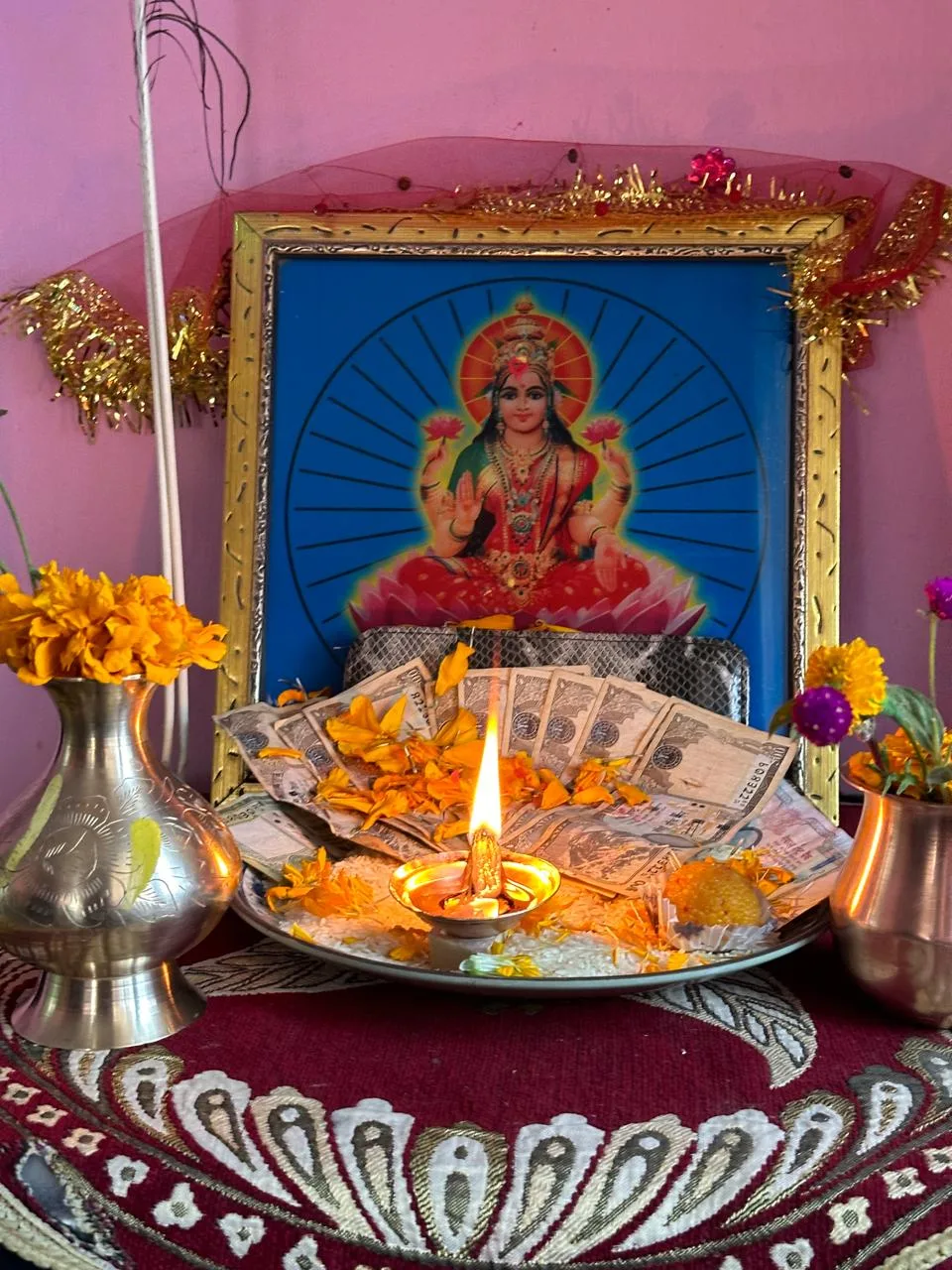
Every family has its own habits, but the main items for the puja are simple. They are often arranged on a tray or a low table in front of the family shrine, with a picture or a small statue of Laxmi, and sometimes a figure of Ganesh. The items are chosen for their meaning, and each one has a purpose.
The tray is simple but full of feeling. For a visitor invited to a home, it is good manners to bring a small gift, such as fruit or sweets, and to wait quietly while the family gets ready. A cultural home visit can be arranged through us, and many hosts love to explain what each object means.
The puja is led by the head of the family or by a priest who visits the house. It is not long, and it has a gentle rhythm. Here is a simple outline of how many families do it, though details change from home to home.
1. The family washes hands and sits in front of the shrine, with the lamps already lit around it. 2. The priest or elder sprinkles water to purify the place and the items. 3. Laxmi is invited with flowers and rice, and a tika is placed on her picture. 4. Incense, lamps and food are offered while a short prayer or mantra is chanted. 5. The family offers flowers and bows, asking for health, peace and honest wealth. 6. The aarti is sung, and a lamp is moved in circles before the goddess. 7. Everyone receives a tika and a share of the sweets, called prasad.
The whole ritual may take thirty minutes to an hour. After it, the mood in the house becomes light and cheerful. If you are invited, follow the family quietly, keep your phone away and accept the tika with both hands. A guide on a Laxmi Puja home tour can explain each step in a calm voice.
The aarti is the part of the ritual that many visitors find most beautiful. The head of the family lifts a brass lamp and moves it in slow circles in front of the goddess, while the others clap, ring a small bell or sing a simple devotional song. The flame trembles, the incense smoke rises and the picture of Laxmi seems to shine. It is a calm, joyful moment in which the whole house is united.
The words of the prayer ask the goddess to stay in the home, to protect the family and to bless its work. Many people also pray for the health of their parents, the success of their children and peace for the country. In some homes, a prayer is offered for neighbours and strangers too, because the festival teaches that wealth should be shared.
After the aarti, the family walks through the house with a lamp, blessing each room, the kitchen, the storeroom and the gate. This small walk is meant to carry the blessing to every corner. If you stay in a home stay, you may be invited to join, and our festival homestay hosts are glad to include guests in this warm moment.
A special custom of this night is to keep the front door open. People say that the goddess will not enter a closed house, so doors and windows are left open as long as the family stays awake. Lamps burn on the doorstep, and the rangoli at the entrance shows her the way inside.
In many homes, small footprints are drawn from the door to the shrine with red powder, rice paste or coloured water. These are the footprints of Laxmi, and they are painted facing inwards. They are among the most charming details of the festival, and they remind the family that wealth should be invited in. Some families also place a small coin or a sweet on the first step.
As a visitor, you can see these footprints in many lanes of Kathmandu and Lalitpur. If a door is open and a family is nearby, a polite smile and a quiet namaste will usually be answered warmly. Never step on the rangoli or the footprints, because they are an offering. A walking guide on our Kathmandu festival walk will help you move with respect.
For shopkeepers and business owners, Laxmi Puja is the most important evening of the year. Shops are cleaned, painted and decorated with lights and flowers, and the owner sits in front of the cash box or the account books and prays for success. In older businesses, the new account book is opened with a red mark, and the old accounts are closed. Many people believe that the way they spend this evening sets the tone for the year.
In the markets of Asan and Thamel, shops stay open late, and the doorways are decorated with marigold and rangoli. Families visit their favourite shops, take tika, share sweets and wish each other a happy year. Some shopkeepers give small gifts to regular customers, and the atmosphere is friendly and warm.
This custom gives the festival a lively commercial colour, and visitors will find it a delight to shop on this night. Silver, brass, handicrafts and incense are easy to find, and the sellers are in a good mood. If you plan to buy gifts, you can ask our team for a trusted shopping tour, which will take you to honest sellers and fair prices.
After the family prayer, the streets become the stage. People step out to see the lights, to visit relatives and to enjoy the night air. Every old lane is lined with lamps, and the courtyards are full of music. The oldest quarters of Kathmandu Durbar Square, Patan Durbar Square and Bhaktapur Durbar Square look like a painting of gold.
The best way to enjoy the night is to walk. Start from Thamel, where hotels and shops are covered in marigold and lights, and move slowly to the old squares. Look up at the windows and the roof lines, and look down at the rangoli. Stop at a stall for a cup of tea and watch the families go by. The mood is joyful, the faces are bright and the children are in new clothes.
For a safer and richer evening, join a small group with a local guide. Our evening festival walk avoids the biggest crowds, includes a stop at a family courtyard and ends with a warm dinner. Keep your valuables close, dress modestly and follow your guide, and the walk will be unforgettable.
As the night deepens, a new sound spreads through the lanes. Groups of young people go from house to house singing Bhailo and Deusi, the traditional blessing songs of Tihar. Girls sing Bhailo, usually on the night of Laxmi Puja, and boys sing Deusi on the nights that follow, although the groups are now often mixed. They carry a drum called a madal, a few bells and sometimes colourful costumes.
At each door, the leader sings a verse in praise of the house, and the group answers with a lively call. The songs bless the family with health and wealth, and the house gives money, rice, fruit or sweets in return. The funds are often used for a temple, a school or a community project, and the singing is a kind of village fundraiser.
For visitors, joining a Bhailo group for an hour is one of the best experiences of the night. You will clap, sing a few words and share snacks with the families. Our Deusi-Bhailo experience is arranged with a trusted local group, and you can read more in our guide to Deusi-Bhailo.
Food is a big part of the evening. The star is sel roti, a ring-shaped bread made of rice flour, sugar and ghee, fried until it is golden and crisp. It is served with spiced potatoes, pickles and milk tea. The plate also holds anarsa, laddu, barfi, fried bread, fruits and nuts, and the sweets are offered to the goddess first and then shared with the family.
In Newar homes, the dinner may include beaten rice, spiced meat, fried fish, lentil cakes and rice wine, and the table is full and colourful. Each community has its own favourite dish, and neighbours often exchange plates of food. If you are invited to a home, it is polite to take a little of everything and to eat with your right hand, and the host will certainly offer a second helping.
If you want to learn how to cook these dishes, a short Nepali cooking class is a fun way to spend an afternoon. You can make sel roti, taste different sweets and take home a few recipes. Many guests say that the food is the best way to understand Nepali hospitality.
Laxmi Puja night is also a night of play. In many homes, families sit together with cards, dice or board games, and play late into the night. Playing cards on this night is an old tradition, and it is believed to bring good luck, though it is now mostly a friendly family game with small stakes. The sound of laughter spills out of windows and courtyards.
Other customs include lighting sparklers, setting off small crackers and visiting friends. Young people gather in groups, take photos with lamps and fairy lights, and share sweets. Some families set out bowls of oil and flowers for passers by, and some leave a lamp at the shrine of the neighbourhood. The night belongs to everyone.
If you join a game, play lightly and respect the rules of the house. Do not bet money without the host, and do not push anyone to take part. Many visitors enjoy simply watching, with a cup of tea in hand. A good host or a guide will tell you what is welcome, and our cultural evening is designed to feel natural and safe.
As midnight approaches, the streets slowly empty. The lamps burn lower, the music fades and families gather for a last prayer or a quiet chat. Many people leave the lamps burning until they die out on their own, because the light is seen as a blessing. The door may be closed late, and some families stay awake as long as they can.
The next morning brings a new mood. On the fourth day of Tihar, the oxen are worshipped in the villages as part of Goru Tihar, and the Newar community celebrates Mha Puja, the worship of the self and the start of the new year. The rangoli from the night before is still on the doorsteps, and the smell of burnt oil lingers in the air. It is a gentle, thankful morning after the grand night.
If you are travelling, this is a good time to rest, to tidy your photos and to plan the next days. You can read about Day 5, Bhai Tika, in our guide, and decide where you will spend it. A calm breakfast and a slow walk to a local temple make a lovely close to the night, and it fits well in a Tihar itinerary.
The festival is celebrated all over Nepal, but each place has its own flavour. In Kathmandu, the old squares and the narrow lanes are the best places to feel the glow. In Patan, the courtyards and temples have a peaceful, artistic mood, and in Bhaktapur, the brick lanes and wooden windows give a very traditional picture.
In Pokhara, the lakeside is lit with lamps, and the hills around Phewa Lake glow. In the plains, Janakpur celebrates with great joy around the Janaki temple, and the ponds fill with lamps. In the hills and mountain villages, the festival is simple, with mud floors, oil lamps and songs, and the stars are brighter than in any city.
Wherever you choose, the heart of the night is the same. A clean home, a warm lamp, a family together. If you have time, try to spend the evening in more than one setting, and talk to people from different communities. Our regional festival tours are planned to give you that variety, with time for rest between stops.
The Newars of the Kathmandu Valley celebrate Tihar as Swanti, a festival with its own rituals and flavour. On the night of Laxmi Puja, they decorate their houses with lamps, draw patterns on the floor and offer special food to Laxmi, and many homes have a small carved shrine for the goddess. The old courtyards of the valley, with their wooden windows and brick floors, are the perfect setting.
The Newar community also celebrates the next day as Mha Puja, the worship of the body, and the new year of the Nepal Sambat calendar. It is a rich and beautiful extension of the night, and it shows how the festival can have many layers. If you want to see these customs, a visit to the old streets of Bhaktapur or Patan is a good idea.
Newar hosts are usually proud and generous, and they enjoy explaining their customs to guests. Ask politely, accept the food with thanks and learn a few words in Newari, and you will be warmly welcomed. A Newar heritage tour is the best way to see this side of the festival with a local expert.
If you are visiting for the first time, the best places to see the festival are the old squares of the Kathmandu Valley. The area around Kathmandu Durbar Square and Asan has dense lights and rich rangoli, and the roof terraces of nearby hotels give a fine view. Patan Durbar Square is calm and artistic, and Bhaktapur Durbar Square has the warmest old-world feel.
For a high view, climb Swayambhunath before sunset and watch the city turn into a field of lights. For a spiritual mood, visit Boudhanath, where the great stupa is surrounded by butter lamps and the pilgrims walk slowly in the glow. For a quiet sacred scene, choose Pashupatinath, where the evening aarti burns brightly on the river.
A home visit is the most special way to see the puja. Ask your hotel or guide whether a host family can welcome you, and bring a small gift. Our Laxmi Puja home visits are arranged with trusted families, and we limit the group size so that every guest has a good view and the family feels comfortable.
If you have just one day to enjoy the festival, here is a plan that combines culture, comfort and a good view of the night. Adjust the times to fit your pace and the local advice on the day.
This plan is easy to adapt. Some guests prefer a slower day, and others like to add a visit to Boudhanath or Pashupatinath. Our team can design a private plan, and our Tihar day tour gives a ready-made option with a local guide, a driver and a reserved home visit.
Laxmi Puja is a family festival, and a few small habits make your visit smooth. Dress modestly, in clothes that cover your shoulders and knees, and wear shoes that are easy to take off. Remove your shoes before entering a home or a shrine. Do not step on the rangoli, the lamps or the footprints at the door, because they are offerings and not decorations.
Ask before you take photos of people, especially during the prayer. Keep your voice low, turn your phone to silent and do not use flash near the shrine. If you are given a tika or a sweet, accept it with your right hand and say thank you. If you are invited to a meal, bring a small gift, such as fruit or sweets, and try a little of every dish.
Be careful with fire. Oil lamps and candles are everywhere, and loose clothes can catch a flame, so keep a respectful distance. Some streets are crowded, so keep your bag in front of you and stay with your group. Our respectful travel tips are shared with every guest before the festival, so that you feel confident.
The days around Laxmi Puja are very busy. Roads around the old squares may be closed to cars, taxis are harder to find, and prices rise because many families are travelling. Plan your transport early, agree the fare in advance and ask your hotel to help with a driver. A private car with a guide is the easiest choice.
Banks, offices and many shops are closed on the main days, so keep cash with you, and carry a small bottle of water. Mobile networks can be slow in crowded places, so decide on a meeting point with your group. Keep your passport copy and valuables at the hotel, and carry only what you need.
If you are travelling with children or elderly people, plan rest breaks and choose quieter places. The festival can be loud, with crackers and music, and some people prefer a calm rooftop or garden. A flexible plan is the best plan, and our private festival tour is always designed with rest and safety in mind.
Laxmi Puja is just one jewel in Nepal's long festival calendar. If your trip is longer than a week, you can see many more events, and the best way to plan is to open our full list of festivals and events and match it with your dates. A good plan can include a mix of village traditions, temple ceremonies and mountain celebrations.
Before Tihar, the great Dashain festival fills the autumn with kites, swings and family feasts. In the spring, Holi brings colour and water, and in the summer, Gai Jatra, Indra Jatra and the Kumari Jatra fill the old city with masks and chariots. In the Newar towns, Seto Machindranath Jatra and Gunla Lakhey bring music and processions, and Sankhu Bajrayogini Jatra lights an old hill town.
There are also pilgrimage and mountain events, such as the Tsum Valley Horse Race, Vivah Panchami in Janakpur and the Janakpur Parikrama. Each of these gives a different window on Nepali culture, and together they make a rich journey. We can build a plan that links them with treks, temple visits and quiet days of rest.
We can help you plan a Laxmi Puja visit that is comfortable, respectful and full of feeling. Our local team knows the best places, the best times and the best families to visit, and we arrange guides, drivers, hotels and home visits. You can choose a short one-day experience or a full Tihar tour that covers all five days, and we can adapt it for families, couples or small groups.
Start by browsing our tour list and the places guide, and send us a message about your dates and interests. If you want to add a short trek after the festival, we can suggest a route that fits the autumn season, and if you prefer a gentler plan, we can add yoga, cooking or craft sessions. Booking early is important, because the best homes and hotels fill quickly in Tihar week.
You can also check our events page for the full festival calendar and ideas for other celebrations. The Enticing Himalayas team is always happy to answer questions, and we love to help guests see Nepal through its festivals and its people.
Laxmi Puja is a night of light, hope and welcome. It teaches that wealth begins with a clean home, an open door and a grateful heart, and it shows that a whole country can celebrate together with nothing more than a small clay lamp. For a traveller, it is a rare chance to see Nepali family life at its warmest.
If you are in Nepal on 8 November 2026, step out of your hotel, walk the lit lanes and let a stranger offer you a sweet. Watch the rangoli, listen to the songs and feel the quiet joy in every home. When you are ready, open the tour list, look at the places guide, and read about other festivals in Nepal before you plan your trip.
We hope that your own Laxmi Puja is as bright as the lamps on every doorstep, and that Enticing Himalayas can help you find your way into the glow.
Key experiences and features
Traditional Laxmi Puja worship and aarti
Beautifully decorated homes with glowing diyos
Colourful Rangoli and Laxmi footprints
Traditional marigold flower decorations
Deusi-Bhailo songs and festive celebrations
Traditional Nepali sweets, sel roti, and family gatherings
Recommended packing list
Kathmandu, Kathmandu, Bagmati, Nepal
Got questions about this event?
Laxmi Puja will be celebrated on Sunday, 8 November 2026. It is one of the most important days of Tihar, when families worship Goddess Laxmi and illuminate their homes with traditional oil lamps.
The main traditions include cleaning and decorating homes, creating colourful Rangoli, lighting diyos, performing Laxmi Puja and aarti, offering sweets, and welcoming Goddess Laxmi for prosperity and good fortune.
Visitors can explore Kathmandu Durbar Square, Patan Durbar Square, Bhaktapur Durbar Square, Asan, and Thamel to experience festive decorations, illuminated streets, traditional music, and local celebrations.
Tourists can respectfully observe public celebrations and learn about the traditions. Participation in private family worship depends on the host family's invitation and customs.
Visitors should wear comfortable, modest clothing suitable for walking and visiting religious places. Warm layers are useful for evening celebrations, especially when exploring Kathmandu's outdoor heritage areas.
Nov 8, 2026
1 day
Quick Info
More festival experiences
Aug 17 – Sep 16, 2027Godavari Kunda
 Jan 15 – Jan 16, 2027
Swayambhu Bhuikhhel
 Nov 1 – Jan 1, 2028
Bhaktapur