 Mar 23 – Mar 7, 2027
Kathmandu
Seto Machindranath Jatra 2027: Kathmandu’s Sacred Festival
Culture
5 Tage
Festival
Free
Kathmandu 5 Tage
Event Details
Loading...
Event starts in
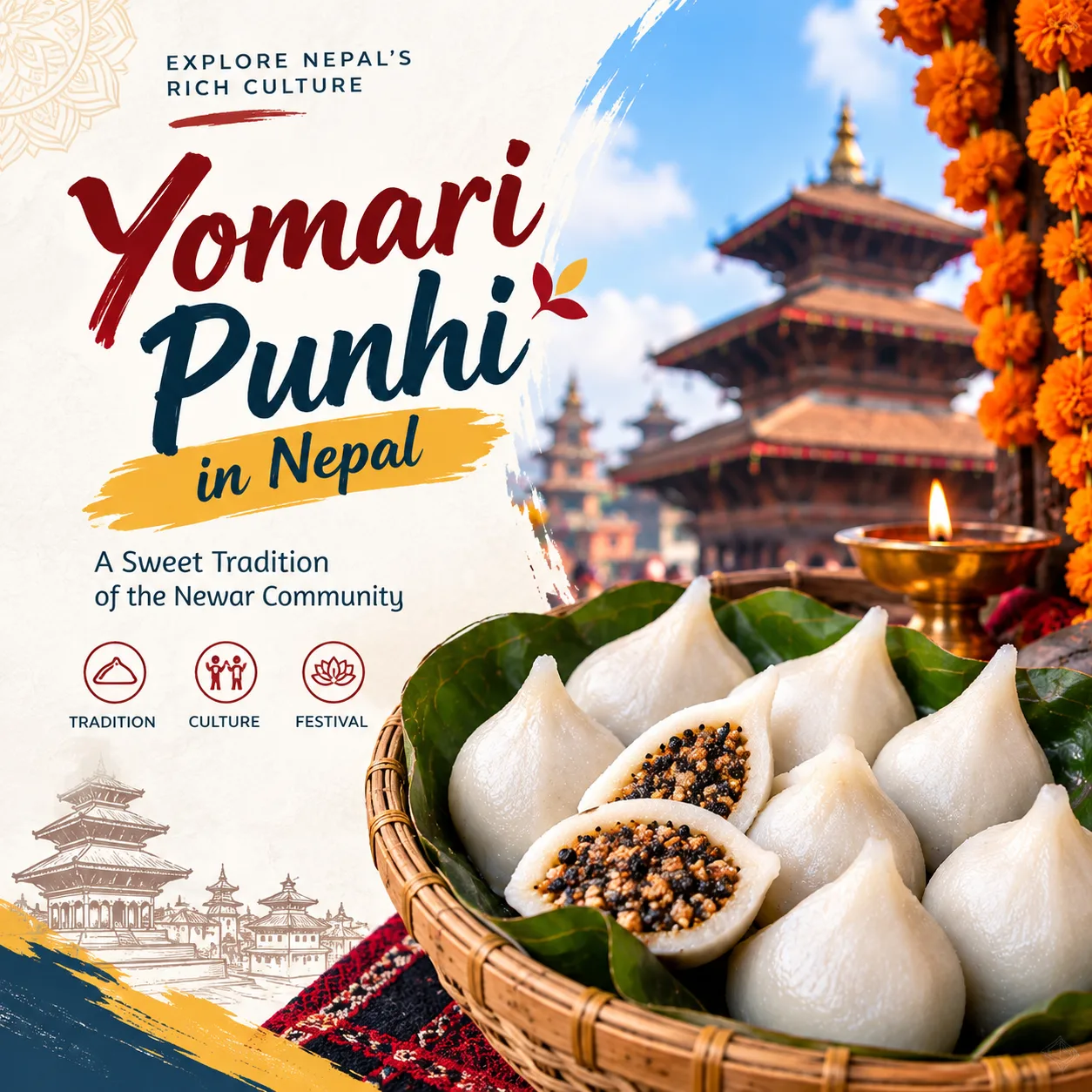
Yomari Punhi is one of the most loved Newar festivals in Nepal, bringing together food, family, harvest traditions, religion, community, and the living heritage of the Kathmandu Valley. Celebrated around the winter full moon, the festival is best known for yomari, a steamed rice-flour delicacy filled traditionally with chaku, sesame, or khuwa. For the Newar community, however, Yomari Punhi is much more than a famous food festival. It is a celebration of the rice harvest, gratitude, prosperity, family life, and devotion. The Nepal Tourism Board describes the festival as an auspicious Newar occasion associated with worship of Annapurna, the goddess of crops and food, and prayers for a good rice harvest.
The festival offers travelers a special way to understand Nepal because it happens inside homes, courtyards, old settlements, temples, and neighbourhoods rather than only on a formal stage. Families prepare yomari together, children and young people take part in traditional customs, and old Newar communities preserve food and rituals that connect present-day Nepal with its agricultural past. A visitor who wants to understand this atmosphere can begin with the wider cultural resources available through Enticing Himalayas and explore the living heritage of the Kathmandu Valley through a dedicated cultural journey. Yomari Punhi is therefore not simply an event to watch. It is a festival to taste, understand, respect, and experience.
Yomari Punhi is a traditional Newar harvest festival celebrated mainly by the Newar community of the Kathmandu Valley and other Newar settlements in Nepal. The name is closely connected with the festival's most important food, yomari. In Nepal Bhasa, punhi refers to a full-moon day, while yomari is the special sweet bread or dumpling prepared for the occasion. The festival is connected with the completion of the rice harvest and the arrival of fresh grain into the household.
The festival combines several layers of Newar life. There is the religious layer, where families make offerings and worship deities connected with food, grain, wealth, and prosperity. There is the agricultural layer, because the festival reflects gratitude for the rice harvest. There is the family layer, because preparing yomari is often a shared household activity. Finally, there is the social layer, because neighbours, relatives, children, and community members have traditionally participated in songs, food sharing, and festive visits. This combination makes Yomari Punhi especially valuable for anyone interested in Nepal culture and traditions. For travelers planning a cultural holiday, a visit to the Kathmandu Valley around festival season can be combined with a carefully planned cultural itinerary through Enticing Himalayas' Kathmandu Valley guide.
Yomari Punhi follows the lunar calendar, so its English date changes from year to year. It generally falls during the cool period of November or December and is associated with the full moon of the Newar month Thinla. The festival is particularly connected with the end of the rice harvest and the preparation of food using new rice flour.
For 2026, Yomari Punhi falls on Thursday, December 24, 2026, according to Nepal's published holiday calendar. It is also listed together with Dhanya Purnima and Udhauli in the government's 2083 public-holiday notice. Travelers should still check the local calendar before making final plans because lunar festivals are date-sensitive and community programmes may extend before or after the main day. The festival calendar maintained by Enticing Himalayas' Nepal Festival Calendar can also be useful when building a wider Nepal festival itinerary.
The importance of Yomari Punhi in Nepal comes from its connection with food, agriculture, faith, and community. Rice has historically been central to life in the Kathmandu Valley. A successful rice harvest meant food for the household and security for the coming months. Yomari Punhi therefore became a time to express gratitude for the harvest and ask for continued abundance.
The festival also demonstrates how Newar culture connects ordinary food with sacred meaning. The rice flour used for yomari is not treated simply as an everyday ingredient. It comes from the new harvest and becomes part of a special seasonal ritual. The finished yomari is prepared with care, offered in a religious setting, and shared afterward. In this way, a simple Newari food becomes a symbol of gratitude and prosperity. Visitors can explore this wider relationship between food and culture through Enticing Himalayas' Nepali Food Guide, which discusses yomari alongside other important foods of Nepal.
The exact historical beginning of Yomari Punhi is difficult to separate from centuries of Newar agricultural and religious traditions. One popular tradition connects the origin of yomari with Panauti, where a Newar couple is said to have experimented with freshly harvested rice flour and molasses. The food was appreciated by the community and gradually became part of special occasions. The Nepal Tourism Board also records this traditional origin story.
Another important point is that Yomari Punhi developed within a society where agriculture, religion, architecture, food, and community life were closely connected. Newar settlements were not simply residential areas. They contained temples, courtyards, water sources, craft workshops, and communal spaces where seasonal traditions could be maintained. This helps explain why the festival remains especially visible in historic settlements around the Kathmandu Valley. Visitors can understand this setting better through Enticing Himalayas' Kathmandu cultural resources and related heritage stories available through Enticing Himalayas' travel stories.
The word Yomari is often explained through Newar language and cultural interpretations. One common explanation connects yo with something liked or loved and mari with bread or a special type of food. The important idea is simple: yomari is a beloved traditional food. Yomari Punhi therefore takes its name from the food that has become the central symbol of the celebration.
The shape of yomari is also important. It is commonly made in a pointed, elongated form, although different shapes may be prepared according to family and local tradition. Some cultural interpretations connect its form with prosperity and sacred symbolism. The meaning can vary between communities, so visitors should avoid treating one interpretation as the only explanation. What is clear is that the yomari itself represents food, harvest, celebration, and tradition, making it one of the strongest culinary symbols of Newar culture.
Traditional yomari is made mainly from rice flour dough. The dough is shaped carefully and filled with a sweet mixture. One of the most traditional fillings is chaku, a thick molasses or jaggery-based preparation. Sesame seeds may be added for flavour and texture. Another popular filling is khuwa, made from concentrated milk. The filled dumpling is then steamed.
The combination is simple but deeply connected to the agricultural season. New rice becomes the outer covering, while sweet ingredients provide richness during the cold season. The Nepal Tourism Board describes yomari as a steamed, fish-shaped rice-flour dumpling commonly filled with chaku or khuwa and sesame. Travelers who want a broader food experience can explore Traditional Nepali Culinary & Food Tour, where yomari is specifically included among the foods connected with Newar culinary heritage.
Making yomari requires patience and practice. First, rice is processed into flour or suitable rice flour is prepared. The flour is mixed with water to create a soft dough. The dough needs to be flexible enough to shape without breaking. Small portions are then taken and formed into a hollow shape.
The sweet filling is placed inside before the dough is closed and shaped. The final form is traditionally distinctive, with a narrow pointed end. Once shaped, the yomari is placed inside a steamer. The steaming process cooks the rice-flour shell while warming the sweet filling. Families may prepare many yomaris at one time because the festival is a social occasion as much as a religious one. Children often watch, help, learn, and eventually develop the skills needed to make them themselves.
One of the central religious associations of Yomari Punhi is the worship of Annapurna, the goddess connected with food and grain. The festival expresses gratitude for the harvest and hopes for continued prosperity. This relationship between agriculture and worship is important because it shows that traditional festivals were closely tied to the practical needs of everyday life.
The harvest was not simply an economic event. It was a source of life, security, and community wellbeing. Offering food to the divine therefore expressed thanks for what the land had provided. The Nepal Tourism Board specifically notes that residents of the Kathmandu Valley worship Annapurna and pray for a good rice harvest during Yomari Punhi. Travelers interested in the spiritual side of Nepal can also explore the wider discussion of religious journeys through Spiritual Tour in Nepal.
Yomari Punhi is closely linked with the rice harvest in Nepal. Rice has been a major part of the agricultural life of the Kathmandu Valley for generations. After months of planting, growing, and harvesting, the new rice becomes available for household use. Yomari provides a festive way to transform that harvest into a food with cultural meaning.
This is why the festival is sometimes associated with Dhanya Purnima, a full-moon harvest observance. The different traditions sharing the same period should not be treated as identical, but they reflect Nepal's wider agricultural calendar and the importance of grain. The festival reminds modern visitors that the Kathmandu Valley was historically an agricultural landscape, not only a collection of temples and urban streets.
Perhaps the strongest feature of the festival is its connection with Newar community life. The celebration is not limited to a temple. Much of the preparation takes place at home. Families gather around food preparation, older generations pass recipes and customs to younger people, and neighbours participate in seasonal activities.
This makes Yomari Punhi an excellent example of living heritage in Nepal. A museum can preserve an object, but a living festival preserves behaviour, language, food, songs, beliefs, relationships, and memories. The tradition continues because people practise it. The Kathmandu Valley remains one of the best places to observe this relationship between heritage and everyday life. Kathmandu Valley heritage guide by Enticing Himalayas offers useful background before visiting.
Children have traditionally played an important role in Yomari Punhi. One of the best-known customs involves young people visiting neighbourhood homes, singing traditional songs, and asking for yomari or other offerings. Radio Nepal reported that this practice, known as Tyaḥchīṃ Tyaḥ / Bakachhīṃ Tyaḥ, has historical roots but is becoming less common in some places.
The custom shows that festivals can act as informal education. Children learn songs, community manners, food traditions, and local history by participating rather than simply reading about them. The festival therefore becomes a way to transfer knowledge between generations. Protecting such customs does not mean freezing them in the past. It means allowing communities to decide how their traditions should continue in modern life.
The Kathmandu Valley is the most important destination for travelers interested in Yomari Punhi. Kathmandu, Patan, Bhaktapur, Kirtipur, Thimi, Bungamati, and other historic Newar settlements provide different cultural settings. Each neighbourhood can have its own atmosphere, food practices, shrines, courtyards, and community customs.
The valley is especially valuable because its Newar heritage remains part of daily life. Traditional architecture, temples, courtyards, festivals, food, music, and craft are still visible. A traveler can combine Yomari Punhi with heritage walks, local food experiences, and visits to historic squares. A dedicated Kathmandu Valley destination guide can help visitors understand the cultural geography before arriving.
Bhaktapur is one of the most attractive places for travelers interested in traditional Newar culture. Its brick lanes, pagoda temples, pottery traditions, historic squares, and Newari food culture create a strong setting for understanding seasonal festivals.
During Yomari Punhi, the attraction is not only the possibility of eating yomari. The greater experience is observing how food fits into family and community life. Travelers should walk slowly, notice traditional architecture, and avoid treating private rituals as public performances. A respectful visit can include tasting local food, exploring heritage streets, and learning from a local guide.
Patan, also called Lalitpur, is another important centre of Newar art and culture. Its courtyards, temples, metalwork, festivals, and traditional neighbourhoods make it ideal for travelers interested in the deeper cultural side of Nepal.
Patan can be included in a broader Kathmandu Valley heritage route. Visitors may combine a morning heritage walk with a food experience and then spend the afternoon exploring local courtyards and traditional markets. The experience becomes more meaningful when travelers focus on local life rather than sightseeing alone. This approach also supports community-based tourism and local businesses.
Kirtipur is another historic Newar settlement where visitors can experience traditional architecture, narrow streets, temples, local food, and community life. Its hilltop setting also provides views over the Kathmandu Valley.
For Yomari Punhi, Kirtipur can be a quieter alternative to the busiest tourist areas. Visitors should remember that the festival is primarily a community and religious tradition. A quiet walk through historic neighbourhoods, a meal at a local Newari restaurant, and respectful observation can provide a stronger experience than trying to photograph every ceremony.
Yomari can be made in different forms. The most familiar shape is elongated and pointed, but families may create different designs for particular symbolic purposes. Some shapes are associated with deities, prosperity, or household rituals.
The shaping process itself is an important cultural skill. It requires practice because the dough must be thin enough to cook properly but strong enough to hold the filling. Watching a skilled person prepare yomari can be as interesting as eating it. For travelers, a hands-on food experience can provide a deeper connection with Newari culinary heritage than simply ordering a dessert at a restaurant.
Chaku yomari is one of the most traditional versions. Chaku is a concentrated sweet made from sugarcane or molasses-like ingredients and has a deep caramel flavour. When placed inside steamed rice dough, it becomes soft, rich, and aromatic.
The combination is particularly suitable for the cool season. It provides a dense sweet taste and makes yomari feel like a special winter food. Visitors trying yomari for the first time may find chaku filling stronger and darker than ordinary sugar-based desserts. It is one of the best ways to understand why yomari has remained popular across generations.
Khuwa yomari offers a different taste. Khuwa is made by reducing milk until it becomes thick and concentrated. It creates a creamy filling that contrasts with the soft rice-flour shell.
Trying both chaku and khuwa varieties is an excellent way to experience the diversity of traditional Nepali sweets. Neither needs to replace the other. Families and food sellers may prepare different fillings according to preference. During the festival, tasting several varieties can turn a simple snack into a small culinary exploration.
Yomari cannot be separated from the wider Newari food culture. Newari cuisine is known for its variety, strong flavours, ritual foods, fermented foods, snacks, sweets, and dishes prepared for specific ceremonies. Food is often connected with social identity and religious practice.
Visitors who want to understand Yomari Punhi should therefore look beyond yomari itself. Dishes such as bara, choila, chatamari, samay baji, beaten rice preparations, and traditional sweets help explain the larger food culture in which yomari exists. The culinary experience offered through Traditional Nepali Culinary & Food Tour can be particularly relevant for travelers who want to explore food alongside cultural history.
Cultural tourism in Nepal becomes stronger when visitors can experience living traditions rather than only famous monuments. Yomari Punhi offers exactly this opportunity. The festival connects food, agriculture, architecture, religion, family, and community.
For tourism, the key is responsible participation. Visitors should not expect every household to open its doors. They should support local food businesses, use local guides where useful, ask before photographing people, and respect temple restrictions. A cultural festival becomes more valuable when tourism strengthens rather than changes the tradition.
A visitor can experience Yomari Punhi in several simple ways. The first is to taste fresh yomari from a reputable local Newari food establishment. The second is to walk through an old Newar settlement and observe the seasonal atmosphere. The third is to learn how yomari is prepared if a community or cooking experience is available.
Travelers can also visit historic temples and courtyards, learn about Newar architecture, speak with local guides, and explore traditional markets. A good festival itinerary should not be rushed. The value of Yomari Punhi is found in small details: steam rising from a kitchen, families shaping dough, children singing, and neighbours sharing food.
The most important rule for festival travel in Nepal is respect. Yomari Punhi is not a commercial show created for tourists. It is a living community tradition. Visitors should dress appropriately around temples and religious spaces, ask permission before photographing people, avoid blocking processions or ceremonies, and follow local instructions.
Photography can be tempting because the food, architecture, and festival atmosphere are visually rich. Still, a camera should never become more important than the people participating in the ritual. When visiting a private courtyard or household, always wait for an invitation or permission. Responsible behavior creates better relationships between visitors and local communities.
The obvious answer is yomari, but visitors can use the festival as an introduction to wider Newari cuisine. Try yomari with both chaku and khuwa if available. Explore local snacks and traditional meals at established Newari restaurants. Ask local guides about seasonal dishes rather than assuming every food is available everywhere.
The advantage of a guided culinary experience is context. A guide can explain what you are eating, how it is made, when it is traditionally served, and why it matters. This turns a meal into a cultural lesson. For travelers interested in this approach, Traditional Nepali Culinary & Food Tour is a natural activity to consider.
Festivals create an opportunity for sustainable tourism in Nepal because much of the spending can remain within local communities. Buying food from local sellers, hiring local cultural guides, staying in community-oriented accommodation, and purchasing locally made crafts can support the people who maintain the traditions.
Visitors should also reduce waste. Carry a reusable bottle, avoid unnecessary plastic packaging, and use public areas responsibly. Do not touch old carvings or religious objects without permission. The goal is simple: leave the neighbourhood as you found it, or better.
Nepal's heritage is not only found in monuments listed by international organisations. It also exists in recipes, songs, language, festivals, crafts, family rituals, and local knowledge. Yomari Punhi demonstrates this beautifully.
A yomari may look like a simple steamed dumpling, but behind it are centuries of agriculture, Newar identity, food knowledge, family teaching, religious belief, and community relationships. This is why Yomari Punhi Festival in Nepal deserves attention from both cultural travelers and researchers interested in intangible heritage.
The Kathmandu Valley provides a rare combination of urban life and ancient cultural traditions. Historic squares stand close to modern shops. Traditional courtyards sit behind busy streets. Ancient temples remain part of neighbourhood life. During festivals, this connection becomes even clearer.
Travelers can use Yomari Punhi as a reason to slow down and explore beyond the standard sightseeing route. A festival-focused trip can include Kathmandu, Patan, Bhaktapur, Kirtipur, and smaller Newar settlements. The wider cultural background can be explored through Enticing Himalayas' Kathmandu Valley guide and the site's collection of Nepal travel stories.
Planning a Yomari Punhi trip to Nepal does not require an extremely complicated itinerary. Start by identifying the festival date. Then choose a base in Kathmandu Valley. From there, plan cultural visits according to opening times, local traffic, and community activities.
A flexible itinerary is better than a rigid one because festival schedules can change according to local practice. Travelers should leave enough time for unexpected experiences such as a neighbourhood food preparation, a small cultural performance, or a local invitation. If you want a broader Nepal journey, you can also explore the wider travel options offered by Enticing Himalayas.
A good festival day can begin with a relaxed breakfast before heading into an old Newar settlement. Spend the morning walking through historic courtyards, temples, and local streets. Rather than rushing from monument to monument, focus on observing the relationship between architecture and community life.
Around lunchtime, try a traditional Newari meal. Later, look for yomari and learn about the preparation process. In the afternoon, visit another historic neighbourhood and observe local activity. As evening approaches, the atmosphere may become more social, with traditional songs and community gatherings in some areas. End the day with a simple meal and time to reflect on what you experienced.
International travelers often arrive in Nepal looking for mountains, trekking, and wildlife. Those experiences are important, but Nepal's festivals provide another way to understand the country. Yomari Punhi is particularly accessible because it is based around food and community rather than a difficult trek or remote pilgrimage.
The festival can therefore work well for families, older travelers, photographers, food lovers, students, and cultural travelers. It can also be added to a longer Himalayan itinerary. Travelers interested in a deeper spiritual perspective can read Spiritual Tour in Nepal 2026, while those interested in food can explore Nepali Food Guide.
Family is at the heart of the festival. Preparing yomari requires several people in many households, making food preparation a social activity. Older family members can teach younger people how to prepare the dough, make the filling, shape the dumpling, and steam it correctly.
This process is important because cultural knowledge is often passed through ordinary activities rather than formal lessons. A child who learns to shape yomari is also learning about family identity, seasonal change, food, language, and community. This is one reason why festivals remain powerful even in rapidly changing cities.
No. Although Yomari Punhi is famous for yomari, calling it only a food festival would miss its wider meaning. It is a harvest celebration, a religious observance, a family tradition, a community event, and an important part of Newar identity.
Food is simply the most visible symbol. The deeper meaning lies in gratitude for the harvest and the continuation of community traditions. For travelers, understanding this difference is essential. Eating yomari is enjoyable, but learning why people make it is what turns the experience into meaningful cultural tourism.
Nepal has an extraordinary festival calendar. Different communities celebrate festivals connected with religion, agriculture, seasons, history, and local identity. Yomari Punhi belongs to this larger cultural landscape but has its own distinctive Newar character.
Visitors can combine their festival journey with other cultural events when dates allow. Enticing Himalayas' Nepal Festival Calendar provides a useful starting point for comparing different celebrations across the year. Other festival experiences, such as the Newar-centered Indra Jatra Festival experience, can help travelers see how different Newar traditions use food, music, processions, temples, and community spaces in different ways.
There are many reasons to experience Yomari Punhi in Nepal. Food lovers will appreciate the yomari itself. Cultural travelers will enjoy the Newar heritage of the Kathmandu Valley. Photographers will find beautiful streets, kitchens, temples, and seasonal details. Families can discover an accessible festival experience without a difficult trek.
Most importantly, the festival provides a chance to experience Nepal as a living culture. You do not need to climb a mountain to find something remarkable here. Sometimes the most meaningful experience is sitting in an old courtyard, watching someone shape rice dough by hand, and understanding that the same basic knowledge has been passed between generations.
Yomari Punhi offers many opportunities for respectful photography. Food preparation, traditional architecture, markets, and public spaces can provide excellent subjects. However, always ask before photographing individuals, especially children and people engaged in religious rituals.
Use natural light when possible and avoid intrusive flash photography inside sacred spaces. Instead of photographing only finished food, focus on the process: hands shaping dough, steam rising from a traditional steamer, ingredients being prepared, or a family arranging food. These details tell a better story about the festival.
For a traveler who loves food, Yomari Punhi is one of the most interesting times to visit the Kathmandu Valley. The festival turns a traditional sweet into the centre of a cultural celebration. Trying different yomari fillings can become a small food journey across the valley.
Food lovers should also explore the wider Newari table. Traditional Newari cuisine contains many textures and flavours, from spicy savoury dishes to sweet and fermented foods. A food-focused itinerary can therefore combine festival yomari with a dedicated culinary experience such as Traditional Nepali Culinary & Food Tour.
For students studying Nepal tourism, culture, anthropology, or heritage, Yomari Punhi is an excellent case study. It demonstrates how intangible heritage survives through repeated community practice.
A tourism student can study the festival from several angles: destination management, food tourism, cultural preservation, community participation, responsible photography, festival economics, local business opportunities, and visitor behaviour. The festival also shows why tourism should not treat culture as a product separated from the people who own and practise it.
Visitors can contribute positively by spending money with local businesses rather than relying entirely on international chains. Eat at local restaurants, hire local guides, purchase locally made products, and choose experiences that respect community traditions.
The goal should not be to turn every festival activity into a tourism product. Some rituals should remain private. Instead, responsible tourism should create opportunities for visitors to learn while allowing communities to maintain control over their own traditions.
Yomari Punhi is a traditional Newar harvest festival associated with the full moon and the end of the rice harvest. It is famous for yomari, a steamed rice-flour dumpling filled with sweet ingredients such as chaku or khuwa.
Yomari Punhi follows the lunar calendar and generally falls in November or December. In 2026, it falls on December 24.
The festival celebrates the rice harvest and expresses gratitude for food and agricultural abundance. Newar households also observe religious traditions associated with deities such as Annapurna.
Yomari is made from rice-flour dough and commonly filled with chaku, sesame, or khuwa before being steamed.
The Kathmandu Valley is the best-known region for experiencing Newar traditions connected with Yomari Punhi. Kathmandu, Patan, Bhaktapur, Kirtipur, and other Newar settlements offer opportunities to experience the wider culture, although exact community activities vary.
Yomari Punhi Festival in Nepal is a beautiful example of how food can carry history, identity, faith, and community memory. The festival begins with the rice harvest but reaches far beyond agriculture. It brings families together, teaches younger generations, honours food and prosperity, and keeps Newar traditions alive.
For travelers, the most rewarding approach is not to treat Yomari Punhi as a show. Come with curiosity and respect. Walk through the old neighbourhoods. Taste fresh yomari. Learn how it is made. Listen to local stories. Ask before taking photographs. Spend time with local businesses and guides. Most importantly, remember that the festival belongs to the communities who have preserved it.
If your goal is to experience Nepal festivals, Newar culture, traditional food, heritage tourism, and authentic local experiences, Yomari Punhi deserves a place on your itinerary. You can begin planning through Enticing Himalayas, explore the wider Kathmandu Valley cultural destination, discover seasonal celebrations through the Nepal Festival Calendar, and add a food-focused experience through Traditional Nepali Culinary & Food Tour.
Yomari Punhi ultimately tells a simple story: harvest brings food, food brings people together, and people keep culture alive by sharing it. That is why this small steamed dumpling has become one of the most powerful symbols of Newar cultural heritage in Nepal.
Key experiences and features
Traditional Newar harvest festival
Taste authentic Yomari
Learn about Newar culture and traditions
Traditional rituals and offerings
Family and community celebrations
Recommended packing list
Kathmandu, Kathmandu, Bagmati, Nepal
Got questions about this event?
Yomari Punhi is a traditional Newar festival in Nepal associated with the rice harvest and celebrated with a special steamed rice-flour dumpling called Yomari.
It is celebrated on the full moon day of Poush according to the Nepali lunar calendar, usually in December.
Yomari is mainly made from rice flour and commonly filled with chaku (molasses), sesame, or khuwa.
The festival is especially associated with Newar communities in the Kathmandu Valley, including Kathmandu, Bhaktapur, Lalitpur, and surrounding settlements.
Yes. Visitors can observe celebrations, learn about Newar traditions, and experience traditional food while respecting local customs.
Dec 24, 2026
1 day
Quick Info
More culture experiences
Mar 23 – Mar 7, 2027Kathmandu
 Dec 13 – Dec 17, 2026
Janaki Mandir, Janakpur
 Nov 15 – Nov 16, 2026
Tsum Valley