Loading...
1 day
1 Option Available
From Kathmandu: Dhulikhel - Namobuddha Spiritual Guided Hike
Country
Kathmandu
Duration
1 day
Group size
Flexible group size
Difficulty
moderate
4.8(12 reviews)
Kathmandu
Tour Description
From Kathmandu to Namobuddha: A One-Day Spiritual Hike Through the Heart of Nepal
Just a few hours from the bustle of Kathmandu, the old Newari town of Dhulikhel sits on a ridge overlooking a panorama of Himalayan peaks that stretches from Langtang in the west to Everest in the east. From here, a trail winds through terraced fields, pine forests, and traditional villages to Namobuddha, one of the most important Buddhist pilgrimage sites in Nepal. This one-day guided hike is not a long trek; it is a journey of a different kind. It is a walk through living history, through landscapes that have been shaped by human hands for centuries, to a place where, according to legend, a previous incarnation of the Buddha offered his own body to a starving tigress and her cubs in an act of boundless compassion. In a single day, you move from the medieval streets of Dhulikhel to the serene courtyards of Thrangu Tashi Yangtse Monastery, with the Himalayas as your constant companion. This is the spiritual heart of Nepal, accessible, profound, and unforgettable.
The Dhulikhel to Namobuddha hike is one of the most rewarding day experiences in the Kathmandu Valley region. It requires no special fitness, no trekking permits, and no overnight gear. All you need is a pair of comfortable walking shoes, a sense of curiosity, and a willingness to slow down and pay attention. The trail is gentle, the views are spectacular, and the destination, Namobuddha, is a place of such deep peace that even the most skeptical visitors find themselves moved. This package includes everything: private transportation from Kathmandu, an experienced guide who knows the trail and its stories, lunch at a local restaurant, and entry to the monastery. You leave in the morning and return by evening, but the experience stays with you far longer.
Why This Hike Matters: The Spiritual Geography of the Kathmandu Valley Rim
The Kathmandu Valley is often described as a living museum of Hindu and Buddhist culture, and the rim of the valley, the ring of hills that encloses it, is where some of its most sacred sites are found. Namobuddha is one of the three most important Buddhist pilgrimage sites in Nepal, alongside Swayambhunath and Boudhanath, but unlike those two, which sit within the valley itself, Namobuddha is perched on a hilltop above the village of Panauti, surrounded by forests and farmland. Its relative remoteness, just far enough from Kathmandu to feel like a genuine escape, is part of its power. The journey to Namobuddha, whether by vehicle or on foot, is a pilgrimage in the traditional sense: you leave the city behind, you climb into the hills, and you arrive at a place set apart from the ordinary world.
The hike from Dhulikhel to Namobuddha is also a journey through the cultural landscape of the Newar people, the indigenous inhabitants of the Kathmandu Valley whose civilization dates back more than a millennium. The terraced fields you walk past, the stone water spouts, the small shrines at every crossroads, and the red-brick houses with their intricately carved wooden windows are all expressions of a living culture that has adapted to this landscape over centuries. Your guide will help you read this landscape, pointing out the details that a casual visitor might miss: the significance of a particular tree, the story behind a roadside shrine, the rhythm of agricultural life that follows the seasons. By the time you reach Namobuddha, you have not just walked a trail; you have traveled through layers of history, culture, and meaning.
The Legend of Namobuddha: The Prince Who Fed a Tigress
The story of Namobuddha is one of the most powerful Jataka tales, the stories of the Buddha's previous lives. Long before Siddhartha Gautama attained enlightenment under the Bodhi tree, he was born as a prince named Mahasattva. One day, while walking in the forest with his two brothers, the prince came upon a tigress who had just given birth to cubs. She was so weak from hunger that she could not move, and her cubs were crying for milk. The prince's brothers searched for food but found nothing. Moved by compassion, Prince Mahasattva made a decision. He sent his brothers away, lay down before the tigress, and offered his own body as food. The tigress, too weak even to eat, could only lick his blood. But the prince's compassion was so great that it gave her strength, and she was able to feed and save her cubs. The place where this act of supreme selflessness occurred is Namobuddha, and the name itself means "Homage to the Buddha."
At the site today, a small stupa marks the spot where the prince's bones are said to have been buried, and the Thrangu Tashi Yangtse Monastery, a magnificent Tibetan Buddhist monastery built in the traditional style, stands as a living center of practice and learning. The monastery is home to over 250 monks, ranging from young novices to senior lamas, and visitors are welcome to observe the daily rituals, spin the prayer wheels, and sit in the main prayer hall, where the sound of chanting and the scent of incense create an atmosphere of profound tranquility. The monastery also houses a school for young monks, and the sight of children in maroon robes playing in the courtyards between their studies is a reminder that this is not a museum but a living community. For many visitors, the experience of sitting in the prayer hall, listening to the monks chant the ancient texts, is the highlight of the day, a moment of stillness that cuts through the noise of modern life.
The Hike: From Dhulikhel to Namobuddha, Step by Step
Morning: Departure from Kathmandu and Arrival in Dhulikhel
Your day begins with a morning pickup from your hotel in Kathmandu. The drive to Dhulikhel takes approximately one hour, climbing out of the Kathmandu Valley on the Arniko Highway. As you ascend, the air clears and the city gives way to terraced hillsides and pine forests. Dhulikhel itself is a gem of a town, one of the best-preserved Newari settlements in the region. Its narrow, brick-paved streets wind between traditional houses with elaborate carved windows, and its temples and shrines, dedicated to a mix of Hindu and Buddhist deities, reflect the syncretic religious culture of the Newar people. Before beginning the hike, your guide will lead you on a short walk through the old town, pointing out the architectural details and sharing the history of this ancient trading post on the route between Kathmandu and Tibet.
The Trail: Terraced Fields, Pine Forests, and Mountain Vistas
The hike from Dhulikhel to Namobuddha is approximately 12 kilometers and takes about 4 to 5 hours at a leisurely pace, with plenty of stops for photographs, rest, and conversation. The trail is well-marked and mostly gentle, with a few short uphill sections that are easily managed by anyone with a basic level of fitness. You leave Dhulikhel behind and immediately enter a landscape of terraced fields, where farmers tend their crops of rice, wheat, and vegetables using methods that have changed little in centuries. The trail passes through small villages where children wave and call out greetings, and where you can stop for a cup of tea at a local home. The pine forests that alternate with the farmland are cool and fragrant, and the birdlife is rich: look for Himalayan bulbuls, black drongos, and the occasional eagle soaring overhead.
On clear days, the mountain views from the trail are breathtaking. The entire Himalayan range is visible, from Langtang Lirung in the west to the Everest massif in the east, with Dorje Lakpa, Gauri Shankar, and numerous other peaks filling the horizon. Your guide will help you identify the mountains and share stories about the communities that live in their shadows. The trail is never crowded, and the pace is relaxed, allowing you to absorb the beauty of the landscape and the rhythm of rural life. This is not a race; it is a walk designed for noticing, for being present, for letting the mountains work their quiet magic on the mind.
Arrival at Namobuddha: The Monastery and the Stupa
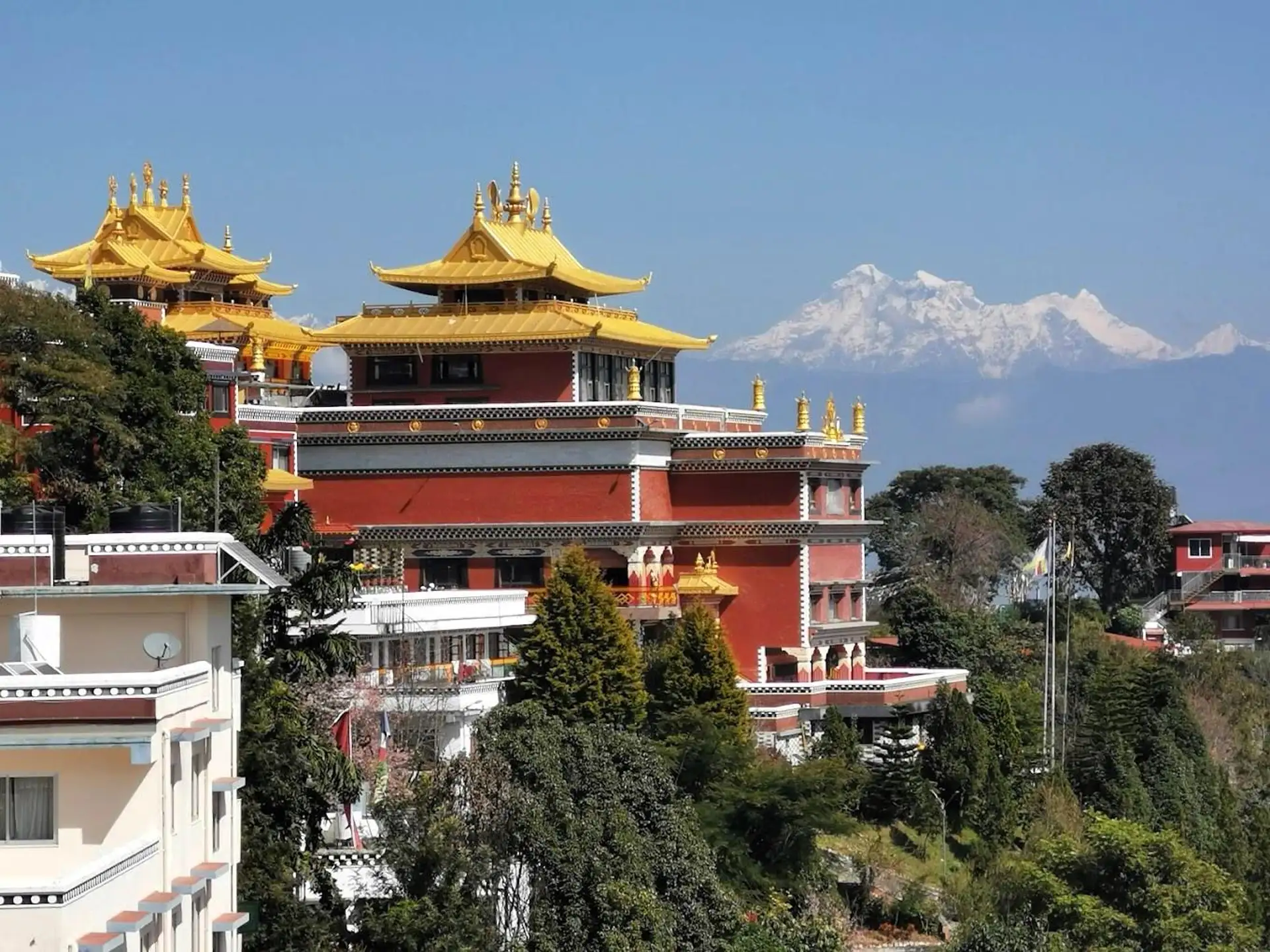
As you approach Namobuddha, the trail climbs gently through a final stretch of forest, and then the monastery appears, its golden roofs and white walls gleaming against the green hillside. The first sight of Thrangu Tashi Yangtse Monastery is always striking, a vision of Tibetan Buddhist architecture transplanted to a Nepali hilltop. You enter the monastery complex and your guide leads you through the main prayer hall, where the walls are covered with intricate murals depicting the life of the Buddha and the Jataka tales. The central statue of Shakyamuni Buddha is flanked by statues of Guru Rinpoche and other important figures in the Tibetan Buddhist tradition. If your visit coincides with a prayer session, you can sit quietly at the back and listen to the monks chant, the deep, resonant sound of their voices filling the hall.
Outside the main hall, you visit the ancient stupa that marks the site of Prince Mahasattva's sacrifice. The stupa is modest compared to the grand monastery, a simple white dome with a golden spire, but its significance is immense. Pilgrims circumambulate the stupa, spinning the prayer wheels and reciting mantras, and you are welcome to join them. The atmosphere here is one of deep reverence and peace. After exploring the monastery and the stupa, you enjoy lunch at a local restaurant with views of the surrounding hills and mountains. The food is simple and delicious, typically dal bhat or noodle soup, and it tastes especially good after a morning of walking.
Afternoon: Return to Kathmandu
After lunch, you have time for a final walk around the monastery grounds, perhaps visiting the monk school or the small shop where you can buy prayer flags and other Buddhist items. Then your private vehicle takes you back to Kathmandu, a drive of about two hours that descends through the same beautiful landscape you walked through in the morning. The return journey is a time for reflection, and many participants find that the experience of Namobuddha continues to resonate long after they have left the monastery behind. You arrive back at your hotel in the late afternoon or early evening, with the rest of the day free to relax or explore Kathmandu. The entire experience, from pickup to drop-off, takes about 8 to 9 hours, making it an ideal day trip for travelers with limited time who want a meaningful encounter with Nepal's spiritual and natural heritage.
The Cultural Landscape: Newar Villages and Living Traditions
One of the great pleasures of the Dhulikhel to Namobuddha hike is the opportunity to experience the rural Newar culture of the Kathmandu Valley rim. The Newars are the original inhabitants of the valley, and their civilization, with its distinctive architecture, cuisine, festivals, and religious practices, is one of the most sophisticated in the Himalayan region. The villages you pass through on the trail, Kavre, Sangkhu, and others, are living communities where traditional ways of life continue alongside modern influences. You will see women weaving on handlooms, farmers plowing with oxen, and children walking to school in their uniforms. The small temples and shrines that dot the trail are actively used, with fresh offerings of flowers and rice left by local devotees.
Your guide, who is likely to be from the region, will share insights into the customs and daily life of these communities. You will learn about the agricultural calendar, the festival cycle, and the complex web of kinship and caste that structures Newar society. You may be invited into a home for tea, an experience that many travelers cite as the most memorable part of their trip to Nepal. The hospitality of the Nepali people is legendary, and in these villages, far from the tourist crowds of Kathmandu, it is offered freely and without expectation. This is cultural immersion at its most authentic: not a staged performance, but a genuine encounter with people going about their lives in a landscape they have inhabited for generations.
Thrangu Tashi Yangtse Monastery: A Center of Buddhist Learning
Thrangu Tashi Yangtse Monastery is not just a pilgrimage destination; it is a functioning monastery and a center of Buddhist education. Founded by the Venerable Thrangu Rinpoche, one of the most respected teachers in the Karma Kagyu lineage of Tibetan Buddhism, the monastery is home to a community of monks who dedicate their lives to study, meditation, and ritual practice. The monastery's architecture is a stunning example of the Tibetan Buddhist style, with its golden roofs, intricate woodwork, and walls covered in murals that depict the deities, teachers, and sacred geography of the tradition. The main prayer hall, which can accommodate hundreds of monks, is a space of extraordinary beauty and serenity, and visitors are welcome to sit and absorb the atmosphere.
The monastery also runs a school for young monks, where boys from poor families in the surrounding region receive a free education that includes both traditional Buddhist studies and modern subjects like English, mathematics, and science. The sight of these young monks, in their maroon robes, playing football in the courtyard or reciting their lessons in the classroom, is a reminder that Buddhism in Nepal is not a relic of the past but a living, evolving tradition. If you are interested, your guide can arrange for you to speak with one of the senior monks or teachers, who are often happy to answer questions about the monastery, the teachings, and the daily life of the community. These conversations, informal and unscripted, are often the most meaningful part of the visit.
Best Time for the Dhulikhel to Namobuddha Hike
This hike can be done year-round, but the best seasons are spring (March to May) and autumn (September to November). In spring, the hillsides are green and the rhododendrons are in bloom, and the weather is warm but not hot. The mountain views are often clearest in the early morning, so an early start from Kathmandu is recommended. Autumn offers the crispest air and the most reliable mountain panoramas, with the post-monsoon atmosphere washed clean of dust and haze. The terraced fields are golden with ripening rice, and the festival season adds an extra layer of cultural richness. Winter (December to February) is also a good time for the hike, with cool, clear days and excellent visibility, though mornings can be chilly and you will want to bring a warm layer. The monsoon months (June to August) bring rain and muddy trails, but the landscape is lush and green, and the hike is still possible with appropriate rain gear. Because this is a day hike at relatively low elevation (Dhulikhel is at 1,550 meters and Namobuddha at 1,750 meters), altitude is not a concern, and the hike is suitable for all seasons with the right preparation.
What's Included and Practical Information
This one-day guided hike includes everything you need for a seamless and enriching experience. Private transportation from your hotel in Kathmandu to Dhulikhel and back is provided, along with an experienced, English-speaking guide who knows the trail, the history, and the culture of the region. Lunch at a local restaurant near Namobuddha is included, as is the entry fee to Thrangu Tashi Yangtse Monastery. The guide will carry a basic first-aid kit and will be able to assist with any minor issues that arise on the trail. You should bring comfortable walking shoes or light hiking boots, a hat and sunscreen, a reusable water bottle, and a light jacket or fleece depending on the season. A camera is essential; the mountain views and the monastery are extraordinarily photogenic. The total walking distance is approximately 12 kilometers, with an elevation gain of about 200 meters, making this a gentle hike suitable for anyone with a basic level of fitness, including children and older adults.
The hike can be customized to suit your interests and schedule. If you prefer a shorter walk, the vehicle can drop you closer to Namobuddha, reducing the hiking distance to about 6 kilometers. If you are interested in extending the day, you can add a visit to the medieval town of Panauti, with its beautiful Indreshwar Temple and its confluence of two sacred rivers, or to the hill station of Nagarkot for sunset views of the Himalayas. Our team is happy to tailor the itinerary to your preferences.
Extending Your Spiritual Journey in Nepal
The Dhulikhel to Namobuddha hike is an ideal introduction to Nepal's spiritual heritage, but it is only the beginning. The Kathmandu Valley alone contains seven UNESCO World Heritage Sites, including the great stupas of Boudhanath and Swayambhunath, the Hindu temple complex of Pashupatinath, and the medieval palace squares of Bhaktapur and Patan. For those drawn to Buddhist pilgrimage, a visit to Lumbini, the birthplace of the Buddha in the southern Terai, is an essential extension. For those who want to combine spiritual exploration with trekking, the Gosaikunda Lake Trek and the Gosaikunda Sacred Lakes Trek with Yoga Retreat offer multi-day pilgrimages to one of Nepal's holiest high-altitude sites. Our Spiritual Tour in Nepal guide provides a comprehensive overview of the country's sacred geography, and our detailed planning guides, Cultural and Spiritual Tours in Nepal: The Complete 2026 Guide and Best Trekking Agency in Nepal in 2026, are essential reading for anyone planning a journey to the Himalayas.
Frequently Asked Questions
How difficult is the Dhulikhel to Namobuddha hike?
The hike is rated as easy to moderate. The total distance is approximately 12 kilometers with an elevation gain of about 200 meters, making it accessible to anyone with a basic level of fitness. The trail is well-marked and mostly gentle, with a few short uphill sections. The hike takes 4 to 5 hours at a leisurely pace with plenty of rest stops. It is suitable for children, older adults, and anyone who can walk comfortably for a few hours.
What is the significance of Namobuddha?
Namobuddha is one of the three most important Buddhist pilgrimage sites in Nepal, alongside Swayambhunath and Boudhanath. According to the Jataka tales, a previous incarnation of the Buddha, Prince Mahasattva, offered his body to a starving tigress and her cubs at this very spot in an act of supreme compassion. A stupa marks the site, and the Thrangu Tashi Yangtse Monastery, home to over 250 monks, stands as a living center of Buddhist practice and learning.
What should I bring for the day hike?
You should bring comfortable walking shoes or light hiking boots, a hat and sunscreen, a reusable water bottle, and a light jacket or fleece depending on the season. A camera is highly recommended for the mountain views and monastery. The guide carries a basic first-aid kit. No special equipment or trekking gear is required, and you do not need a large backpack since this is a day hike with lunch provided.
Can I visit the monastery and interact with the monks?
Yes, visitors are welcome at Thrangu Tashi Yangtse Monastery. You can enter the main prayer hall, observe the daily rituals, spin the prayer wheels, and circumambulate the ancient stupa. If a prayer session is in progress, you may sit quietly at the back. Your guide can arrange for you to speak with a senior monk or teacher if you are interested. Please dress modestly, covering shoulders and knees, and remove your shoes before entering the prayer hall.
What is the best time of year for this hike?
The hike can be done year-round, but spring (March to May) and autumn (September to November) offer the best conditions. Spring brings blooming rhododendrons and green hillsides, while autumn delivers the clearest mountain views. Winter (December to February) offers cool, clear days with excellent visibility. The monsoon months (June to August) bring rain and muddy trails, but the landscape is lush and the hike is still possible with appropriate rain gear.
Can the hike be customized or combined with other activities?
Yes, the hike is fully customizable. If you prefer a shorter walk, the vehicle can drop you closer to Namobuddha, reducing the distance to about 6 kilometers. You can also extend the day with a visit to the medieval town of Panauti, with its beautiful Indreshwar Temple, or to Nagarkot for sunset Himalayan views. Our team is happy to tailor the itinerary to your interests, fitness level, and schedule.
About Enticing Himalayas

Enticing Himalayas is a premier trekking and tour operator based in Kathmandu, Nepal, dedicated to creating transformative Himalayan experiences. Our mission, "Explore, Heal, Thrive," reflects our belief that travel in the Himalayas is not just about reaching a destination; it is about inner discovery, cultural connection, and personal growth. We specialize in curated treks, cultural tours, spiritual journeys, and wellness retreats across Nepal, from the high passes of the Everest and Annapurna regions to the sacred lakes of Langtang and the jungles of Chitwan.
Our Services
- Trekking and peak climbing expeditions across all major Himalayan regions
- Cultural and heritage tours of Kathmandu Valley, Lumbini, and beyond
- Spiritual pilgrimage treks to Gosaikunda, Muktinath, and other sacred sites
- Wellness and yoga retreats in mountain settings
- Jungle safaris in Chitwan and Bardiya National Parks
- Customized private itineraries tailored to your interests and schedule
- Helicopter tours and luxury travel experiences
- 24/7 in-country support and experienced, licensed guides
Our Accreditations


Enticing Himalayas is a licensed trekking and tour operator registered with the Nepal Tourism Board and the Trekking Agencies' Association of Nepal (TAAN). We are also a proud partner of GetYourGuide, offering verified, bookable experiences to travelers worldwide.
About the Author
This guide was written by the Enticing Himalayas content team, drawing on decades of combined experience guiding cultural and spiritual tours across Nepal. Our writers have walked the Dhulikhel to Namobuddha trail in every season, sat in the prayer hall of Thrangu Tashi Yangtse Monastery, shared tea with the monks, and explored every temple and shrine along the route. We write from direct experience, not from a desk, and every recommendation in this guide has been tested on the trail.
Why Trust Enticing Himalayas
With years of operation in the Nepal tourism sector, Enticing Himalayas has earned a reputation for reliability, safety, and authentic experiences. Our guides are locally trained, licensed, and deeply knowledgeable about the regions they lead. We maintain small group sizes to ensure personalized attention and minimize environmental impact. Our pricing is transparent, with no hidden fees, and our cancellation policies are among the most flexible in the industry. When you travel with us, you are not just a client; you are a guest in our mountain home, and we take that responsibility seriously. Read more about our approach in our comprehensive guides: Cultural and Spiritual Tours in Nepal: The Complete 2026 Guide and Best Trekking Agency in Nepal in 2026.
Highlights
- Spiritual Sanctuary: Discover peace at Namobuddha, Kathmandu Valley's Monastery
- Cultural Immersion: Immerse in Buddhist culture and traditions on this Journey
- Scenic Day Hike: Experience landscapes on a guided trek from Dhulikhel.
- Enhanced Imagery: Capture beauty with compliant imagery
- Optional Meditation Session: Elevate your experience with meditation
What's Included
- Hotel pick-up and drop-off
- Transportation
- Bottle of Water
- Licensed Tour Guide
What's Not Included
- Food and personal expenses
Detailed Itinerary
Day 1Day 01
Gallery
1 photoDownloads
4.812 reviews
5
0
4
0
3
0
2
0
1
0
No reviews yet. Be the first to review this tour!
Tour Video
No video available for this tour.
1 option available
From Kathmandu: Dhulikhel - Namobuddha Spiritual Guided Hike
Standard tour package with flexible dates
1 day
Guide: English
Select a date
1
$380
1 Adult × $380
Free cancellation
Cancel up to 24 hours in advance for a full refund
From
$380/person
Booking options
Choose a departure below, or use the availability calendar to select a flexible date. Availability and final pricing are confirmed during booking.