Loading...
3 days
1 Option Available
Lumbini Buddhist Pilgrimage — Birthplace of Buddha (3 Days)
Country
Lumbini, Rupandehi
Duration
3 days
Best season
Spring / Autumn / Winter
Group size
Flexible group size
Difficulty
easy
4.5(15 reviews)
Lumbini, Rupandehi
Tour Description
The Birthplace of the Buddha: A Journey to the Source
Somewhere around 563 BCE, in a grove of sal trees in the Terai plains of what is now southern Nepal, a child was born who would change the course of human thought. His name was Siddhartha Gautama, and the world would come to know him as the Buddha, the Awakened One. The place of his birth, Lumbini, is today a UNESCO World Heritage Site and one of the four great pilgrimage destinations of Buddhism, alongside Bodh Gaya (where he attained enlightenment), Sarnath (where he first taught), and Kushinagar (where he died). For Buddhists, a visit to Lumbini is a homecoming to the very source of their faith. For non-Buddhists, it is an encounter with one of the world's oldest and most influential wisdom traditions at the exact spot where it began.
This three-day pilgrimage from Kathmandu takes you to that spot. You will stand beside the marker stone that identifies the precise location of the Buddha's birth, inside the Maya Devi Temple. You will walk through the Sacred Garden where Queen Maya Devi is said to have bathed in a pond before giving birth. You will see the Ashoka Pillar, erected in 249 BCE by the emperor who spread Buddhism across Asia. And you will explore the monastic zone, where Buddhist communities from Thailand, Tibet, Japan, Myanmar, Sri Lanka, and a dozen other nations have built temples and monasteries, each in their own architectural tradition, creating a living museum of global Buddhist culture. This is not a rushed day trip. It is a pilgrimage with time to sit, reflect, and absorb the peace that pervades this extraordinary place.
Why Lumbini Matters
Buddhism is often described as a philosophy rather than a religion, and its founder as a man rather than a god. Siddhartha Gautama was a historical figure, a prince of the Shakya clan who renounced his privileged life at the age of 29 to seek an end to suffering. The path he discovered, the Middle Way between indulgence and asceticism, became the foundation of a tradition that today counts over 500 million followers worldwide. To visit Lumbini is to connect with that historical reality. The marker stone, the Ashoka Pillar, the ruins of ancient monasteries: these are not myths. They are archaeological evidence of a life that was actually lived and a teaching that spread from this quiet corner of the Terai to every continent on earth.
For Nepal, Lumbini is a source of immense national pride and a cornerstone of the country's identity as the birthplace of the Buddha. The Nepali government has invested heavily in developing the site as a centre for international pilgrimage and tourism, and the result is a vast, beautifully landscaped complex that balances archaeological preservation with spiritual function. Our complete guide to cultural and spiritual tours in Nepal places Lumbini at the top of any serious spiritual itinerary, and for good reason. There is simply nowhere else on earth like it.
Day One: The Journey from Kathmandu to Lumbini
The Road to the Terai
Your pilgrimage begins with an early morning departure from Kathmandu. The drive to Lumbini takes approximately seven to eight hours, descending from the Kathmandu Valley at 1,400 metres through the Mahabharat Range and into the Terai, Nepal's southern lowland plain. The landscape changes dramatically as you descend: terraced hillsides give way to subtropical forest, and the cool mountain air becomes warm and humid. Your driver will make rest stops along the way, and your guide will use the journey to provide context for what you are about to experience: the life of the Buddha, the history of Lumbini, and the significance of the sites you will visit.
The route passes through several interesting towns, including Narayanghat, a bustling commercial centre on the banks of the Narayani River. If time permits, you may stop for lunch at a clean, reliable restaurant your guide knows well. The final stretch of the journey takes you through the flat agricultural landscape of the western Terai, where rice paddies stretch to the horizon and the air carries the scent of earth and growing things. You will arrive in Lumbini by late afternoon and check into your hotel, a comfortable property within easy reach of the Sacred Garden. The evening is yours to rest after the long drive. If you have the energy, a short walk in the quiet lanes around the hotel, with the sounds of evening prayers drifting from nearby monasteries, is a gentle introduction to the atmosphere of this place.
Day Two: The Sacred Garden and the Monastic Zone
The Maya Devi Temple and the Birthplace Marker
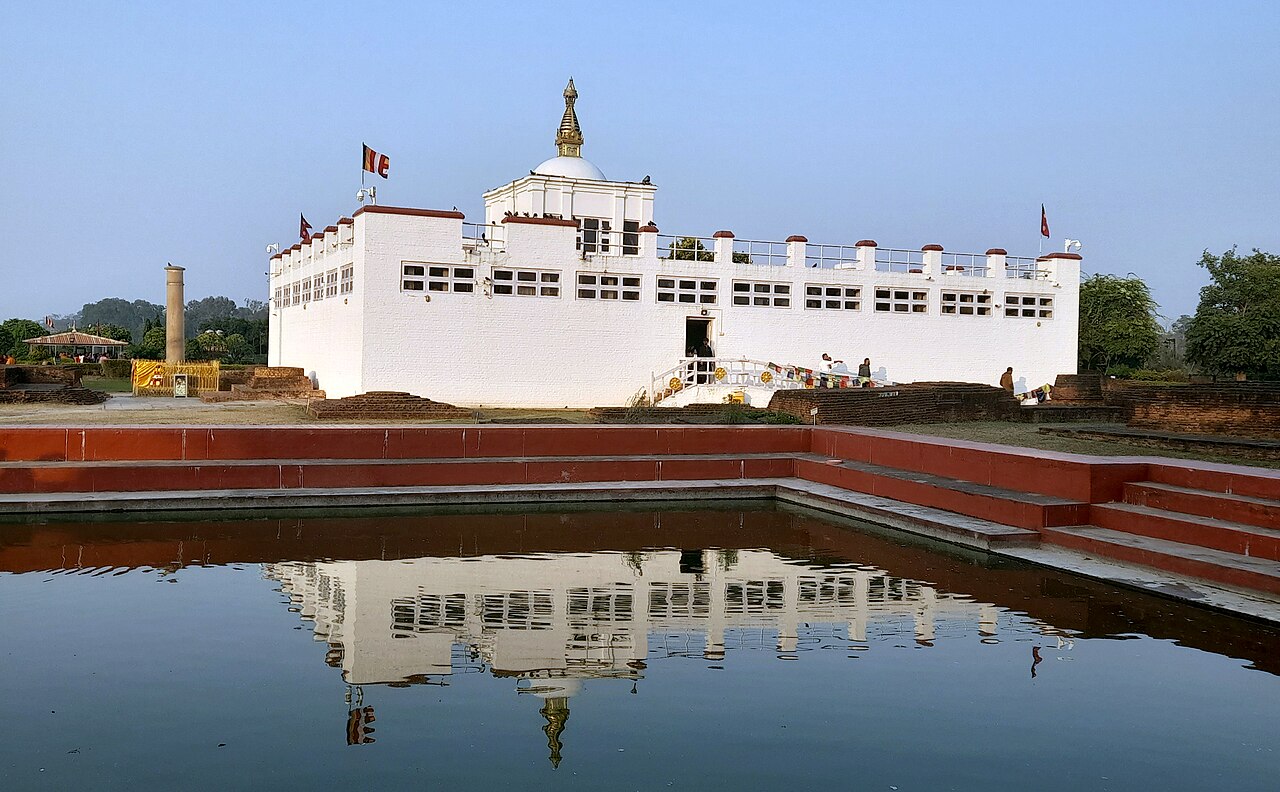
After an early breakfast, you enter the Sacred Garden, the heart of the Lumbini complex. The garden is a large, rectangular enclosure of manicured lawns, ancient trees, and excavated ruins, with a raised brick walkway leading to the Maya Devi Temple at its centre. The temple itself is a simple white structure built over the ruins of earlier temples dating back to the third century BCE. Inside, under a protective glass panel, is the marker stone: a sandstone block set into the floor that archaeologists have identified as the exact spot where the Buddha was born. Pilgrims from around the world kneel here, touch the stone, and offer prayers. The atmosphere inside the temple is quiet and intense, charged with the devotion of those who have travelled great distances to be here.
Your guide will explain the iconography: the bas-relief depicting Maya Devi holding a branch of the sal tree as she gives birth, the infant Buddha taking seven steps immediately after birth and declaring his final rebirth, the lotus flowers that are said to have sprung up where his feet touched the ground. These are stories, but they are also teachings, encoding the Buddhist understanding of the Buddha's nature and mission. Even if you approach them as metaphor rather than literal history, their power is undeniable.
The Sacred Pond and the Ashoka Pillar
Just south of the temple is the sacred pond, Puskarni, where Queen Maya Devi is believed to have bathed before giving birth. The pond is rectangular, lined with brick steps, and shaded by large trees. The water is still and dark, reflecting the sky and the temple walls. Pilgrims often sit on the steps in silent meditation. It is one of the most peaceful spots in the entire complex.
Near the pond stands the Ashoka Pillar, a sandstone column roughly six metres tall, erected by the Mauryan emperor Ashoka in 249 BCE during a pilgrimage to the site. The pillar bears an inscription in Brahmi script that reads, in part: "King Devanampriya Priyadarsin, in the twentieth year of his reign, came in person and paid reverence. Because the Buddha Sakyamuni was born here, a stone railing was built and a stone pillar erected." This inscription is the primary archaeological evidence confirming Lumbini as the Buddha's birthplace. To stand before it is to stand before a document that has shaped the understanding of Buddhist history for over two millennia.
The Monastic Zone: A World of Buddhist Architecture
After lunch, you explore the monastic zone, a vast area to the north of the Sacred Garden divided into an eastern and western section. The eastern zone houses Theravada monasteries, built by Buddhist communities from Thailand, Myanmar, Sri Lanka, Cambodia, and Laos. The western zone houses Mahayana and Vajrayana monasteries, built by communities from Tibet, China, Japan, Korea, Vietnam, and Mongolia. Each monastery is built in the architectural style of its home country, and walking through the zone feels like travelling across Asia in an afternoon.
The Thai monastery, with its gleaming white walls and multi-tiered golden roof, is one of the most striking. The Myanmar monastery, with its ornate woodcarvings and gilded spires, is another highlight. The Tibetan monastery, with its prayer wheels, colourful murals, and the deep resonance of chanting monks, offers a completely different aesthetic. Your guide will take you into several of the monasteries, explaining the differences in practice and iconography between the traditions. You may be invited to sit and observe a prayer session, or to light a butter lamp as an offering. These are not museum exhibits. They are working monasteries where monks live, study, and pray.
The Eternal Peace Flame
At the northern end of the canal that divides the monastic zone, you will find the Eternal Peace Flame, a gas flame that has burned continuously since 1986, the International Year of Peace. The flame symbolises the Buddha's message of non-violence and compassion, and it is a focal point for meditation and reflection. The area around the flame is quiet and open, with benches where you can sit and absorb the stillness. Many pilgrims end their day here, watching the flame as the sun sets over the Terai. It is a fitting conclusion to a day spent walking in the Buddha's footsteps.
Day Three: Morning Meditation and Return to Kathmandu
A Final Morning in the Sacred Garden
On your final morning, you have the option of returning to the Sacred Garden for a quiet hour before the day's visitors arrive. The garden at dawn is a different place: the light is soft, the air is cool, and the only sounds are birdsong and the distant murmur of monks at prayer. Your guide can arrange for you to sit in meditation under the bodhi tree near the Maya Devi Temple, or simply to walk the grounds one last time at your own pace. This is not a guided activity. It is time for you to absorb what you have experienced and to leave with a sense of closure.
The Return Journey
After breakfast at the hotel, you begin the drive back to Kathmandu. The return journey follows the same route, but the experience is different. You are no longer travelling toward something unknown. You are returning with the memory of the marker stone, the Ashoka Pillar, the monasteries, and the peace flame. The long drive gives you time to process what you have seen. Your guide is available for conversation, but there is no pressure to fill the silence. Many travellers find that the return journey is when the experience of Lumbini truly settles into place. You arrive back in Kathmandu by evening, with a full day of travel behind you and a pilgrimage completed.
What Makes This Pilgrimage Special
A Knowledgeable Guide Who Understands Buddhism
Lumbini is rich in symbolism and history, and a guide who can interpret what you are seeing makes the difference between a sightseeing trip and a genuine pilgrimage. Our guides are trained in Buddhist philosophy and history. They can explain the significance of the marker stone, the Ashoka inscription, the architectural differences between Theravada and Mahayana monasteries, and the stories and teachings associated with each site. They also understand the importance of silence and reflection, and they will give you space when you need it.
Comfortable Logistics for a Long Journey
The drive from Kathmandu to Lumbini is long, but we make it as comfortable as possible. You travel in a private, air-conditioned vehicle with a dedicated driver who knows the route well. Rest stops are built into the schedule. Your hotel in Lumbini is a clean, comfortable property with air conditioning, hot water, and a good restaurant. All entrance fees to the Lumbini complex are included. You do not need to worry about logistics. You only need to be present for the experience.
Time to Reflect
Many Lumbini tours are rushed, cramming the Sacred Garden and a few monasteries into a single day before hurrying back to the airport. Our three-day itinerary gives you a full day in the Sacred Garden and monastic zone, plus a quiet final morning. You have time to sit by the sacred pond, to meditate under the bodhi tree, to watch the peace flame as the sun sets. This is not a tour designed for Instagram. It is a tour designed for the kind of travel that changes you.
Practical Information
Best Time to Visit Lumbini
The best months for a Lumbini pilgrimage are October through March, when daytime temperatures in the Terai are pleasant (20 to 28 degrees Celsius) and the skies are clear. April and May are hot, with temperatures often exceeding 35 degrees. The monsoon (June to September) brings heavy rain, but the landscape is lush and the site is less crowded. Buddha Jayanti, the full-moon day in April or May that marks the Buddha's birth, enlightenment, and death, is the most important festival at Lumbini and draws large crowds of pilgrims. If you wish to visit during Buddha Jayanti, book well in advance.
What to Wear and Bring
Dress modestly, covering shoulders and knees, especially when entering temples and monasteries. Light, breathable fabrics are best for the Terai climate. Comfortable walking shoes are essential: the Lumbini complex is large, and you will walk several kilometres over the course of the day. Bring a hat, sunscreen, and insect repellent. A small notebook or journal is recommended; many travellers find that Lumbini inspires reflection and writing.
Extending Your Spiritual Journey
Lumbini is one of several great spiritual destinations in Nepal. If you have more time, consider combining this pilgrimage with a visit to the sacred sites of the Kathmandu Valley: Pashupatinath, Boudhanath, and Swayambhunath, all accessible on our Kathmandu Spiritual Circuit. For those drawn to high-altitude pilgrimage, the Muktinath helicopter pilgrimage takes you to the 108 sacred waters at 3,710 metres. Our spiritual tour in Nepal guide covers all these options in detail. And if you are interested in combining spiritual travel with trekking, our complete guide to trekking in Nepal outlines routes that pass through remote monasteries and sacred lakes in the high Himalaya.
The Deeper Meaning: What You Take Home from Lumbini
Pilgrimage is an ancient human practice, older than any organised religion. It is the act of travelling to a place made sacred by association, of walking where someone walked, of standing where something happened. Lumbini is one of the world's great pilgrimage destinations because it marks the beginning of a story that has shaped the inner lives of hundreds of millions of people across two and a half millennia. To stand beside the marker stone, to touch the Ashoka Pillar, to sit by the sacred pond: these are not merely tourist activities. They are acts of connection with a tradition that has asked the deepest questions about human existence and offered answers that still resonate today.
You do not need to be a Buddhist to feel the power of Lumbini. The Buddha's core insight, that suffering arises from attachment and can be overcome through ethical conduct, mental discipline, and wisdom, is a universal teaching. The peace that pervades the Sacred Garden is available to anyone who sits quietly and pays attention. This three-day pilgrimage is an invitation to do exactly that: to step out of the noise of daily life, to travel to a place of profound historical and spiritual significance, and to return with something that cannot be captured in a photograph. That is what the best travel offers. And that is what Lumbini, more than almost any other place on earth, delivers.
Do I need to be a Buddhist to visit Lumbini?
Not at all. Lumbini welcomes visitors of all faiths and none. The site is an archaeological treasure and a place of profound peace that resonates with anyone who visits. Our guides explain the history and symbolism in a way that is accessible to everyone, and many non-Buddhist travellers describe their visit to Lumbini as one of the most meaningful experiences of their time in Nepal.
How long is the drive from Kathmandu to Lumbini?
The drive takes approximately seven to eight hours each way, depending on road conditions and traffic. We travel in a private, air-conditioned vehicle with a dedicated driver, and rest stops are built into the schedule. The journey descends from the Kathmandu Valley through the Mahabharat Range into the Terai plains, and the changing landscape is part of the experience.
What is included in the package price?
The package includes round-trip private transport from Kathmandu, two nights in a comfortable Lumbini hotel with breakfast, an expert English-speaking guide for the full duration, all entrance fees to the Lumbini Sacred Garden and monastic zone, bottled water in the vehicle, and all government taxes. Meals other than breakfast, personal expenses, and tips are not included.
Can I fly to Lumbini instead of driving?
Yes, domestic flights operate between Kathmandu and Bhairahawa (Gautam Buddha Airport), roughly 30 minutes from Lumbini. The flight takes about 35 minutes. We can arrange a fly-in, drive-back itinerary or a round-trip flight on request. The standard package uses road transport both ways, which is more economical and allows you to see the Nepali countryside.
Is Lumbini safe and comfortable for solo travellers?
Yes. Lumbini is a peaceful, well-managed site with good security and a steady flow of international pilgrims. Our hotel is safe and comfortable, and your guide is with you throughout the day. Solo travellers, including women travelling alone, have completed this pilgrimage with us many times and reported feeling safe and well cared for at every stage.
What is the best time of year to visit Lumbini?
October through March offers the most comfortable weather, with daytime temperatures between 20 and 28 degrees Celsius. April and May are hot (35 degrees and above). The monsoon months of June through September bring rain but also lush greenery and fewer visitors. Buddha Jayanti (April/May full moon) is the most important festival and draws large crowds; book early if you wish to visit then.
About Enticing Himalayas
 Enticing Himalayas is a Kathmandu-based trekking and tour operator built on the philosophy of Explore, Heal, Thrive. We design journeys that connect travellers with Nepal's natural beauty, cultural depth, and spiritual heritage. From the birthplace of the Buddha at Lumbini to the high-altitude shrines of the Mustang region, every itinerary we offer is crafted with care, operated with professionalism, and guided by people who know and love this country.
Our Services
- Trekking and peak climbing across all major Himalayan regions
- Cultural and spiritual tours of the Kathmandu Valley and beyond
- Buddhist pilgrimages to Lumbini, Namobuddha, and other sacred sites
- Helicopter pilgrimages to Muktinath, Everest Base Camp, and remote monasteries
- Jungle safaris in Chitwan and Bardiya National Parks
- Custom itineraries tailored to your interests, fitness, and schedule
- 24/7 in-country support from our Kathmandu operations team
Accreditations


About the Author
This package description was written by the Enticing Himalayas content team, drawing on firsthand experience of the Lumbini pilgrimage. Our writers have stood beside the marker stone in the Maya Devi Temple, walked the monastic zone in every season, and sat in meditation by the sacred pond at dawn. The details in this description come from real experience, not from a brochure.
Why Trust Enticing Himalayas
We are a licensed trekking and tour operator registered with the Nepal Tourism Board and the Trekking Agencies' Association of Nepal (TAAN). Every guide we employ is government-certified, first-aid trained, and experienced in the specific region they lead. Our vehicles are insured and regularly maintained. We carry comprehensive liability insurance. And we answer our phones. When you travel with Enticing Himalayas, you travel with a team that takes your safety, comfort, and experience seriously. Read what our guests say on GetYourGuide and TripAdvisor, or learn more about why we are considered one of the best trekking agencies in Nepal.
Highlights
- Maya Devi Temple — the exact birthplace of Lord Buddha and the Marker Stone
- The Ashoka Pillar (249 BCE) confirming Lumbini's antiquity
- Monastic Zone: Thai, Tibetan, Japanese and Burmese monasteries
- World Peace Pagoda and the sacred Bodhi tree replica
- Guided reflection time at the quiet gardens of the UNESCO World Heritage Site
What's Included
Private AC vehicle (Kathmandu/Pokhara–Lumbini transfers), 2 nights' hotel with breakfast, English-speaking spiritual guide, all monastery entry fees, and bottled water.
What's Not Included
Lunch and dinner, international/domestic airfare, and personal offerings.
Detailed Itinerary
Day 1Drive or fly to Bhairahawa and transfer to Lumbini
Drive or fly to Bhairahawa and transfer to Lumbini. Begin at the Maya Devi Temple, standing at the Marker Stone that marks the Buddha's birth, beside the sacred Bodhi tree and the Pushkarini pond. Evening meditation in the gardens as the monastic zone falls quiet.
Day 2Full day exploring the Monastic Zone: the ornate Thai Monastery, the serene Tibetan monast
Full day exploring the Monastic Zone: the ornate Thai Monastery, the serene Tibetan monasteries, the Japanese Peace Stupa, and the 3rd-century Ashoka Pillar. Walk the circular pilgrimage path and sit in silent meditation at the World Peace Pagoda.
Day 3A final pre-dawn meditation at the birthplace, then drive back via the Terai countryside t
A final pre-dawn meditation at the birthplace, then drive back via the Terai countryside to Pokhara or Kathmandu, carrying the stillness of the Buddha's land.
Gallery
1 photoDownloads
4.515 reviews
5
0
4
0
3
0
2
0
1
0
No reviews yet. Be the first to review this tour!
Tour Video
No video available for this tour.
1 option available
Lumbini Buddhist Pilgrimage — Birthplace of Buddha (3 Days)
Standard tour package with flexible dates
3 days
Guide: English
Select a date
1
$354
1 Adult × $354
Free cancellation
Cancel up to 24 hours in advance for a full refund
From
$354/person
Booking options
Choose a departure below, or use the availability calendar to select a flexible date. Availability and final pricing are confirmed during booking.