Sacred Valleys and Living Goddesses: A 4-Day Journey to the Heart of Nepal
Introduction: Where the Divine Walks Among Us
In the Kathmandu Valley, the boundary between the sacred and the everyday is so thin as to be invisible. Here, a young girl is worshipped as a living goddess. Ancient temples are not museum pieces but active places of worship where butter lamps have burned continuously for centuries. Buddhist stupas and Hindu shrines stand side by side, reflecting a syncretism that has flourished here for over two thousand years. The 4-day Sacred Valleys and Living Goddesses journey is an invitation to step into this extraordinary world, where spirituality is not a concept but a lived, breathing reality.
This tour is designed for travelers who want to go beyond the surface of Nepal's famous heritage sites and into the deeper currents of meaning that flow through them. Over four unhurried days, you will visit the living goddess Kumari in her Kathmandu palace, explore the medieval city squares of Bhaktapur and Patan, and experience the spiritual power of Pashupatinath, Boudhanath, and Swayambhunath. With a private guide, comfortable accommodation, private transport, and all entrance fees included, every detail is arranged so you can focus entirely on the journey. For a comprehensive overview of Nepal's spiritual landscape, read our complete guide to cultural and spiritual tours in Nepal.
Why Four Days in the Kathmandu Valley?
Four days is the ideal duration for a deep, unhurried exploration of the Kathmandu Valley's spiritual and cultural treasures. While shorter tours can cover the major sites, four days allows you to experience them at a contemplative pace, with time for spontaneous discoveries, personal reflection, and the kind of serendipitous encounters that make travel truly memorable. You will not be checking sites off a list; you will be immersing yourself in a living culture.
The Kathmandu Valley is one of the most culturally dense regions on Earth. Within a radius of just 20 kilometers, it contains seven UNESCO World Heritage monument zones, countless temples and monasteries, and traditions that have survived invasions, earthquakes, and the pressures of modernization. This tour focuses on the valley's spiritual core: the living goddess tradition, the great Hindu and Buddhist monuments, and the medieval cities where Newari culture reached its zenith. Each day builds on the last, creating a cumulative understanding of how Hinduism and Buddhism have intertwined here to create something unique in the world.
For travelers interested in combining cultural exploration with Himalayan trekking, our complete guide to trekking in Nepal provides expert advice on planning the perfect Nepal adventure.
Day-by-Day Itinerary
Day 1: Arrival and the Living Goddess - Kathmandu Durbar Square and Swayambhunath
Your journey begins at Tribhuvan International Airport, where your private guide welcomes you with a traditional greeting and transfers you to your hotel in the heart of Kathmandu. After settling in and a brief orientation, the afternoon exploration begins at Kathmandu Durbar Square, the historic heart of the city and a UNESCO World Heritage Site. This sprawling complex of palaces, courtyards, and temples was the seat of Nepal's royalty from the 12th to the 19th centuries, and it remains the ceremonial and spiritual center of the city.
Your guide leads you through the Hanuman Dhoka Palace, named for the monkey god whose statue guards its entrance. You will see the Taleju Temple, the massive Kal Bhairav statue, and the intricately carved wooden struts that adorn every building. But the heart of this visit is the Kumari Ghar, the residence of the Kumari, Nepal's living goddess. The Kumari is a prepubescent girl chosen through an ancient and rigorous selection process that tests her courage, composure, and physical perfection. She is believed to be the incarnation of the goddess Taleju, and she is revered by both Hindus and Buddhists. If the timing aligns, she may appear at her ornate window, a moment of profound cultural connection. Even if she does not appear, the Kumari Ghar itself, with its exquisite woodcarvings and the palpable sense of sanctity, is a deeply moving place.
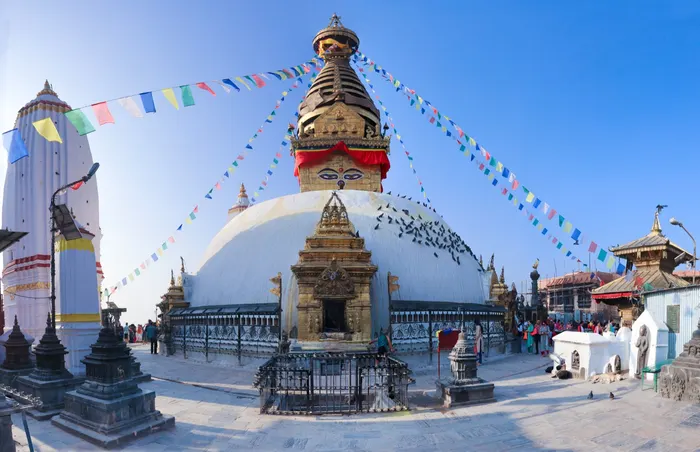
As the afternoon light begins to soften, you ascend to Swayambhunath Stupa, the Monkey Temple. Perched on a hilltop overlooking the entire valley, this ancient Buddhist complex is one of the oldest religious sites in Nepal, with origins dating to the 5th century. The iconic white dome, topped with a gilded spire bearing the all-seeing eyes of Buddha, is one of Nepal's most recognizable symbols. As you circumambulate the stupa clockwise, spinning brass prayer wheels and listening to the flutter of prayer flags, the panoramic view of Kathmandu below is breathtaking. The resident monkeys, considered sacred, add a lively energy to the serene atmosphere. Sunset from Swayambhunath is an experience that stays with you forever.
Day 2: The Sacred River and the Great Stupa - Pashupatinath and Boudhanath
The second day is dedicated to two of Nepal's most powerful spiritual sites, beginning with Pashupatinath Temple in the morning. Located on the banks of the holy Bagmati River, Pashupatinath is the most sacred Hindu shrine in Nepal and one of the most important Shiva temples in the world. The main temple, with its two-tiered golden roof and silver doors, is accessible only to Hindus, but the surrounding complex offers profound experiences for all visitors.
Walking along the riverbank, you will observe the open-air cremation ghats where Hindu funeral rites are performed. This is not a tourist attraction; it is a living tradition that has continued here for centuries, and witnessing it can be a transformative experience. The atmosphere is solemn yet not somber, a place where the cycle of life and death is accepted with a clarity that can be deeply affecting. Sadhus, or holy men, with ash-smeared bodies and matted hair, meditate near the temple gates. The air is thick with the scent of sandalwood, incense, and marigolds. Your guide will explain the symbolism of the temple's architecture, the significance of the Shiva lingam, and the rituals that take place throughout the day.
In the afternoon, you visit Boudhanath Stupa, one of the largest spherical stupas in the world and the spiritual heart of Nepal's Tibetan Buddhist community. The sheer scale of Boudhanath is awe-inspiring: a massive white dome rising over 36 meters high, crowned with a gilded spire and surrounded by a circular plaza lined with monasteries, shops, and rooftop cafes. The stupa was built in the 5th century and has been a pilgrimage site for Tibetan Buddhists ever since. After the Chinese invasion of Tibet in 1959, thousands of refugees settled around Boudhanath, and today over fifty Tibetan monasteries surround the stupa.
Join the stream of pilgrims, monks, and locals as they perform kora, the ritual circumambulation. The energy is palpable: prayer wheels spin, butter lamps flicker, and the deep, resonant sound of monks chanting drifts from nearby gompas. You may choose to light butter lamps, receive a blessing from a lama, or simply sit on the steps of a monastery and absorb the atmosphere. A rooftop cafe overlooking the stupa is the perfect spot for a cup of butter tea, offering an unforgettable view as the sun sets behind the golden spire. For more on Nepal's spiritual sites, explore our spiritual tour in Nepal guide.
Day 3: The Cities of Art and Devotion - Patan and Bhaktapur
Day three takes you to the two other royal cities of the Kathmandu Valley, each a UNESCO World Heritage Site and a masterpiece of Newari urban design. The morning begins in Patan, also known as Lalitpur, the City of Beauty. Patan Durbar Square is widely considered the finest collection of Newari architecture in Nepal. The ancient Royal Palace, with its golden gate and sunken royal bath, is a masterpiece of craftsmanship. The Krishna Mandir, built entirely of dark stone and carved with scenes from the great Hindu epics, is unique in Nepal. The square is surrounded by Buddhist courtyards known as bahals, reflecting the seamless integration of Hindu and Buddhist traditions that characterizes Newari culture.
Patan is also the center of Nepal's metalworking tradition. In the backstreets behind the square, you can watch artisans hammering copper and brass into statues of deities using techniques passed down through generations. The Patan Museum, housed in a beautifully restored palace wing, contains an extraordinary collection of Hindu and Buddhist art, including gilded bronze statues, thangka paintings, and ritual objects. Your guide will help you understand the iconography and the stories behind the art.
After lunch, you continue to Bhaktapur, the best-preserved medieval city in the Kathmandu Valley. Walking through Bhaktapur's brick-paved streets feels like stepping back in time. The entire city is a living museum, free from the traffic that chokes modern Kathmandu. Your exploration begins at Bhaktapur Durbar Square, dominated by the 55-Window Palace, a masterpiece of woodcarving. The Golden Gate, one of the most beautiful gates in the world, leads into the palace's inner courtyards. Nearby stands the statue of King Bhupatindra Malla atop a stone column, his hands folded in prayer.
From the Durbar Square, you walk to Taumadhi Square, home to the magnificent Nyatapola Temple. Rising five stories high, this is the tallest pagoda temple in Nepal, built in 1702 and so well-constructed that it survived the devastating 2015 earthquake with minimal damage. The temple's staircase is flanked by stone guardians of increasing power, and climbing to the top rewards you with a panoramic view of the square and the surrounding city. At Pottery Square, artisans shape clay on traditional wheels, and you can try your hand at the wheel yourself. And you must taste juju dhau, the king of yogurts, a creamy delicacy served in clay pots that has been made in Bhaktapur for generations.
Day 4: Morning Reflection and Departure
Your final morning in Kathmandu is flexible. Depending on your interests and flight schedule, you may choose to revisit a favorite site for a quieter, more personal experience, explore the vibrant streets of Thamel for last-minute souvenirs, or simply enjoy a leisurely breakfast at your hotel, reflecting on the journey. Your guide is available to accompany you or to recommend independent explorations. When the time comes, you are transferred to Tribhuvan International Airport for your departure. As your plane rises above the valley, you carry with you not just photographs and memories, but a genuine connection to a culture where the sacred is woven into the fabric of everyday life.
The Living Goddess Tradition: A Deeper Understanding
The Kumari tradition is one of the most fascinating and least understood aspects of Nepali culture. The Kumari is a prepubescent girl from the Shakya clan of the Newari community, chosen through a rigorous selection process that includes tests of courage, composure, and physical perfection. She must have 32 specific physical attributes, including a neck like a conch shell, a body like a banyan tree, and eyelashes like a cow. Once selected, she lives in the Kumari Ghar in Kathmandu Durbar Square, appearing at her window for devotees and during festivals. She is believed to be the incarnation of the goddess Taleju, and her blessing is sought by everyone from ordinary citizens to the President of Nepal. The Kumari retires when she reaches puberty, at which point a new Kumari is selected. This tour offers the rare opportunity to understand this tradition not as a curiosity but as a living expression of Nepal's unique spiritual culture.
What's Included in Your Package
- Airport pickup and drop-off by private vehicle
- 3 nights accommodation in a boutique hotel (twin-sharing basis) with daily breakfast
- Private, English-speaking cultural guide for all four days
- All ground transportation by private vehicle
- All entrance fees to UNESCO World Heritage Sites: Kathmandu Durbar Square, Swayambhunath, Pashupatinath, Boudhanath, Patan Durbar Square, and Bhaktapur Durbar Square
- All government taxes and service charges
The Spiritual Landscape of the Kathmandu Valley
The Kathmandu Valley is a sacred geography where every hill, river, and crossroads has spiritual significance. The valley was once a great lake, according to both geological evidence and Buddhist legend, and its emergence as a habitable plain is attributed to the bodhisattva Manjushri, who is said to have cut a gorge at Chobar with his sword, draining the waters. This mythological origin story infuses the valley with a sense of sacred purpose that is reflected in its countless temples, stupas, and shrines.
What makes the valley's spiritual landscape unique is the coexistence and intermingling of Hinduism and Buddhism. Unlike in many parts of the world where these traditions have been in conflict, in Nepal they have influenced and enriched each other for over two thousand years. The Newari people, the indigenous inhabitants of the valley, practice a syncretic form of religion that incorporates elements of both traditions. A single courtyard may contain a Hindu shrine and a Buddhist stupa. The Kumari, a Buddhist girl, is worshipped as a Hindu goddess. This tour helps you understand this unique religious synthesis, not as an academic concept but as a lived reality.
Best Time to Embark on This Journey
The Kathmandu Valley's cultural sites can be visited year-round, but the most comfortable seasons are spring (March to May) and autumn (September to November). During these months, temperatures are mild, skies are generally clear, and the valley is at its most beautiful. Spring brings blooming flowers and the festival of Holi, a joyous celebration of color. Autumn offers crystal-clear air and the major festivals of Dashain and Tihar, when the valley is alive with celebrations, lights, and rituals. Winter (December to February) is cooler but still pleasant for sightseeing, with fewer tourists and crisp, clear mornings. The monsoon season (June to August) brings rain, but also lush green landscapes and dramatic skies.
Cultural Etiquette and Practical Guidance
Respecting local customs is essential for a meaningful experience. When visiting Hindu temples, remove your shoes before entering and dress modestly, covering shoulders and knees. Leather items, including belts and bags, are not permitted inside some Hindu temples, particularly Pashupatinath. At Buddhist stupas, always walk clockwise around the monument. Photography is generally allowed at most sites, but always ask before photographing sadhus, monks, or cremation ceremonies. A small donation at monasteries and temples is appreciated. Your guide will brief you on specific protocols at each site, ensuring you navigate with confidence and respect.
Accommodation and Nepali Cuisine
You will stay in a carefully selected boutique hotel in the Thamel or Lazimpat area of Kathmandu, within walking distance of major attractions. Rooms are comfortable and well-appointed, with en-suite bathrooms, Wi-Fi, and breakfast included. Nepali cuisine is a highlight of the experience. You will have opportunities to sample dal bhat, the national dish of lentil soup, rice, and vegetable curry; momos, steamed or fried dumplings filled with meat or vegetables; Newari specialties like bara (lentil pancakes) and chatamari (rice crepes); and the famous juju dhau of Bhaktapur. Vegetarian options are abundant, reflecting the country's Hindu and Buddhist traditions.
Extending Your Nepal Journey
Four days in the Kathmandu Valley is a perfect foundation for a longer Nepal adventure. Popular extensions include a visit to Pokhara, with its lakeside tranquility and Annapurna mountain views; a journey to Lumbini, the birthplace of Lord Buddha; a wildlife safari in Chitwan National Park; or trekking in the Annapurna, Langtang, or Everest regions. Browse our Nepal tour packages for inspiration, or explore Kathmandu and Bhaktapur in more detail.
About Enticing Himalayas

Enticing Himalayas is a premier Nepal-based travel company dedicated to crafting transformative journeys through the Himalayas. Our philosophy, Explore, Heal, Thrive, guides every itinerary we design. We specialize in cultural tours, spiritual pilgrimages, trekking adventures, and wellness retreats that connect travelers with Nepal's rich heritage and breathtaking landscapes.
Our Services
- Cultural and heritage tours across Nepal
- Spiritual pilgrimages to sacred Hindu and Buddhist sites
- Trekking and hiking adventures in the Annapurna, Everest, and Langtang regions
- Wellness retreats, yoga, and meditation programs
- Customized private tours and group travel
- Helicopter tours and mountain flights
- Jungle safaris in Chitwan and Bardia National Parks
- Airport transfers, hotel bookings, and travel logistics
Our Accreditations


About the Author
This itinerary was crafted by the Enticing Himalayas team, a group of Nepal-based travel professionals with decades of combined experience guiding visitors through the cultural and spiritual heart of the Kathmandu Valley. Our guides are licensed by the Nepal Tourism Board and trained in the history, religion, and cultural traditions of every site on this itinerary. We are passionate about sharing the authentic Nepal with travelers from around the world.
Why Trust Enticing Himalayas
We are a registered travel and trekking company in Nepal, licensed by the Nepal Tourism Board and the Government of Nepal. Our team has over fifteen years of experience organizing cultural tours, treks, and pilgrimages across the country. We maintain direct relationships with local communities, monasteries, and heritage sites, ensuring authentic and respectful experiences. Every itinerary is personally vetted by our senior guides, and we maintain a 24/7 support line for all our guests. Your safety, comfort, and spiritual enrichment are our highest priorities.
Frequently Asked Questions
What makes the living goddess Kumari tradition unique to Nepal?
The Kumari is a prepubescent girl chosen through an ancient selection process and worshipped as a living incarnation of the goddess Taleju. She resides in the Kumari Ghar in Kathmandu Durbar Square and is revered by both Hindus and Buddhists. This tradition, unique to the Kathmandu Valley, represents the living intersection of Nepal's spiritual and cultural heritage.
How physically demanding is this 4-day cultural tour?
This is a cultural tour with minimal physical demands. You will walk through temple complexes and medieval city squares, and climb approximately 365 steps to Swayambhunath. The pace is relaxed, with plenty of time for rest and reflection. Comfortable walking shoes are recommended, but no special fitness level is required.
Can I take photographs inside the temples and at the cremation ghats?
Photography is generally permitted at most sites, including the exteriors of temples and stupas. However, photography is restricted inside some Hindu temples and at the Pashupatinath cremation ghats, where discretion is essential. Always ask your guide before photographing sadhus, monks, or ceremonies. Respectful observation is always appropriate.
What is the best time of year for this tour?
Spring (March to May) and autumn (September to November) offer the most pleasant weather, with mild temperatures and clear skies. These seasons also coincide with major festivals like Holi, Dashain, and Tihar, adding cultural richness to your experience. Winter is quieter with crisp days, while monsoon brings lush green landscapes.
Is this tour suitable for families with children?
Yes, this tour is family-friendly. The pace is relaxed, and children are often fascinated by the living goddess, the monkeys at Swayambhunath, and the pottery-making in Bhaktapur. The private guide format allows the itinerary to be adapted to your family's needs. Note that the cremation ghats at Pashupatinath may not be suitable for very young children.
Can this tour be combined with trekking or other Nepal destinations?
Absolutely. This 4-day tour is an excellent foundation that can be extended with visits to Pokhara, Lumbini, Chitwan National Park, or trekking in the Annapurna, Langtang, or Everest regions. Contact our team with your interests, and we will design a personalized itinerary that combines cultural immersion with adventure.