When is Janai Purnima in 2026?
Janai Purnima 2026 falls on Friday, 28 August 2026. According to the Nepali calendar, the festival is observed on Bhadra 12, 2083 BS, coinciding with the full moon (Purnima). The date shifts each year because the festival follows the lunar cycle, which is why an annually updated guide matters if you are planning a trip around it.
Janai Purnima is not a single ritual but a cluster of sacred observances that share the same auspicious full-moon day. On 28 August 2026, Nepal also marks Raksha Bandhan, Kwati Khane Din (the day of eating sprouted-bean soup), Rishi Tarpani (offerings to the seven sages), Poornima Vrata (full-moon fasting), and Sanskrit Diwas, the day celebrating the Sanskrit language. If you visit Nepal in late August 2026, you will see temples busier than usual along the Bagmati riverbanks, lines of pilgrims queuing for priest blessings, and nearly every Hindu household preparing for a thread-changing ceremony at home or at a temple.
For travelers, this timing lands inside the monsoon season, which brings its own rewards: intensely green hillsides, dramatic skies over the valley rim, and thinner crowds on popular trekking routes. The trade-off is rain and muddy trails, which we cover in the travel tips section below.
What is Janai Purnima?
Janai Purnima is one of Nepal's most important Hindu festivals, observed primarily by Brahmin and Chhetri communities and, increasingly, by Hindus across the country. The word Janai refers to the sacred thread worn diagonally across the chest by men who have undergone the Bratabandha (Upanayana) ceremony, and Purnima means full moon. The name literally means "the full moon of the sacred thread."
On this day, men who have completed their Bratabandha bathe in a holy river or spring before sunrise, sit through a Vedic fire ritual with a priest, and change last year's worn Janai for a freshly consecrated one. The new thread is looped over the left shoulder and under the right arm, a physical symbol of purity, spiritual responsibility, discipline, and a lifelong commitment to dharma (righteous duty).
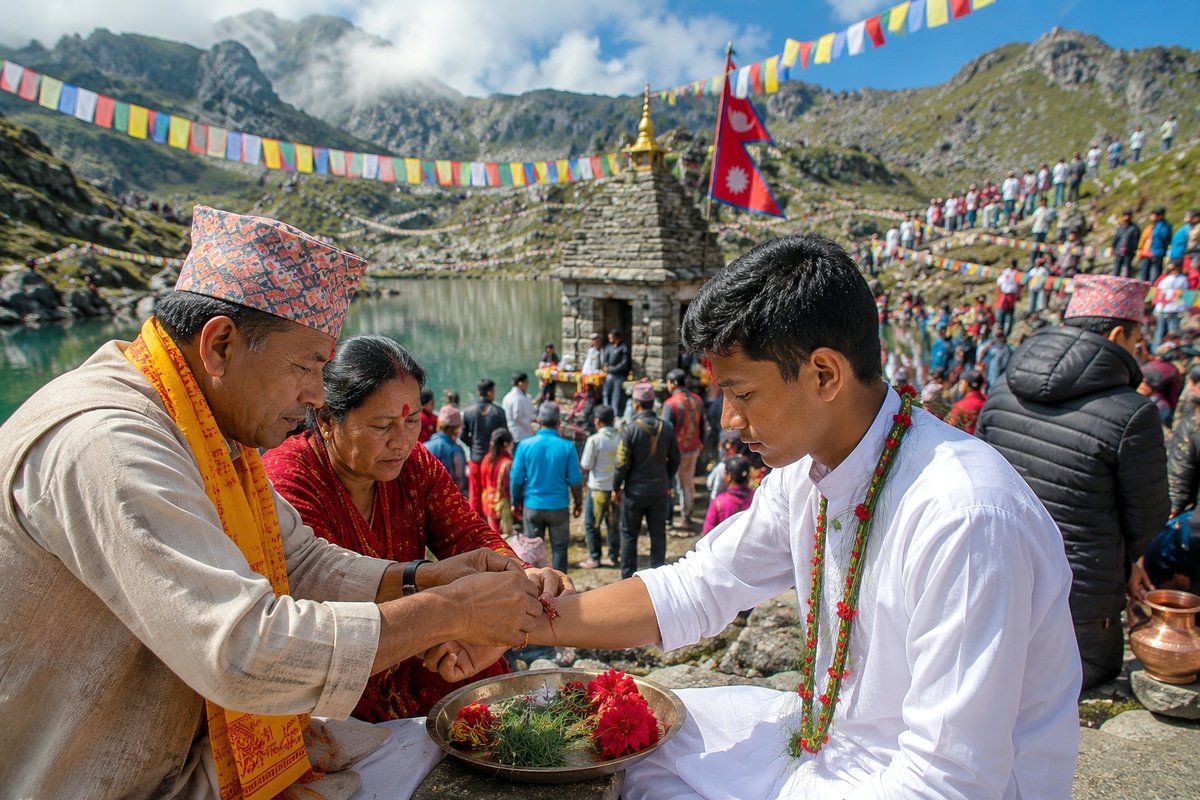
At the same time, priests tie a sacred protection cord called the Raksha Bandhan or Doro around the wrists of everyone who comes for a blessing, men, women and children alike, regardless of caste. This cord, usually made of colored cotton and knotted while Vedic mantras are chanted, is believed to protect the wearer from harm. Many Nepalis wear the Doro for several weeks before respectfully immersing it in a river on Kushe Aunsi (Father's Day, usually in late August or September).
The festival also coincides with Raksha Bandhan in India, where sisters tie a similar thread (a rakhi) around their brothers' wrists as a symbol of protection. In Nepal the two traditions overlap: families visit each other, sweets are exchanged, and sisters who are far from home send rakhis by post to their brothers.
The Spiritual Significance
Understanding the symbolism behind Janai Purnima turns a busy temple visit into something much richer. The festival brings together several strands of Hindu philosophy in a single day.
The Upanayana ceremony
Upanayana, known in Nepal as Bratabandha, is the traditional initiation ceremony during which a young boy receives his first Janai. It marks his formal entry into spiritual education and disciplined life. Without Upanayana, a man does not wear the Janai, so Janai Purnima is effectively an annual renewal of that original vow. The festival therefore celebrates not just the thread itself but the continuity of a spiritual lineage stretching back thousands of years.
The Gayatri Mantra
During Bratabandha, the initiate is whispered the Gayatri Mantra by his guru or father. This short Vedic verse, addressed to the divine light of the sun, becomes the private daily prayer of every thread-wearer. On Janai Purnima, priests chant the Gayatri Mantra aloud during the thread-changing ritual as a reminder of that first transmission.
The sacred thread itself
The Janai is not a simple loop of cotton. A traditional Brahmin Janai has six strands (three pairs of three) twisted from consecrated thread, with a knot at the centre called the Brahma-granthi, the knot of the creator. Each triplet of strands represents a set of triple obligations: to the gods (deva rin), to the ancestors (pitri rin), and to the teachers (rishi rin). Wearing it is a daily reminder that life is sustained by forces larger than oneself, and that those debts are repaid through duty, prayer and good action.
Offerings to the Seven Sages
One of the lesser-known rituals of the day is Rishi Tarpani, an offering of gratitude to the Sapta Rishis, the seven great sages of the Vedic tradition (Atri, Bharadwaja, Gautama, Jamadagni, Kashyapa, Vashistha and Vishvamitra). Water, sesame, kusha grass and flowers are offered into a river or ritual vessel while their names are recited. Many travelers miss this quieter morning ritual entirely, yet it explains why so many devotees cluster at riverbanks before the sun rises over the valley.
Protection, karma and purification
The Raksha Bandhan cord tied on the wrist is the day's most democratic ritual. No initiation is needed. The Doro is believed to guard the wearer against illness, misfortune and negative energy. In Nepali folk tradition the thread soaks up harm and is later released into flowing water, which is why immersion on Kushe Aunsi completes the cycle: the year's symbolic protection is returned to the river, and a fresh thread will be tied the following Janai Purnima.
Major Rituals of Janai Purnima
Changing the Janai
The core ceremony usually takes place in the morning at temples, river ghats, or at home with a family priest. Devotees bathe in holy water before sunrise, sit on mats of kusha grass, and listen as the priest chants purification mantras over a fire. The old Janai is removed and laid respectfully aside (it is later burned or placed under a sacred tree, never discarded casually). The new thread, blessed during the ritual, is then slipped over the shoulder and under the right arm while the devotee joins his palms in prayer. For outside observers, the ceremony is visually humble but spiritually significant: a whole year's worth of blessing compressed into one knot of cotton.
Raksha Bandhan and the Doro cord
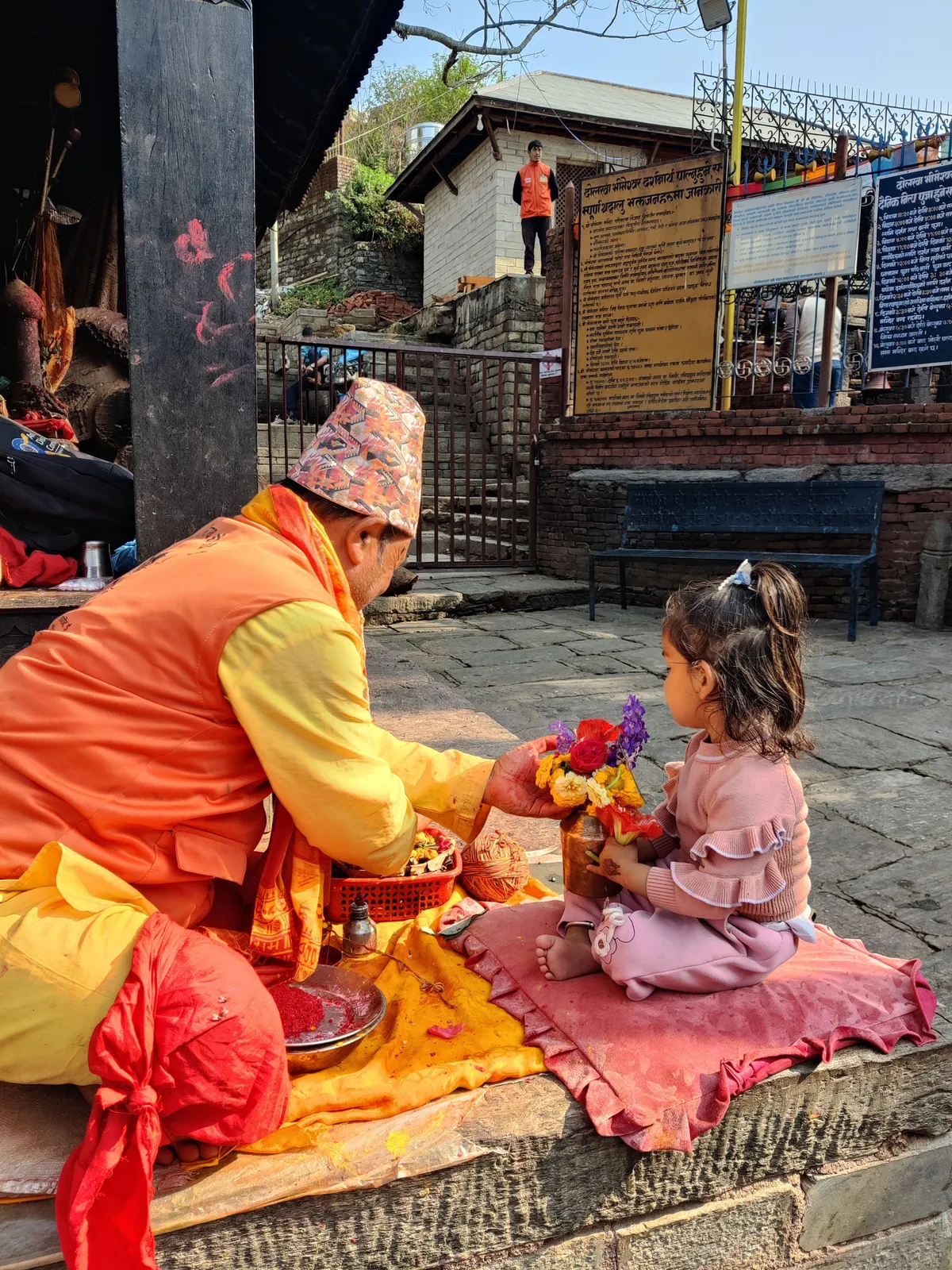
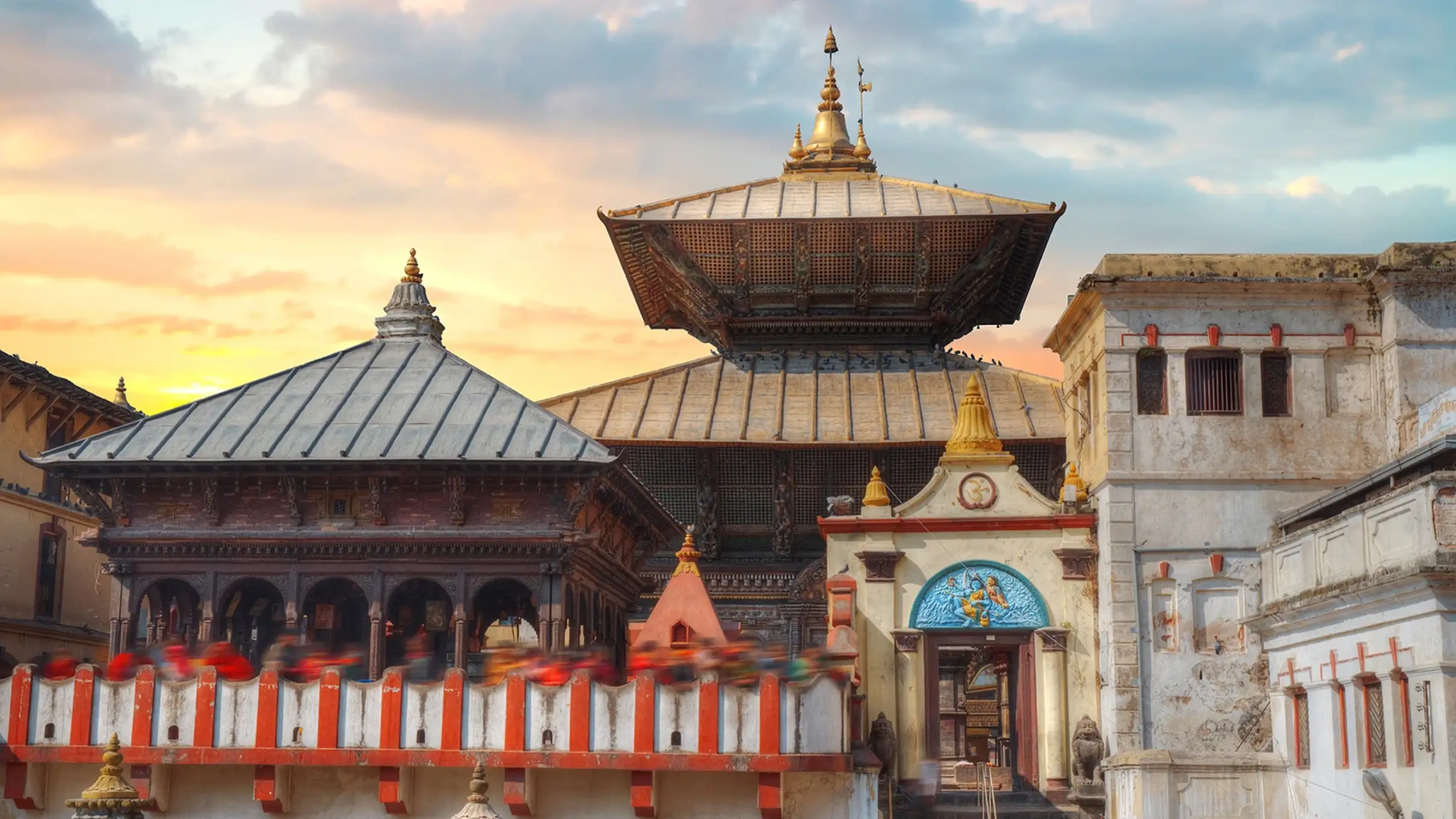
Priests then move among the gathered devotees, tying a colored-cotton Doro onto each outstretched wrist. In Kathmandu the pace at Pashupatinath and Kumbeshwar can feel almost industrial: hundreds of wrists extended, dozens of priests working their way through the crowd. At smaller temples the ritual is more personal, often accompanied by a dab of tika (red rice paste) and a blessing for the year ahead. In Nepali homes, sisters also tie rakhis to their brothers, continuing the pan-Hindu tradition of sibling protection.
Rishi Tarpani
Earlier in the morning, usually just after the holy bath, devotees offer water mixed with black sesame seeds, kusha grass and flower petals to the Seven Sages. The offering is poured into flowing water while the names of the rishis are recited. Rishi Tarpani is one of the reasons devotees queue at rivers like the Bagmati at Pashupatinath and the ponds of Kumbeshwar before dawn even breaks.
The holy bath
Bathing in sacred water on Janai Purnima is believed to wash away accumulated sin and prepare the body for the new thread. In cities, this happens at river banks and temple ponds (the five sacred taps at Kumbeshwar are famous for it). In the mountains, thousands of pilgrims walk to alpine lakes, above all Gosaikunda, to immerse themselves in water so cold it takes your breath away. The chilly bath is part of the ritual: it strips away comfort long enough for the mind to focus on prayer.
Poornima fasting and the full moon
Because the festival falls on a full moon, many Hindus also keep a Poornima Vrata, a day-long fast broken only after moonrise with a simple meal of milk, fruits and sweets. The full moon is considered the most auspicious night of the month for prayer and meditation. If you are at a temple on the evening of 28 August 2026, look for families sitting together under the moonlight finishing their fast with puja lamps flickering beside them.
Kwati Khane Din: the nine-bean soup
The day's most delicious ritual is Kwati Khane Din, the day of eating Kwati, a hot spiced soup made from nine sprouted beans. Families soak nine varieties of beans and grains (black gram, green gram, field peas, garden peas, cowpea, soybeans, lentils, chickpeas and rice bean) a few days in advance so that they sprout by festival day. The sprouting process massively increases their protein and nutrient content, which is exactly what farm families need as they wade through monsoon rice-paddy season. The beans are slow-cooked with turmeric, cumin, garlic and a final tempering of spices fried in clarified butter. Every household in the Kathmandu Valley has their own version, and sharing a bowl of steaming Kwati is one of the friendliest ways to be welcomed into a Nepali home on Janai Purnima.
Best Places to Experience Janai Purnima in Nepal
You can watch thread-changing ceremonies at almost any Hindu temple in the country, but three places stand out for the scale, beauty and depth of their celebrations.
Gosaikunda Lake, Langtang
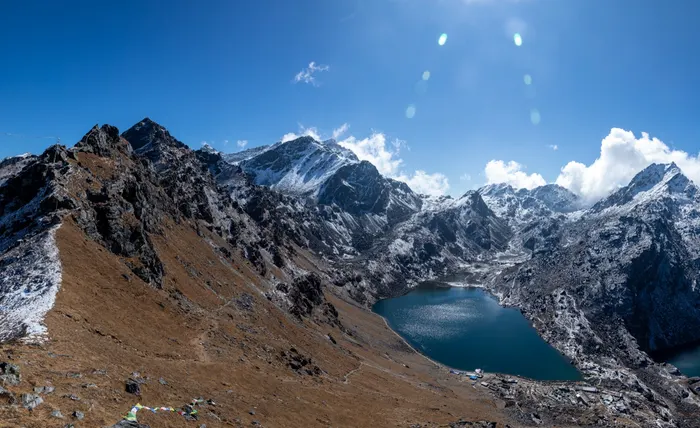
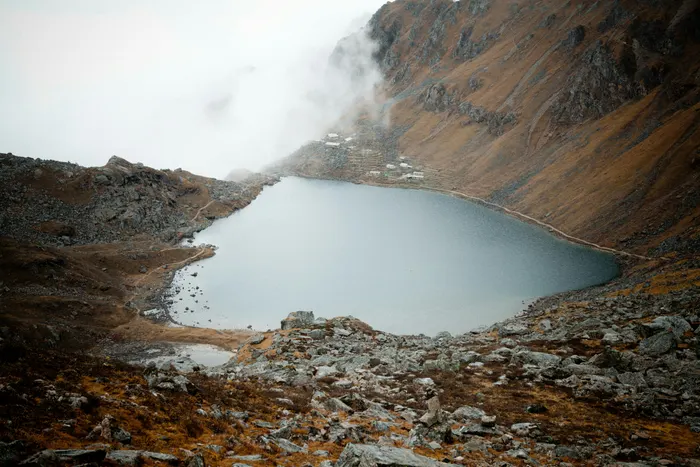
The most famous Janai Purnima pilgrimage in Nepal is the long walk to Gosaikunda Lake at 4,380 m in Langtang National Park. According to Hindu legend, the lake was created by Lord Shiva when he thrust his trident into a mountain to draw water and cool his burning throat after swallowing poison. Every August, thousands of pilgrims trek the ridgelines of Rasuwa district to reach the lake for the full moon, filling Dhunche, Chandanbari and Lauribina with porters, priests and sadhus carrying tridents and conch shells.

For international travelers, the Janai Purnima pilgrimage is one of the few times you can join a living Himalayan pilgrimage rather than simply observing one. Our 5-day Gosaikunda Lake Trek and longer 10-day Langtang Valley and Gosaikunda trek are both timed so you can attend the lake fair on 28 August, join the ritual bath at dawn, and watch thousands of colored Doro cords flutter on the lakeshore shrines. If you prefer a more contemplative frame, our Gosaikunda Sacred Lakes Trek & Yoga Retreat combines the pilgrimage route with guided meditation at the lakeshore.
Pashupatinath Temple, Kathmandu
South of the ring road, Kathmandu's holiest Shiva temple becomes a sea of pilgrims on Janai Purnima. By mid-morning, the bridges over the Bagmati and the ghats below the main temple are packed shoulder to shoulder. Priests set up platforms along the eastern bank, chanting over small ritual fires while worshippers queue with their families to have new threads blessed. Photographers should arrive before 8 am, when the smoke from the fires coils through the temple spires and the light just clears the tree line.
Our Kathmandu Spiritual Circuit pairs Pashupatinath's thread ceremonies with evening Boudhanath kora and sunrise at Swayambhunath, so you experience the festival's full arc from ritual morning to moonlit stupa prayers.
Kumbeshwar Temple, Patan
In Patan's southern quarter, Kumbeshwar Temple is one of only two five-storey traditional pagoda temples in Nepal and sits above a sacred pond fed by natural springs. On Janai Purnima day, thousands of pilgrims climb the steps to bathe at Kumbeshwar's stone taps, then line the temple courtyard for Janai blessings from local priests. The Patan fair feels more intimate than Kathmandu: families bring picnic lunches, boys in fresh daura-suruwal outfits join their grandfathers on the temple steps, and Newari brass vendors set out ceremonial oil lamps around the courtyard. If you only have one day in the valley, pair Patan's morning rituals with an evening walk through Patan Durbar Square.
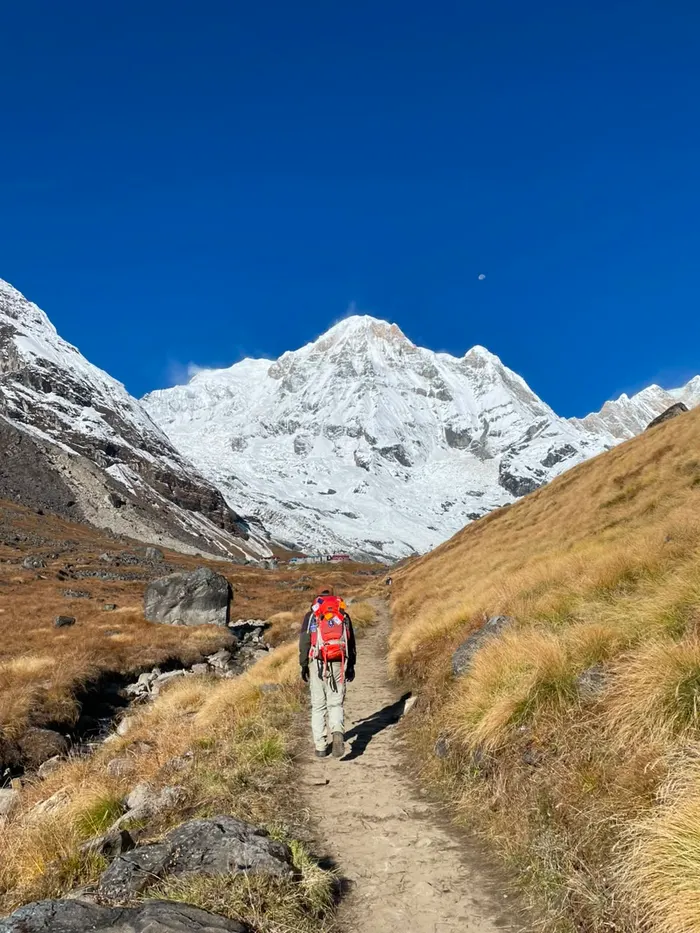
For a broader overview of how festivals like Janai Purnima fit into Nepal's wider sacred landscape, our complete guide to cultural and spiritual tours in Nepal maps the major heritage circuits, pilgrimage routes and festival calendar by season. If you are combining Janai Purnima with trekking, the best trekking agency in Nepal guide explains how to choose a licensed operator and what questions to ask before you book.


Why Travelers Love Janai Purnima
Beyond the spectacle, Janai Purnima gives travelers something most festival tourism cannot: a window into ceremony that is still practiced for its original reason, not for an audience. The festival is not a performance staged for visitors. Thousands of priests, families and pilgrims gather because they genuinely believe in the thread's power. Visitors who arrive with humility are welcomed, sometimes invited into homes for a bowl of Kwati or a Doro blessing.
- Authentic local culture at its least commercialized. Unlike heavily promoted festivals, Janai Purnima remains centered on prayer rather than shopping stalls.
- Temple photography that rivals any Himalayan view: smoke, saffron robes, five-storey towers, and thousands of waving prayer-threads.
- Pilgrimage walking up to Gosaikunda, one of the few times each year that trail is crowded with believers rather than trekkers.
- Traditional Newari food, especially Kwati soup, sel roti, jerri sweets, and fresh curd sold by vendors outside Kumbeshwar.
- Family celebration that spills out of temples into neighborhoods, letting visitors sit beside old women stringing marigold garlands and teenagers comparing new Doro threads.
- A palpable spiritual atmosphere that even secular travelers describe as the closest they have come to watching living religion in motion.
Local Foods to Try on Janai Purnima
Kwati
The festival's signature dish, Kwati, is a hearty nine-bean soup that comes alive during the festival. Families prepare it in huge copper vats and send thermos flasks to relatives working in fields. Most Newari eateries in the Kathmandu Valley serve a small bowl of Kwati for free or at a token price during the festival week. The taste is earthy, slightly spicy, and deeply comforting.
Sel Roti
The ring-shaped, lightly sweet rice-flour bread is a year-round Nepali staple, but on Janai Purnima street vendors fry it in fresh ghee so large home kitchens can focus on the ceremonial dishes. Best eaten hot out of the oil with a spoon of achar.
Fruit and yoghurt offerings
At temples, devotees offer seasonal fruit and bowls of sweetened buffalo-milk curd (dahi). Vendors sell small clay cups of curd near every major shrine. Try the juju dhau (King of Curds) variety if you see the clay pots lined up near Patan's Durbar Square.
Festival sweets
Newari confectioners pile trays of jerri (deep-fried loops of fermented batter dipped in syrup), laddu (round chickpea-flour balls), and lakhamari (a dense ceremonial sweet). Small packets of these make the best festival-souvenir.
Travel Tips & Weather for Janai Purnima 2026
Dress modestly
Temples require covered shoulders and knees for both men and women. Loose long-sleeved shirts and trousers or long skirts are appropriate. Carry a light shawl during the evening arati when temperatures drop and the breeze picks up.
Remove shoes before entering inner sanctums
At Pashupatinath and most other major temples, non-Hindus may observe from outside the inner sanctum. Always remove footwear before crossing any threshold marked by a stepping-stone or inner door.
Ask before photographing rituals
Priests are accustomed to cameras, but always ask permission before photographing individuals, especially pilgrims bathing or receiving blessings. A nod and a smile goes further than a long lens. Avoid photographing cremation ceremonies at Pashupatinath ghats out of respect.
Carry rain protection
Late August is still monsoon season. Expect 18 to 28°C during the day, with afternoon thunderstorms that usually clear by evening. Pack a lightweight rain jacket, a dry bag for electronics, and quick-dry shoes with grip. Trails up to Gosaikunda will be muddy in places.
Book Gosaikunda accommodation far in advance
Teahouses along the Gosaikunda route fill up completely for the festival week. The same applies to the handful of lodges in Dhunche and Syabru Besi. If you want to be at the lake for the full moon on 28 August, finalise your trek arrangements by June 2026 at the latest. Our Gosaikunda trek team reserves rooms months in advance for festival departures.
Weather summary
Daytime highs in Kathmandu range between 25 and 28°C, nights 17 to 19°C. Afternoon showers are reliable, but mornings are usually clear and perfect for temple visits. The mountains at Gosaikunda are colder at 5 to 12°C by day and near freezing at night, so a proper sleeping bag and a down jacket are essential even though the cities are steamy.
Suggested 5-Day Janai Purnima Itinerary
The festival rewards slow travel. This paced plan lets you soak in the full arc of the celebration, from valley rituals to alpine pilgrimage.
Day 1: Pashupatinath & evening arati
Warm up with a morning visit to Kathmandu's Pashupatinath temple complex. Spend time on the east bank ghats, watching ritual bathing and the steady queue of devotees receiving blessings. In the late afternoon, walk over to Boudhanath stupa to see thousands of butter lamps lit as the full moon rises. End the day at the evening arati along the Bagmati river, where hundreds of oil lamps are floated downstream.
Day 2: Patan & Kumbeshwar
Early in the morning, head south on the UNESCO Wonders route to Patan Durbar Square. Spend the morning exploring the square and the Golden Temple, then climb the steps to Kumbeshwar temple for the festival-bathing crowd. Share a bowl of Kwati with a Newari family in a traditional baha courtyard before walking the market streets of Mangal Bazar. In the afternoon, drive back toward Kathmandu and pass by Swayambhunath on the hilltop for sunset views over the city.
Day 3: Drive to Dhunche, start the Gosaikunda trek
After an early breakfast, drive north on rough mountain roads to Dhunche, the gateway to Gosaikunda and the headquarters of Langtang National Park. From Dhunche, the trail climbs through rhododendron forests to Deurali or Chandanbari, where millions of wildflowers bloom in monsoon season. Spend the first night in a teahouse and listen to the sound of rain on the tin roof.
Day 4: Lauribina and acclimatisation
Continue the steady climb past Chandanbari up over the Lauribina ridge at 3,920 m. The trail here is steep and the altitude begins to bite, so take it slowly and drink plenty of water. From the ridge you will see prayer flags snapping in the wind and, on a clear day, the Annapurnas and Langtang Lirung on the horizon. Overnight at a lodge near Lauribina or lower down.
Day 5: Janai Purnima at Gosaikunda Lake
Wake before dawn and walk the final two hours up to Gosaikunda Lake. Arrive as the first light touches the water and as thousands of pilgrims are beginning their ritual bath. Take photographs from the northern shore, where painted Shiva shrines sit beside the glacial stream. Join the bathers if you dare, the water is heart-poundingly cold, and then sit on a rock to thaw while priests distribute new Doro cords. Stay overnight at the lakeside lodge, or descend to Lauribina before driving back to Kathmandu the next morning.
Responsible Tourism at Sacred Festivals
Janai Purnima's popularity among pilgrims carries an environmental and cultural cost. Plastic bottles, thread-snippings and food wrappers pile up around Gosaikunda every August. As a visitor, you can make the festival better by traveling lightly and respectfully.
- Respect local customs. Walk clockwise around holy objects, do not touch ritual items, and step aside when priests pass with offerings.
- Avoid single-use plastic. Bring a refillable bottle and refill at teahouses. Choose local snacks served in sal-leaf plates over packaged imports.
- Support local communities. Eat in the small family eateries around Pashupatinath and Patan rather than in chain restaurants. Buy from the temple-side vendors who depend on festival income.
- Hire licensed guides. Local cultural guides can translate rituals, explain symbolism, and ensure you do not accidentally violate temple rules.
- Dress respectfully. The festival is a religious observance, not a photo gallery. Quiet behavior and modest dress go a long way.
- Leave no trace on the trail. If you trek to Gosaikunda, pack out all wrappers and batteries. Lake water is sacred: do not wash with soap directly in it.
Plan Your Janai Purnima Trip with Enticing Himalayas
Experiencing Janai Purnima meaningfully takes more than showing up on the day. It requires timing the full moon correctly, knowing which temples open when, arranging teahouses that fill months in advance, and having a local guide who can read the symbolic language of the rituals. That planning is exactly what our team has been doing for over a decade.
We build customized festival tours around Janai Purnima 2026 that combine temple visits, heritage walks through Patan's hidden courtyards, and optional Gosaikunda pilgrimage trekking. Every itinerary is paced so you attend each ceremony at its most vivid hour, from the pre-dawn Rishi Tarpani at riverbanks to the moonlit arati at Pashupatinath. Browse our Sacred Kathmandu Heritage Tour, 7 UNESCO Wonders route, and the Gosaikunda pilgrimage trek to see the formats. Then tell us your dates and we will tailor the route around the full moon.
Janai Purnima only happens once a year, on one sacred full-moon night. Make yours one you will remember for the rest of your life.

Explore. Heal. Thrive.
About Enticing Himalayas
We are a locally owned travel company based in Kathmandu, Nepal, specializing in authentic cultural, spiritual and trekking experiences across the Himalayas. For over a decade, our licensed local guides have led international travelers through Nepal's living festivals, sacred pilgrimage trails, and hidden heritage courtyards.
Our services:
- Customized festival and cultural tours
- Sacred pilgrimage treks (Gosaikunda, Muktinath, Langtang)
- UNESCO World Heritage site experiences
- Trekking and climbing expeditions
- Wellness, yoga and spiritual retreats
- Private and small-group itineraries
Accredited & Licensed


About the author
The Enticing Himalayas Content Team crafts guides drawn from decades of combined local experience in Kathmandu, Pokhara, and the high Himalayas. Our writers and guides attend Janai Purnima ceremonies every year, walk the Gosaikunda pilgrimage routes each monsoon, and live in the neighbourhoods of the temples we describe.
Why trust Enticing Himalayas
Every itinerary we publish is built on real, current experience. We do not recycle scraped content or generic travel blurbs: our team physically visits the temples, treks the routes, and tastes the festive food described in this guide. Our recommendations are backed by Nepal Tourism Board accreditation and a commitment to responsible travel that benefits local communities directly.