Loading...
2 days
1 Option Available
Kathmandu Spiritual Circuit: Sacred Temples & Stupas
Country
Nepal
Duration
2 days
Best season
Spring / Summer / Autumn / Winter
Group size
Flexible group size
Difficulty
easy
4.9(8 reviews)
Kathmandu Valley
Tour Description
The Sacred Heart of the Kathmandu Valley
The Kathmandu Valley is not merely Nepal's political capital. It is one of the densest concentrations of sacred architecture and living religious tradition anywhere on earth. Within a radius of roughly 15 kilometres, you will find three UNESCO World Heritage Sites that between them represent more than two millennia of Hindu and Buddhist devotion: Pashupatinath, the holiest Shiva temple in Nepal; Boudhanath, the largest stupa in South Asia and the spiritual heart of Tibetan Buddhism in exile; and Swayambhunath, the self-arisen hilltop shrine whose white dome and golden spire have watched over the valley since at least the fifth century. This two-day private circuit connects all three in a sequence that respects both geography and the natural rhythm of worship, so that you arrive at each site at the time of day when it is most alive.
What makes this tour different from a rushed sightseeing checklist is the pacing. Two full days, with a private vehicle and an expert cultural guide, give you the space to sit, observe, and absorb rather than snap a photograph and move on. You will witness the evening aarti on the banks of the Bagmati River as oil lamps are offered to the setting sun and the chanting of Vedic hymns fills the air. You will walk the kora of Boudhanath at dawn, joining Tibetan pilgrims who have been circumambulating this stupa for centuries. And you will climb the 365 stone steps to Swayambhunath in the golden light of late afternoon, when the valley spreads out beneath you like a living map. This is not a tour about checking boxes. It is an invitation to step into Nepal's spiritual current, even if only for two days.
Why This Circuit Matters
Nepal sits at the crossroads of Hinduism and Buddhism, and nowhere is that convergence more visible than in the Kathmandu Valley. For centuries, Newar artisans, Tibetan lamas, Indian sadhus, and Himalayan traders have all left their mark on these sacred sites. Pashupatinath draws Shaivite devotees from across the subcontinent. Boudhanath is the most important Tibetan Buddhist monument outside Tibet itself. Swayambhunath predates the arrival of both organised Hinduism and Buddhism in the valley and is revered by both traditions. To visit all three in a single journey is to grasp something essential about Nepal: that its spiritual identity is not a single thread but a rich tapestry, woven from many strands and still being woven today.
For travellers with limited time, this circuit is the most efficient way to encounter that tapestry. It is also the most meaningful. Rather than scattering your attention across a dozen minor temples, you focus on three sites of genuine world significance, each explored at a pace that allows for quiet reflection. Our complete guide to cultural and spiritual tours in Nepal explains why this focused approach yields a far richer experience than a hurried multi-stop itinerary. You leave with more than photographs. You leave with a felt sense of what these places mean to the people who pray there every day.
Day One: Pashupatinath and the Evening Aarti
Arrival at the Temple Complex
Your guide will meet you at your hotel in the early afternoon and drive you east to the banks of the Bagmati River, where the Pashupatinath temple complex sprawls across both sides of the water. The main temple, a two-tiered pagoda with a gilded roof and silver-plated doors, dates to the fifth century, though the site itself is far older. The jyotirlinga inside, a black stone Shiva lingam with four faces, is one of the most venerated in the Shaivite world. Non-Hindus may not enter the inner sanctum, but the real experience of Pashupatinath unfolds outside, along the riverbank and among the subsidiary shrines, ashrams, and cremation ghats that line the Bagmati.
The Ghats and the Cycle of Life
Walking along the eastern bank, you will pass the cremation platforms where funeral pyres burn throughout the day. This is not a morbid spectacle. In Hindu cosmology, death at Pashupatinath and cremation on the Bagmati's banks is considered especially auspicious, a release from the cycle of rebirth. Your guide will explain the rituals: the eldest son shaving his head and wearing white, the circumambulation of the pyre, the lighting of the flame. Watching this with a knowledgeable interpreter transforms what might feel voyeuristic into a profound encounter with one of the world's oldest continuous death rituals. It is a reminder that Pashupatinath is not a museum piece. It is a working temple where the full arc of human life, from birth to death, plays out every day.
The Evening Aarti
As dusk approaches, the focus shifts to the riverbank opposite the main temple, where priests prepare for the evening aarti. This ceremony, performed every evening without fail, is one of the most visually arresting rituals in South Asia. Three priests stand on a raised platform, each holding a large brass lamp with multiple wicks soaked in ghee. As the sun sets behind the temple spires, they begin a synchronised sequence of movements: the lamps are raised, circled, and lowered in offering to the river, to the temple, and to the four directions. The air fills with the sound of bells, conch shells, and the rhythmic chanting of Sanskrit hymns. The crowd, a mix of pilgrims, sadhus, and visitors, falls silent. For roughly forty-five minutes, the only light comes from the flames and the only sound from the prayers. It is, quite simply, unforgettable.
After the aarti, your driver will return you to your hotel. The evening is yours to reflect on what you have witnessed. Many travellers find that the aarti lingers in the mind long after the flames have been extinguished.
Day Two: Boudhanath at Dawn and Swayambhunath at Sunset
Morning Kora at Boudhanath
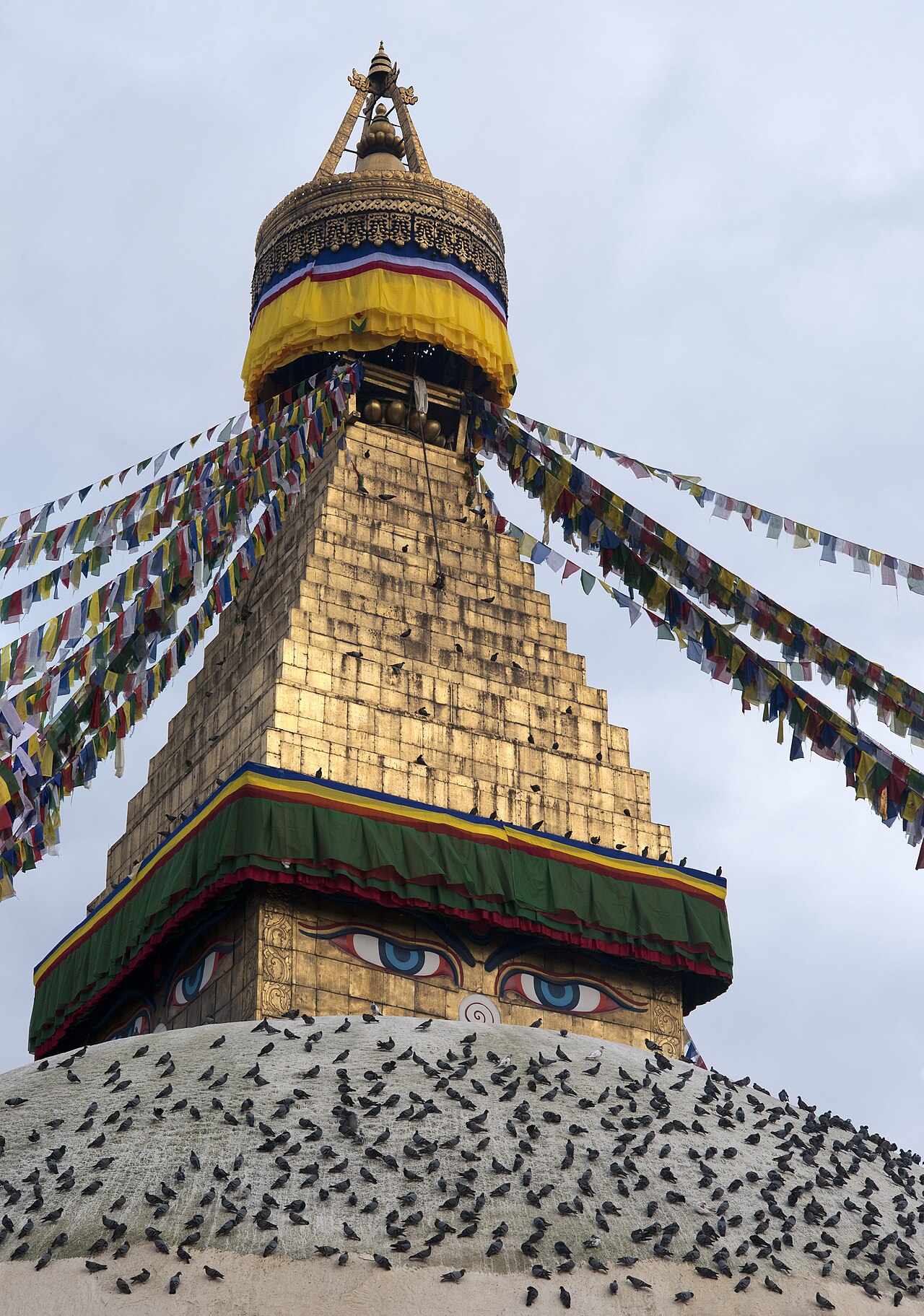
An early start brings you to Boudhanath as the first light touches the stupa's golden spire. At this hour, before the souvenir shops open and the tour buses arrive, Boudhanath belongs to the faithful. Tibetan monks in maroon robes walk the kora, the ritual circumambulation path that circles the stupa, turning prayer wheels and murmuring Om Mani Padme Hum. Elderly Tibetan women prostrate themselves on wooden boards, rising and falling in a rhythm that has not changed in a thousand years. The air smells of juniper incense and butter lamps. The 36-metre-high stupa, with its all-seeing eyes of the Buddha painted on all four sides of the golden harmika, seems to float above the morning mist.
Your guide will lead you on a full circuit of the kora, explaining the stupa's symbolism as you walk. The white dome represents the earth; the square harmika above it, the four noble truths; the spire, the thirteen stages of enlightenment; the umbrella at the top, the void. Every element of the structure encodes a teaching. You will also visit one of the surrounding gompa (monasteries), where you may be invited to sit quietly and observe morning prayers. The sound of deep-throated Tibetan chanting, accompanied by horns and cymbals, is a sonic experience as powerful as any visual one. After the kora, there is time for a rooftop breakfast at one of the cafes overlooking the stupa. The view from above, with the stupa framed by the Himalayan foothills, is one of the finest in the valley.
Midday: The Tibetan Refugee Community
Boudhanath is not only a monument. It is the centre of a living Tibetan community, home to thousands of refugees and their descendants who have made the Kathmandu Valley their home since the 1950s. Your guide can take you through the narrow lanes behind the stupa, where you will find thangka painting schools, butter-lamp workshops, and monasteries that train young monks in the traditional curriculum of Buddhist philosophy and debate. If you are interested, we can arrange a short visit to a thangka studio, where you can watch an artist at work and learn how these intricate devotional paintings are made, from the preparation of the cotton canvas to the application of mineral pigments and gold leaf. This is not a shopping stop. It is a window into a culture that has preserved its artistic traditions against considerable odds.
Afternoon: Swayambhunath, the Monkey Temple
In the late afternoon, your driver takes you west to the base of the hill that Swayambhunath crowns. The 365 stone steps that lead to the top are a pilgrimage in themselves, one for each day of the year. As you climb, you will be joined by the temple's most famous residents: troops of rhesus macaques who have lived on this hill for as long as anyone can remember. They are the reason for the site's popular name, the Monkey Temple, though the real story of Swayambhunath is far older and stranger than its simian inhabitants.
According to the Swayambhu Purana, the hill on which the stupa stands was once an island in a great lake that filled the entire Kathmandu Valley. A lotus flower appeared on the lake's surface, and from it a self-arisen (swayambhu) flame emerged. The bodhisattva Manjushri, travelling from his mountain abode in China, drained the lake by cutting a gorge at Chobar, making the valley habitable. The lotus settled on the hilltop, and the stupa was built to enshrine it. Geologists confirm that the valley was indeed a lake roughly 100,000 years ago, drained by tectonic activity. The myth, in other words, encodes a geological memory.
At the summit, the white dome and gilded spire of the main stupa rise above a crowded complex of smaller shrines, temples, and votive structures. The all-seeing eyes of the Buddha gaze out in all four directions, with the number one (in Devanagari script) between them, symbolising the unity of all things. Prayer flags strung from the spire radiate outward in every direction, their colours representing the five elements: blue for sky, white for air, red for fire, green for water, and yellow for earth. The flags are printed with mantras, and the belief is that the wind carries their blessings across the valley.
From the western edge of the complex, the view opens across the entire Kathmandu Valley. On a clear day, you can see the white peaks of the Ganesh Himal and Langtang ranges on the northern horizon. As the sun sets, the valley fills with a soft golden haze, and the stupa's white dome catches the last light. This is the moment to sit on the stone steps, watch the monkeys chase each other through the prayer flags, and let the day settle. Your guide will be nearby to answer any final questions, but this is also a moment for silence. After the descent, your driver returns you to your hotel. The circuit is complete.
What Makes This Tour Special
Expert Cultural Guidance
The difference between a good spiritual tour and a great one is the guide. Our cultural guides are not drivers who have memorised a script. They are university-educated specialists in Nepali history, religion, and art, many of whom have studied Buddhist philosophy or Hindu scripture in depth. They can explain the iconography of a chaitya, the significance of a particular mudra (hand gesture) in a statue, and the historical context of the Licchavi-era inscriptions you will encounter at all three sites. More importantly, they know when to speak and when to step back and let the place speak for itself. This balance of information and silence is what transforms a tour into a pilgrimage.
Private Transport and Flexible Pacing
You travel in a private, air-conditioned vehicle with a dedicated driver. There is no fixed schedule beyond the broad shape of each day. If you want to spend an extra hour at Boudhanath, sitting in a monastery courtyard and listening to the chanting, you can. If the aarti at Pashupatinath moves you and you want to stay until the very end, your driver will wait. This flexibility is impossible on a group tour and is one of the reasons our guests consistently rate this circuit as the highlight of their time in Kathmandu.
All Logistics Handled
All entrance fees to the three UNESCO sites are included in the package price. Your guide handles ticketing, so you never queue. Bottled water is provided in the vehicle. If you need a meal between sites, your guide knows the cleanest, most authentic local restaurants near each location. The only thing you need to bring is comfortable walking shoes, a respectful attitude (shoulders and knees covered at Pashupatinath), and an open mind.
Practical Information
Best Time to Go
This tour operates year-round, but the most comfortable months are October through March, when daytime temperatures in Kathmandu range from 15 to 25 degrees Celsius and the skies are generally clear. The monsoon months (June to September) bring rain, but the sites are less crowded and the valley is lush and green. The aarti at Pashupatinath and the kora at Boudhanath happen every day regardless of weather. If you are visiting during a major festival such as Shivaratri (February/March) or Buddha Jayanti (April/May), the atmosphere at all three sites is especially charged, though crowds are larger. Your guide will advise on timing to avoid the heaviest congestion.
What to Wear and Bring
Dress modestly. At Pashupatinath, both men and women should cover their shoulders and knees. A light scarf or shawl is useful for covering your head if you wish to enter certain shrine areas. Comfortable walking shoes are essential: you will climb 365 steps at Swayambhunath and walk the full kora at Boudhanath, roughly 1.5 kilometres. Bring a camera, but be mindful of photography restrictions inside temples and near cremation ghats. Your guide will tell you where photography is permitted and where it is not.
Extending Your Spiritual Journey
If two days in the valley leave you wanting more, consider our longer spiritual tours in Nepal, which extend to sites beyond the valley: the Buddhist pilgrimage at Lumbini, the birthplace of the Buddha; the sacred lakes of Gosaikunda in the Langtang Himal; or the 108 waters of Muktinath in the Mustang region. For those drawn to the mountains as well as the temples, our complete guide to trekking in Nepal outlines routes that combine high-altitude adventure with visits to remote monasteries and sacred lakes. Enticing Himalayas is a leading trekking agency in Nepal, and we can design a combined spiritual and trekking itinerary tailored to your interests and fitness level.
The Deeper Meaning: What You Take Home
Travellers often arrive in Kathmandu expecting to see old buildings and leave having felt something they did not anticipate. The Kathmandu Valley's sacred sites are not ruins. They are living places of worship where the same rituals have been performed, in some cases, for more than fifteen hundred years. To sit by the Bagmati as the aarti lamps are raised, to walk the kora at Boudhanath as the morning sun catches the golden spire, to stand at the summit of Swayambhunath and watch the valley fill with dusk: these are not tourist experiences. They are moments of genuine connection with a spiritual tradition that predates most of the world's organised religions and continues to shape the daily lives of millions of people.
This two-day circuit is designed for travellers who want that connection, even if they have only a short time in Nepal. It is compact but never rushed, structured but never rigid. You will leave with a deeper understanding of Hinduism and Buddhism, a collection of powerful memories, and, we hope, a sense of having touched something real. That is what the best travel does. It does not just show you a place. It lets the place show you something about yourself.
Is this tour suitable for someone with no background in Hinduism or Buddhism?
Absolutely. The tour is designed for curious travellers of any background, including those with no prior knowledge of either tradition. Your guide explains the symbolism, rituals, and history in clear, accessible terms without assuming any familiarity. Many of our guests arrive knowing very little and leave with a genuine appreciation for both faiths.
Can non-Hindus enter the main temple at Pashupatinath?
No, the inner sanctum of the main Pashupatinath temple is open only to Hindus. However, the vast majority of the complex, including the riverbank, the ghats, the subsidiary shrines, and the viewing areas for the evening aarti, is fully accessible to all visitors. The experience of Pashupatinath is primarily external, and non-Hindu guests consistently find it deeply moving.
How physically demanding is the tour?
The tour involves moderate walking, including the 365-step climb to Swayambhunath and the roughly 1.5-kilometre kora circuit at Boudhanath. There is no high altitude involved (Kathmandu sits at 1,400 metres). Most reasonably fit travellers find the pace comfortable. We can adjust the route for guests with mobility concerns; please let us know in advance.
What is included in the package price?
The package includes private air-conditioned transport with a dedicated driver for both days, an expert English-speaking cultural guide, all entrance fees to Pashupatinath, Boudhanath, and Swayambhunath (all UNESCO World Heritage Sites), bottled water in the vehicle, and all government taxes. Meals, accommodation, and personal expenses are not included, though your guide can recommend excellent local restaurants.
Can the itinerary be customised?
Yes. While the three core sites form the backbone of the tour, we can adjust timings, add stops at lesser-known temples or monasteries, or extend the tour to include sites such as the ancient city of Bhaktapur or the hilltop monastery at Namobuddha. Contact us with your interests and we will tailor the itinerary accordingly.
Is photography allowed at the sites?
Photography is permitted in most outdoor areas at all three sites, including the stupa at Boudhanath, the hilltop at Swayambhunath, and the riverbank at Pashupatinath. Photography is restricted inside the main Pashupatinath temple and near the cremation ghats. Your guide will clearly indicate where you may and may not take photographs at each location.
About Enticing Himalayas
 Enticing Himalayas is a Kathmandu-based trekking and tour operator built on the philosophy of Explore, Heal, Thrive. We design journeys that connect travellers with Nepal's natural beauty, cultural depth, and spiritual heritage. From the high passes of the Annapurna Circuit to the sacred sites of the Kathmandu Valley, every itinerary we offer is crafted with care, operated with professionalism, and guided by people who know and love this country.
Our Services
- Trekking and peak climbing across all major Himalayan regions
- Cultural and spiritual tours of the Kathmandu Valley and beyond
- Helicopter pilgrimages to Muktinath, Everest Base Camp, and remote monasteries
- Jungle safaris in Chitwan and Bardiya National Parks
- Custom itineraries tailored to your interests, fitness, and schedule
- 24/7 in-country support from our Kathmandu operations team
Accreditations


About the Author
This package description was written by the Enticing Himalayas content team, drawing on years of firsthand experience guiding spiritual tours in the Kathmandu Valley. Our writers have walked the kora at Boudhanath at dawn, sat through the evening aarti at Pashupatinath more times than they can count, and climbed the steps to Swayambhunath in every season. The details in this description come from real experience, not from a brochure.
Why Trust Enticing Himalayas
We are a licensed trekking and tour operator registered with the Nepal Tourism Board and the Trekking Agencies' Association of Nepal (TAAN). Every guide we employ is government-certified, first-aid trained, and experienced in the specific region they lead. Our vehicles are insured and regularly maintained. We carry comprehensive liability insurance. And we answer our phones. When you travel with Enticing Himalayas, you travel with a team that takes your safety, comfort, and experience seriously. Read what our guests say on GetYourGuide and TripAdvisor, or learn more about why we are considered one of the best trekking agencies in Nepal.
Highlights
- Evening aarti (fire ritual) on the Bagmati River at Pashupatinath Temple
- Kora (circumambulation) of Boudhanath Stupa with spinning prayer wheels
- Swayambhunath ('Monkey Temple') panorama and Buddha eyes
- Hidden sanctums and tantric shrines with a local priest guide
- Vegetarian Newari blessing feast
What's Included
Private vehicle, 1 night hotel with breakfast, professional spiritual guide, all temple entry fees, and bottled water.
What's Not Included
Meals not specified, personal puja offerings, and tips.
Detailed Itinerary
Day 1Morning visit to Pashupatinath, the holiest Shiva temple, observing sadhus and cremation r
Morning visit to Pashupatinath, the holiest Shiva temple, observing sadhus and cremation rites on the ghats. At dusk, join the devotional aarti on the Bagmati. Continue to Boudhanath for the evening kora, lighting butter lamps and turning the great prayer wheels beneath the all-seeing Buddha eyes.
Day 2Climb to Swayambhunath for sunrise blessings over the valley, then explore Patan Durbar Sq
Climb to Swayambhunath for sunrise blessings over the valley, then explore Patan Durbar Square's Krishna Mandir and the Golden Temple. Conclude with a blessing at a local Buddhist stupa before return.
Gallery
1 photoDownloads
4.98 reviews
5
7
4
1
3
0
2
0
1
0
F
Felix Wagner
Austria · ✓ Verified
Authentic, safe, breathtaking
My partner and I did Kathmandu Spiritual Circuit for our honeymoon — couldn't have picked better. Lakpa spoke excellent English and had a great sense of humor that kept morale high. Local women weaving traditional textiles — I bought a scarf directly from the maker. Blisters on day 1 taught me a lesson; proper boots are essential. I was surprised by how comfortable the rooms were at altitude. Communication via WhatsApp before the trip was fast and helpful. The suspension bridges over the deep gorges were heart-pounding. If you're reading this and hesitating — just book it.
S
Sven Eriksson
Sweden · ✓ Verified
Best decision of my year
I celebrated my 50th birthday doing Kathmandu Spiritual Circuit — best gift I've ever given myself. Prayer flags fluttering against snow-capped peaks — an image burned into my memory. The garlic soup at high altitude genuinely helped with acclimatization. Spotting a Himalayan monal (national bird) was a lucky treat. The wood-burning stoves in the dining rooms created a cozy atmosphere. The private jeep transfer was comfortable and the driver was excellent. The trail markers were excellent — very easy to follow. I'd do it again tomorrow if I could.
T
Tom Wilson
New Zealand ·
Highly recommend Kathmandu Spiritual Circuit
After a tough year, I needed perspective and Kathmandu Spiritual Circuit delivered exactly that. Lakpa woke up at 5am with us every morning to catch the best sunrise light. Hot showers and warm meals felt like luxury after long walking days. Blisters on day 1 taught me a lesson; proper boots are essential. The teahouses were basic but clean — and the blankets were warm. Communication via WhatsApp before the trip was fast and helpful. I expected pain; I got perspective. And a bit of pain too — good pain. Worth every penny and every step.
R
Rajesh Kumar
India · ✓ Verified
This is what trekking dreams are made of
I'd never been to Asia before, and Kathmandu Spiritual Circuit was the perfect introduction. Guide Nima adjusted the pace perfectly when I struggled on the steeper sections. Tea house momos (dumplings) became my daily reward. The suspension bridge over the gorge required courage but was exhilarating. Pickup from the airport was seamless — I was met despite flight delays. Each village has its own character — charming and distinct. The teahouse-to-teahouse rhythm was meditative and grounding. I'll be back, and I'll bring friends.
L
Lucas Silva
Brazil · ✓ Verified
Best decision of my year
I found Kathmandu Spiritual Circuit while researching Nepal trips and the reviews convinced me — now I'm adding my own. Prayer flags fluttering against snow-capped peaks — an image burned into my memory. Hot showers and warm meals felt like luxury after long walking days. The architecture in the mountain villages tells centuries of history. The suspension bridges over the deep gorges were heart-pounding. We crossed three high passes and each one felt like a personal victory. This changed how I think about travel and about myself.
J
Julia Roberts
USA · ✓ Verified
Best guided trek I've done
I almost cancelled Kathmandu Spiritual Circuit due to work stress; so relieved I didn't. What I appreciated most: Ang Tenzing checked in with each of us individually every evening. Each day brought a completely different landscape — forests, meadows, moraine. Tea house momos (dumplings) became my daily reward. The architecture in the mountain villages tells centuries of history. Cold mornings were tough, but the first cup of tea warmed everything. The teahouses were basic but clean — and the blankets were warm. Equipment rental was affordable and the gear was good quality. The trail markers were excellent — very easy to follow. The morning light on the peaks is something I'll never forget. Every aspect was thoughtfully managed — stress-free adventure.
N
Nadia Rahman
Bangladesh · ✓ Verified
Five stars for Enticing Himalayas
My wife chose Kathmandu Spiritual Circuit; I just showed up. Best surprise ever. We crossed suspension bridges over roaring rivers that made my heart race. I learned to order 'extra spicy, extra comfort' — it worked every time. The hot springs on the return day were exactly what my legs needed. The family-run teahouses had character and genuine hospitality. Equipment rental was affordable and the gear was good quality. The suspension bridges over the deep gorges were heart-pounding. The trail markers were excellent — very easy to follow. Every aspect was thoughtfully managed — stress-free adventure.
A
Amelia Jones
Australia · ✓ Verified
Pure mountain magic with exceptional guides
My friend had just finished Kathmandu Spiritual Circuit and insisted I do it — she was right. When my knees acted up, Nima arranged a porter within hours. Professional and kind. Sunrise over Annapurna South — worth the 4:30am wake-up call. I learned to order 'extra spicy, extra comfort' — it worked every time. Blisters on day 1 taught me a lesson; proper boots are essential. Walking above the tree line for hours was surreal. Every aspect was thoughtfully managed — stress-free adventure.
Tour Video
No video available for this tour.
1 option available
Kathmandu Spiritual Circuit: Sacred Temples & Stupas
Standard tour package with flexible dates
2 days
Guide: English
Select a date
1
$189
1 Adult × $189
Free cancellation
Cancel up to 24 hours in advance for a full refund
From
$189/person
Booking options
Choose a departure below, or use the availability calendar to select a flexible date. Availability and final pricing are confirmed during booking.