 Nov 8 – Nov 8, 2026
Kathamandu
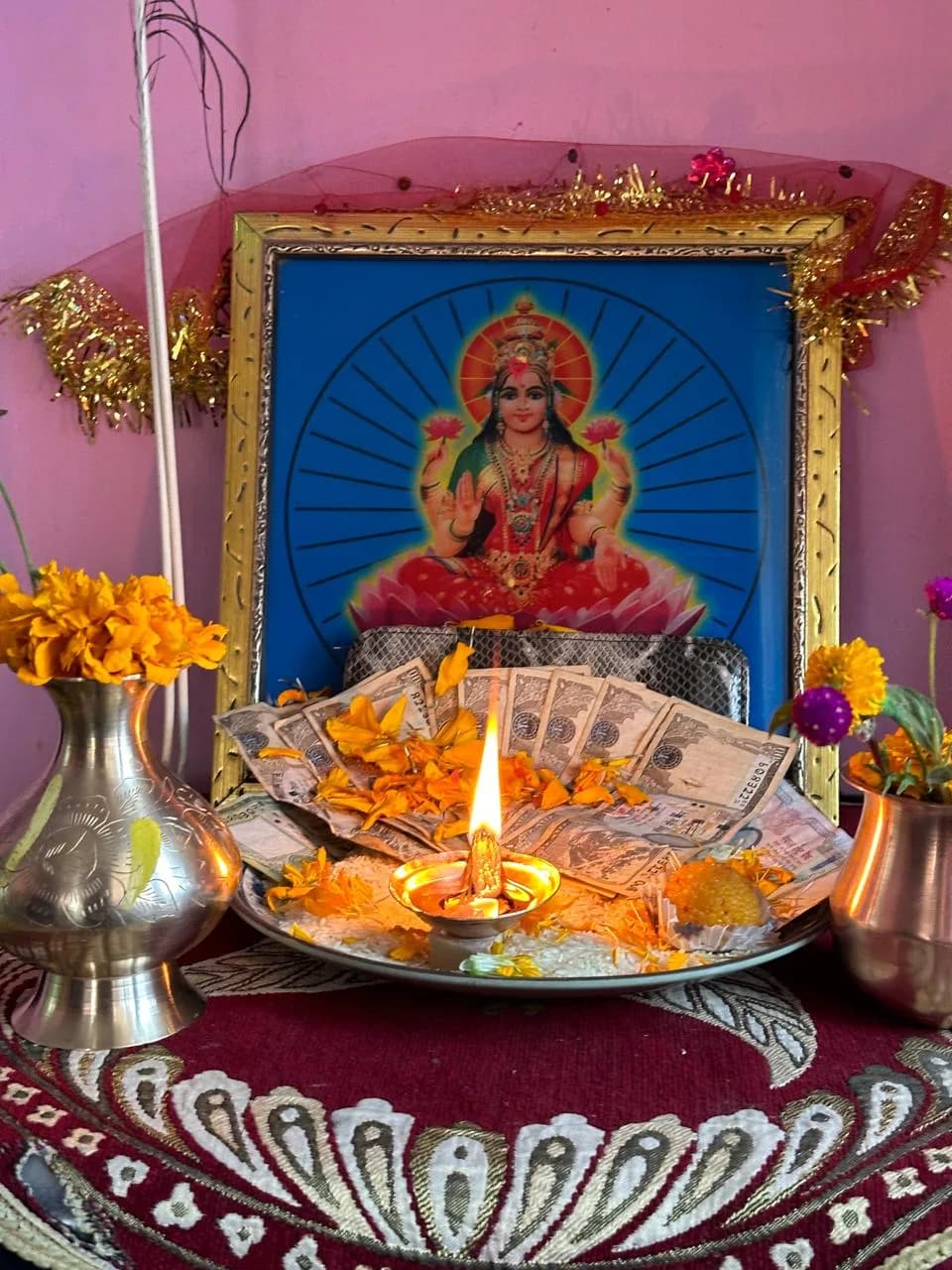
Laxmi Puja 2026 in Nepal: Tihar Festival Guide
Festival
1 día
Festival
Free
Kathamandu1 día
Event Details
Loading...
Event starts in
Every twelve years, the quiet brick lanes of Thecho and Sunakothi,
tucked in the southern folds of the Kathmandu Valley, come alive with
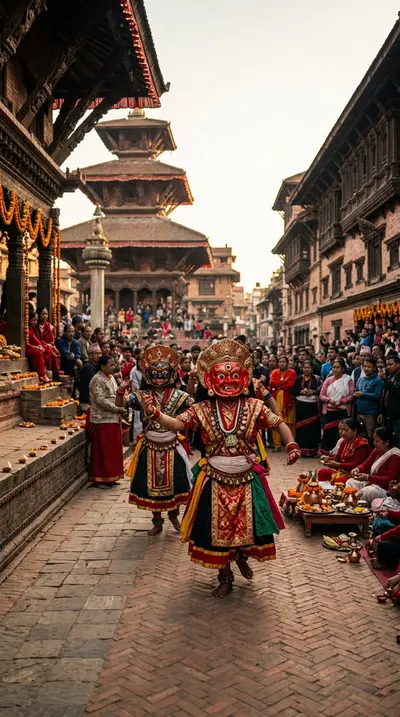
drumbeats, incense smoke, and the slow, trance-like footsteps of masked dancers
who are, in the eyes of devotees, no longer ordinary men. This is the Nava
Durga Bhawani Jatra — one of the rarest and most spiritually charged
festivals in Nepal, where nine fierce goddesses and their divine companions are
believed to descend into human bodies through an ancient dance ritual carried
down since the Licchavi period. Unlike annual celebrations such as the Indra
Jatra or the Gai Jatra, this jatra unfolds only once
every dozen years, so every performance becomes a once-in-a-generation
privilege. This guide walks through the complete start-to-end calendar of the
festival, its mythology, its rituals, and everything a visitor needs to plan a
respectful trip through Nepal's living cultural
heritage.
What Is the Nava Durga
Bhawani Jatra?
The Nava Durga Bhawani Jatra, sometimes written as Navadurga
Jatra, is a sacred masked dance festival rooted in the Newar
communities of the Kathmandu Valley. The word Nava Durga
literally means Nine Durgas, referring to a group of fierce mother
goddesses who, together with a handful of guardian deities, are worshipped as
the protectors of the towns where the jatra is held. Two versions of this
tradition survive today — one centred in Thecho and Sunakothi
near Lalitpur, and another in Bhaktapur, where the same lineage of
goddesses is honoured through a slightly different annual cycle connected to
the Bisket Jatra. Both traditions share the
same core belief: that the masks used in the dance are not costumes but
temporary vessels for the goddesses themselves.
What sets this jatra apart from Nepal's many other chariot festivals,
such as the Seto Machindranath Jatra or the Rato
Machhindranath Jatra, is its rarity and its intensity. The
festival is managed entirely by the Navadurga Guthi, a traditional community
trust responsible for preserving the masks, the choreography, and the ritual
calendar. Because the dance is performed only once every twelve years in Thecho
and Sunakothi, entire generations of local families grow up preparing for a
single cycle, making it one of the most anticipated cultural pilgrimages
for both devotees and travellers interested in Nepal's
living traditions.
The dance itself is called Gathu Pyakha in the Thecho tradition, a
name that translates loosely to the dance of the mask-bearers. It is performed
by thirteen Devgan, or divine performers, chosen from specific families
within the community whose right and duty to dance has been passed down for
generations. Becoming one of these dancers is not a casual honour — candidates
undergo months of ritual purification, dietary restriction, and rehearsal
before they are considered fit to carry a deity's mask, and the responsibility
often stays within a single household across several twelve-year cycles. This
hereditary structure is part of what gives the Nava Durga Bhawani Jatra its
unbroken authenticity, in contrast to festivals that have adapted more freely
over the centuries.
The Legend Behind the
Nine Goddesses
According to local tradition, the Bhaktapur strand of the Nava Durga
dance was established by King Bhuvan Malla to end a famine and restore
prosperity to the ancient city. Thirteen masked deities — including Bhairav,
Mahakali, Barahi, Brahmayani, Maheshwari, Kumari,
Vaishnavi, Indrayani, Ganesh, Mahadev, Shwet
Bhairav, and the lion-and-tiger pair Sima and Duma — were
said to have appeared to protect the settlement, and the dance has been
re-enacted in their honour ever since. The Thecho and Sunakothi lineage carries
a parallel legend, with the dance ritual believed to have been introduced
during the Licchavi period, making the Nava Durga Bhawani Jatra one of
the oldest continuously performed ritual dances in the entire Kathmandu Valley.
Devotees describe the masks as living, breathing vessels rather than
props. Once a dancer is dressed and the mask placed upon his face, he is
treated as the deity itself — offered food first at feasts, avoided in casual
conversation, and approached only with folded hands. During the active dance
ritual period, the community observes strict prohibitions: no weddings, no
death-rite feasts, and no bratabandha (coming-of-age ceremonies) are
permitted, a reminder of just how deeply this jatra is woven into the rhythm of
everyday Newar life.
The prince-and-princess legend behind the wider Malla-era jatra
tradition, later echoed in festivals such as Bisket
Jatra, reinforces a recurring theme across Newar mythology: that
ritual dance and chariot processions exist to defeat hidden danger and renew
the safety of a community. In the Nava Durga story, that danger is a famine
threatening to empty Bhaktapur's granaries; in Bisket Jatra's legend, it is a
serpent curse threatening a royal bloodline. Both stories end the same way —
with a masked, divine intervention that the community re-enacts every single
cycle to keep the original blessing alive.
Where the Ritual Dance
Unfolds
The heart of the festival lies in Thecho and Sunakothi, two
closely linked settlements on the southern edge of the Kathmandu Valley, a short drive from
central Lalitpur. The opening tantric ritual takes place at the historic Bal
Kumari Temple in Sunakothi, while the dance procession itself moves through
the courtyards of Thecho before travelling toward Mulchowk inside the
magnificent Patan Durbar Square complex, one of the
valley's three UNESCO-listed royal squares. Every household in Thecho and
Sunakothi is expected to receive the dancing deities at least once during the
cycle, turning the entire town into an open-air stage.
The parallel Bhaktapur tradition, meanwhile, plays out across the narrow
lanes and public squares of that ancient city, with the thirteen masked deities
visiting different neighbourhood pith shrines throughout the year — the
very stones Bhaktapur residents believe guard the town against outside harm.
Travellers who want to understand the full geography of Newar festival culture
often pair a visit to Thecho and Sunakothi with a walk through Bhaktapur and
the wider Kathmandu Valley's heritage sites, since
the two Nava Durga traditions illuminate each other.
Visitors are welcome in most public courtyards during the festival, but
it helps to understand a few unspoken rules before joining a crowd. Photography
is generally tolerated, though flash photography directly at a masked dancer's
face is considered disrespectful, since devotees believe the deity itself is
present in that moment. It is customary to remove shoes before stepping into a
temple courtyard such as Bal Kumari Temple, to avoid touching a dancer even in
a crowd, and to let elders and priests move to the front of any gathering.
Dressing modestly, avoiding leather items near temple entrances, and following
the lead of local families are simple courtesies that go a long way toward being
welcomed rather than merely tolerated as a spectator.
Nava Durga Bhawani
Jatra: Day-by-Day Schedule
Because the jatra is really a long ritual cycle rather than a single
event, its start-to-end structure unfolds across several distinct
stages. Local priests and the Navadurga Guthi confirm the exact dates before
each twelve-year cycle, but the traditional sequence of days runs as follows:
●
Fulpati (Day 7 of Dashain) — The Opening Tantric
Ritual: The cycle formally begins at the Bal Kumari Temple in
Sunakothi, where priests conduct a tantric ritual after nightfall. Worship
continues until midnight, when a ritual animal sacrifice marks the moment the
goddesses are invited into the coming cycle — the same night much of Nepal is
celebrating Fulpati as part of the wider Dashain
festival.
●
Ashtami (Day 8 of Dashain) — The First Dance:
The masked dancers, now understood to be inhabited by the deities, perform
their first public dance in Thecho. This is the day most closely linked to the
grander Maha Ashtami rituals observed across the
valley.
●
Nawami (Day 9 of Dashain) — Procession Toward Patan:
The dance troupe begins its slow procession from Thecho toward Sunakothi and on
toward Mulchowk in Patan Durbar Square, gathering crowds along every courtyard
it passes.
●
Vijaya Dashami (Day 10) — Blessings and Tika: As
families across Nepal exchange tika and jamara for Vijaya
Dashami, the masked deities receive their own tika from senior
members of the Navadurga Guthi, formally accepting their role for the cycle
ahead.
●
Deyh Bhavay — The Sacred Feast: At the heart of
the cycle sits Deyh Bhavay, the central feast of the jatra, where a
devotee dressed as Bhairav personally serves food to the other masked
deities, a ritual said to renew the bond between the gods and the community.
●
Weekly Neighbourhood Visits: Over the following
weeks, the deities travel from household to household and courtyard to
courtyard throughout Thecho and Sunakothi, blessing every family in turn — this
is the longest phase of the cycle and the one most visible to visiting
travellers.
●
Kartik Purnima — The Closing Night: The cycle
concludes on the full-moon night of Purnima, when the final dance is
performed and the masks are ceremonially retired by the Navadurga Guthi until
the next twelve-year cycle begins.
Because the ritual calendar follows the lunar Dashain cycle rather than a
fixed Gregorian date, travellers planning a trip around the Dashain
festival season should confirm exact dates with the local Guthi
or a trusted Nepal tour operator closer to the year of
the next cycle.
The Masked Deities and
What They Represent
Each performer in the Nava Durga dance embodies a distinct deity, and understanding
who they are makes the procession far more meaningful to watch. The core
lineup, most fully preserved in the Bhaktapur tradition, includes:
●
Mahalaxmi — the mother goddess of wealth and
welfare, who leads the group
●
Bhairav — the fierce, destructive form of Shiva,
and the one who serves food at Deyh Bhavay
●
Mahakali — goddess of death, destruction, and
transformation
●
Barahi — goddess of courage and protection
●
Maheshwari and Brahmayani — goddesses of
greatness and of creation
●
Vaishnavi — goddess of nourishment and
sustenance
●
Kumari — goddess of purity, echoing the valley's
famous Living Goddess tradition
●
Indrayani — goddess of rain and administration
●
Ganesh — the elephant-headed god of prosperity,
included as the group's pitha guardian
●
Shwet Bhairav — the peaceful counterpart to the
wrathful Bhairav
●
Sima and Duma — the lion and tiger guardians who
close the procession
Watching these deities in sequence is, in many ways, watching a moving
pantheon — a rare chance to see an entire cosmology performed in real time
through dance, mask, and drumbeat rather than read about it in a temple
carving.
One detail that surprises many first-time visitors is how quiet the
earliest hours of the cycle actually are. The Fulpati-night tantric ritual at
Bal Kumari Temple is a closed, priest-led ceremony rather than a public
spectacle, conducted mostly in darkness and silence except for the low chant of
mantras. The colour, drumming, and crowds that outsiders associate with Nepali
festivals arrive only from Ashtami onward, once the masks have been ritually
activated and the dancers step into the courtyards. Travellers hoping to
witness the full emotional arc of the jatra — from hushed midnight ritual to
full daylight procession — are best served by arriving a day or two before
Ashtami and staying through at least Vijaya Dashami.
Deyh Bhavay and the
Sacred Rituals
The single most important ritual inside the wider jatra is Deyh Bhavay,
the great feast that renews the relationship between the community and its
protective deities. During this feast, a devotee dressed and consecrated as Bhairav
personally serves food to every other masked performer before any human guest
is fed — a striking reversal of ordinary hospitality that underlines how
seriously the community treats the dancers' divine status. Around this central
feast, dozens of smaller observances take place across the year; in fact, the
wider Nava Durga cycle in Thecho is composed of twenty-eight linked
festivals, each with its own small ritual, making Deyh Bhavay the anchor
point rather than the entire story.
Throughout the active dance period, a set of strict social prohibitions
comes into force across Thecho and Sunakothi. No wedding ceremonies, no death-rite
feasts, and no bratabandha initiation rites are permitted while the
deities are considered to be walking among the living — a rule still respected
today, much as families across Nepal adjust their calendars around larger festivals
like Tihar or Teej.
Beyond Deyh Bhavay, the wider twenty-eight-festival cycle includes
smaller mask-blessing ceremonies, neighbourhood-specific worship days, and a
closing rite in which the Navadurga Guthi formally retires the masks until the
next cycle. Each of these smaller observances carries its own local name and
its own small crowd of devotees, but almost none of them are documented in
English-language sources, which is part of why witnessing the jatra in person,
guided by someone familiar with the Guthi's calendar, adds so much more
understanding than reading about it from a distance.
Why the Festival
Matters to the Newar Community
For the Newar residents of Thecho, Sunakothi, and Bhaktapur, the
Nava Durga Bhawani Jatra is not a performance staged for outsiders — it is a
living system of protection. Bhaktapur locals believe their city is physically
guarded by a ring of Nava Durga pith, symbolic stones that mark the
town's boundary and shield it from misfortune, disease, and outside harm. Every
household's participation, whether hosting the dancers for a meal or
contributing to the Navadurga Guthi, is treated as a civic duty as much
as a religious one, similar to how neighbourhoods across the valley rally
around the Kumari Jatra or the Sindoor
Jatra each year.
This sense of collective ownership is part of what makes the jatra such a
powerful cultural experience for visitors exploring Nepal's Newar heritage. Where many
festivals have become increasingly commercial, the Nava Durga Bhawani Jatra
remains almost entirely community-run, funded and organised by the very
families who will dance in it, watch it, and feed it — a structure of devotion
that has survived largely unchanged since the Malla era.
Preserving a tradition this demanding has not been without challenges.
Younger generations increasingly move abroad for work or study, making it
harder for the Navadurga Guthi to guarantee a full roster of trained dancers
for every household role. Community elders have responded by documenting the
choreography more formally, training younger relatives earlier, and, in recent
cycles, welcoming a modest and respectful flow of outside visitors whose
interest helps sustain the festival's costs — from mask restoration to temple
upkeep. Understanding this quiet effort behind the scenes adds another layer of
appreciation for anyone lucky enough to witness the dance in person, and it is
part of why responsible, well-informed travel through operators familiar with Nepal's
cultural calendar matters so much here.
Best Time to Witness
the Nava Durga Bhawani Jatra
Because the opening tantric ritual falls during Fulpati, the most
important window to witness the beginning of a new twelve-year cycle sits
inside the broader Dashain festival period in autumn —
typically late September to mid-October. This is, conveniently, also the
richest festival season in the entire Kathmandu Valley, overlapping with the
grand chariot processions of Indra Jatra, the sacred walk of the Kumari
Jatra, the colourful vermillion rituals of Sindoor
Jatra, and the fasting traditions of Teej.
Travellers arriving during this window can often combine a Nava Durga sighting
with several other unforgettable celebrations in a single trip, from Kojagrat
Purnima to the New Year drama of Bisket
Jatra the following spring.
Outside of the twelve-year opening window, the weekly neighbourhood visits
in Thecho and Sunakothi continue for months, giving travellers a longer — if
less dramatic — opportunity to catch a performance. For those visiting in a
year when the main cycle is not active, nearby festivals such as Holi,
Maha
Shivaratri, or the masked dances of Gunla
Lakhey offer a comparable glimpse into Newar ritual life.
Local transport within Thecho and Sunakothi is best done on foot once you
arrive, since the dance moves through narrow lanes that vehicles cannot easily
enter. Many travellers hire a car with driver for the day, park near the main
square, and follow the procession on foot alongside local families — a slower,
more immersive way to experience the festival than trying to track it from a
fixed viewing spot.
How to Reach Thecho,
Sunakothi and Bhaktapur
Thecho and Sunakothi sit roughly 30–40 minutes by road south of central Lalitpur,
easily reached from any hotel base inside the Kathmandu Valley. Most international
travellers fly into Kathmandu, spend their first days exploring the valley's
UNESCO squares, and then take a short taxi or organised transfer out to Thecho
for the festival itself. Bhaktapur, home to the parallel Nava Durga dance
tradition, is a similar distance in the opposite direction and is easily
combined with the same trip.
Travellers extending their journey beyond the valley often base
themselves in Pokhara for a few days of lake views
before or after the festival, since domestic flights and tourist buses connect
the two cities in a matter of hours. A local Nepal
tour specialist can arrange festival-day transport, a
knowledgeable guide who can explain each masked deity as it passes, and onward
travel to any of the country's other cultural
and trekking destinations.
Where to Stay and What
Else to Explore Nearby
A festival trip built around the Nava Durga Bhawani Jatra rarely needs to
stand alone. Most visitors base themselves inside the Kathmandu Valley and use the festival days
as the centrepiece of a longer Nepal itinerary. Culture-focused travellers
often add a short excursion to Nuwakot, the historic hilltop fortress
north of the valley, or a sunrise outing to Kalinchowk for its snow-capped shrine and
panoramic views. Those craving lake scenery and a slower pace typically head
onward to Pokhara, with a stop at the sunrise
viewpoint of Sarangkot along the way.
For travellers combining the jatra with a trekking chapter, the Everest Region, the Annapurna Region, and the gentler
ridgeline of Mardi Himal all connect conveniently
through Kathmandu. More adventurous itineraries can stretch further to the
remote Manaslu Region and the sacred Tsum
Valley, the far-eastern wilderness of Kanchenjunga, the pilgrim trail through Solukhumbu, the lesser-known Pikey Peak, or the turquoise waters of Shey Phoksundo in the far west. Pairing
any of these with the jatra turns a single festival visit into a complete
cross-section of Nepal's culture and landscape, best planned through the full
list of Nepal's destinations.
Other Living Festivals
You Should Not Miss in Nepal
The Nava Durga Bhawani Jatra is only one thread in a much larger tapestry
of Newar and national celebrations. Chariot festivals form one of the richest
categories, from the towering wooden chariots of Bisket
Jatra in Bhaktapur to the springtime procession of Seto
Machindranath Jatra in central Kathmandu, the eight-day journey
of Sankhu Bajrayogini Jatra, the Banepa procession of Chandeshwori
Jatra, and the grand finale of Bhoto
Jatra in Jawalakhel. Living-goddess traditions echo the Kumari
role seen within the Nava Durga itself, most visibly during the annual Kumari
Jatra.
Masked and ritual dances beyond the Nava Durga cycle include the Buddhist
Gunla
Lakhey performed through Kathmandu's monsoon month, the Sherpa
mask dances of Mani Rimdu Festival at Tengboche
Monastery, the sacred Dumji Festival in Namche Bazaar, and the
Tibetan-rooted Tiji Festival deep in Upper Mustang. New
Year celebrations punctuate the calendar too, from the Newar Bisket
Jatra Newari New Year Festival to the Tamang Sonam
Losar, the Sherpa Gyalpo
Losar, and the Gurung Tamu
Losar.
Harvest and seasonal festivals round out a full annual calendar,
including the muddy joy of Ropai Jatra, the Kirat celebrations of Udhauli
Parva and Chasok Tangnam, the crow-worship rituals
of Kaag Tihar and dog-worship day of Kukur
Tihar during the wider Tihar
Festival of Lights, the Mithila traditions of Sama
Chakeva and Vivah Panchami in Janakpur, and grand
pilgrimages such as Janakpur Parikrama. Spiritual and
religious observances add still more depth, from Maha
Shivaratri at Pashupatinath to Buddha
Jayanti in Lumbini, the springtime colour of Holi,
and the wellness-focused Himalayan Meditation and Wellness Retreat
in Pokhara. Together, these celebrations make Nepal's festival
calendar one of the richest in the world, and the Nava Durga
Bhawani Jatra one of its most extraordinary chapters.
Plan Your Cultural
Journey with Curated Tours
Because the Nava Durga Bhawani Jatra follows a lunar ritual calendar and
moves through several neighbourhoods over many weeks, travelling with a
knowledgeable local team makes a genuine difference to the experience. A
well-planned Kathmandu Valley Tour can time your visit
to Thecho and Sunakothi around the exact festival day, arrange respectful
access to the Bal Kumari Temple rituals, and explain the significance of each
masked deity as it passes through the courtyard.
Travellers building a longer Nepal itinerary around the festival often
combine it with the Best of Nepal Tour, which threads together
the valley's heritage sites with the mountains beyond, or the Pokhara
Adventure Tour for lake views and gentle trekking after the
festival concludes. Whichever route you choose, a browse through the full range
of Nepal tour packages and cultural
activities is the easiest way to turn a single festival sighting
into a complete, well-paced journey through the country.
Final Thoughts on the Nava Durga Bhawani Jatra
Few festivals anywhere in the world ask a traveller to wait twelve years
for a single performance — and fewer still reward that patience with something
as layered, sincere, and communally alive as the Nava Durga Bhawani Jatra.
From the midnight tantric ritual at Bal Kumari Temple to the closing dance
under the Kartik Purnima moon, every stage of this jatra is a reminder that in
the Kathmandu Valley, mythology is not
confined to temple walls — it walks through the streets, wearing a mask, once
every twelve years. Start planning your own timing around this rare cycle with Enticing
Himalayas, and let a cycle-defining festival anchor your next
journey through Nepal.
Key experiences and features
Thecho
Sunakothi
Nava Durga Bhawani Jatra
Navadurga Jatra
Gathu Pyakha
Devgan
King Bhuvan Malla
Deyh Bhavay
Navadurga Guthi
Fulpati
Recommended packing list
Bhaktapur, Bhaktapur, Bagmati, Nepal
Got questions about this event?
Nava Durga Bhawani Jatra is a traditional Newar religious festival featuring sacred masked dances, rituals, processions, and performances dedicated to the Nava Durga deities.
The festival is strongly associated with Bhaktapur and surrounding communities in the Kathmandu Valley, where traditional masked performances and religious ceremonies are held.
The festival honors the Nava Durga deities and preserves important Newar religious traditions through sacred rituals, masked dances, music, and community ceremonies.
The major Nava Durga Bhawani tradition follows a distinctive long-cycle festival tradition, with important celebrations connected to a 12-year cycle.
Visitors may be able to observe public performances, but they should respect restricted rituals, local customs, performers, and photography guidelines.
Nov 1 – Jan 1, 2028
60 days
Quick Info
More festival experiences
Nov 8 – Nov 8, 2026Kathamandu
 Aug 17 – Sep 16, 2027
Godavari Kunda
 Jan 15 – Jan 16, 2027
Swayambhu Bhuikhhel