 Nov 8 – Nov 8, 2026
Kathamandu
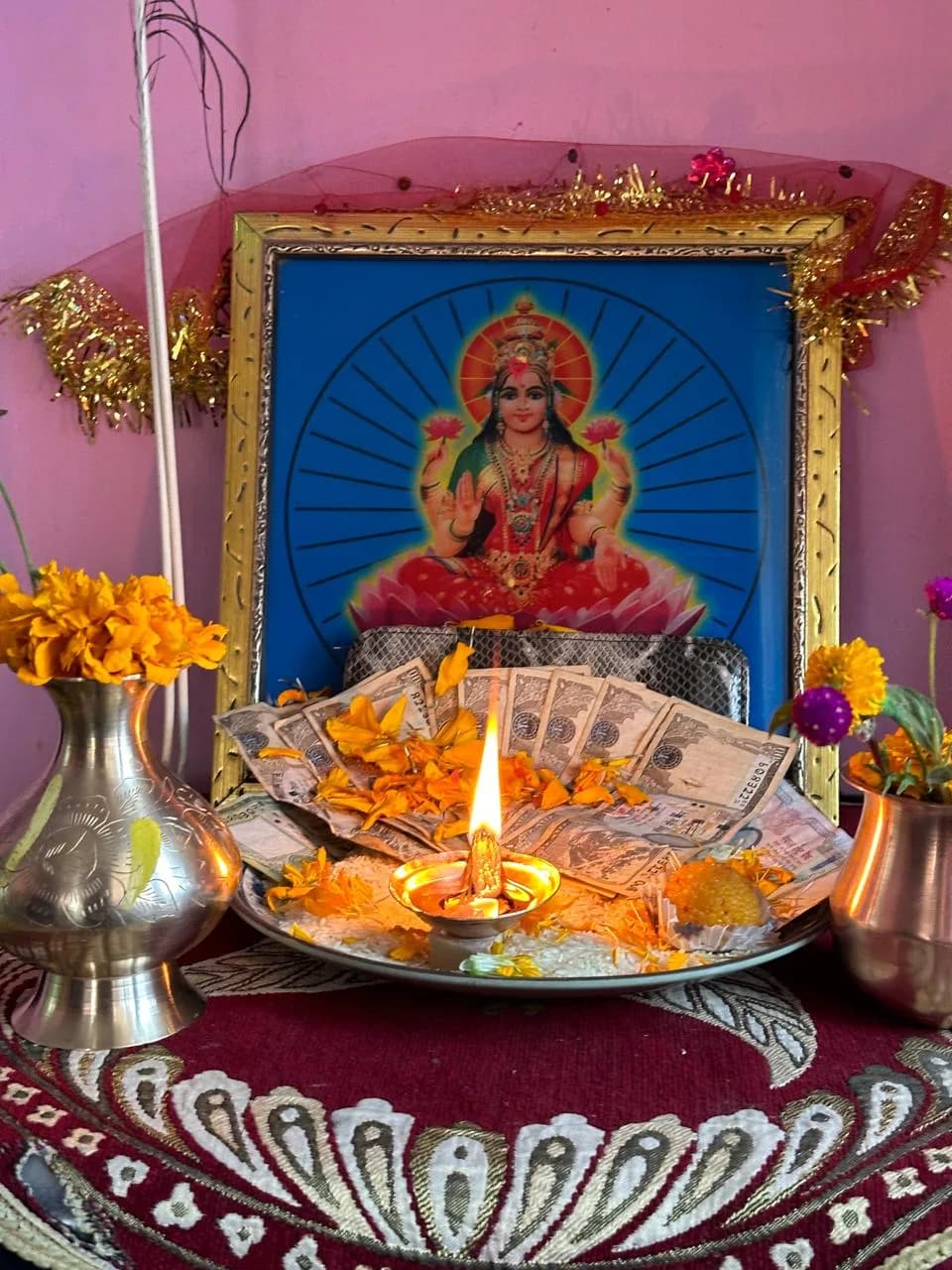
Laxmi Puja 2026 in Nepal: Tihar Festival Guide
Festival
1 Tag
Festival
Free
Kathamandu1 Tag
Event Details
Loading...
Event starts in
There is a particular kind of hush that falls over Patan when the wheels of a sixty-foot chariot start to creak, and no festival captures that feeling better than the Rato Machhindranath Jatra 2027. If you are already browsing Enticing Himalayas for your next Nepal trip, this is one celebration worth building an entire itinerary around, because it unfolds slowly, over many weeks, across the old brick lanes of Lalitpur rather than in a single afternoon. Long before you land, it helps to understand the full shape of the event, from the quiet enshrinement of the deity at Pulchowk to the crowd-drawing spectacle of the Bhoto Jatra finale at Jawalakhel. This guide walks through the complete calendar, the meaning behind each ritual, where to base yourself, which nearby destinations pair well with the trip, and how the festival connects to Nepal's wider festival calendar, so your visit lines up with the days that matter rather than an empty street.
The Rato Machhindranath Jatra is widely regarded as the longest-running religious festival in the Kathmandu Valley, and by some counts in all of Nepal, with roots that stretch back well over a thousand years, possibly to the eleventh century or earlier. Unlike a single-day parade, this is a rolling, weeks-long procession that moves at the pace of hand-pulled ropes and hand-carved wooden wheels. The deity at its centre, known locally as Bunga Dyah or Karunamaya, is worshipped jointly by Hindus as an incarnation of the rain god and by Buddhists as a form of Avalokiteshvara, the bodhisattva of compassion. That dual identity is part of what makes the festival so unusual; priests from both traditions perform rites side by side, and the crowds that gather along the route in Kathmandu Valley reflect that same shared devotion. Farmers in particular treat the festival as a barometer for the coming monsoon, since Bunga Dyah is petitioned each year for timely rain and a good harvest, a tradition you can read more about among Nepal's agrarian celebrations on the events page.
What keeps the festival alive today is not government funding or a tourism board calendar, but a set of Newar guthis, community trusts that have organised the chariot's construction and the ritual calendar for generations. Every stage of Rato Machhindranath Jatra 2027, from carpentry to the choice of an auspicious date, passes through these guthis, which is part of why the festival still feels handmade rather than staged, even in an era when most of Kathmandu Valley has modernised around it.
Every great jatra in Nepal carries a story, and this one is unusually vivid. Local legend holds that a farmer once cured the aching eyes of the wife of Karkot, the serpent king of Taudaha, and was rewarded with a jewel-studded vest, the bhoto. The farmer later lost the vest in his fields, and it was found by a stranger who refused to give it back. Their dispute was taken before the deity himself, since it was believed that whoever lied in the presence of Rato Machhindranath would meet an immediate end. Both men grew afraid to claim the vest, so it was left with the god for safekeeping, and every year since, the bhoto has been held up from the chariot for the crowd, in case its rightful owner ever steps forward. That single, strange ritual is now the emotional peak of the entire Bhoto Jatra, and it is worth knowing the backstory before you stand in the crowd at Jawalakhel, because the display suddenly makes a lot more sense.
Historians add a second layer to the legend, noting that the chariot-pulling tradition itself may date to roughly the eleventh century, while the separate ritual of exhibiting the bhoto is thought to have been added several centuries later, sometime around the fourteenth or fifteenth century. That means the version of Rato Machhindranath Jatra 2027 travellers will witness is really two older traditions fused into one long festival, a chariot pull representing the rain god's tour of his devotees, and a jewel display representing an act of civic justice, both preserved side by side.
Because the festival follows the lunar Nepali calendar rather than a fixed Gregorian date, the exact days shift slightly from year to year and are confirmed by a council of astrologers closer to the season, the same way dates are finalised for Seto Machindranath Jatra 2027 in neighbouring Kathmandu. As a working guide, the chariot construction and enshrinement traditionally begin in the Nepali month of Baisakh, which falls in mid to late April, and the slow pulling of the chariot through Lalitpur continues over several weeks into May. The grand finale, the Bhoto Jatra display, typically lands in late May or early June, roughly four days after the chariot reaches its final stop at Jawalakhel. Travellers planning around Rato Machhindranath Jatra 2027 should treat late April through the first half of June as the active festival window, and check the finalised dates through the Enticing Himalayas festival calendar a few months out, since local committees announce the precise schedule only once the priests and astrologers agree on an auspicious day.
It is worth building in a buffer of a few extra days around whichever date you plan to fly in for. In years when the chariot's axle or wheels need mid-route repair, or when the astrologers delay a pull for a more favourable date, the whole calendar can shift by several days, so travellers with rigid schedules should prioritise the confirmed Bhoto Jatra date over any single pulling day.
What makes this festival so rewarding to follow is that it is not one event but a chain of smaller ceremonies, each with its own character and its own corner of Kathmandu Valley. Below is the traditional sequence travellers can expect, built from the route the festival has followed for generations.
Travellers who can only spare a single day should prioritise either a pulling day at Mangal Bazaar for the atmosphere, or the Bhoto Jatra itself for the spectacle, since these two moments offer very different but equally memorable versions of the same festival.
Geographically, Rato Machhindranath Jatra 2027 is really a story about two villages and the historic city that connects them. It begins at Pulchowk, on the northern edge of Lalitpur, close to Patan Durbar Square, and it ends nearly two months later at Bungamati, a quiet Newar village on the valley's southern rim that serves as the deity's alternate home for half the year. In between, the chariot's slow crawl through Gabahal, Mangal Bazaar, Sundhara, Lagankhel, and Kumaripati effectively traces a walking map of old Lalitpur, and travellers based anywhere in the wider Kathmandu Valley can reach any of these points within twenty to thirty minutes. The finale itself unfolds at Jawalakhel, an open ground close to the Lalitpur zoo that briefly becomes one of the most crowded public spaces in the entire valley.
Bungamati itself is worth a slower visit outside festival days too. The village's brick courtyards, woodcarving workshops, and the deity's second temple give a much quieter sense of Newar life than the crowded finale at Jawalakhel, and many travellers who join the closing procession end up returning the following week simply to see the village at rest.
Beyond the visual drama of the chariot itself, several smaller rituals give the festival its depth. The construction of the chariot without nails is itself considered a devotional act, carried out by specific Newar carpenter guilds whose families have held the role for generations. The astrologers' role in choosing each date, from the first pull to the final display, reflects a belief that the god's movements must align with auspicious timing or risk bad fortune for the valley's harvest. The presence of the Living Goddess Kumari, who is traditionally brought to witness the Bhoto Jatra, links this festival directly to Kathmandu's own Kumari tradition, one of the reasons travellers interested in one living-goddess ceremony often plan around the other, such as Kumari Jatra 2026: Living Goddess Chariot Festival in Kathmandu. Music plays a constant role too, with traditional Newar drums and wind instruments accompanying almost every stage of the route, turning what could be a purely religious event into a genuinely festive, community-wide celebration.
The symbolism of rain runs through nearly every layer of the festival. Because Bunga Dyah is petitioned as a rain deity, any unexpected shower during the chariot's slow journey is read by many locals as a good omen, a sign the god is already answering the valley's prayers before the season even begins. That belief is one reason the festival is watched so closely by farming communities well beyond Lalitpur itself.
Because the procession moves gradually across Kathmandu Valley, basing yourself centrally gives you the flexibility to catch several stages without long commutes. Staying near Patan Durbar Square, inside the wider Kathmandu Valley heritage core, puts you within easy walking distance of Pulchowk, Gabahal, and Mangal Bazaar during the festival's opening weeks. Travellers who prefer a quieter base can look slightly further out and still reach Jawalakhel for the finale without difficulty. If your Nepal trip extends beyond the valley, it is worth pairing the festival with time in Pokhara for lakeside downtime, or with a short hill excursion to Sarangkot for sunrise views over the Annapurna range before returning to the valley for the chariot's final days. Culturally curious travellers with a longer window sometimes combine the festival with a heritage detour to Nuwakot, whose hilltop fortress offers a different, older layer of Nepali history than anything found in the valley itself, or to Kalinchowk for a cooler, higher-altitude break between festival days.
Because late April to early June also marks the start of the pre-monsoon trekking window, some travellers extend their trip toward Solukhumbu or the Annapurna Region once the festival's main days are behind them, using the chariot festival as a cultural opener before heading into the mountains.
A festival this long naturally reshapes daily life along its route, and one of the simplest pleasures of following Rato Machhindranath Jatra 2027 is the street food that appears wherever the chariot pauses. Vendors selling chatamari, yomari, and sweetened curd set up stalls near Mangal Bazaar and Lagankhel on pulling days, while tea stands do brisk business during the long waits that often precede a chariot's final push forward. Local markets around Patan Durbar Square also sell miniature replicas of the chariot and devotional items connected to Bunga Dyah, souvenirs that carry more meaning than the typical trinkets found elsewhere in Kathmandu Valley. None of this is arranged for tourists specifically; it is simply what happens naturally when a community spends weeks gathered around the same slow-moving event, which is part of what makes the experience feel authentic rather than staged.
Elderly residents of Lalitpur often treat the festival's long pauses as a kind of open-air social calendar, meeting the same neighbours at the same street corner year after year while the chariot waits for its next auspicious pull. Children grow up watching the towering wheels from their grandparents' shoulders long before they understand the legend behind the sacred bhoto, and by the time they are old enough to help pull the ropes themselves, the festival has already become a part of family identity rather than a once-off spectacle. This generational thread is easy to miss on a single-day visit, but it becomes obvious the moment you spend more than one pulling day along the same stretch of road, watching familiar faces reappear.
Following a multi-week chariot festival independently can be tricky, since the route and pause points shift with the astrologers' decisions, which is exactly why a guided Kathmandu Valley cultural tour from Enticing Himalayas is worth considering if this is your first visit during Rato Machhindranath Jatra 2027. A well-timed Patan heritage walking tour booked through the tour packages page can position you at Gabahal or Mangal Bazaar exactly when the chariot is expected to pass, saving hours of guesswork. Travellers who want the festival woven into a wider trip can look at a broader Nepal festival and culture package on the same tour list, combining the jatra with temple visits, a Bhaktapur pottery walk, or a short Pokhara extension. For the finale itself, a dedicated Bhoto Jatra viewing tour, arranged through Enticing Himalayas' tour packages, typically secures a better vantage point at Jawalakhel than arriving on your own, given how dense the crowd becomes on the display day.
Travellers arriving specifically for the festival often ask whether it can be combined with trekking, and the honest answer is yes, provided the itinerary is built with some flexibility. A short Kathmandu Valley heritage tour from the tour list ahead of the festival, followed by a longer Annapurna or Everest region trek booked through the same page once the Bhoto Jatra concludes, is one of the more popular ways travellers structure a spring visit to Nepal.
One of the most rewarding things about visiting Nepal around Rato Machhindranath Jatra 2027 is that the valley's festival calendar rarely goes quiet for long. The following seven celebrations sit closest to it in spirit, timing, or shared characters, and each is worth reading up on through the Enticing Himalayas events page before you finalise your dates.
Bhoto Jatra is, strictly speaking, the closing chapter of the same festival, and the two are often discussed together since one cannot happen without the other; it is the single day within the larger jatra that draws the biggest crowd and the most senior dignitaries.
Seto Machindranath Jatra 2027: Kathmandu's Sacred Festival is the sister celebration across the river in Kathmandu city, honouring the "white" form of the same rain deity with its own chariot procession through Kathmandu's old core, making it a natural companion trip for anyone already drawn to the Lalitpur version.
Kumari Jatra 2026: Living Goddess Chariot Festival in Kathmandu shares the theme of a deity carried through the streets on a wooden chariot, and the Living Goddess Kumari herself is traditionally present at the Bhoto Jatra display, linking the two celebrations directly.
Indra Jatra Festival Kathmandu 2026 is Kathmandu's own eight-day street festival of masked dances and chariot processions, and travellers who enjoy the atmosphere of a crowded, music-filled jatra tend to find this one just as compelling as the Rato Machhindranath celebration.
Bisket Jatra Festival in Nepal: History & Travel Guide, held in nearby Bhaktapur, brings its own tug-of-war style chariot battle and is often visited in the same trip by travellers touring all three Kathmandu Valley cities.
Mataya Festival 2027: Patan's Journey of Lights takes place in the very same city, Patan, and honours the Newar Buddhist community with a nighttime procession of lamps, offering a gentler, more contemplative counterpoint to the noise of the chariot festival.
Gunla Lakhey 2027: Sacred Masked Dance of Kathmandu rounds out the list with its month-long tradition of masked dance performances during the sacred Gunla month, another example of how deeply the valley's Buddhist and Hindu calendars intertwine across the year.
Beyond these seven, a handful of other celebrations sit close enough on the calendar to be worth watching too, including Buddha Jayanti Nepal: Festival Guide & Traditions, Guru Purnima 2026 in Nepal: Date, Rituals & Significance, Sankhu Bajrayogini Jatra: 8-Day Newar Chariot Festival, and Chandeshwori Jatra 2027: Banepa Festival Guide, each adding another layer to Nepal's late spring and early summer festival season.
Nepal has no shortage of chariot festivals, but few match the sheer duration of Rato Machhindranath Jatra 2027. Where Indra Jatra Festival Kathmandu 2026 runs its course in about eight days and Bisket Jatra Festival in Nepal wraps up within roughly a week, the Lalitpur procession can stretch across a month or more, depending on how quickly the astrologers approve each stage. Autumn favourites such as Dashain 2026: Complete 15-Day Hindu Festival Guide and the Newar harvest celebration Yomari Punhi in Nepal: Newar Festival Guide are built around fixed lunar dates rather than a moving procession, which makes the slow, weather-dependent nature of the Machhindranath festival unusual even by Nepal's own standards. That unpredictability is, for many repeat visitors, exactly the appeal; no two years look quite the same.
A festival that unfolds over weeks rewards a bit of planning. Traffic around Pulchowk, Mangal Bazaar, and Jawalakhel is heavily restricted on pulling days, so walking or arriving early by taxi works far better than driving yourself. The display day of the Bhoto Jatra draws some of the densest crowds seen anywhere in Kathmandu Valley all year, so arrive at Jawalakhel well ahead of the announced time if you want an unobstructed view. Light, breathable clothing suits the late spring heat during the chariot's slow crawl through Lalitpur, while a scarf or hat helps on the more exposed finale day. Photography is welcomed almost everywhere along the route, though it is worth being respectful near the moment the bhoto is actually displayed, since this is treated as a solemn religious act rather than a photo opportunity. If you would rather not navigate the shifting schedule alone, a local guide booked through Enticing Himalayas can track the astrologers' updates on your behalf and adjust your plan day to day.
It is also worth keeping a flexible return flight if your travel dates fall close to the expected Bhoto Jatra date, since the finale can occasionally be pushed back by a day or two if repairs to the chariot's massive wheels are needed. Travellers who build in even a two or three day buffer rarely miss the display entirely.
Most travellers arrive in Nepal chasing mountain views, and the Everest Region or the Annapurna Region understandably dominate most itineraries. But a festival like this offers something a trek cannot: a living, moving piece of history that has repeated itself, largely unchanged, for well over a thousand years. Watching a community physically pull a sixty-foot wooden chariot through streets their ancestors walked centuries ago is a different kind of altitude entirely. Pairing a few festival days in Kathmandu Valley with a trek toward Mardi Himal or a scenic stop at Kalinchowk gives a trip real range, mountains on one end and living heritage on the other, and it is exactly the kind of combined itinerary that Enticing Himalayas builds regularly for travellers who want both.
Travellers with an extra week to spare sometimes extend even further, toward the remote monasteries of Tsum Valley or the far quieter trails of Manaslu Region, using the festival as the cultural anchor of a trip that otherwise leans heavily toward mountain scenery.
Few festivals anywhere in the world ask as much patience of their audience as Rato Machhindranath Jatra 2027 does, and few reward that patience as generously. From the quiet enshrinement at Pulchowk to the roar of the crowd at the Bhoto Jatra, and finally to the deity's return journey to Bungamati, this is a festival built entirely around the idea that some things are worth doing slowly. Whether you catch a single pulling day at Mangal Bazaar or plan your whole Nepal trip around the finale at Jawalakhel, it is worth checking the confirmed dates through the Enticing Himalayas festival calendar, browsing the places nearby worth exploring in between, and looking at the available tour packages if you would rather leave the timing to someone who tracks it every year.
Key experiences and features
Rato Machhindranath Jatra
Bhoto Jatra
Bunga Dyah
Karunamaya
Karkot
Bhoto
Mangal Bazaar
Living Goddess Kumari
Annapurna Region
Patan heritage walking
Recommended packing list
Lalitpur, Lalitpur, Bagmati, Nepal
Got questions about this event?
Rato Machhindranath Jatra 2027 takes place in Patan, Lalitpur, with the festival continuing through several traditional chariot and ceremonial events.
The main celebrations take place around Patan in Lalitpur, with the chariot moving through traditional neighborhoods and historic festival routes.
The festival features the construction and pulling of the large chariot, religious rituals, processions, traditional music, cultural gatherings, and the final chariot events.
Yes. Visitors can observe the public celebrations, but they should respect religious practices, local traditions, crowds, and safety instructions.
The festival honors Rato Machhindranath and is traditionally associated with prayers for rain, prosperity, and a good harvest in the Kathmandu Valley.
Apr 1 – Jun 1, 2027
60 days
Quick Info
More festival experiences
Nov 8 – Nov 8, 2026Kathamandu
 Aug 17 – Sep 16, 2027
Godavari Kunda
 Jan 15 – Jan 16, 2027
Swayambhu Bhuikhhel