 Nov 8 – Nov 8, 2026
Kathamandu
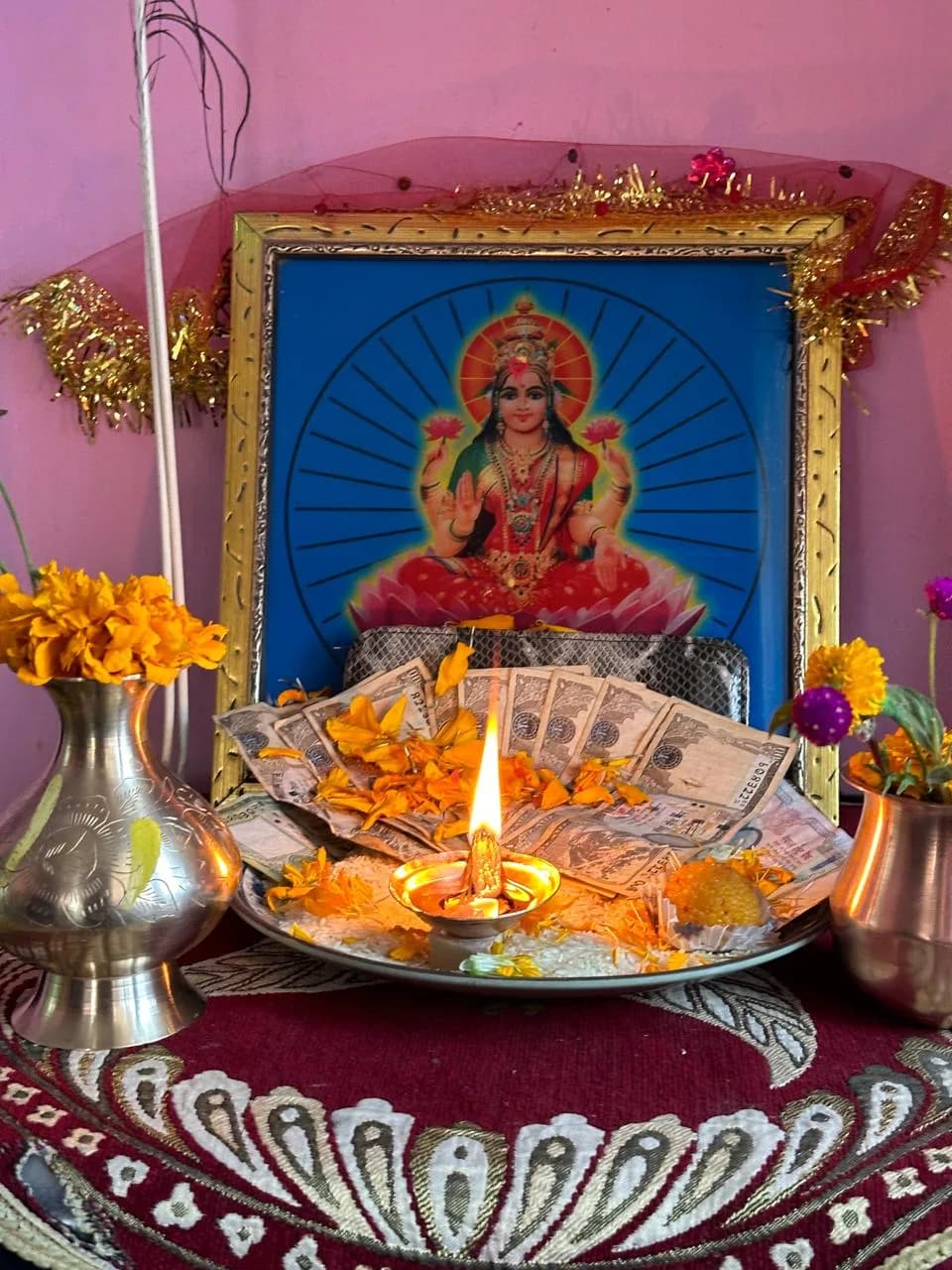
Laxmi Puja 2026 in Nepal: Tihar Festival Guide
Festival
1 Tag
Festival
Free
Kathamandu1 Tag
Event Details
Loading...
Event starts in
The Sankhu Bajrayogini Jatra is one of the oldest and most colourful chariot festivals of the Kathmandu Valley, and every year in April an old Newar town on the north-eastern edge of the valley turns into a moving river of people, music and red powder. For eight days the golden idol of goddess Bajrayogini, carried down from her hilltop Bajrayogini temple, travels through the narrow lanes of the town on a palanquin, while a second wooden carriage bears the ancient Swayambhu chaitya. If you love Nepal festivals such as Bisket Jatra, Indra Jatra or Rato Machindranath Jatra, you will find this one smaller, warmer and far more personal. Visitors can join it as a day trip from Kathmandu, or fold it into a longer cultural tour of Nepal arranged by Enticing Himalayas, and this guide explains every day from the first descent to the final return.
A jatra in the Newar language simply means a festival with a procession, and the Bajrayogini Jatra is the biggest one in Sankhu. Local people call it the festival of the Mother Goddess, because Bajrayogini is treated less like a distant deity and more like a protective mother of the whole town. Her idol is not kept in the town at all. It lives in a small hilltop shrine in the forest above Sankhu, and once a year it comes down to visit the people who pray to it.
What makes the festival special is that it is still run by the community, not by a stage or a tourism board. Families of the four neighbourhoods take turns to host the gods, young men carry the heavy palanquins, and neighbours cook and share food in the streets. A visitor who comes here for the first time is often surprised by how open the welcome feels. Nobody asks for a ticket, and a quiet visitor who stands respectfully at the side of the lane is usually offered a smile and sometimes a plate of food.
The festival sits well beside other cultural events in Nepal, and travellers who like to compare them will notice that Sankhu keeps its old rhythm better than many of the bigger city festivals, where crowds and cameras can sometimes swallow the ritual.
Sankhu is an old town, and its story is tied to a king named Shankhadev. According to the local tradition written down in the temple chronicles, King Shankhadev founded the town in the old Kaligad calendar era and started the Bajrayogini Jatra a little later, in the year 1818 of that same era. Whether every detail is exactly right or not, the people of Sankhu believe the festival is as old as the town itself, and that belief is what keeps it alive.
The town grew along the old trade route that once joined the Kathmandu Valley with Tibet, and merchants passing through were glad to seek the blessing of a goddess before a hard journey over the mountains. That is one reason why Sankhu town still has tall brick houses, carved wooden windows and paved courtyards that look like a museum but are still full of living families.
The earthquake of April 2015 hit Sankhu badly, and the Bajrayogini temple itself needed heavy repair work. Yet the jatra went on, because the community understood that the festival was the best way to bring people together again. Today, when you see the town in April, you are seeing a place that has rebuilt its homes and kept its traditions at the same time.
Bajrayogini, also remembered as Ugratara, is a fierce and loving goddess of the Vajrayana Buddhist tradition, often shown with a red body, a garland of skulls and a dancing pose. In the Tibetan tradition she is known as Vajrayogini and is a heart practice for many great teachers. In Sankhu she is also worshipped by Hindus, which shows how easily the two religions live together in the valley.
Her yellow-faced local form is called Mhasukhwamaju, and her husband is a stupa-shaped image called Chibadya, also known as Nibha Dya, the old Swayambhu chaitya. Their two small children, Singli, the lioness, and Byangli, the tigress, complete the family of four that comes down from the hill. Seeing all four move through town gives the festival a gentle, human side that surprises many first-time guests.
If you have already visited Swayambhunath or Boudhanath, you will recognise the same deep respect for the Buddhist path, but here the mood is less about silent prayer and more about a joyful procession full of drums, horns and colour.
Sankhu lies around seventeen kilometres north-east of central Kathmandu, and the road takes about an hour by car or taxi in normal traffic, and longer on a festival day. Public buses run from the Bhotebahal and Ratnapark side of the city, and they are cheap but crowded. If you want a calm trip, a private car with a driver is the smart choice, especially if you plan to stay for the full day.
The route passes near Pashupatinath and the Bouddha area, then continues through farmland and small brick villages. On the way you can stop for tea and see the green edge of the valley, and in a clear spring morning the northern hills look sharp and bright. Many travellers start early so that they reach Sankhu by nine, before the main procession begins to move.
Once you arrive, leave the vehicle near the gate of the town and walk. The lanes are narrow and the chariots take up the entire width, so a comfortable pair of shoes matters more than any camera lens. A local guide from Enticing Himalayas can meet you at the gate and explain each ritual in easy words as it happens.
The Bajrayogini Jatra follows the Nepali lunar calendar, so the English date changes every year. It is held in the spring, in the Nepali months of Chaitra and Baisakh, which means it falls in late March or April. In 2026, photographers recorded the palanquin procession around the first week of April, which matches the usual timing.
Because the dates move, it is wise to check a fresh festival calendar a few weeks before you travel. You can look at the festival calendar of Nepal and plan your trip around the starting day, because the first day and the fourth day are the two moments most visitors do not want to miss. The main day is usually easy to work out once the start date is confirmed.
Spring is also a lovely season for travel. The days are warm, the rhododendron begins to open on the higher hills, and you can join the jatra in the morning and take a short day tour from Kathmandu in the afternoon. Just remember that exact dates should always be confirmed with local sources, since the lunar calendar can shift the days by a small amount.
Weeks before the first day, Sankhu starts to feel different. Families clean their houses, repaint the doors and gather relatives who live in other towns and even other countries. The wooden chariots and palanquins are checked by the guthi, the traditional community trust, which looks after the ritual objects and the money for the festival.
Women prepare the special food that will be offered to guests, and men repair the ropes, bamboo poles and cloth covers. In the evening, small groups sit together to practise the traditional music, because the bands that walk beside the gods must be ready. This planning is a lesson in how a whole community can share one large task without any outside help.
If you arrive a day early, walk around the old lanes and watch the quiet preparation. It is a wonderful way to see the town before the crowds arrive, and it helps you understand why locals speak of the festival with such pride. A visitor who joins a guided heritage walk in the Kathmandu Valley will often hear the stories of each house as they pass it.
The first day is the most dramatic. At dawn the priests climb up the forest path to the Bajrayogini temple on the hill of Manichud, where the idols wait. After the morning rituals, the golden idol of Bajrayogini is placed on a palanquin, and the ancient Nibha Dya is placed on a separate wooden carriage. The two small idols of Singli and Byangli are carried on their own smaller palanquins by children of the community.
Then the long walk down begins. Bands play, people cheer, and red powder flies in the air as the four palanquins move along the hill road toward the town. This is the moment when the temple, which has been quiet all year, seems to empty itself into the waiting streets. Elderly women bend and touch their forehead to the palanquin, and young men shoulder the weight with proud faces.
When the procession reaches the town, it enters through the gate known as Dhunla Dhwakha, the gate reserved for the ritual entry of the goddess. From there the palanquins are taken to a specially chosen house in one of the four neighbourhoods, and the gods rest for the night. Anyone who wants to see this first descent should reach Sankhu Bajrayogini early, ideally by seven in the morning, and find a spot near the bottom of the hill road.
Sankhu has four old neighbourhoods, called toles, named Sun Tole, Dhunla Tole, Chalakhu Tole and Inla Tole. Each year the gods stay in a different one, so the honour of hosting passes around in turn. The chosen tole becomes the centre of the festival, and its lanes are decorated with flags, flowers and clean-swept courtyards.
Being the host is both a joy and a heavy duty. Families of that tole provide food, lodging for the guests, and helpers for every ritual. A visitor who understands this will see the festival not just as a show but as a shared responsibility that keeps the neighbourhoods close to each other.
If you visit two years in a row, you may find that the gods are resting in a different corner of the town, and your favourite viewing spot has changed. It is worth asking the locals where the palanquins are kept this year, because the place also becomes a small centre of worship and offering for nearby families.
After the gods arrive, the next two days are calmer, but they are not empty. On these days, people from Sankhu and nearby villages queue up to offer flowers, incense, fruits, coloured rice and small oil lamps to the idols. The house where the gods stay becomes a temporary temple, with a constant hum of bells and prayers.
Each family has its own way of worshipping. Some bring a whole plate with red powder, rice and coins. Others bring only a single flower and stand silently. Priests guide the ritual and place a small tika of red powder on the forehead of each visitor as a blessing. If you are invited to receive one, accept it with your right hand and a small bow.
This is also the best time for quiet photography. Compared with the crowded main day, the second and third days let you look at the carvings and faces of the idols more carefully, and speak with the priests if they have a free moment. A relaxed day here can be combined with a short visit to Changu Narayan, which is only a short drive away.
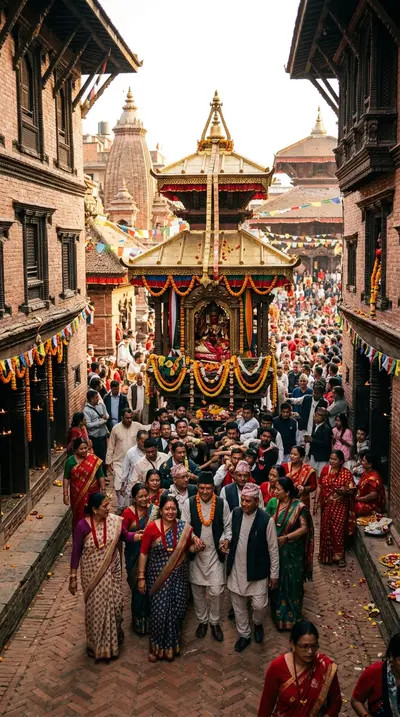
The fourth day is the heart of the festival, and people from Bhaktapur, Lalitpur, Kathmandu and villages far beyond fill the town. In the morning, the four idols and their palanquins are lifted again and taken around the settlements of Sankhu in a long circular route. Devotees line the streets on both sides, and many come from far away just to offer prayer on this day.
The atmosphere is full of sound. Drums beat, cymbals clash, long horns call, and the crowd calls out the name of the goddess. Every few steps the bearers stop and sway the palanquin, to the delight of the cheering crowd. Residents stand on their windows and balconies, throwing flower petals and coloured powder onto the procession as it passes below.
At each main crossing, the palanquin halts for a short ritual, and offerings are placed on it. The whole route can take many hours, because so many people wish to pause and pray. If you are visiting, choose a spot near a small courtyard, where you can see without blocking the road. Travellers who like chariot festivals in Nepal often say that this day is the best moment of the whole spring season.
Bring water, a hat and patience. The sun can be strong in April, and the lanes get very busy by noon. Many guests stay until the evening when the palanquins return to the host house, and the lamps are lit in the courtyards.
On the day after the main procession, the four idols are placed outside a guest house known as the Pahuna Ghar, which means a house for guests. Here the gods sit in the open for ordinary people to worship. There is no rush, no tight route and no heavy crowd, so this is a gentle day for anyone who wants time in front of the idols.
Older people often say the fifth day is the best time for a personal prayer. You can stand in line, place your offering, receive a tika and step aside without any pressure. Children run through the square, sellers set up small stalls with sweets and toys, and the whole town enjoys a slow festival afternoon.
For visitors, the fifth day is also a wonderful chance to talk with local families, who may be sitting outside their homes with tea. Ask permission before taking a portrait, and thank them warmly. An easy friendly talk is often the most memorable part of a trip to Sankhu, and many travellers join a village-style cultural experience tour in Nepal for exactly this reason.
Reports of the middle days differ slightly from year to year, so treat these days as flexible. In general, the sixth and seventh days continue the same spirit of visits, offerings and small processions inside the town, with the gods staying near the host neighbourhood and receiving devotees. Some families invite relatives to a feast at home, which is a part of the Newar tradition of sharing food after a ritual.
These days are quieter than the fourth day but still lovely. You may notice that the streets are cleaner, the crowd is smaller and the musicians play at an easier pace. It is a perfect time for a slow walk, a cup of milk tea, and a look at the old brick houses and wooden windows of the town.
If you are travelling on a tight schedule, you can skip these two days and return for the last day. But if you have time, try to spend at least one night in a guest house, so you can wake up with the bells and see the town before it is busy. A stay in Nagarkot, which sits on a high ridge to the south-east, also gives you beautiful sunrise views of the Himalayas while staying close enough for a short drive to the festival.
On the last day, the festival slowly comes to a close. The idols of Bajrayogini, Nibha Dya, Singli and Byangli are prepared for their journey home. Priests perform the final rituals, and the palanquins are lifted once again as people walk beside them in a farewell procession. Many locals say this is the saddest moment, because the mother goddess is leaving her children for another year.
The procession moves along the same old road toward the hill, and the sound of the bands becomes softer as the path climbs into the forest. When the palanquins reach the temple, the priests place the idols back in their shrine and complete the closing worship. Then the temple returns to its quiet life on the hill until the next spring.
If you want to end your own trip with a small ritual, climb the stone steps to the Bajrayogini temple after the festival. The walk takes some effort, but from the top you can see the roofs of Sankhu below and the green folds of the Manichud hills above. It is a peaceful way to say goodbye to the goddess, and it gives you a view that few tourists ever see.
For readers who like a quick summary, here is the flow of the festival as it is usually described. The exact rituals can change a little from year to year, so always confirm with local guides.
To enjoy the festival you should know who is who. The largest idol is Mhasukhwamaju, the yellow-faced form of Bajrayogini. Beside her rides Nibha Dya, the stupa-shaped image on a wooden carriage, often described as her husband. The two smaller palanquins, carried by children, hold Singli and Byangli, the lion-faced and tiger-faced children.
The way the community treats them is very tender. The little palanquins are a reminder that this is a family festival and that children are part of the ritual from a young age. It is common to see a small boy proudly holding one pole, while his father walks beside him with a watchful hand.
Local people also say that the participation of different groups, including the Tamang community, is what makes the festival feel truly shared by everyone. In a valley where old divisions could easily grow, the jatra shows how a single tradition can stitch neighbours together.
Sankhu is an old town with five ceremonial gates, each with its own role. One of them, the Dhunla gate, is the special entrance for the Bajrayogini chariot and other ritual processions. Another, the Naari gate, is used during the month-long Madhav Narayan festival of winter, when devotees walk to the river to bathe and pray.
The streets inside the gates are paved with old brick and stone, and the houses are decorated with carved wooden struts and tiny courtyards. When you walk along the route of the festival, look upward. Many balconies are filled with elders and children, and some families hang long banners and flags that turn the lane into a tunnel of colour.
Sankhu is also famous for its second great gathering, the Salinadi fair, which happens in the cold months. The two festivals, one in spring and one in winter, are the main reasons why the town is known as a centre of living devotion. A traveller who returns for both will see two very different faces of the same place.
A good festival must be heard and tasted, and Sankhu offers both. The bands include drums, cymbals, horns and small flutes, and they follow the palanquins with a strong, steady rhythm. You may hear the same tune several times a day, and by the end of the week you will find it stuck in your head.
Food is a large part of the joy. Newar households prepare beaten rice with spicy potato and meat, fried lentil cakes called bara, roasted soybean, and rice beer or local spirit that goes by the name aila. Vegetarian travellers can also find fried snacks, sweet curd, fruits and fresh milk tea from small stalls. A plate shared with a family is a proud gift of hospitality.
Colour is everywhere too. Red powder marks foreheads, yellow and orange flowers decorate the palanquins, and bright cloth hangs from balconies. If you enjoy such a vivid atmosphere, you might also like the Holi festival in Nepal, where the streets of the valley become a moving painting. The jatra of Sankhu offers a gentler, more devotional side of that same colour.
The jatra is a religious event first and a photo opportunity second. Please dress modestly with shoulders and knees covered, and remove your shoes when entering temples or houses where rituals are being held. Avoid touching the palanquins, the idols or the offerings unless a priest invites you to do so.
When you take photographs, keep a polite distance and never place a camera in front of a priest or a bearer while the palanquin is moving. Ask before making a portrait, especially of elders and women. A smile and a small namaste will open more doors than any lens. Do not throw powder at people who have not asked for it, since the festival is about devotion and not a party.
Carry small bills and coins for offerings, and keep your bag close in the crowd. If the road is blocked, be patient and let the procession pass. A visitor who behaves with humility becomes part of the community memory, and locals will often call out a friendly greeting when they see you again the following year.
Even outside the jatra, the temple on the hill is worth a visit. A long flight of stone steps leads from the base of the hill through pine forest to the shrine, and the climb usually takes forty-five minutes to an hour at a relaxed pace. Monkeys sometimes sit on the walls, so keep food out of sight.
At the top, the temple is small and quiet. Pilgrims light butter lamps, ring bells and tie prayer flags. The building suffered damage in the 2015 earthquake, and repair work has continued, so parts of it may be covered by scaffolding or support beams when you visit. Yet the atmosphere of deep peace remains as strong as ever.
The hill also has a network of paths that connect to the higher ridge of Manichud. Adventurous walkers can turn this climb into a longer day hike near Kathmandu, with views of terraced fields and the distant white peaks. It makes a good short warm-up for those who plan to try a larger trekking adventure in Nepal later in the season.
Because Sankhu is near several famous places, it is easy to design a rich cultural week around it. A classic order is to spend the first days in the old city, visit the jatra on the fourth day, and end with a quiet stay on a hill. Here is one way to blend the sights in a relaxed way.
Begin with Kathmandu Durbar Square, where the old palace courtyards and temples give you a picture of the valley's royal past. Continue to Patan Durbar Square for its superb metal work and stone carving, and Bhaktapur Durbar Square for its potters and woodcarvers. These three places show the same Newar culture that fills the lanes of Sankhu, and they help you understand the artistic heritage behind the festival.
From there, drive to Changu Narayan, an ancient Vishnu temple on a hilltop with some of the oldest stone carvings in Nepal. It sits close to Sankhu by road, so it works well as a morning stop before the jatra. In the evening, Pashupatinath offers the quiet river-side ritual of the evening aarti, a strong contrast to the noise of the day and a perfect closing for a spiritual journey.
Many visitors come to Nepal for the mountains and only discover the festivals later, but the two go together well. After the jatra, you can start a short Langtang trek, which begins not far to the north of Kathmandu, or a longer route such as the Annapurna trek or the Everest Base Camp trek. Spring is a good season for all three, with mild days and clear morning views.
If you prefer softer travel, a Nepal cultural tour can join the Kathmandu Valley sights with Pokhara's lakes, or with a jungle stay in Chitwan. Those who love ancient trade routes may like a Tsum Valley trek, a remote route that keeps much of the old Tibetan-Buddhist culture, and which pairs beautifully with the Buddhist side of Bajrayogini. The valley is also known for the Tsum Valley Horse Race, a lively event that offers another taste of the Himalayan festival world.
For pilgrims, a pilgrimage tour in Nepal can bring together Sankhu, Swayambhunath, Boudhanath, Namo Buddha and Lumbini, giving a full picture of the Buddhist landscape. Because Enticing Himalayas plans these journeys with local knowledge, guests can join the jatra at the right hour and enjoy a smooth well-timed itinerary.
Nepal has a festival for almost every week of the year, and once you have seen Sankhu, you will want to see more. In late summer, Gai Jatra brings cows and costumes to the streets, and Indra Jatra fills Kathmandu with masked dances, the living goddess Kumari and pulled chariots. In autumn, Dashain is the largest Hindu festival, and Tihar lights every home with lamps.
In spring, the same season as Sankhu, you may also catch Bisket Jatra in Bhaktapur and the great chariot procession of Rato Machindranath in Patan. A little earlier in the year, Holi splashes colours through the valley, and Maha Shivaratri draws thousands of pilgrims to the temple of Pashupatinath. Each one shows a different face of Nepali faith and joy.
Mountain regions also have their own celebrations, such as Lhosar, the Tibetan New Year, and the Tsum Valley Horse Race. A traveller who plans one year around a series of festivals will see how the same cultural thread runs from the temples of the valley to the high Himalayan villages. A good Nepal festival tour can link three or four of these in a single trip.
Sankhu itself has a few small guest houses and home stays, and they are simple but warm. If you want more comfort, the nearby towns and ridges offer a good range. Nagarkot is a favourite for sunrise views, and Dhulikhel offers hotels with wide Himalayan panoramas, while central Thamel gives you restaurants, shops and easy transport.
A home stay is the best choice if you wish to feel the town's rhythm. Families cook fresh meals, tell stories and sometimes invite guests to join a small ritual. Booking early is important, because the festival week is busy and rooms fill fast. If you contact a local operator before you travel, they can arrange a room in the host neighbourhood and even introduce you to the local families.
If your budget is small, you can stay in Kathmandu and travel to Sankhu each morning. Just leave early, carry water and snacks, and be ready for slow traffic on the main festival days. A relaxed daily schedule will keep you fresh, and the return ride in the evening gives you time to think about the day and sort the best photographs.
Spring weather in the valley is generally pleasant, with warm afternoons around twenty-five degrees and cool mornings and evenings. Carry a light jacket, a sun hat, sunscreen, sunglasses, a reusable water bottle and a small first-aid kit. Comfortable walking shoes are important because you will stand and walk for many hours.
Money matters are simple. Bring some cash in small notes for offerings, snacks and transport, because small shops may not accept cards. Keep a photocopy of your passport in your bag, and store the original safely at the hotel. If you need help, a local guide from the festival tour team can handle tickets, transport and timing so you can focus on the experience itself.
Finally, plan your day around the fourth day if you can visit only once. Reach the town early, stay for the morning procession, take lunch in a small local restaurant, and rest in the afternoon shade before watching the palanquins return. Even a single day can leave a lasting impression, and most travellers say they wish they had stayed longer.
Sankhu Bajrayogini Jatra is not the loudest festival in Nepal, and it is not the most famous one on postcards. That is exactly why it is precious. It keeps the old habits of a living town, where gods still travel through the streets and neighbours still carry them together. When a whole community lifts a palanquin, one can feel real devotion that no stage show could copy.
For travellers who want to understand Nepal beyond the mountain views, this jatra is a good teacher. It shows how faith, family, music, food and history can live together in one week, and how a small town can host a goddess with love and pride. It is a lesson in patience and respect that stays long after the red powder has washed away.
If you are ready to see it yourself, explore the places to visit in Nepal, choose a spring date, and let Enticing Himalayas help you shape a journey that includes the jatra, the temples, and perhaps a walk in the hills. Come with an open heart, dress simply, and be ready to smile. The goddess will be waiting on the hill, and the town will be waiting with its open doors.
Key experiences and features
Bajrayogini Jatra
Mother Goddess
Vajrayana
Traditional music
carvings and faces
spring season
prayer
Newar tradition
sunrise views
Recommended packing list
Sankhu, Kathmandu, Bagmati, Nepal
Got questions about this event?
Sankhu Bajrayogini Jatra is an eight-day Newar chariot festival dedicated to Goddess Bajrayogini.
It is celebrated in Sankhu, Kathmandu, around the historic Bajrayogini Temple and surrounding areas.
The traditional festival lasts for eight days, featuring rituals, chariot processions, and cultural activities.
The festival is generally held during Chaitra–Baisakh, according to the Nepali lunar calendar.
Visitors can witness traditional chariots, religious rituals, Newar traditions, music, and community celebrations.
Apr 20, 2027
1 day
Quick Info
More festival experiences
Nov 8 – Nov 8, 2026Kathamandu
 Aug 17 – Sep 16, 2027
Godavari Kunda
 Jan 15 – Jan 16, 2027
Swayambhu Bhuikhhel