 Nov 8 – Nov 8, 2026
Kathamandu
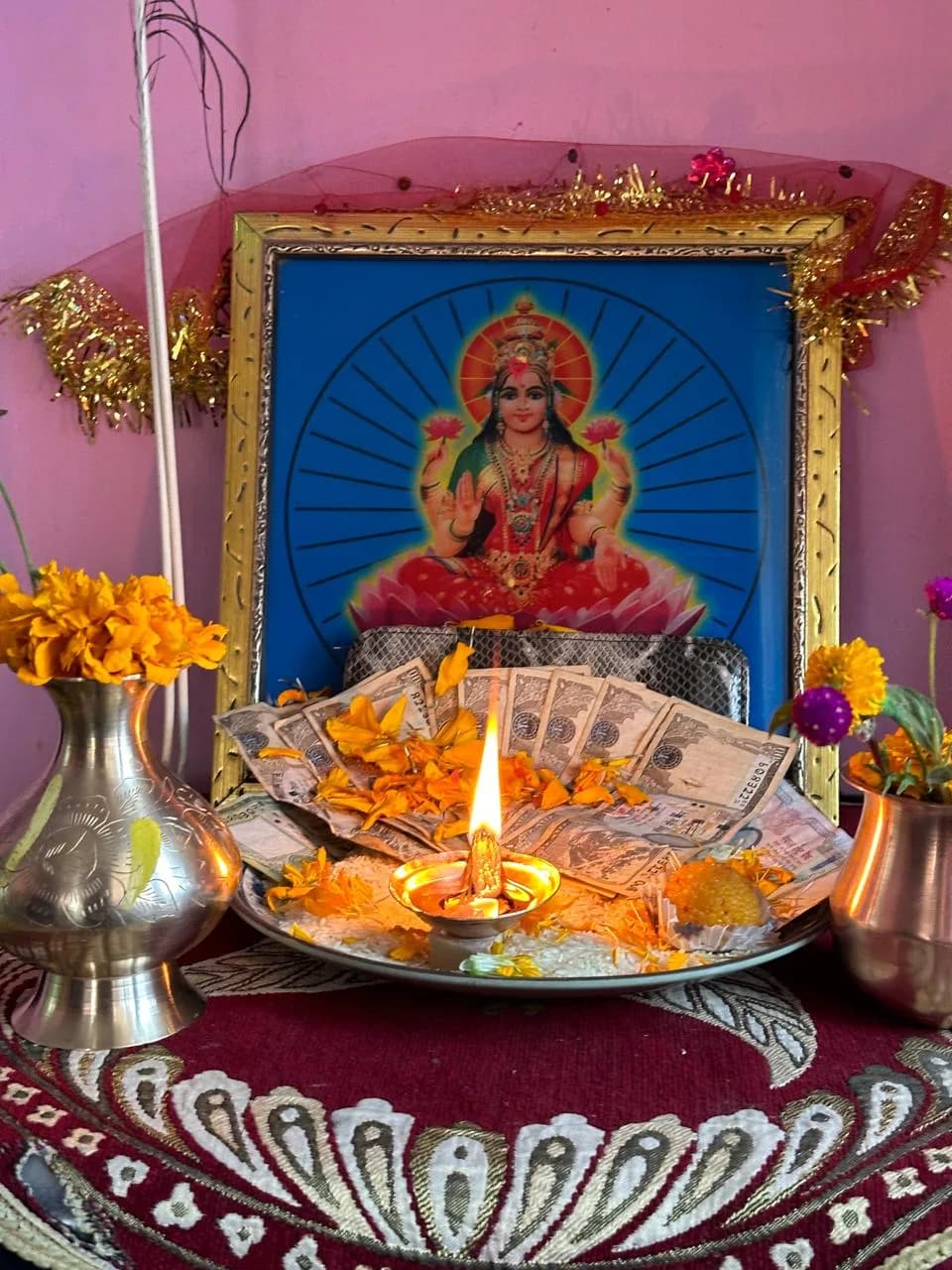
Laxmi Puja 2026 in Nepal: Tihar Festival Guide
Festival
1 Tag
Festival
Free
Kathamandu1 Tag
Event Details
Loading...
Event starts in
Every year, as the cold winds begin sweeping down from the high Himalayas and the harvest season draws to a close, the Kirat communities of eastern Nepal come together for one of their most cherished observances: Udhauli Parva. It is a festival built around gratitude, migration, and the deep bond between people and nature, and it remains largely unknown outside the communities that celebrate it, which makes it one of the more authentic cultural experiences available for anyone exploring Nepal beyond its usual mountain routes. For the Rai, Limbu, Sunuwar, and Yakkha peoples, Udhauli is not simply a seasonal marker but a living expression of identity, ancestry, and thanksgiving that has continued largely unchanged for generations, even as the country around it has modernized rapidly. It offers a striking counterpoint to Nepal's more widely known Hindu and Buddhist festivals, rooted instead in indigenous shamanic tradition and a worldview that treats the natural world as an active spiritual partner rather than a passive backdrop to daily life.
Udhauli, which translates roughly to "going down," refers to the traditional downward migration Kirat communities once made from higher hill settlements to warmer, lower-elevation areas as winter approached. In earlier centuries, this was a practical necessity rather than a symbolic gesture, since surviving harsh winters at higher altitudes without modern heating or infrastructure was genuinely difficult. Over time, this seasonal movement became woven into a broader spiritual framework, and today Udhauli stands as a formal thanksgiving festival, offered to Mother Nature in gratitude for a successful harvest and as a plea for continued protection and abundance in the year ahead.
The festival is closely paired with its counterpart, Ubhauli, which takes place roughly five months later in April or May and marks the upward migration back toward the hills as summer begins. Together, these two festivals reflect a cyclical understanding of life drawn directly from the Mundhum, the sacred oral scripture of the Kirat people, in which the rhythm of ascent and descent mirrors the passage of the year itself. Udhauli is sometimes referred to as Sakela Udhauli, tying it to the wider Sakela festival tradition observed by Rai and other Kirat sub-groups.
Kirat mythology traces the roots of this festival back to a story involving Paruhang, a heavenly god, and Sumnima, an earthly goddess. According to the traditional account, Paruhang saw Sumnima on earth and fell in love with her, eventually presenting her with a comb as a gesture of proposal. Their union, described as the marriage of heaven and earth, produced children who are considered the mythological ancestors of the Kirat people. This story underpins much of the symbolism found in Udhauli's rituals, particularly the emphasis on fertility, harvest, and the sacred connection between the natural and spiritual worlds.
Historically, the Kirat people are recorded as having ruled parts of the Kathmandu Valley and surrounding regions for roughly 1,225 years, from around 800 BC to 300 AD, across a lineage of 29 kings. While that political history belongs to a much earlier chapter of Nepal's story, the cultural and spiritual practices tied to that era, including the seasonal worship reflected in Udhauli, have persisted largely intact within present-day Kirat communities in the eastern hills.
Udhauli falls on the full moon day, or Purnima, of the Nepali month of Mangsir, which typically corresponds to late November or early December on the Gregorian calendar. In 2026, the festival falls on December 24, corresponding to Poush 9 in the Nepali calendar for that year, since the exact solar date shifts annually based on the lunar cycle. Because of this variability, anyone hoping to plan travel around the festival should confirm the specific date closer to the year in question, ideally by checking a current Nepali calendar alongside the Nepal travel homepage and a resource like the Nepal festival and events calendar, which can help cross-reference Udhauli against other observances happening around the same window.
Unlike fixed national holidays, Udhauli is primarily observed within Kirat-majority districts, meaning the scale of celebration and the degree to which daily life pauses for the occasion varies significantly depending on location. Districts such as Khotang, Bhojpur, Dhankuta, Taplejung, Panchthar, Ilam, and Sunsari see the most visible and organized celebrations, while smaller Kirat communities elsewhere mark the day with more modest, family-based observance.
The day typically opens with households cleaning their homes and courtyards, a practice believed to prepare the space for blessings tied to the harvest season. Family shrines are attended to early, with offerings of rice, local grain, and flowers placed before household deities and ancestral spirits. In many villages, a designated shaman or spiritual practitioner, known locally as a Nakchhong or Mangpa depending on the specific Kirat sub-group, performs an opening ritual meant to invoke protection and continued prosperity for the community in the months ahead.
Morning hours are also when many families make their first offerings directly tied to the harvest itself, presenting portions of newly gathered crops as a gesture of thanks. This is treated as a solemn part of the day, carried out with focus and respect before the more festive, communal elements of Udhauli begin later on. Elders often use this quieter period to pass down oral knowledge to younger family members, reinforcing the intergenerational transmission that keeps Kirat tradition alive.
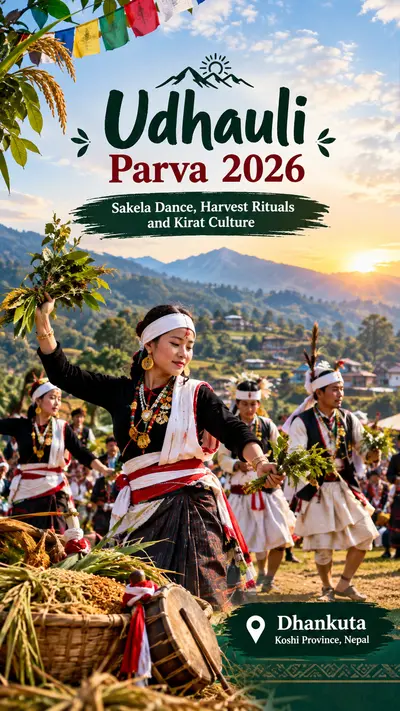
By midday, Udhauli shifts into its most visually striking phase: the Sakela dance. Performed in open fields, courtyards, and designated community gathering grounds, this ancient circular dance involves large groups moving in coordinated, rhythmic patterns to the beat of traditional drums, most notably the dhol and jhyamta cymbals. The dance is led by a Mangpa or Nakchhong, whose movements and chants guide the group through a sequence said to represent the stages of agricultural life, from sowing and growth through harvest and renewal.
These gatherings draw entire villages together, with participants ranging from young children learning the steps for the first time to elders who have performed the same dance for decades. In larger towns such as Dhankuta, Khotang, and Bhojpur, the midday Sakela celebration can draw crowds numbering in the hundreds or more, transforming open ground into a vibrant display of color, music, and movement. For visitors, this is typically the most accessible and rewarding part of the day to witness, since it is inherently public and communal rather than restricted to private household ritual.
As the dancing winds down in the late afternoon, attention turns toward food and shared celebration. Communal feasts are prepared, often featuring millet-based dishes, locally distilled beverages, and meat prepared according to traditional methods. Sharing this meal across family and neighboring households is considered an important part of reinforcing the community bonds that Udhauli is meant to strengthen, and guests, including respectful outside visitors, are frequently welcomed to join.
As evening sets in, smaller closing rituals take place at household shrines, offering final thanks for the day and, symbolically, for the harvest season as a whole. In some communities, storytelling continues into the night, with elders recounting portions of the Paruhang and Sumnima legend or other Mundhum narratives tied to the festival's origins. This closing period tends to be quieter and more reflective, mirroring the tone of the morning and bringing the day full circle from solemn ritual to joyful celebration and back again.
The most vibrant and accessible Udhauli celebrations take place across the eastern hill districts, particularly Khotang, Bhojpur, Dhankuta, Pathari, Kanepokhari, and Kerabari, alongside Taplejung, Panchthar, and Ilam. Each location brings its own local variation in dance style, dress, and ritual detail, shaped by the specific Kirat sub-group most prevalent in that area. Travelers interested in comparing these regional differences can review the broader destinations across eastern Nepal to understand which towns align most closely with their travel dates and interests, whether that leans toward the Sakela dance itself or the surrounding natural landscapes of the hill districts.
Dhankuta in particular has become known as a relatively accessible base for witnessing Udhauli, offering more established infrastructure and lodging options that can be found among current Nepal tour packages, than some of the more remote celebration sites, while still providing genuine, community-led festivities rather than a staged tourist version of the event. Khotang and Bhojpur, while less developed for tourism, offer a more immersive and less commercialized experience for travelers willing to arrange transport and lodging further in advance.
Clothing worn during Udhauli often reflects the specific Kirat sub-group celebrating, with Rai and Limbu communities each maintaining distinct patterns, colors, and jewelry styles passed down through generations. Women frequently wear elaborate headpieces and beaded necklaces alongside traditional woven fabric, while men often dress in attire suited to the physical demands of the Sakela dance itself. These clothing choices are not incidental; they serve as a visible, wearable form of cultural memory, and many families take considerable pride in maintaining pieces inherited from earlier generations specifically for use during Udhauli and its counterpart, Ubhauli.
Music plays an equally central role, with the dhol drum providing the rhythmic backbone for the Sakela dance and the jhyamta cymbals adding sharp, punctuating accents throughout. These instruments are typically played by designated musicians who train from a young age, and the specific rhythms used during Udhauli differ notably from those reserved for Ubhauli, reflecting the different agricultural and seasonal themes each festival represents. Offerings of rice, grain, and flowers placed at household shrines throughout the day serve as further symbols tied directly to the harvest theme at the heart of the celebration.
While Udhauli and Ubhauli are frequently mentioned together, and are sometimes assumed by outsiders to be the same event, they mark distinctly different points in the agricultural and seasonal calendar. Udhauli, occurring in late November or December, centers on gratitude for a completed harvest and marks the symbolic downward migration toward warmer areas as winter approaches. Ubhauli, occurring around April or May, instead celebrates the beginning of the new farming cycle and the symbolic upward migration back toward the hills as summer arrives.
Both festivals share the Sakela dance as a central element, but the specific rhythms, chants, and ritual emphasis differ between the two. Udhauli tends to carry a slightly more reflective, thanksgiving-oriented tone, given its association with the close of the harvest year, while Ubhauli leans toward themes of renewal and new beginnings. Understanding this distinction helps travelers and researchers avoid conflating the two occasions, since each offers a genuinely different atmosphere and seasonal context despite their shared roots in Kirat tradition.
As travel interest in Nepal continues shifting toward more meaningful, less commercialized experiences, festivals like Udhauli offer an increasingly valuable alternative to conventional mountain-focused itineraries. Rather than observing culture from a distance, visitors who attend Udhauli in a respectful, low-impact way are able to witness a living tradition that has been maintained through direct community effort rather than tourism-driven revival. This distinction matters both for the authenticity of the experience and for ensuring that tourism interest supports rather than distorts the practices being observed.
For operators and travelers alike, festivals such as Udhauli also help diversify the regions of Nepal that benefit economically from tourism, drawing attention toward eastern hill districts that receive far less visitor traffic than the Everest or Annapurna regions. Anyone building an itinerary around this goal can browse relevant Nepal tour packages covering the eastern hills that already include stops in Kirat-majority districts, then adjust timing to align with the specific Mangsir Purnima date for the year of travel.
Because Udhauli celebrations are spread across multiple districts rather than concentrated in a single well-known location, planning ahead matters considerably. Confirming the exact date well in advance is essential, since it shifts each year according to the lunar calendar rather than falling on a fixed Gregorian date. Travelers should also expect more limited accommodation options in smaller towns such as Khotang or Bhojpur compared to larger hubs, and booking lodging early or arranging a stay in a more established base like Dhankuta is generally the safer approach.
Respectful participation matters just as much as logistics. Visitors are generally welcome to observe or even join community feasting and dancing, provided they approach the occasion with genuine curiosity rather than treating it purely as a photo opportunity. Asking permission before photographing rituals, dressing modestly, and following the lead of local hosts regarding when to observe quietly versus when to participate actively all go a long way toward ensuring the visit remains respectful of the community hosting the celebration.
At the heart of Udhauli lies a worldview in which nature is not simply a backdrop to human life but an active, sacred force deserving of direct engagement. Kirat spiritual practice draws heavily on shamanism, with practitioners believed capable of communicating with natural and ancestral spirits on behalf of the community. This belief system treats forests, rivers, and agricultural land as inhabited by spiritual presence, which explains why so much of Udhauli's ritual content centers on offerings made directly to nature rather than to a distant or abstract deity.
This worldview also shapes how Kirat communities historically approached agriculture itself, favoring practices believed to maintain balance with natural cycles rather than working against them. Udhauli, occurring precisely at the seasonal transition into winter, functions as a formal checkpoint within this broader relationship, a moment to acknowledge what nature has provided over the previous farming cycle before the community turns its attention toward survival through the colder months ahead. Understanding this underlying philosophy makes the festival's specific rituals, from grain offerings to the symbolic downward migration, considerably easier to appreciate in context.
The Mundhum, the extensive oral scripture of the Kirat people, provides much of the structural and symbolic foundation for Udhauli. Passed down through generations by shamans and community elders rather than through written text for most of its history, the Mundhum contains creation narratives, ritual instructions, and moral teachings that continue to inform how festivals like Udhauli are conducted today. The story of Paruhang and Sumnima, central to Udhauli's origin, is drawn directly from this tradition, as are many of the specific chants and invocations used during the day's rituals.
Because the Mundhum exists primarily through oral transmission, festivals such as Udhauli also function as informal preservation mechanisms, ensuring that specific stories, songs, and ritual sequences continue being taught to younger generations through direct participation rather than academic study alone. This is part of why community elders take the responsibility of leading rituals so seriously, viewing their role not merely as ceremonial but as an active act of cultural transmission that keeps the wider Mundhum tradition alive for the future.
Visitors researching Udhauli for the first time often want to know whether outsiders can attend, and the general answer is yes, provided visitors remain respectful of the ritual and communal nature of the occasion. Since Udhauli is fundamentally a community-led celebration rather than a tourist performance, showing genuine interest, following local guidance, and avoiding disruptive behavior during rituals goes a long way toward being welcomed rather than viewed as an intrusion.
Another frequent question concerns the difference between Udhauli as celebrated by different Kirat sub-groups, since Rai, Limbu, Sunuwar, and Yakkha communities each maintain slightly different variations in dance style, dress, and specific ritual sequence. While the core meaning, thanksgiving for the harvest and the symbolic downward migration, remains consistent, travelers hoping to witness a specific regional variation should research the particular district and community they plan to visit rather than assuming the celebration will look identical everywhere.
Because Udhauli celebrations are concentrated in eastern Nepal, a trip built around the festival naturally opens the door to a region that receives far less international visitor traffic than the Everest or Annapurna areas. Beyond the festival itself, districts such as Ilam offer expansive tea gardens and quiet hillside viewpoints, while Taplejung provides access toward the eastern approach of Kanchenjunga for travelers with additional time for trekking. Dhankuta and Bhojpur add further layers of small-town charm, market culture, and scenic hill terrain rarely covered in mainstream travel guides.
Structuring a trip this way allows Udhauli to serve as one meaningful highlight within a broader regional itinerary rather than the sole focus of the journey, spreading both interest and economic benefit across multiple communities rather than concentrating it around a single event. Anyone planning such a route can start from the wider list of Nepal destinations before narrowing in on the specific eastern districts that align with both the Mangsir Purnima date and personal travel interests, whether that leans toward cultural festivals, tea culture, or slower community-based travel.
While the Sakela dance has already been described as the visual centerpiece of Udhauli, it deserves a closer look given how central it is to the day's identity. The dance unfolds in concentric circles, with participants moving in coordinated steps that shift in tempo and formation as the performance progresses through distinct phases. Each phase is believed to represent a different stage of the agricultural cycle, beginning with movements associated with sowing seeds, progressing through steps representing growth and cultivation, and concluding with more energetic sequences tied to the harvest itself.
The Mangpa or Nakchhong leading the dance holds a position of significant respect within the community, often training for years under a senior practitioner before being entrusted with leading a full ceremony. Their chants, delivered in a rhythmic, almost trance-like cadence, guide dancers through transitions that would otherwise be difficult to coordinate across large groups. Spectators, including respectful outside visitors, are generally welcome to watch from the edges of the dancing ground, and in many communities, onlookers are eventually invited to join the outer rings of the circle once the initial ceremonial sequences have concluded, turning observation into participation as the celebration progresses into the afternoon.
Like many indigenous festivals worldwide, Udhauli faces ongoing pressure from urban migration, as younger generations increasingly move toward Kathmandu or abroad for education and employment. Community leaders and cultural organizations have responded by documenting rituals more formally, recording chants and dance sequences, and organizing youth-focused workshops aimed at teaching Sakela steps and Mundhum stories to children who may not grow up immersed in a fully traditional village setting.
These preservation efforts have made Udhauli somewhat more visible beyond Kirat communities themselves, drawing modest attention from researchers, cultural organizations, and increasingly from travelers interested in Nepal's indigenous heritage. This growing outside interest, when approached respectfully, can actually support these preservation goals by reinforcing the value of maintaining the tradition, provided it does not tip into treating the festival as a spectacle staged primarily for outside consumption rather than a genuine community observance carried out on its own terms.
Udhauli Parva stands as one of the clearest expressions of how deeply Nepal's Kirat communities remain connected to the rhythms of nature, ancestry, and seasonal change. From the quiet morning rituals performed at household shrines to the energetic Sakela dance filling village courtyards by midday, and finally to the shared feasts and closing prayers of the evening, the festival moves through a full emotional arc in a single day. For travelers genuinely interested in Nepal's cultural depth rather than its most photographed landmarks, exploring the full range of Nepal travel experiences alongside a closer look at eastern Kirat festivals like Udhauli offers a far richer understanding of the country than the mountains alone can provide. Approaching the day with patience, respect, and genuine interest is ultimately what turns a simple visit into a meaningful encounter with one of Nepal's oldest living traditions.
Key experiences and features
Udhauli Parva
Kirat communities
Sakela Udhauli
Gregorian calendar
Sakela Dance
dhol and jhyamta
Mangpa or Nakchhong
Recommended packing list
Dhankuta, Dhankuta, Koshi Province, Nepal
Got questions about this event?
Udhauli Parva is a major Kirat festival associated with the harvest season, nature, ancestors and community traditions.
Udhauli is observed according to the Kirat lunar calendar and generally falls around the full moon of Mangsir. The exact date should be confirmed with the relevant annual calendar and local organizers.
Sakela is a traditional Kirat group dance performed during important cultural celebrations. Dancers move together in coordinated formations accompanied by traditional music and gestures representing aspects of nature and community life.
Important celebrations can be found in eastern Nepal, including Dhankuta, Khotang, Bhojpur, Solukhumbu, Sunsari, Morang and other areas with Kirat communities.
Yes. Visitors can observe public cultural programs and Sakela performances while respecting local religious practices and community guidelines.
Dec 4, 2026
1 day
Quick Info
More festival experiences
Nov 8 – Nov 8, 2026Kathamandu
 Aug 17 – Sep 16, 2027
Godavari Kunda
 Jan 15 – Jan 16, 2027
Swayambhu Bhuikhhel