 Mar 23 – Mar 7, 2027
Kathmandu
Seto Machindranath Jatra 2027: Kathmandu’s Sacred Festival
Culture
5 days
Festival
Free
Kathmandu 5 days
Event Details
Loading...
Event starts in
Chasok Tangnam is one of the most important traditional festivals of the Limbu or Yakthung community of Nepal, particularly associated with eastern Nepal and the harvest season. It is commonly described as a Limbu harvest festival, Nwagi festival, and a celebration of gratitude toward nature, ancestors, deities, and the sources of agricultural abundance. The festival is deeply connected with Mundhum, the oral religious and cultural tradition of the Yakthung people. After crops are harvested, newly produced food is traditionally offered before it is consumed by the community. This practice expresses gratitude and recognizes the relationship between human beings, nature, agriculture, and spiritual traditions. Modern Chasok Tangnam celebrations can also include traditional dances, music, cultural programs, community gatherings, food, costumes, and social exchanges, making it an important cultural experience for visitors interested in indigenous festivals of Nepal. Cultural sources describe Chasok as the ritual of offering newly harvested crops, while Tangnam refers to the festival or celebration.
The meaning of Chasok Tangnam becomes
clearer when the two parts of the name are understood in their cultural
context. Chasok refers to the offering of newly harvested food, while Tangnam
refers to a festival or celebration. The tradition therefore connects the
physical harvest with a spiritual expression of gratitude. Rather than eating
newly harvested crops immediately, the community traditionally recognizes the
spiritual and cultural relationship behind the food by offering it first. This
practice reflects the importance of agriculture in traditional Limbu society
and demonstrates how food can carry religious, social, and historical meaning.
Chasok Tangnam is consequently much more than a seasonal party. It is a
celebration of the connection between people and the land that sustains them.
For travelers researching Nepal cultural festivals, the festival provides an
opportunity to understand eastern Nepal through indigenous heritage rather than
viewing the region only through mountains and landscapes.
Chasok Tangnam is also widely known as
Nwagi, a term associated with the practice of offering and consuming newly
harvested crops. Traditional descriptions explain that Limbu families
historically performed these rituals within their own households, often with
the involvement of a religious specialist. Over time, Chasok Tangnam has
increasingly developed into a larger community celebration, particularly in
towns and areas where Limbu people live outside their traditional villages.
This transition from primarily household-based rituals toward larger public
cultural events shows how traditions can adapt while retaining their central
identity. The essential idea remains the same: newly harvested food is treated
with respect and offered before being consumed. Visitors interested in
traditional Nepalese festivals can therefore see Chasok Tangnam as an example
of cultural continuity, where ancient agricultural practices remain meaningful
even as communities become increasingly urban and globally connected.
The Limbu people, who commonly use the
name Yakthung, are one of the important indigenous communities of Nepal, with
deep historical and cultural roots in the eastern Himalayan region. Their
cultural heritage includes language, oral literature, religious traditions,
music, dance, clothing, food, agriculture, social customs, and distinctive
forms of community organization. Chasok Tangnam brings many of these elements together
because the festival is connected with the agricultural cycle and the cultural
worldview expressed through Mundhum. The festival should therefore be
understood as part of a wider Yakthung cultural heritage, rather than as an
isolated event. Travelers who want to explore this heritage can begin with the Eastern
Nepal cultural destinations, where the
geography of the region provides an important background for understanding
Limbu communities, traditional settlements, landscapes, and cultural practices.
Eastern Nepal provides the geographical
and cultural setting in which Chasok Tangnam has developed. Districts such as
Taplejung, Panchthar, Ilam, Tehrathum, Dhankuta, Sankhuwasabha, and surrounding
areas contain communities with strong Limbu cultural connections. The landscape
includes hills, forests, agricultural terraces, rivers, villages, and mountain
environments. These surroundings are important because traditional Limbu
culture has historically been closely connected with farming and nature. A
journey through Eastern Nepal destinations can therefore add geographical context to the festival
experience. Instead of visiting only an organized urban cultural program,
travelers can explore the wider environment in which agricultural traditions,
community life, and oral heritage developed. The region also provides
opportunities to combine cultural travel with nature tourism, village
experiences, hiking, local food, and Himalayan viewpoints, creating a broader
understanding of eastern Nepal.
The heart of Chasok Tangnam is the
agricultural cycle. Traditional Limbu communities have historically depended
heavily on farming, and the completion of the harvest represented a significant
moment in the yearly rhythm of village life. Crops such as rice, millet,
buckwheat, and other locally cultivated foods could become part of the new
harvest. The festival recognizes that food does not appear independently; it
comes through seeds, soil, rainfall, sunlight, labor, animals, forests, water,
and human cooperation. The first harvest therefore becomes an opportunity to express
gratitude. This agricultural connection makes Chasok Tangnam particularly
relevant for travelers interested in agrarian culture in Nepal and traditional
relationships between communities and their environment. The festival also
demonstrates how indigenous calendars and celebrations often developed in
response to seasonal changes and agricultural requirements rather than simply
following modern fixed dates.
One of the strongest themes associated
with Chasok Tangnam is the relationship between nature and spirituality.
Cultural sources describe the festival as a celebration in which newly
harvested crops are offered to deities and spiritual forces before people
consume them. This reflects a worldview in which humans are not completely
separate from the natural world. Food, forests, water, land, ancestors,
animals, and spiritual beings can all be understood as part of an
interconnected system. Such ideas are especially valuable for travelers who
want to explore the meaning behind indigenous spirituality in Nepal. The nature
and spiritual destinations of Nepal provide a
wider context for comparing the country's many traditions of nature worship,
pilgrimage, sacred landscapes, and seasonal festivals.
Mundhum occupies a central position in
understanding many Yakthung traditions, including Chasok Tangnam. Rather than
being understood simply as a written religious scripture, Mundhum is strongly
connected with oral knowledge, narratives, ritual instructions, ancestral
memories, cultural philosophy, and explanations of relationships between human
beings, nature, and spiritual forces. Cultural accounts of Chasok Tangnam explain
the festival through Mundhumic traditions concerning agriculture and the first
offering of crops. This demonstrates why the festival is important beyond the
harvest itself. It carries memories about how the community understands its
origins and relationship with agriculture. Travelers interested in Nepal's
indigenous cultural heritage can explore
Chasok Tangnam alongside other articles about ethnic communities, traditional
celebrations, spiritual practices, and cultural destinations.
Traditional explanations of Chasok
Tangnam include stories about early ancestors learning agriculture and the
importance of offering the first harvest before eating it. Different oral
accounts may describe the origins of agriculture and the relationship between
humans and spiritual beings in different ways. These stories should be treated
as cultural traditions rather than presented as scientifically verified
historical events. Their importance lies in what they communicate about
Yakthung worldview and cultural memory. The first harvest becomes meaningful
because it represents the relationship between people, ancestors, nature, and
the knowledge required to survive. This is one reason the festival remains
culturally significant even when many participants no longer depend entirely on
subsistence agriculture. The stories preserve an understanding of why
gratitude, respect, and community remain important.
Yuma Sammang is an important spiritual
figure within descriptions of Limbu traditions and is associated with the
relationship between the community, nature, and spiritual life. Chasok Tangnam
includes offerings connected with deities and spiritual forces recognized
within Yakthung traditions. For visitors, it is important to understand these
beliefs respectfully rather than reducing them to simple mythology or
entertainment. The religious dimension of the festival is part of a living
cultural tradition maintained by community members. Travelers exploring sacred
places of Nepal can gain a broader perspective by
comparing the ways different communities understand mountains, forests, rivers,
temples, monasteries, and agricultural landscapes. Chasok Tangnam provides a
particularly clear example of a festival in which nature worship, agriculture,
and community identity remain connected.
Chasok Tangnam is closely associated with
the Udhauli season within broader Kirat cultural understanding. Different Kirat
communities use different names for their corresponding celebrations. Among the
Limbu, Chasok Tangnam is the name commonly associated with the harvest
celebration, while other Kirat communities have their own terminology and
ritual traditions. The Kathmandu Post has reported that Rai, Yakkha, Sunuwar,
and Limbu communities use different names for related Udhauli celebrations,
while the Limbu community observes Chasok Tangnam. This relationship is useful
for travelers because it shows that Nepal's Kirat festivals contain both shared
seasonal ideas and distinct community identities. Visitors can explore Kirat
cultural destinations in Nepal to understand
how similar seasonal themes are expressed through different languages, dances,
rituals, and traditions.
The timing of Chasok Tangnam can vary
depending on traditional practice, community organization, and the calendar
used. It is generally associated with the harvest period in late autumn and
early winter, and public celebrations are often connected with Mangsir Purnima.
Some cultural sources emphasize that historically the festival was tied more
directly to when crops were harvested and stored rather than one universally
fixed Gregorian date. This is important when planning cultural travel.
Published calendars may give different dates, especially when traditional lunar
calendars and modern calendar conversions are compared. Travelers should
confirm the current year's local program before making bookings. In 2025, for
example, Nepali reporting described Chasok Tangnam celebrations around Mangsir
Purnima in early December. Travelers can monitor Nepal
festival and cultural travel updates before
planning their itinerary.
Although the roots of Chasok Tangnam are
strongly connected with rural agriculture, the festival is now also celebrated
in urban areas where Limbu communities have established cultural organizations
and social networks. Cities such as Dharan and Kathmandu can host large public
programs involving traditional dances, music, speeches, cultural exhibitions,
food, and community gatherings. These events provide younger generations with
opportunities to experience their heritage even when they live far from
ancestral villages. This urban transformation is an important part of modern
Limbu cultural preservation. It shows that a traditional festival can move from
household and village settings into contemporary public spaces without
completely losing its identity. Travelers interested in Kathmandu
cultural experiences may encounter
Chasok Tangnam events alongside many other ethnic and religious festivals
celebrated in Nepal's capital.
Historically, Chasok was often observed
at the household level, with families conducting rituals after the harvest.
Cultural sources explain that a portion of the new crop was offered to
household deities before people began consuming it. Religious specialists could
be invited to conduct or guide rituals depending on local customs. This
household dimension is important because it reminds visitors that the public
festival is only one expression of the tradition. The deepest cultural meaning
can exist within families and communities away from large stages. Modern public
celebrations may feature thousands of people, but the basic principle of
gratitude for the new harvest remains connected with household practice. This
is one reason visitors should approach public Chasok programs with respect and
recognize that they represent a much wider living tradition.
At its simplest level, Chasok Tangnam can
be understood as a celebration of gratitude. The community gives thanks for
food, successful cultivation, family, nature, ancestors, and the knowledge
passed between generations. Such gratitude is particularly significant in an
agricultural culture because a harvest depends on many conditions beyond human
control. Rainfall, sunlight, soil quality, pests, temperature, and natural
events can all affect agricultural production. A successful harvest therefore
becomes a reason for celebration. This message gives Chasok Tangnam relevance
beyond the Limbu community. Visitors can appreciate the universal idea that food
represents labor, nature, and cooperation. The festival provides an opportunity
to think about where food comes from and how traditional societies developed
cultural practices that acknowledge their dependence on the environment.
Food is an important part of Chasok
Tangnam celebrations because the festival centers on newly harvested crops.
Traditional meals can vary according to location, household, availability, and
community practice. Rice, millet, fermented foods, vegetables, meat dishes, and
locally prepared drinks may be part of festive gatherings. Tongba, a
traditional millet-based fermented beverage, is also strongly associated with
many eastern Nepal cultural experiences, although its role can differ between
families and events. Travelers should experience local food respectfully and
avoid assuming that every public program follows identical customs. Food
provides one of the most accessible ways to understand the agricultural
foundation of the festival. Visitors interested in Nepal
food and cultural experiences can explore how
regional ingredients, farming systems, festivals, and family traditions connect
across Nepal.
Traditional clothing contributes strongly
to the visual identity of Chasok Tangnam. During public celebrations, community
members may wear traditional Limbu garments and jewelry, particularly when
participating in cultural performances. Clothing can communicate identity, age,
community, gender, occasion, and cultural pride. However, visitors should
remember that traditional clothing is not simply a costume created for
tourists. For many participants, it represents heritage and belonging.
Photography should therefore be approached respectfully, particularly when
photographing individuals rather than public performances. A cultural festival
can provide an excellent opportunity to learn about Limbu traditional dress,
but the emphasis should remain on understanding the culture rather than
treating clothing as an exotic visual object.
One of the most recognizable cultural
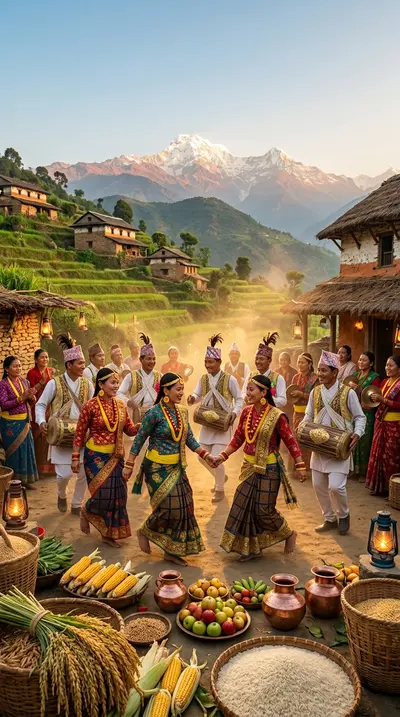
performances associated with Chasok Tangnam is Dhaan Nach, often connected with
the term Yalang. The dance is performed by participants holding hands and
moving rhythmically, and it has strong cultural significance within Limbu
communities. The Kathmandu Post has documented traditional dances including
paddy dance, Chyabrung, Palam, Khayali, and Hakpare during Chasok Tangnam celebrations.
Yalang is especially interesting because it can become a social space where
young people and older generations participate together. For travelers,
watching or learning about Yalang provides insight into how dance functions as
social heritage, not simply entertainment. Cultural performances are often
strongest when the community itself controls the meaning and setting of the
tradition.
Chyabrung, often referred to in
connection with Kelang, is another important element of Limbu cultural
performance. The Chyabrung is a traditional drum associated with the community,
and its rhythm contributes to the energy of festival gatherings. During Chasok
Tangnam, groups may perform Chyabrung dances as part of public cultural
programs. The sound of the drum can transform an open community space into a
lively cultural gathering, bringing participants together through rhythm and
movement. For visitors interested in traditional music of Nepal, Chasok Tangnam
provides a valuable opportunity to experience a form of musical heritage that
is deeply tied to community identity. Travelers can learn more about eastern
Nepal's musical traditions through cultural
travel experiences in Nepal.
Palam is another important element of
Limbu cultural expression and can be associated with Chasok Tangnam gatherings.
It is connected with singing and social interaction, particularly among young
people. Traditional songs can preserve stories, emotions, cultural values,
relationships, and memories that are difficult to communicate through written
descriptions alone. During a festival, music therefore becomes a form of
cultural communication. Visitors who hear Palam should understand that they are
experiencing more than a musical performance. It can be part of a social
environment in which people communicate through traditional artistic forms. The
continuation of these practices demonstrates the importance of oral heritage in
Nepal and explains why cultural festivals remain significant even in an
increasingly digital society.
Chasok Tangnam can also include
traditional games and recreational activities, particularly in larger community
celebrations. Historical and contemporary descriptions mention activities such
as Paklung Lepma, a traditional stone-throwing or strength-related game, along with
music, dancing, singing, and social gatherings. These activities create
opportunities for people of different generations to interact. A festival is
therefore not limited to ritual or performance; it can become a space for
social relationships, friendly competition, storytelling, food sharing, and
community celebration. For travelers, observing traditional games can provide a
more everyday perspective on cultural heritage. Instead of focusing only on
ceremonial moments, visitors can watch how people interact naturally during the
broader celebration.
Another important social dimension of
Chasok Tangnam is family reunion. Cultural reporting describes the festival as
an opportunity for relatives and friends who may not have met throughout the
year to gather, exchange greetings, share food, and celebrate together. This
social role is particularly important because festivals create predictable
moments when communities reconnect. Modern migration means many people live away
from their ancestral villages, making cultural festivals important
opportunities for maintaining relationships. Chasok Tangnam therefore functions
as both a religious celebration and social gathering. Travelers visiting
eastern Nepal during the festival may notice that the most meaningful moments
often occur away from formal performances, when families and friends gather to
share meals, stories, music, and memories.
The importance of Chasok Tangnam extends
to Limbu cultural identity. In modern Nepal, indigenous communities have
increasingly emphasized the preservation and public recognition of their
languages, traditions, rituals, and historical narratives. Festivals provide
visible spaces where these identities can be expressed collectively. Cultural
events in cities can bring together people from different generations and
backgrounds, creating opportunities for younger people to learn traditions from
elders. This process is especially significant for communities whose members
have migrated away from traditional settlements. Chasok Tangnam becomes a
bridge between village heritage and contemporary life. Travelers exploring Nepal's
indigenous cultural destinations can
appreciate how festivals contribute to maintaining cultural diversity across
the country.
Cultural preservation in Nepal is not
simply about maintaining old objects or buildings. It also involves protecting
languages, songs, dances, oral traditions, ritual knowledge, agricultural
practices, clothing, food, and community relationships. Chasok Tangnam brings
many of these forms together in one celebration. When young people participate
in Yalang, Chyabrung, Palam, traditional clothing, and food preparation, they
are not merely attending an event; they are participating in cultural
transmission. Digital media and social networks have also allowed diaspora
communities to maintain connections with festivals from outside Nepal.
Travelers can support this process by learning about the culture accurately,
avoiding stereotypes, and supporting locally organized experiences rather than
demanding that traditions be modified for entertainment.
Elders play an important role in
maintaining knowledge about Chasok rituals and Mundhum traditions. Oral
cultures depend heavily on transmission from one generation to another, meaning
that knowledge can be preserved through storytelling, ritual instruction,
songs, family practices, and community participation. A young person may learn
the meaning of a ceremony not from a textbook but through observing parents,
grandparents, cultural specialists, and community leaders. This makes festivals
valuable educational spaces. The continuity of Chasok Tangnam therefore depends
not only on public celebrations but also on everyday teaching. Travelers should
be cautious about treating a single public event as a complete representation
of Limbu culture because the deeper knowledge may exist within family and
community contexts.
For young Limbu people, Chasok Tangnam
can provide a way to reconnect with cultural identity while living in cities or
abroad. Traditional dances, music, clothing, food, and community gatherings
create an environment in which younger participants can experience their
heritage directly. Social media has also changed how cultural festivals are
shared. Performances can reach audiences far beyond the original community,
creating both opportunities and challenges. Wider visibility can strengthen cultural
pride, but it can also encourage simplified representations. The best form of
cultural tourism allows communities to present their traditions on their own
terms. Travelers can contribute by listening to community explanations and
understanding that cultural identity cannot be reduced to photographs of
costumes and dances.
Dharan has become an important urban
location for public Chasok Tangnam celebrations because of its strong Limbu and
wider Kirat cultural presence. Community gatherings in and around Dharan can
bring together performers, families, cultural organizations, elders, and young
people. Public events may include traditional dances, songs, food, speeches,
cultural exhibitions, and social gatherings. The city is therefore an
accessible place for visitors who want to encounter Chasok Tangnam without
traveling immediately into remote hill villages. Travelers interested in Dharan
and eastern Nepal destinations can combine
cultural exploration with nearby natural and historical attractions. The city
can also serve as a gateway for deeper journeys into the hills and mountain
districts where Limbu traditions have long been rooted.
Taplejung is one of the important
districts associated with Limbu cultural heritage and provides a particularly
interesting setting for travelers interested in Chasok Tangnam. The district is
also known for its spectacular Himalayan environment, including routes toward Kanchenjunga.
This creates an opportunity to combine cultural tourism with trekking and
mountain experiences. A journey through Taplejung can therefore show how
indigenous cultural traditions and Himalayan geography coexist. Visitors should
avoid assuming that every village celebrates the festival in exactly the same
way. Local customs can differ, and community members should be treated as the
primary source of information. Travelers can explore Taplejung
and Kanchenjunga destinations as part of a
wider eastern Nepal cultural itinerary.
Combining Chasok Tangnam with
Kanchenjunga travel can create a distinctive itinerary for visitors interested
in both culture and mountains. The Kanchenjunga region is less visited than the
Everest region, making it attractive to travelers seeking a quieter Himalayan
environment. At the same time, the surrounding communities contain rich
cultural traditions. A well-planned trip can therefore combine village
experiences, local food, traditional celebrations, hiking, and mountain
landscapes. Travelers should remember that remote Himalayan travel requires
careful logistical planning, particularly regarding transport, accommodation, weather,
permits, and guides. The Kanchenjunga
and eastern Nepal travel destinations can
provide the geographical foundation for designing such a journey.
Ilam is famous for tea gardens, green
hills, forests, and peaceful landscapes, but the wider eastern region also
contains diverse cultural communities and traditions. A cultural journey around
Chasok Tangnam can therefore include Ilam as a scenic stop before continuing
toward other Limbu heritage areas. Tea tourism and cultural tourism can
complement each other because both involve understanding the relationship
between people, land, agriculture, and local economies. Travelers interested in
Ilam tea garden experiences can use the destination as part of a broader eastern Nepal
itinerary rather than treating it as an isolated stop. This approach creates a
richer picture of the region and its agricultural heritage.
Tehrathum is another eastern hill
district associated with Limbu communities and traditional cultural landscapes.
The district's terraced fields, forests, villages, and hills provide an
environment in which visitors can understand the agricultural roots of Chasok
Tangnam. Cultural travel here can focus on village life, local food, farming,
traditional architecture, music, and seasonal celebrations. Travelers should
recognize that rural cultural experiences work best when they are community-led
and when visitors contribute to the local economy respectfully. The Tehrathum
cultural landscape can be included in an eastern Nepal
journey that explores how traditional festivals connect with agriculture and
local geography.
Panchthar has strong Limbu cultural
connections and is another important location for understanding Chasok Tangnam.
The district provides an opportunity to explore the relationship between
traditional agricultural communities and the surrounding hills. Cultural events
can become especially meaningful when visitors understand the landscape in
which the traditions developed. Terraced agriculture, village settlements,
forests, and local rivers are not simply scenery; they are part of the
environment that shaped the community's way of life. Travelers can explore Panchthar
destinations and cultural landscapes while
learning about local festivals and traditions from community members.
The growing interest in cultural tourism
in Nepal has created opportunities for lesser-known festivals such as Chasok
Tangnam to receive wider attention. However, increased tourism must be managed
carefully. A cultural festival should not be changed simply to satisfy visitor
expectations. Instead, tourism can support cultural visibility while allowing
communities to maintain control over how traditions are represented. Travelers
can contribute by choosing locally operated accommodation, transportation,
guides, restaurants, and cultural experiences. This helps ensure that tourism
benefits the people who maintain the heritage. The Nepal
travel experience can include cultural journeys alongside
trekking, nature, wellness, spiritual travel, and adventure, allowing visitors
to explore a wider definition of what tourism in Nepal can offer.
Responsible tourism is particularly
important when visiting indigenous festivals. Visitors should ask before
photographing people, avoid entering restricted ritual areas, follow
instructions from organizers, dress appropriately, and avoid mocking or
imitating sacred practices. It is also helpful to learn the basic meaning of
the festival before attending. A respectful traveler does not need to share the
same beliefs as the community; they simply need to recognize that those beliefs
are meaningful to the people who practice them. Supporting local businesses and
cultural organizations can also help strengthen community participation.
Travelers interested in responsible experiences can explore community-based
travel in Nepal to find destinations where local culture
remains an important part of the visitor experience.
Festival photography in Nepal can be
rewarding because Chasok Tangnam contains colorful clothing, dancing, musical
instruments, community gatherings, food, and rural landscapes. However,
visitors should remember that not every moment is intended for photography.
Rituals involving spiritual specialists, family ceremonies, offerings, or
sacred objects may require particular sensitivity. Ask permission when
photographing individuals, especially children and elders. Avoid blocking
dancers or participants simply to obtain a better image. Good cultural
photography is not only about visual quality; it also depends on context and
respect. A photograph that accurately communicates the meaning of a festival
can be more valuable than dozens of disconnected images. Visitors can also
learn about photography opportunities through Nepal
cultural travel stories.
Travelers can learn several broader
lessons from Chasok Tangnam in Nepal. First, the festival demonstrates how
agricultural communities created traditions that express gratitude for food and
nature. Second, it shows how oral heritage such as Mundhum can preserve
cultural memory across generations. Third, the festival demonstrates that cultural
identity can remain strong even as communities move between villages, cities,
and countries. Finally, Chasok Tangnam illustrates that festivals can combine
religion, social relationships, music, dance, food, and community identity
within one cultural event. These lessons make the festival valuable not only
for Limbu communities but also for travelers trying to understand the diversity
of Nepal. More cultural stories can be explored through Nepal
cultural and travel articles.
A Chasok Tangnam cultural tour can become
an educational experience when travelers approach it with preparation. Before
visiting, travelers can learn about the Limbu community, Mundhum, agricultural
traditions, traditional dances, and the geography of eastern Nepal. During the
festival, they can observe how rituals and community activities take place.
Afterward, they can visit villages, museums, cultural centers, tea gardens, and
other destinations to understand the wider region. This approach transforms the
festival from a short event into a broader cultural journey. Travelers looking
for organized Nepal experiences can explore the Nepal
tour collection and identify itineraries that could be
adapted around eastern Nepal cultural interests.
A Chasok Tangnam itinerary in Nepal can
begin in Kathmandu before moving east toward Dharan, Ilam, Panchthar,
Taplejung, or another location where a public festival is taking place. The
exact route should depend on the year's confirmed festival program and local
transportation conditions. Travelers may combine cultural events with tea
gardens, village walks, nature experiences, and Himalayan trekking. Those who
have more time can continue toward Kanchenjunga, while visitors with limited
time may focus on one major festival location. The important point is to avoid
building the entire itinerary around an assumed date before confirming the
local program. The Nepal tour list can provide inspiration for combining cultural experiences
with other travel themes.
Village tourism in eastern Nepal provides
an opportunity to experience the environment behind the festival. A village
stay can allow travelers to see agricultural terraces, local kitchens,
traditional homes, forests, community spaces, and everyday life. During Chasok
Tangnam, such an experience can become especially meaningful because visitors
can see how the festival relates to the harvest rather than encountering only a
stage performance in a city. Community-based accommodation can also provide
direct economic benefits to local families. Travelers should remember that
village life is not a tourist performance and should respect household privacy.
Those interested in rural experiences can explore Nepal
village destinations for ideas about
culturally respectful travel.
Agriculture is not simply an economic
activity in the traditional context of Chasok Tangnam. It is part of the
community's cultural memory. Farming knowledge was historically transmitted
through generations, and seasonal festivals provided opportunities to mark
stages in the agricultural cycle. Crops represented food security, family
survival, community stability, and relationships with nature. Chasok Tangnam
therefore preserves a memory of a time when the agricultural calendar strongly
shaped everyday life. Even as modern employment and urbanization change how
people live, the festival keeps that connection visible. Understanding this
agricultural background helps visitors appreciate why the new harvest offering
is the central element rather than an incidental part of the celebration.
Modern Nepal has experienced major
changes in agriculture, migration, education, employment, and urbanization.
These changes naturally influence traditional festivals. Many Limbu families
now live in cities or abroad, while rural communities may depend on different
economic activities than previous generations. Yet festivals can adapt to these
changes. Chasok Tangnam can become a way for people to return home, meet
relatives, participate in cultural programs, and maintain a relationship with
their heritage. This ability to adapt is one reason festivals survive. Cultural
preservation does not necessarily mean freezing a tradition in the exact form
it had centuries ago; it can also mean allowing communities to reinterpret and
continue it within contemporary life.
The significance of Chasok Tangnam extends
beyond Nepal because Limbu communities and cultural organizations exist outside
the country. Diaspora celebrations can provide opportunities to maintain
language, dance, music, food, clothing, and cultural identity among younger
generations. Although these celebrations may differ from ceremonies conducted
in ancestral villages, they demonstrate the ability of cultural traditions to
travel with communities. For Nepal tourism, diaspora interest can also create
opportunities for people living abroad to return during festival periods and
combine family visits with cultural travel. This makes Chasok Tangnam relevant
not only as a domestic festival but also as part of the wider story of Nepali
indigenous heritage around the world.
Language is an important part of cultural
identity, and Limbu language preservation is closely connected with the
continuation of traditional songs, oral narratives, ritual terminology, and
Mundhum knowledge. Festivals create environments where traditional words and
expressions can continue to be used naturally. Songs and ceremonial language
can preserve meanings that might otherwise disappear when younger generations
shift toward dominant languages. Visitors should therefore understand that cultural
tourism can interact with language preservation. Learning even a few respectful
words from community members can demonstrate interest, although visitors should
avoid pretending to speak a language they do not understand. Cultural travel
becomes more meaningful when language is treated as living heritage rather than
merely a translation problem.
Traditional music gives Chasok Tangnam
celebrations much of their energy. Drums, songs, rhythmic movement, and group
performances can transform a gathering into a collective cultural experience.
Music is also an important method of transmitting memory. A song can preserve a
story or emotional expression across generations, while a traditional rhythm
can create a sense of shared identity among participants. Visitors should pay
attention to the interaction between music and dance rather than seeing them as
separate performances. The relationship between sound, movement, clothing, and
community participation is what makes a cultural festival feel alive. Travelers
interested in traditional music and cultural experiences in
Nepal can explore related cultural
destinations and stories.
The festival also has a strong social
dimension. Community members can use the occasion to meet relatives, exchange
greetings, put aside disagreements, share food, and celebrate together. Nepali
reporting has described Chasok Tangnam as a time when people meet friends and
relatives, exchange good wishes, enjoy food, and participate in cultural
activities. This social function is important because festivals can strengthen
relationships that may weaken through migration, work, education, and modern
lifestyles. In this sense, Chasok Tangnam is not only about remembering the
past. It actively creates relationships in the present.
Young people are central to the future of
Limbu cultural heritage. Their participation in traditional dances, music,
clothing, storytelling, and community events can help ensure that cultural
practices remain relevant. Public Chasok programs often provide a space for
younger participants to perform in front of larger audiences. This visibility
can create pride and encourage cultural learning. At the same time, traditions
evolve when younger generations reinterpret them through contemporary music,
social media, education, and urban lifestyles. Such changes do not necessarily
mean that culture is disappearing. They demonstrate that living traditions
continuously adapt. The challenge is ensuring that adaptation does not remove
the cultural meaning at the center of the festival.
The seasonal character of Chasok Tangnam
connects the festival with the rhythm of nature. The transition from the
productive agricultural period toward winter provides a natural moment for
reflection and gratitude. In traditional communities, seasonal change was
directly visible through crops, weather, animal movement, vegetation, and
changes in daily work. Modern urban life can make these relationships less
visible, but festivals preserve memories of them. Chasok therefore provides a
cultural reminder of how strongly human societies once organized time around
nature. Travelers visiting eastern Nepal during this season can experience not
only a festival but also the landscape at a distinctive point in its annual
cycle.
Chasok Tangnam
and Sustainable Cultural Tourism
There is strong potential for sustainable
cultural tourism in eastern Nepal if local communities remain at the center of
tourism development. Rather than building large attractions around the
festival, tourism can focus on small-scale community experiences, local guides,
homestays, traditional food, village walks, cultural interpretation, and
responsible visitor behavior. This model can distribute benefits while reducing
pressure on a single festival site. It also allows communities to decide how
much cultural activity should be shared publicly. Travelers can support this
approach by choosing locally organized experiences and purchasing genuine local
products. The Nepal destinations collection can be used as a starting point for planning culturally
responsible travel across different regions.
Nepal's festival calendar includes Hindu,
Buddhist, Kirat, indigenous, regional, and community-specific celebrations.
Chasok Tangnam stands apart through its strong connection with the Limbu
agricultural cycle, Mundhum, nature worship, and new-harvest offering.
Comparing it with other festivals can help travelers understand Nepal's
cultural diversity without assuming that all festivals have the same meaning.
For example, urban Newar festivals may focus heavily on processions and
historic city rituals, while Himalayan Buddhist festivals can center on
monastery ceremonies. Chasok brings agricultural gratitude and indigenous
identity to the foreground. Travelers can explore additional Nepal
festival stories to understand how different communities
express their histories and beliefs.
Eastern Nepal has enormous potential for cultural tourism, but it remains less internationally recognized than destinations such as Kathmandu, Pokhara, and Everest. Chasok Tangnam can help draw attention to the region's indigenous heritage when tourism is developed responsibly. The festival can be combined with tea gardens, mountain landscapes, village experiences, historical sites, hiking routes, and local cuisine. However, promotion should accurately represent the culture and avoid turning sacred traditions into commercial performances. The strongest tourism experiences are those where travelers learn from community members while contributing to local livelihoods. Exploring eastern Nepal travel destinations can therefore form the foundation of a broader cultural itinerary.
Chasok Tangnam
and the Meaning of the Harvest
At the center of Chasok Tangnam is a
simple but powerful idea: the new harvest should be acknowledged before it is
consumed. This principle reflects gratitude toward nature, spiritual
traditions, ancestors, and the labor involved in producing food. In a modern
world where food often reaches people through supermarkets and supply chains,
such a practice can feel particularly meaningful. It reminds travelers that
agriculture has always been connected with human survival and that communities
developed rituals to recognize this relationship. Chasok Tangnam preserves that
memory through living cultural practice. The festival is therefore both a
celebration of abundance and a reminder of dependence on the natural world.
The survival of Chasok Tangnam in Nepal
demonstrates that traditions can remain meaningful even when the societies
around them change. A ritual that was once primarily performed within
individual households can become a major public cultural festival without
losing its connection with the harvest. Traditional dances can be performed by
young people who also use modern technology and live in cities. Cultural
organizations can organize large gatherings while families continue their own
practices. This combination of continuity and adaptation is what makes Chasok
Tangnam a living tradition. It is not a historical reconstruction. It remains
part of contemporary Limbu cultural life.
Experience
Eastern Nepal Beyond the Festival
A traveler visiting for Chasok Tangnam
should consider staying longer than the festival day itself. Eastern Nepal
contains tea gardens, hill villages, forests, rivers, viewpoints, cultural
settlements, and Himalayan landscapes that can enrich the journey. Extending
the trip allows visitors to understand why agriculture and nature are so
important to the festival. A few additional days can also reduce the feeling of
rushing from one cultural event to another. Travelers can explore Ilam's
cultural and natural attractions, continue
toward Panchthar's eastern hills, or plan a longer journey toward Taplejung
and Kanchenjunga.
Chasok Tangnam is also valuable for
students, researchers, writers, photographers, and anyone studying Nepal's
indigenous communities. The festival provides a case study in how oral
traditions, agricultural systems, religion, music, dance, clothing, family
structures, and cultural identity interact. Researchers should rely on
community voices and credible academic or cultural sources rather than treating
general tourism descriptions as complete explanations. It is also important to
recognize differences between communities and avoid presenting one family's or
village's practice as universal. Travelers who want to continue their research
can explore Nepal cultural articles and destination stories for additional context before visiting eastern Nepal.
Although Chasok Tangnam is specifically
associated with the Limbu/Yakthung community, it also sits within a broader
landscape of Kirat heritage. Rai, Yakkha, Sunuwar, and Limbu communities have
their own names, practices, languages, and identities while sharing historical
and cultural connections. The broader Udhauli season illustrates this
relationship, but visitors should avoid assuming that all Kirat groups
celebrate in exactly the same way. Understanding both shared heritage and
community-specific traditions is essential. Chasok Tangnam is therefore best
presented as a distinctive Limbu festival within the wider Kirat cultural
world, rather than simply labeling every related tradition under one name.
The festival can naturally connect with
nature tourism in eastern Nepal because its cultural meaning is strongly
connected with the land and agricultural environment. Travelers can combine the
festival with forest walks, tea garden visits, village hikes, mountain
viewpoints, and longer trekking routes. This combination allows visitors to see
how nature functions simultaneously as landscape, resource, livelihood, and
spiritual environment. The nature
destinations of Nepal offer many
possibilities for extending a cultural journey into outdoor experiences. For
travelers who prefer a balanced trip, a Chasok-focused itinerary can therefore
combine cultural learning with gentle walking, scenic exploration, and local
community interaction.
Food can become an important doorway into
understanding eastern Nepal culture. Locally grown grains, vegetables,
fermented products, herbs, dairy products, and traditional cooking methods
reflect the environment in which communities live. During harvest festivals,
food gains additional meaning because the ingredients represent the outcome of
an agricultural season. Visitors should be open to eating locally prepared
dishes while understanding that recipes vary between households. A meal shared
during a festival can create a stronger cultural connection than a formal performance
because food encourages conversation and interaction. Travelers can explore
more Nepal food and cultural travel stories while preparing for their journey.
Hospitality is an important part of
festival culture in many Nepali communities, and Chasok Tangnam provides
opportunities for people to welcome relatives, friends, and guests. Visitors
may notice that festival gatherings are often characterized by shared food,
greetings, music, and conversation. However, tourists should not assume that
every household is open to visitors. Invitations and community boundaries
should be respected. The most meaningful cultural experiences usually happen
when interaction develops naturally rather than when visitors demand access to
private activities. A local guide can help explain appropriate behavior and
introduce travelers to experiences that communities have chosen to share.
As Chasok Tangnam receives more attention
online, accurate cultural storytelling becomes increasingly important. Articles
should distinguish between established cultural practices, oral traditions,
contemporary interpretations, and claims that vary between communities. Dates
should be verified because festival calendars can differ. Ritual meanings should
be attributed to community or cultural sources rather than presented as
universal facts. Tourism websites also have a responsibility not to exaggerate
traditions simply to attract visitors. Responsible SEO content can rank well
while remaining culturally respectful. Travelers looking for more Nepal-related
cultural information can explore the Enticing
Himalayas travel blog collection for
related topics.
A good Chasok Tangnam travel experience
begins with respect. Visitors do not need to know every ritual or speak the
Limbu language to participate appropriately. They simply need to recognize that
the festival belongs to a living community. Listening, asking permission,
following instructions, dressing appropriately, and avoiding intrusive
photography are simple ways to demonstrate respect. Travelers should also avoid
describing cultural practices as strange or primitive. Every tradition has a
history and a meaning that deserves to be understood within its own context.
This attitude transforms cultural tourism from passive sightseeing into genuine
learning.
A specialized Chasok Tangnam tour package
could combine cultural participation with eastern Nepal exploration. Depending
on the confirmed festival location, a program might include Kathmandu
preparation, travel toward Dharan or another eastern hub, cultural visits,
local food experiences, festival participation, village exploration, and
optional extensions to Ilam, Panchthar, Taplejung, or Kanchenjunga. The exact
itinerary should be flexible because public festival schedules can change.
Travelers interested in organized trips can explore the Nepal
tour list for existing travel themes and consider
a customized cultural itinerary designed around the festival calendar.
Because festival dates and local programs
can vary, customized Nepal travel can be particularly useful for Chasok
Tangnam. Instead of choosing a fixed package designed around a standard
sightseeing route, travelers can create an itinerary based on the cultural
event and then add destinations around it. This can include eastern Nepal
villages, tea gardens, nature experiences, cultural sites, and Himalayan
trekking. A customized journey can also provide additional time for unexpected
changes in transport or festival schedules. The custom
Nepal tour options provide a useful starting point for
travelers who want to combine cultural heritage with broader Nepal exploration.
The future of cultural tourism in Nepal
will increasingly depend on whether tourism development can support communities
without taking control away from them. Festivals such as Chasok Tangnam can
attract visitors and generate local economic opportunities, but cultural
integrity should remain more important than visitor numbers. Community
organizations should have a meaningful role in deciding how festivals are
presented, photographed, promoted, and interpreted. Tourism companies can
support this by employing local guides, using accurate descriptions, promoting
respectful behavior, and directing income toward local businesses. Travelers
can support the same goal by choosing experiences that prioritize community
participation rather than staged entertainment.
Many travelers first discover Nepal
through Mount Everest, trekking, temples, wildlife, or adventure sports. Chasok
Tangnam introduces another dimension: the cultural relationship between people
and the land. It shows how an indigenous community has preserved an
agricultural and spiritual worldview through ritual, food, music, dance, family
gatherings, and oral traditions. This perspective can make a journey through
Nepal more meaningful because it demonstrates that the country's identity is
not represented by one religion, one region, or one type of landscape.
Travelers can continue exploring this diversity through Nepal
destinations and cultural places, Nepal
travel stories, and Nepal
tour experiences.
Chasok Tangnam Festival in Nepal is a
celebration of harvest, gratitude, nature, ancestry, community, and Limbu
cultural identity. Its roots in Mundhum and traditional agricultural practices
give it a meaning that goes far beyond a public festival. The offering of newly
harvested crops reflects respect for nature and the spiritual traditions of the
Yakthung community, while dances such as Yalang, performances involving
Chyabrung, songs such as Palam, traditional clothing, food, and family
gatherings create a vibrant contemporary expression of heritage. Cultural
sources consistently describe the festival as an important occasion for
offering the first harvest and strengthening community relationships.
For travelers, the best way to experience
Chasok Tangnam in eastern Nepal is to approach it as a living cultural
tradition rather than a tourist performance. Learn about the Limbu people,
understand the importance of Mundhum, respect religious practices, ask before
taking photographs, support local communities, and take time to explore the
landscapes in which the tradition developed. A journey can extend beyond the
festival into Dharan, Ilam, Panchthar, Tehrathum, Taplejung, Kanchenjunga, and
other eastern Nepal destinations, creating a deeper understanding of the
region. Explore Eastern Nepal cultural destinations, discover more Nepal
festival and cultural stories, and browse Nepal
tours and customized travel experiences when
planning a wider journey.
Ultimately, Chasok Tangnam tells a simple
but powerful story: the food people receive from the earth should be
appreciated, the knowledge of ancestors should be remembered, and communities
should maintain relationships with one another and with nature. That message
makes the festival important not only to the Limbu community but also to anyone
interested in understanding Nepal's cultural diversity. Through responsible
travel, careful storytelling, and genuine community participation, visitors can
experience Chasok Tangnam as part of the living heritage of eastern Nepal while
helping bring greater attention to a region rich in indigenous culture,
agricultural traditions, music, dance, spirituality, nature, and Himalayan
landscapes.
Key experiences and features
Chasok Tangnam
Yakthung community
Spiritual traditions
Limbu society
Nepalese festivals
Yakthung cultural heritage
spirituality in Nepal
Udhauli
Recommended packing list
Phidim, Panchthar, Koshi Province, Nepal
Got questions about this event?
Chasok Tangnam is a traditional Limbu harvest festival celebrating nature, agriculture, community, and cultural heritage.
It is primarily celebrated by Limbu communities in eastern Nepal, particularly in the Koshi Province.
Yes. Visitors can experience cultural performances, traditional food, music, dances, and community celebrations while respecting local customs.
Comfortable, respectful clothing is recommended. Traditional clothing can also be appropriate for cultural participation.
Yes, cultural celebrations can be suitable for families, although visitors should follow venue-specific guidance.
Dec 5, 2026
1 day
Quick Info
More culture experiences
Mar 23 – Mar 7, 2027Kathmandu
 Dec 13 – Dec 17, 2026
Janaki Mandir, Janakpur
 Nov 15 – Nov 16, 2026
Tsum Valley