 Mar 23 – Mar 7, 2027
Kathmandu
Seto Machindranath Jatra 2027: Kathmandu’s Sacred Festival
Culture
5 days
Festival
Free
Kathmandu 5 days
Event Details
Loading...
Event starts in
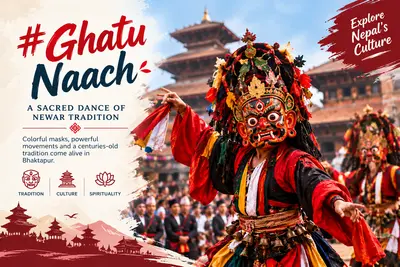
High in the mid-hills of western Nepal, where terraced fields spill down from Lamjung, Kaski, Gorkha, and Tanahun toward the Marsyangdi and Seti rivers, a centuries-old ritual dance quietly returns every spring. It is called Ghatu Naach, and unlike the festival dances that draw crowds with color and spectacle, Ghatu is slow, hypnotic, and deeply sacred a performance in which young Gurung girls are said to be entered by the spirit of a tragic queen. At Enticing Himalayas, we believe that understanding Nepal means going beyond its mountains and into the living traditions of its indigenous communities, and few traditions capture the emotional depth of Gurung culture quite like Ghatu. This guide walks through the history, legend, ritual structure, costumes, music, and cultural weight of one of the Himalayas' most haunting folk dances.
Ghatu Naach (घाटु नाच) is a narrative song-and-dance tradition performed almost exclusively by women of the Gurung (Tamu) community, with related traditions also practiced by the Magar, Dura, Balami, and Kumal peoples of central-western Nepal. Unlike upbeat festival dances meant for entertainment, Ghatu is a slow, meditative performance built around a tragic love story, and it is performed with such intensity that the lead dancers are believed to enter a trance-like state during the ritual.
The word "Ghatu" itself carries meaning tied to sorrow. Gurung elders explain that it derives from two root words: gha, meaning a wound that never fully heals, and tu, meaning to sew or stitch. Combined, Ghatu evokes the image of a wound being stitched a fitting metaphor for a dance built entirely around grief, loss, and remembrance. This isn't folklore performed for spectacle; it's a ritual act of mourning and devotion, passed down almost entirely through oral tradition for hundreds of years.
Ghatu is performed primarily around Baisakh Purnima (the full moon of the Nepali month of Baisakh, typically falling in April or May), though its preparation begins months earlier, and the dancers themselves are selected as early as Shree Panchami (the same day Nepal celebrates Saraswati Puja, usually in late January or early February).
Because Ghatu has always been transmitted orally through guru-ama (female teachers) instructing new generations of dancers its precise origins are difficult to pin down with certainty. Oral historians and Ghatu gurus offer differing accounts, with some tracing the tradition back to the 15th century and others to the 17th. What most agree on is that Ghatu began sometime after the death of a Gurung king, in a period when Hindu customs were beginning to spread into the Gurung hills of Lamjung alongside the community's older Buddhist, Bon, and animist-shamanist practices.
This blending of traditions is precisely what makes Ghatu so historically interesting. Several elements of the dance most notably the practice of sati (a widow's ritual self-immolation) that features in the central legend are not native to traditional Gurung culture, which has long been shaped by Buddhism, Bon shamanism, and animism rather than orthodox Hinduism. Researchers believe these Hindu elements were absorbed into the story as Aryan and Hindu cultural influence expanded through the region, layering a new narrative onto existing Gurung performance traditions. Adding to the mystery, the Ghatu songs themselves are not sung in the Gurung language at all, but in an old form of Nepali carrying traces of Awadhi, Bhojpuri, and Tharu languages from the southern plains, hundreds of kilometers from the Gurung highlands. Some scholars speculate that the legendary queen at the heart of the story may herself have come from the Terai, bringing her songs north with her.
The dance is closely tied to a specific place: Pasgaun, a village in Lamjung district still inhabited predominantly by Gurung people, and believed to be named after the legendary king at the center of the Ghatu story.
Every Ghatu performance retells the same core legend, passed down through generations as both entertainment and cautionary memory. Versions of the names shift slightly from village to village the king is called Parshuram or Pashramu, the queen Yambawati, Champawati, or Hyomaudi but the arc of the story remains consistent.
According to the legend, King Parshuram of Lamjung goes hunting one day and encounters a beautiful woman, Yambawati. The two fall deeply in love and marry, and in time they have a child together. Their happiness is shattered when a neighboring kingdom attacks Parshuram's territory. Duty-bound, the king rides into battle to defend his kingdom and dies fighting.
Grief-stricken, Queen Yambawati makes the devastating decision to commit sati, immolating herself on her husband's funeral pyre despite the pleas of her people and the fate of the infant child she leaves behind. It is this act of devotion and sacrifice impossible, tragic, and total that the Ghatu dancers reenact and, in a sense, relive each time the dance is performed.
Beyond the central tragedy, Ghatu performances also weave in scenes of everyday Gurung life: courtship, farming, animal husbandry, childbirth, and domestic duties, offering a fuller picture of how the community once lived, worked, and loved.
Ghatu is not a single, uniform performance Gurung communities recognize two distinct types, each with its own rules around timing and content.
Once the dance concludes on Baisakh Purnima, it is formally closed with rituals performed at designated temples and riverbanks by a priest, and the dance is not performed again until the following Shree Panchami.
The lead dancers of Ghatu are known as Ghatusari (also spelled Ghatuni), and their selection process is as ritualistic as the dance itself. Traditionally, the girls chosen are prepubescent, free of any bodily scars, and in the strictest interpretations of the tradition have never had their hair cut since birth.
Selection takes place on Shree Panchami through a special puja. A wider group of candidate girls sings Ghatu songs together, and from this group, the two who appear to fall into a trance or possession state during the singing are chosen as that year's Ghatusari one to play the role of King Parshuram, the other Queen Yambawati. These two dancers then train under a guru-ama for three to four months, learning the intricate hand, leg, and body movements, the sequence of the story (broken into performance segments known as dandi), and the physical endurance required for a performance that can stretch across two days and three nights.
Each Ghatusari is assigned a personal caretaker, or susare, whose job is to manage every practical need during the performance adjusting the dancer's dress and headgear, providing sips of water, and even carrying her to and from the toilet, since the dancers are not meant to break formation or fully step out of their ritual state once the performance begins.
A full Sati Ghatu performance is an endurance event bound tightly to religious observance. On the eve of the dance, villagers gather for a communal feast known as dar. On the day of the performance itself, the priest and the dancers eat only fruit a form of fasting meant to purify the body before the ritual begins. After a special puja is performed, the dance commences.
Ghatu is danced to the singing of the guru-ama and male vocalists, accompanied by the steady rhythm of the madal. Throughout the performance, the Ghatusari dance with their eyes closed, moving through slow twists, turns, and squatting positions in a trance-like sequence that can last for hours at a stretch. Observers often describe the effect as mesmerizing rather than energetic closer to a moving meditation than a festival dance. At certain points in the narrative, the dancers are believed to enter deeper states of possession, their bodies responding to the story of the queen's grief almost involuntarily.
The performance uses simple but symbolically rich props recreated by the community each year: a toy horse to represent the king's hunt, a comb for the queen, and a bow and arrow tied to the story's hunting scenes. The dance closes on Baisakh Purnima with formal rituals at a temple or river, marking the symbolic "healing" of the wound the dance's name refers to until the cycle begins again the following year.
Costume is central to how the Ghatusari physically transform into the king and queen of legend. The dancers wear traditional Gurung cultural dress along with the community's characteristic silver and gold jewelry, and each is crowned with a striking headpiece made from fresh flowers woven together with roasted paddy a crown that is remade by hand before every performance and worn nowhere else in Gurung life.
The broader Gurung community's traditional attire also frames the visual identity of Ghatu performances and related festivals such as Tamu Lhosar. Women typically wear a gunyu cholo (a wrapped skirt-and-blouse combination), a Makhamali velvet blouse, a woven shawl called a ghalek, and a wide waist-binding cloth known as a patuki, all finished with layered silver jewelry. Male performers and singers, where present, traditionally wear a sleeveless vest called a bhoto, a loose shirt known as a bhangra, and a kilt-style lower garment called a kachhad. Together, this clothing doesn't just decorate the performance it visually anchors Ghatu within the wider fabric of Gurung identity, connecting a single village ritual to an entire ethnic heritage.
Music in Ghatu is deliberately spare, built to support trance rather than spectacle. The central instrument is the madal, a double-headed hand drum carved from wood and stretched with leather, whose steady, low rhythm anchors the entire performance and gives Ghatu its distinctive, meditative pace. Vocals sung primarily by men and by the guru-ama carry the actual narrative of the legend, with lyrics passed down orally in an archaic dialect that even many Gurung speakers today can't fully translate without a guru's guidance.
There is no elaborate orchestration, no fast percussion, no crowd-pleasing crescendo. The music exists to guide the dancers deeper into the story, verse by verse, until the full arc courtship, marriage, war, death, and sacrifice has been sung and danced into being once more.
It would be easy to view Ghatu purely as folklore, but within Gurung communities it functions as something closer to a living institution. Ethnographers who have studied the tradition describe it as playing a genuine role in social cohesion a yearly event that pulls entire villages together around a shared story, a shared set of rituals, and a shared sense of identity that has persisted despite centuries of political, religious, and social change in the region.
For the Gurung community specifically, Ghatu functions as a badge of cultural continuity. In a country as ethnically diverse as Nepal, where dozens of communities maintain distinct languages, dress, and customs, dances like Ghatu are one of the clearest threads connecting present-day Gurung villagers to their ancestors. Villages such as Bujhung in Lamjung still organize an annual mela around Baisakh Purnima specifically built around the Ghatu performance, welcoming visitors with a traditional offering of wheat mixed with curd a small but telling gesture of the hospitality woven into the tradition.
There is also a quieter, more personal significance. Grandmothers who once served as Ghatusari as children often become the storytellers who keep the legend alive for younger generations an oral chain of memory that has kept this tradition intact even as modernization has reshaped so much of rural Nepal.
For travelers genuinely interested in Nepal's living culture rather than staged tourist performances, Ghatu offers something rare: an unfiltered, community-rooted ritual that isn't performed for an audience so much as alongside one. The dance is concentrated in the Gurung heartland of Lamjung, Kaski, Gorkha, and Tanahun districts the same hill country that frames the Annapurna and Manaslu ranges with villages like Bujhung and Pasgaun among the strongest keepers of the tradition today.
Because Sati Ghatu is only performed within its sacred window between Shree Panchami and Baisakh Purnima, timing a visit matters. If you're planning a cultural trip to Nepal built around authentic village traditions rather than curated shows, our team can help design an itinerary through Nepal's tour packages that routes through the Gurung hill villages during the right season, giving you a genuine window into a ceremony most visitors never get to see. It also pairs naturally with the kind of slower, immersive travel we cover in our guide to a Nepal cultural pilgrimage, which explores sacred sites and living traditions across the country in a similar spirit.
Like many oral traditions worldwide, Ghatu faces real pressure from urban migration, shifting religious practice, and the simple difficulty of sustaining a months-long training commitment for very young performers. Yet the tradition has shown notable resilience. Community-led initiatives in villages like Kwholasothar in Bhujung have actively worked to teach Ghatu to new generations of girls, treating the dance not as a museum piece but as a living skill worth passing on. Cultural researchers and ethnographers have also begun documenting Ghatu more formally in recent years, helping preserve the song lyrics, choreography, and oral histories that might otherwise fade as fewer guru-ama remain to teach them.
For a tradition that is literally named after the act of stitching a wound closed, this ongoing effort to keep Ghatu alive feels fitting each new generation of Ghatusari becomes, in a sense, another stitch holding the story together.
Key experiences and features
Traditional folk dance
Gurung culture
Ghatu Naach
Baisakh Purnima
Sati Ghatu
patuki
Recommended packing list
Kathmandu
Kathmandu, Kathmandu, Bagmati, Nepal
Got questions about this event?
Ghatu Naach is a traditional folk dance mainly performed by the Gurung and Magar communities of Nepal. It combines dance, music, singing, storytelling, and spiritual traditions.
Ghatu Naach is traditionally performed during the spring season, particularly around the time of Shree Panchami and Baisakh Purnima, depending on local community traditions.
Ghatu Naach is mainly associated with the Gurung community, while related traditions are also practiced among some Magar communities in western and central Nepal.
The performance traditionally tells stories of King Pashramu and Queen Yambawati, combining historical, cultural, and spiritual elements through songs and graceful movements.
Visitors can experience Ghatu Naach in Gurung villages of western Nepal, particularly in areas around Lamjung, Kaski, Gorkha, and Tanahun, where communities continue to preserve the tradition.
Apr 14 – May 20, 2027
37 days
Quick Info
More culture experiences
Mar 23 – Mar 7, 2027Kathmandu
 Dec 13 – Dec 17, 2026
Janaki Mandir, Janakpur
 Nov 15 – Nov 16, 2026
Tsum Valley