 Mar 23 – Mar 7, 2027
Kathmandu
Seto Machindranath Jatra 2027: Kathmandu’s Sacred Festival
Culture
5 days
Festival
Free
Kathmandu 5 days
Event Details
Loading...
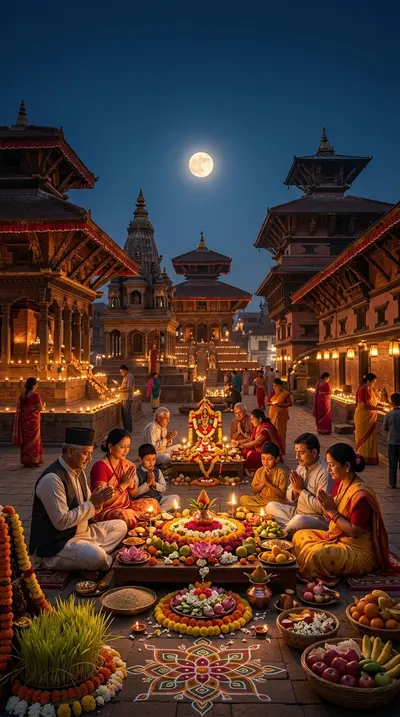
Kojagrat Purnima is one of the most meaningful full-moon observances in Nepal, bringing the long celebration of Bada Dashain to its traditional conclusion. It is a night associated with Mahalakshmi, prosperity, devotion, family, spiritual awareness and staying awake under the full moon. The name Kojagrat comes from the idea of asking, “Who is awake?” and the night is traditionally connected with the belief that Goddess Lakshmi blesses those who remain awake in devotion. In Nepal, the occasion is especially important because it marks the end of the fifteen-day Dashain period.
For travelers
interested in Nepal festivals, Kojagrat Purnima offers a quieter perspective on
Dashain than the famous tika day. The celebration is not primarily about large
public processions. Instead, its atmosphere is created through family worship,
lamps, prayers, food, remembrance, temple visits and the symbolism of the full
moon. In many households, people worship Mahalakshmi during the evening and
remain awake during the night. Traditional practices can differ between
communities and regions, making the festival particularly valuable for
travelers who want to understand Nepal beyond its mountains and trekking
routes.
The relationship
between Kojagrat Purnima and Dashain is central to understanding the festival.
Dashain extends across a long sequence of religious and family traditions,
beginning with Ghatasthapana and continuing through important occasions such as
Phulpati, Maha Ashtami, Maha Navami and Vijaya Dashami. The final full-moon
observance provides a closing point to this extended period of worship and
family gatherings. Nepal Tourism Board describes Kojagrat Purnima as the final
day of Dashain, when families may continue visits, enjoy feasts and participate
in traditional activities associated with the festival season.
The ending of Dashain is therefore more than simply the disappearance of festival decorations. It represents a gradual return from an extraordinary period of family movement, religious observance and social celebration toward ordinary life. Many Nepali families have traveled from cities to ancestral villages, received tika and jamara from elders, sharemeals and spent time with relatives. By Kojagrat Purnima, those journeys begin to come full circle. The full moon night creates a reflective atmosphere in which the celebration of Dashain closes with worship, vigilance and gratitude.
The word Kojagrat is
generally explained through the Sanskrit-derived expression Ko Jagarti,
meaning “Who is awake?” This idea gives the festival its distinctive identity.
According to traditional belief, Goddess Lakshmi moves through the world during
the night and observes who remains awake in devotion. Those who maintain a
vigil and worship her are believed to receive blessings connected with wealth,
prosperity, peace and good fortune. The story is a religious belief rather than
a historical claim, but it remains an important part of the cultural meaning of
the festival.
The idea of staying
awake also carries a deeper symbolic meaning. Being awake can represent awareness,
responsibility and spiritual attentiveness. A traditional interpretation
reported by The Kathmandu Post connects the message of Kojagrat with
remaining vigilant in life rather than living carelessly or unconsciously. In
this sense, the festival can be understood not only as a prayer for material
prosperity but also as a reminder to remain conscious of one's
responsibilities, relationships and spiritual values.
The date of Kojagrat
Purnima changes every year because it follows the lunar calendar. It falls on
the full moon of the Hindu lunar month of Ashwin and normally appears in
September or October in the Gregorian calendar. Travelers should therefore
avoid assuming that it will always occur on the same date.
For 2026, published
Nepali calendar sources place the observance around October 25–26, depending on
the calendar convention and the timing of the full-moon tithi. Drik Panchang
gives the Kojagrat Puja date in Kathmandu as October 25, 2026, with the Purnima
tithi extending into October 26, while Nepali calendar sources identify October
26 as Kojagrat Purnima.
This difference
illustrates why visitors planning a Dashain festival trip to Nepal should check
the Nepali lunar calendar close to their travel date. Religious festivals are
determined by tithi, and the Gregorian calendar does not always
correspond neatly to the beginning or ending of a lunar day.
At the center of
Kojagrat Purnima is Goddess Lakshmi, traditionally associated with prosperity,
abundance and auspiciousness. On this night, devotees may clean and prepare
their homes, arrange offerings, light lamps and perform prayers dedicated to
Mahalakshmi. The worship reflects the hope that prosperity will enter the household
and that the coming period will bring peace, stability and wellbeing.
Lakshmi worship on
Kojagrat Purnima should also be understood within the wider religious diversity
of South Asia. Different communities observe the full moon in different ways, and
similar celebrations are known by names such as Sharad Purnima, Kojagari
Purnima and Kaumudi Purnima in different regions. Practices are therefore not
identical everywhere. In Nepal, the festival has a particularly strong
connection with the conclusion of Dashain.
For visitors, this
is one reason why cultural tourism in Nepal benefits from local interpretation.
A traveler can see a lamp, a prayer, an offering or a family gathering, but
understanding why those actions matter requires listening to the people who
practice them.
Household worship is
one of the most important parts of the celebration. Families may clean the
worship area, prepare offerings, light lamps and make offerings to Mahalakshmi.
The exact ritual differs according to family tradition, ethnicity, locality and
religious practice. Some families observe fasting during the day before
conducting evening worship, while others focus more on the night vigil and
offerings.
Food is also
connected with the celebration. Offerings may include sweets, fruits and other
foods considered appropriate for worship. In some traditions associated with
the broader Sharad Purnima observance, milk-based foods such as kheer have a
special connection with the full moon. Such practices should not be treated as
a single uniform Nepal-wide ritual because Nepal contains numerous regional
traditions and household customs. The beauty of the festival lies partly in
these variations.
The most
recognizable practice of Kojagrat Purnima is the night vigil. Devotees may
remain awake throughout the night, worshipping Goddess Lakshmi, chanting
prayers, singing devotional songs or simply spending the night in a spiritually
focused environment. The practice reflects the belief that Lakshmi looks for
those who are awake and devoted.
For a traveler, the
vigil can be understood as an experience of night-time cultural spirituality
rather than a conventional festival performance. There may not be a stage,
ticket or organized show. Instead, the experience takes place through homes,
neighborhood temples, courtyards and sacred sites. Respectful observation is
therefore much more important than trying to photograph every moment.
The full moon gives
Kojagrat Purnima a distinctive visual and spiritual character. Moonlight has
long held symbolic significance in South Asian religious traditions, and the
bright autumn full moon creates a natural connection between the night sky and
the rituals taking place below it.
The season is also
significant. The festival occurs around the transition into Nepal's autumn
period, when the monsoon has generally retreated and the landscape begins to
experience clearer skies. This makes the period around Dashain and Kojagrat
Purnima particularly attractive for travelers interested in combining cultural
experiences with mountain scenery.
The moon itself
should not be presented as scientifically producing supernatural blessings. The
significance of moonlight belongs to the religious and cultural worldview of
the communities observing the festival. For cultural travelers, understanding
that distinction makes the experience more respectful and meaningful.
One of the important
transitions associated with the final day of Dashain is the ending of the
period of receiving tika and jamara. During Dashain, elders bless younger
family members with tika and jamara as part of the family celebration. On
Kojagrat Purnima, the cycle formally comes to an end.
Traditional accounts
also describe the respectful disposal or immersion of jamara in rivers, ponds
or other appropriate places after the festival. Radio Nepal reported this
practice as part of the conclusion of Bada Dashain.
This provides a
fascinating example of how a festival creates a complete ritual cycle:
something is planted and grown at the beginning of Dashain, carried and blessed
through the festival, and finally returned to nature at its conclusion.
Kathmandu Valley offers travelers an especially rich setting for understanding Kojagrat
Purnima. The valley contains centuries-old Hindu and Buddhist sacred sites
where religious life remains integrated with ordinary urban life.
Nepali Patro notes
that on Kojagrat Purnima, special lights known as Mahadeep Jyoti may be lit at
temples including Swayambhu in Kathmandu, while devotees observe the night with
worship and devotional practice.
Visitors can explore
the wider cultural landscape through the Kathmandu Valley heritage experience,
where temples, courtyards, stupas and traditional neighborhoods demonstrate how
religious traditions continue to shape the city.
A particularly
useful starting point is Kathmandu Valley: the living
heart of Nepal's culture and heritage, which introduces the valley's historic cities, temples
and sacred monuments.
The Kathmandu Valley contains Kathmandu, Patan and
Bhaktapur, three historic urban centers whose architecture reflects centuries
of Hindu and Buddhist traditions. Its seven UNESCO monument zones include the
major Durbar Squares, Swayambhunath, Boudhanath, Pashupatinath and Changu
Narayan.
For someone
researching Kojagrat Purnima in Nepal, the valley is especially useful because
a single journey can connect religious heritage, living traditions, historic
architecture and contemporary Nepali life.
Rather than treating
the festival as an isolated event, visitors can understand it as one part of Nepal's
broader annual cultural calendar.
Pashupatinath Temple and its
sacred surroundings represent an important part of Kathmandu's Hindu spiritual landscape.
Although Kojagrat Purnima is specifically associated with Lakshmi worship,
visiting major Hindu sites can help travelers understand the broader religious
environment in which festivals take place.
The relationship
between temples and festivals in Nepal is complex. A shrine may be dedicated
primarily to one deity but exist within a much larger network of community
traditions, seasonal observances and family rituals. Travelers should therefore
avoid expecting every temple to perform exactly the same Kojagrat ritual.
Swayambhunath sits on a hill overlooking Kathmandu
and is one of the valley's most recognizable sacred landmarks. The site is
primarily associated with Buddhism, yet Kathmandu's religious landscape
frequently places Buddhist and Hindu traditions alongside one another.
This makes
Swayambhunath particularly relevant to travelers who want to understand Nepal's
religious diversity. During festival periods, the atmosphere around sacred
places can become especially meaningful, although visitors should always follow
local instructions concerning photography, entry and worship areas.
Boudhanath Stupa offers another perspective on the
spiritual character of Kathmandu. Prayer flags, monasteries, butter lamps,
incense and circumambulation create an environment very different from a Hindu
Lakshmi shrine, yet the coexistence of traditions is one of the defining
characteristics of Nepal.
A traveler visiting
around Kojagrat Purnima can therefore build a broader cultural itinerary that
includes both Hindu heritage and Buddhist heritage, rather than limiting the
journey to one religious tradition.
This approach is
also reflected in Buddhist pilgrimage in Nepal
from Lumbini to Boudhanath, which explores Nepal's Buddhist pilgrimage landscape and its living
sacred traditions.
Bhaktapur
is another valuable destination for cultural travelers. Its historic squares,
temples, brick architecture, woodcarving and traditional urban spaces provide a
powerful setting for understanding the cultural history of the Kathmandu
Valley.
Kojagrat Purnima is
not simply an architectural festival, but historic towns such as Bhaktapur help
explain why Nepal's festivals remain deeply connected with courtyards, temples,
neighborhoods and community spaces.
A walk through the
old city can therefore complement a festival-focused itinerary, especially for
travelers who want to see how religious traditions exist within everyday urban
life.
Patan
is renowned for its traditional architecture, courtyards, temples and metal
craftsmanship. The city's cultural environment makes it an excellent place to
explore the relationship between religion, art and community.
For travelers
interested in Nepal cultural tours, Patan adds another layer to a Kojagrat
Purnima journey. Instead of viewing the festival only as a single religious
ceremony, visitors can place it within the artistic and historical world that
has shaped Nepal's urban traditions for centuries.
Changu Narayan
and Ancient Valley Traditions
Changu Narayan represents another important sacred location in the Kathmandu Valley.
The temple's ancient history and surrounding landscape demonstrate the depth of
Nepal's Hindu heritage.
A visit to Changu
Narayan can be combined with a broader Kathmandu heritage tour, allowing
travelers to see sacred architecture away from the busiest central streets.
Nagarkot provides a contrasting experience.
Rather than focusing on dense urban heritage, the hill destination offers open
landscapes and Himalayan views.
Around the autumn
festival season, travelers may enjoy combining a cultural stay in Kathmandu
with a peaceful evening or sunrise experience in the surrounding hills.
Kojagrat Purnima itself remains a religious observance, so the hill environment
should complement rather than replace the cultural purpose of the festival.
Dhulikhel can similarly provide a slower
alternative for travelers who want to experience Nepal's autumn atmosphere
beyond central Kathmandu.
A cultural journey
can include historic Kathmandu, traditional Newar towns and a peaceful hill
destination, allowing the traveler to experience both heritage and Himalayan
landscapes.
Panauti is especially interesting for
travelers who want to explore traditional settlement patterns, temples and
community life.
The town provides an
opportunity to move beyond famous tourist landmarks and see how religious
traditions, architecture and local communities interact in smaller Nepali
settlements.
The festival also
has a distinctive cultural significance in Nepal's southern plains,
particularly within Mithila communities. Regional traditions may include
special foods, family gatherings and customs associated with newly married
couples and extended families. An article published by Annapurna Times
describes Kojagra traditions in southern Nepal and notes food, family and
Maithili cultural elements associated with the celebration.
This regional
diversity is extremely important for anyone researching Kojagrat Purnima in
Nepal. The festival should not be represented as if every Nepali household
celebrates it in exactly the same manner.
Nepal is home to
many ethnic, linguistic and religious communities. A festival can therefore
have one meaning in Kathmandu and another layer of significance in the Terai,
while still sharing the common idea of the Ashwin full moon.
International travelers can experience Kojagrat Purnima respectfully by approaching the festival as a living religious and family tradition rather than a tourist performance. Visitors can observe Lakshmi worship, full moon rituals and family gatherings, but should ask permission before photographing people, ceremonies or sacred objects. Modest clothing and respectful behavior are especially appropriate around temples and religious spaces. Household worship should be treated as a private family occasion unless people specifically invite visitors to participate.
Kojagrat Purnima can also introduce travelers to the wider world of spiritual tourism in Nepal. The country contains diverse sacred landscapes, including Hindu temples, Buddhist monasteries, pilgrimage sites, meditation centers and sacred Himalayan destinations. A cultural itinerary can therefore continue beyond Kathmandu toward places such as Lumbini, Muktinath, Gosaikunda and the Himalayan regions.
For travelers interested in meditation, yoga and wellness, the festival's theme of staying awake and maintaining awareness can provide an interesting cultural perspective. However, religious observance and meditation should not be treated as identical practices. The most meaningful experience comes from learning about local traditions while respecting differences between communities.
This approach allows visitors to explore Nepal's spiritual heritage, cultural diversity and religious traditions without turning sacred practices into entertainment.
The period around
Kojagrat Purnima is attractive because it sits within one of Nepal's most
important travel seasons. The monsoon has generally passed, mountain visibility
improves and cultural activity is high.
For trekkers, autumn
is traditionally one of the major trekking windows. For cultural travelers, the
period also includes Dashain and other important festivals.
This combination
makes the season particularly valuable for people searching for Nepal autumn
travel, Dashain festival tours, Nepal cultural tours and Himalayan trekking
holidays.
A festival can
become commercialized quickly when large numbers of visitors arrive without
cultural understanding. Responsible tourism means allowing communities to
control how their traditions are presented.
Travelers should
support local guides, community businesses and respectful cultural
interpretation rather than treating sacred ceremonies as entertainment.
This principle also
aligns with a broader approach to travel that emphasizes authentic experiences,
local expertise and meaningful interactions rather than simply checking famous
attractions from a list.
A Kojagrat Purnima cultural day in Kathmandu can be designed around history, religion, architecture, family traditions and the peaceful atmosphere of the autumn full moon. The experience can begin with a relaxed morning walk through the Kathmandu Valley, where visitors can explore historic neighborhoods, traditional courtyards and ancient temples while learning about the cultural background of Dashain. The afternoon can focus on Newar architecture, heritage sites and the relationship between religious traditions and everyday community life. As evening approaches, travelers can learn about Mahalakshmi worship, the significance of prosperity and the traditional belief connected with staying awake during the full-moon night. Rather than presenting the festival as entertainment, a responsible cultural experience should focus on observation and understanding. Visitors can enjoy traditional food where appropriate, observe public religious activities respectfully and learn why families consider the final full moon of Dashain meaningful. The later evening provides an opportunity to reflect on the symbolism of Kojagrat Purnima, the moonlit night and the transition from the festive Dashain period back toward ordinary life.
Travelers who want to experience Kojagrat Purnima in Nepal can make the festival part of a longer journey covering culture, nature, spirituality and adventure. Kathmandu can serve as the cultural starting point before the itinerary continues toward Pokhara, Chitwan, Lumbini, Bandipur, Panauti, Dhulikhel or a Himalayan trekking region. This approach allows visitors to experience the festival within the wider context of Nepali culture and tourism, rather than treating it as an isolated event. A longer holiday can begin with heritage exploration and family traditions during Dashain, continue with the peaceful atmosphere of the full moon and then move toward natural landscapes or pilgrimage destinations. Travelers looking for organized options can explore specific Nepal tour packages that match their preferred travel style, whether that involves cultural discovery, family travel, wellness, hiking or Himalayan adventure. The important advantage of a festival-centered itinerary is flexibility. A journey does not need to remain exclusively religious. Nepal allows visitors to connect festival culture, sacred heritage, local food, mountain scenery and community experiences within one trip. This combination can create a deeper understanding of how different parts of Nepal's identity exist together.
A Kathmandu Valley cultural tour can provide an excellent setting for understanding Kojagrat Purnima because the valley contains centuries of Hindu and Buddhist traditions alongside distinctive Newar architecture and community life. Visitors can explore Kathmandu, Patan and Bhaktapur, each offering different examples of temples, courtyards, palaces and traditional settlements. Important religious landmarks such as Swayambhunath, Boudhanath, Pashupatinath and Changu Narayan can help travelers understand the broader spiritual environment in which Nepali festivals take place. However, the experience should not stop at famous monuments. Smaller communities and historic towns such as Panauti, Dhulikhel, Nagarkot and Bandipur can provide a slower introduction to local architecture, family life and traditional settlement patterns. During a festival season, travelers may notice lamps, household decorations, temple activity and community gatherings, but customs can differ significantly from one location to another. This diversity is an important part of Nepal's living cultural heritage. A family in Kathmandu may observe Kojagrat Purnima differently from a household in the Terai or another region. Learning about these differences helps visitors avoid the assumption that one ritual represents the entire country and encourages a more thoughtful approach to cultural tourism in Nepal.
Experiencing Kojagrat Purnima respectfully requires travelers to remember that many important rituals take place inside homes and family spaces rather than on stages created for tourists. Photography can preserve valuable memories, but visitors should ask permission before photographing people during prayer or entering private religious activities. It is also important not to touch offerings, lamps, religious objects or ritual materials unless invited to do so. Modest clothing, comfortable walking shoes and a light jacket for an autumn evening are practical choices when visiting temples and historic neighborhoods. Travelers may also carry a reusable water bottle and a small day bag for a full day of cultural exploration. Family traditions are another important part of the festival. Dashain family reunions, traditional foods, household worship and the closing full moon can have strong emotional meaning for Nepali families. Some households may emphasize Lakshmi worship, while others may focus more strongly on family gatherings or regional food traditions. In Mithila communities, for example, visitors may encounter distinctive food and family customs associated with Kojagra celebrations. Understanding these variations helps travelers appreciate the festival as a living tradition rather than a standardized event.
Kojagrat Purnima can become more than a single cultural experience when it is connected with Nepal's wider spiritual, natural and Himalayan landscapes. After exploring Kathmandu during the festival period, travelers can continue toward Lumbini, a major Buddhist pilgrimage destination, or Muktinath, an important sacred landscape associated with both Hindu and Buddhist traditions. Other journeys can lead toward Gosaikunda, Pokhara, Annapurna, Everest, Manaslu, Mardi Himal or Langtang, depending on the traveler's interests and available time. A cultural journey can also be combined with meditation, yoga and wellness, allowing visitors to experience another dimension of Nepal beyond sightseeing. Families may prefer an itinerary combining Kathmandu heritage, Bhaktapur, Nagarkot, Pokhara and Chitwan, while cultural travelers may focus more heavily on architecture, religion, festivals and local communities. Adventure travelers can transition from the festival atmosphere toward trekking and mountain landscapes. The deeper meaning of such a journey is that Nepal culture is not separated from nature, spirituality and everyday life. Kojagrat Purnima can therefore serve as a cultural doorway into a broader Nepal experience, beginning with the full moon and family traditions before continuing toward Himalayan landscapes, sacred destinations and diverse communities.
Kojagrat Purnima in Nepal is a festival of the full moon, but its deeper
significance comes from the ideas surrounding that moon: awareness, prosperity,
family, devotion, gratitude and transition. It closes the long Dashain period
while opening a quieter space for reflection.
The belief that
Goddess Lakshmi asks who is awake gives the night its distinctive
spiritual character. For devotees, remaining awake can represent faith and hope
for prosperity. For cultural travelers, it offers an opportunity to understand
one of Nepal's enduring traditions. For families, it marks the final moments of
Dashain. For visitors, it provides another doorway into Nepal's living
heritage.
The festival is
especially meaningful when understood within the wider cultural landscape of Kathmandu
Valley, the regional traditions of the Mithila and Terai communities, and
Nepal's broader network of sacred places. It shows that the country's heritage
is not confined to monuments. It continues through homes, food, prayers, lamps,
family relationships and seasonal rituals.
A journey around
Kojagrat Purnima can therefore become much more than a festival visit. It can
connect travelers with Nepal's Hindu heritage, Buddhist traditions, Newar
culture, spiritual travel, wellness experiences, mountain landscapes and local
communities.
For travelers
looking to build a complete experience, Nepal's destinations and
Himalayan places, Nepal travel stories and
guides, and curated Nepal tours can be used as starting points for
connecting the festival with a wider itinerary.
Ultimately, the most valuable lesson of Kojagrat Purnima may be contained within its name: stay awake. Stay awake to culture, to family, to nature, to tradition and to the moment itself. Under the autumn full moon, Nepal offers travelers a chance to see that spirituality is not always found in distant mountains. Sometimes it is found in a lamp burning beside a family shrine, a temple courtyard at night, a shared meal, a prayer whispered quietly, or a community continuing a tradition passed from one generation to the next.
Key experiences and features
Kojagrat Purnima
Dashain
Sanskrit
Kojagrat Puja
Purnima tithi
Sharad Purnima
Mardi Himal
food and family customs
Recommended packing list
Kathmandu, Kathmandu, Bagmati, Nepal
Got questions about this event?
Kojagrat Purnima is the full-moon observance marking the closing phase of Dashain, traditionally associated with Goddess Lakshmi, prosperity and staying awake during the night.
Yes. Visitors can observe appropriate public activities and learn about local traditions while respecting private household worship and religious practices.
Modest, comfortable clothing is recommended, especially when visiting temples and religious heritage sites.
Photography may be appropriate in public areas, but always ask permission before photographing people during prayer or private religious ceremonies.
It is primarily a religious and family tradition, rather than a staged tourist event. Travelers should approach it as a cultural learning experience.
Oct 25, 2026
1 day
Quick Info
More culture experiences
Mar 23 – Mar 7, 2027Kathmandu
 Dec 13 – Dec 17, 2026
Janaki Mandir, Janakpur
 Nov 15 – Nov 16, 2026
Tsum Valley