Food and Culture of Nepal: Dal Bhat, Newari Feasts, and the Thakali Thali
Nepal is a small country with an outsized range of landscapes, and that range is written directly into its kitchens. Within a single day of driving you can move from humid Terai plains where mustard and sugarcane grow, up through middle hill terraces of rice and millet, to cold trans-Himalayan valleys where barley, buckwheat, and dried cheese keep people fed through winter. The result is a cuisine that is less one style than a weave of dozens of local foodways, held together by a shared daily rhythm and a deep hospitality instinct. To travel here with an open appetite is to understand the culture faster than any guidebook allows.
This guide walks through the dishes that define Nepali eating, the communities behind them, and the practical ways a visitor can taste the real thing. We begin with the plate you will see at every table, then move into the ritual richness of Newari feasting, the comfort precision of the Thakali thali, and finally the everyday etiquette and festival food that turn meals into cultural moments. For the broader context of heritage travel, see our complete guide to cultural and spiritual tours in Nepal.
Dal Bhat: The Plate That Runs the Country
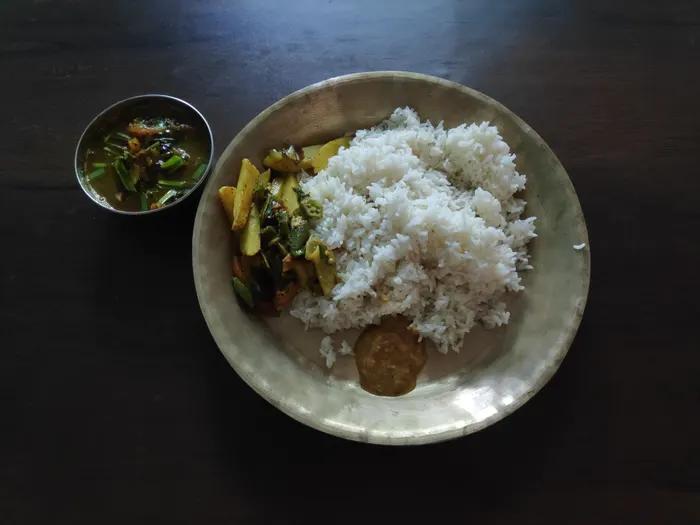
If Nepal has a single national dish, it is dal bhat. The name is almost self explanatory. Dal is lentil soup, lightly spiced and often tempered with fried cumin, garlic, or tomato. Bhat is steamed rice. Together they form the center of the plate, and around them a cook builds a shifting constellation of sides: a vegetable curry, a leafy green called saag, a sour or fiery achar made from tomato, radish, or pickle, perhaps a small bowl of curd, and occasionally a portion of chicken, buffalo, fish, or goat depending on region and occasion.
What makes dal bhat more than a recipe is the verb attached to it. Nepalis do not say they eat dal bhat, they say they do it, as in "I did dal bhat." It is an action repeated twice a day in most households, and it scales beautifully. A farmer and a trekking guide eat the same fundamental meal, but the guide's version might include an extra portion of potatoes or noodles on high passes where rice is harder to carry. The meal is endlessly adaptable to altitude, season, and budget, which is exactly why it has become the fuel of the Himalayas.
The nutrition logic is sound. Rice and lentils together form a complete protein, the vegetables add micronutrients, and the ghee or oil carries calories needed for physical work at altitude. On a trek, a second or third helping of rice is usually free, and seasoned guides will tell you to eat more than you think you need. This is not just tradition, it is practical mountain engineering dressed up as comfort food.
For travelers, the first encounter with dal bhat is often on a trail. Our Annapurna Base Camp trek and Everest Base Camp trek both put you in teahouses where the evening dal bhat is the social center of the day. The cook brings a thali, you finish it, you hand it back, and it returns refilled. There is no shame in a third helping, only quiet approval.
Newari Feasting: The Cuisine of the Kathmandu Valley
The most elaborate food culture in Nepal belongs to the Newar people of the Kathmandu Valley. Where dal bhat is daily sustenance, Newari cuisine is ceremony. A traditional spread, called samay baji or simply a bhoj, is not a single dish but a composed platter of perhaps twenty items, each with its own texture, temperature, and symbolism. At its core sits chiura, flattened beaten rice, surrounded by buffalo meat preparations, black soybeans called bhatmas, spicy potato alo tama made with bamboo shoots, leaf-wrapped sweets, and a bright array of pickles.
Newari food is famous for techniques that surprise first time visitors. Choila is buffalo meat marinated in mustard oil and spices then grilled or smoked over flame. Kwati is a soup of nine sprouted beans, traditionally eaten during the festival of Gunla to build strength in the monsoon. Juju dhau, the "king curd" of Bhaktapur, is a dense, sweet yogurt set in clay pots that travelers make pilgrimages to taste. None of these are casual snacks, they are statements of belonging.
The social setting matters as much as the food. Newari feasts mark everything from birth ceremonies to funeral rites, from the tooth cutting celebration of a toddler to the communal street feasting of Indra Jatra. To be invited to a Newari bhoj is to be treated as family, and the etiquette is to accept every small portion offered, eat with the right hand, and let the elders begin. Food here is how the community remembers who it is.
You can taste this tradition without a private invitation. The old cities of Bhaktapur and the wider Kathmandu Valley are full of restaurants that serve authentic samay baji sets, and our Kathmandu Valley heritage tour builds in time to eat properly rather than rush past. If you want to go deeper, a Kathmandu food tour or a Nepali cuisine tour puts a local guide between you and the menu.
The Thakali Thali: Mountain Comfort, Refined
If Newari food is ceremony and dal bhat is everyday survival, the Thakali thali is the happy middle: a balanced, beautifully arranged platter that became the gold standard for trekking food across Nepal. The Thakali people come from the Thak Khola region along the Kali Gandaki, the windy river corridor that links the Annapurna and Mustang areas. Historically traders, they built lodges that fed passing caravans, and their reputation for clean, reliable, delicious meals spread along every trail.
A proper Thakali thali is a study in balance. You get rice, of course, but also ghee fried dal, a pair of vegetable curries, mustard greens, a fermented radish pickle called mula ko achar, a small mound of curd, and often a portion of chicken or mutton cooked in a house spice mix that includes cinnamon, clove, and timur. The portions are measured so the whole plate feels nourishing rather than heavy, which is exactly what a trekker wants at the end of a long day.
What sets the Thakali style apart is discipline. Where a roadside dal bhat can be inconsistently seasoned, a good Thakali kitchen tastes the same excellent way every time. That reliability is why Thakali hotels became the backbone of Nepal's trekking industry, and why even in Kathmandu you will find Thakali bhojanalayas packed with office workers at lunch. It is comfort food with a standard.
Our Thakali cuisine experience and the broader Newari feast tour are built so you can compare these two great traditions side by side. And if your interest leans spiritual as well as culinary, the Muktinath and Mustang spiritual circuit passes right through the Thak Khola heartland where this food was born.
How Region Shapes the Plate
Nepal's cuisine is best understood as a map. The Terai in the south eats like the plains of northern India: flatbreads called roti and puri, lentil fritters, sweet milk desserts, and abundant vegetables. The middle hills, where most of the population lives, are dal bhat country, with maize and millet appearing in poorer or higher soils. The high Himalayas shift to barley, buckwheat, tsampa roasted flour, and dried foods, because fresh vegetables simply cannot be grown year round.
Each elevation also has its signature. In the hills you find dhido, a dense porridge of maize or millet flour kneaded with hot water and eaten with gundruk, a fermented dried green vegetable. Trekkers who try dhido often describe it as the most filling thing they have ever eaten, and locals will laugh and agree. In the mountains, shyakpa is a hearty noodle and meat stew that warms a freezing lodge, while tsampa mixed with tea or butter tea sustains herders through cold seasons.
This regional layering means a food journey through Nepal is also a geography lesson. A Pokhara tour gives you lakeside thakali and Tibetan influenced momos, while a higher route such as the Mustang circuit trades those for barley beer and dried meat. Even the humble momo, the steamed dumpling now found on every street, tells a migration story, arriving from Tibet and evolving into a Nepali staple filled with buff, chicken, or vegetables and dipped in bright tomato achar.
Momos, Street Food, and the Tibetan Thread
No modern account of Nepali eating can skip the momo. These steamed or fried dumplings arrived with Tibetan communities who settled across the hills and the capital, and they have been thoroughly adopted as a national snack. A Kathmandu street corner at dusk is often defined by the rhythmic clatter of momo steamers and the tang of tomato achar being ground nearby. Fillings range from buff and chicken to paneer and buff free vegetable versions, and the half moon shape is usually pinched by hand rather than machine.
The Tibetan influence runs deeper than dumplings. In the high valleys and in neighborhoods like Boudhanath, you will find thenthuk, a hand pulled noodle soup, and thukpa, a hearty broth with vegetables and meat that doubles as cold weather medicine. Butter tea, salty and rich, is an acquired taste that herders rely on for energy and warmth. These foods blur the border between Nepal and Tibet in exactly the way the geography does, and tasting them is a quiet lesson in how cultures move along mountain trade routes.
Street food in the cities adds a playful layer. Sel roti, a ring shaped rice flour doughnut fried in ghee, appears at festivals and roadside stalls alike, sweet and faintly yeasty. Panipuri and chatpate, spicy puffed rice mixes, show the Terai's link to Indian snack culture. None of these are part of a formal meal, but together they are the texture of daily life, the food you eat standing up, talking, and watching the light change over the hills.
What Nepalis Drink
Beyond chiya, Nepal has a quietly rich drinks culture. In the hills, raksi, a distilled grain liquor, appears at ceremonies and is offered to guests as a sign of respect, though visitors should sip slowly and know their limit at altitude. Chang and tongba, fermented millet drinks served warm in wooden vessels, are specialties of the eastern and high regions, sipped through a bamboo straw as the host tops up hot water to keep the fermentation going. On the non alcoholic side, fresh lime soda, buffalo milk curd drinks, and seasonal fruit juices are everywhere, and Nepal's own tea gardens in Ilam produce black and green leaves worth seeking out.
Water deserves a cautious word. Bottled and filtered water are standard for travelers, and most teahouses now offer safe drinking water to reduce plastic waste. The food will nourish you, but the simple rule of clean water and peeled raw items keeps a trip on the trail rather than in the clinic.
Etiquette: Eating the Local Way
A few habits will make your meals smoother and more welcome. First, eat with your right hand when eating traditionally, and use the left only for holding the plate. Second, do not waste food on a thali, the expectation is that you finish what is served and accept refills graciously. Third, in Hindu and Buddhist homes avoid offering or receiving food with the left hand, and remove shoes before entering a kitchen or dining area.
Vegetarians will find Nepal unusually easy. Meatless dal bhat is common, monasteries and many households cook purely vegetarian, and the range of paneer, vegetable, and lentil dishes means you will not be stuck. Tell your operator in advance and the teahouses on treks will plan accordingly. Those who do eat meat should know that buffalo, goat, and chicken are the usual proteins, while beef is avoided by Hindus and pork by some groups, so read the room before ordering.
Finally, accept the offer of chiya, sweet milky spiced tea. It is the universal social lubricant of Nepal, served in homes, shops, and trail teahouses, and refusing it can feel like refusing friendship. A cup of chiya with a stranger is often the start of the best conversation of a trip.
Food as Festival
No discussion of Nepali food culture is complete without the calendar, because in Nepal eating and celebrating are the same verb. During Dashain, Tihar, Holi, and Indra Jatra, specific dishes mark specific days. Dashain brings meat rich feasts as families gather and slaughter goats and buffaloes for the gods and the table. Tihar, the festival of lights, pairs sisters feeding brothers sweets with households decorated in oil lamps. Holi turns streets into color and ends with festive snacks, while Indra Jatra fills Kathmandu's old squares with masked dances and communal feasting.
The timing of your visit changes what is on offer. Come in autumn and you eat with the harvest; come in winter and you taste richer, oilier comfort foods; come in spring and the markets fill with new greens. Our Bandipur tour and valley circuits can be timed around these festivals if you want the full cultural plate rather than the everyday one.
For travelers building a spiritual or heritage focused trip, the food is part of the pilgrimage. The Lumbini pilgrimage itinerary moves through communities where monastic vegetarian cooking is itself a practice, and the cultural and spiritual tours guide explains how meals fit into the rhythm of temple and stupa visits.
Planning Your Food Focused Trip
If tasting Nepal is a priority, build it into the itinerary rather than leaving it to chance. A dedicated Nepali cuisine tour can pair market walks, cooking classes, and heritage meals in a single week. A Kathmandu food tour compresses the valley's diversity into a few unforgettable evenings. And for those who want the mountains with their meals, any of our trekking packages double as a slow education in trail food, from the first dal bhat in Lukla to the last Thakali thali in Pokhara.
Working with a local, licensed trekking agency matters here because the best food is often off the standard menu. A Kathmandu based operator knows which home kitchens welcome guests, which festival is worth detouring for, and how to keep vegetarian or allergy needs consistent across a two week trek. That local knowledge is the difference between eating to survive and eating to understand.
However you structure it, let food be more than fuel. Sit on the floor, eat with your hand, accept the second helping, and ask what is in the achar. The answers are a shortcut into a culture that values generosity above almost everything else, and the plate is where that generosity is served hottest.
Taste Nepal With Enticing Himalayas
A food and culture tour in Nepal is one of the most grounding ways to experience the country, and 2026 is a strong year for it, with stable seasons, rich festivals, and easy connections. As a Kathmandu based team living the Explore, Heal, Thrive promise, Enticing Himalayas can design a journey around your appetite, your dates, and your pace, whether that means a valley feasting circuit, a Thakali thali trail, or a trek where every dinner teaches you something.
Tell us what you hope to taste, from the dal bhat of the high passes to the samay baji of the old cities, and we will send back two or three realistic itineraries, no obligation. Reach us through our trip planner and let's build your Himalayan table.
About Enticing Himalayas

Enticing Himalayas (legal name Enticing Himalayas Travels) is a Kathmandu based, Nepal licensed travel operator under the brand Explore, Heal, Thrive. We run cultural tours, spiritual and pilgrimage journeys, heritage city experiences, wellness retreats, and trekking across Nepal.
Our services
- Cultural and heritage tours of the Kathmandu Valley and beyond
- Spiritual and pilgrimage journeys (Lumbini, Muktinath, Gosaikunda)
- Wellness and yoga retreats (Heal)
- Community exchange and responsible tourism trips
- Scenic flights and adventure experiences (Explore)
Accreditations


We are a recognized partner of the Nepal Tourism Board and list experiences through established global platforms. Every guide and porter we send guests with is insured, fairly paid, and vetted on our three standards: verifiable training, resident local knowledge, and a track record with international guests.
About the author
Written by the Enticing Himalayas editorial team in Kathmandu, with input from our resident guides and cultural partners. We update this guide as our programs develop.
Why trust Enticing Himalayas
We are based in Kathmandu and our guides run these routes every season. We vet every provider on three things: verifiable training, a resident qualified practitioner, and a track record with international guests. If a provider cannot clear that bar, we do not send you there.