The Muktinath and Mustang Spiritual Circuit: A Pilgrim's Route Through the Forbidden Kingdom
There is a thread of faith that runs the length of the Kali Gandaki valley, from the soot-dark temples of the lower hills up to the wind-cut plateau where the old kingdom of Lo once kept its secrets. The Muktinath and Mustang spiritual circuit follows that thread. On one end sits Muktinath, the flame-and-water shrine honored by both Hindus and Buddhists as a place of liberation. On the other sits Upper Mustang, the walled desert kingdom whose monasteries and sky caves have guarded Tibetan Buddhism for a thousand years. Between them lie Jomsom, Kagbeni, Marpha, and a road of white stupas that feels less like a route and more like a procession.
This guide is built for the pilgrim and the curious traveler alike. We walk through the meaning of each stop, the practical way to connect them, the permits you will need in 2026, and the seasons that make the journey safe. Along the way we link to the deeper guides on cultural and spiritual tours in Nepal and on choosing the best trekking agency in Nepal for 2026, because a circuit like this is best walked with people who know the ground.
Why this circuit, and why now
Nepal is full of holy places, but few routes braid two faiths and two landscapes as tightly as this one. Muktinath is a salvation shrine: Hindus call it Mukti Kshetra, the field of liberation, and Buddhists know it as Chumig Gyatsa, the hundred waters. A short flight or a day's drive north brings you into Mustang, where the language shifts to Tibetan, the houses turn to flat-roofed fortresses, and the prayer flags outnumber the trees. The combination is the reason many travelers tell us it was the most moving part of their whole trip.
2026 is a strong year to go. Flights into Jomsom are more reliable than a decade ago, the road from Beni to Kobang is smoother, and Upper Mustang remains open to a limited number of visitors, which keeps the experience intimate. If you have already read our day-by-day Lumbini pilgrimage itinerary or our month-by-month Nepal festivals calendar, this circuit is the natural next step into the high country.
Muktinath: the confluence of flame and water
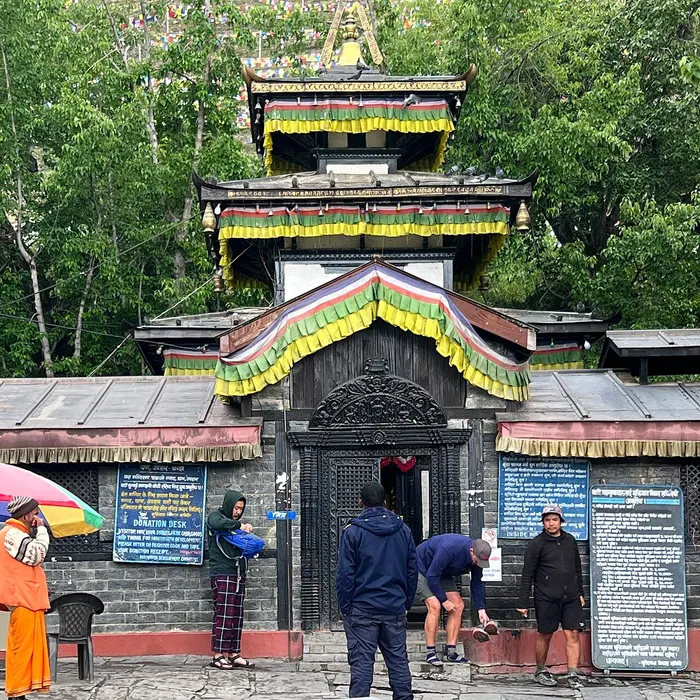
Muktinath sits at 3,710 meters at the foot of the Thorong La, the pass that separates the Annapurna and Mustang sides of the Himalaya. The temple complex is small but charged. At its center is a courtyard where 108 spouts of icy water pour from the mouths of stone naga figures, fed by a spring that Buddhists and Hindus alike consider sacred. Next to the water is an eternal flame that burns from natural gas seeping through the earth, a phenomenon that gives the shrine its dual identity: water and fire, two elements that should not share a room, sharing one courtyard in peace.
For Hindus the site is one of the 108 Divya Desams and one of the Shakti Pithas, a place where the goddess sati's ear is said to have fallen. For Buddhists it is where Guru Rinpoche, the founder of Tibetan Buddhism, meditated and where the dakinis are said to dance. Pilgrims take a ritual bath under the 108 spouts, a bracing act at altitude that is as much about surrender as cleanliness. The nearby Jwala Mai temple houses the natural gas flame that has burned for as long as anyone remembers.
Most visitors reach Muktinath from Jomsom by road, about an hour's drive through a canyon of red cliffs, or by the popular Muktinath helicopter tour that lifts you from Pokhara or Kathmandu and sets you down near the temple in a single morning. The helicopter option is a gift for travelers short on time or unable to manage the altitude on foot, and it pairs naturally with a slower Mustang drive on the days that follow.
Jomsom and the wind of the Kali Gandaki
Jomsom is the administrative capital of Mustang and the usual gateway. It is a windy, sun-bleached town at 2,743 meters where the Kali Gandaki river runs so deep and old that geologists call it the deepest gorge on earth, flanked by Dhaulagiri on the west and Annapurna on the east. The afternoon wind here is famous, a steady gale that starts around late morning and shapes the whole rhythm of travel: flights leave early, and trekkers learn to walk in the cool of the morning.
Jomsom is also where the Annapurna Conservation Area office issues the permits that the circuit requires, and where the trail forks. South leads back toward Tatopani and the Annapurna Circuit. North leads into Mustang, first through the apple orchards of Marpha and then to the medieval lanes of Kagbeni. The town itself holds a small but active temple to the local deity and a museum of Thakali culture worth an hour of your time.
Marpha, Kagbeni, and the white stupas
Marpha is the apple village, a clean grid of stone houses protected by a surrounding wall against the wind. The local apple brandy is legendary, and the Buddhist monastery above the town looks straight down the gorge toward Dhaulagiri. It is an easy, gentle stop, and a good first night in Mustang for travelers acclimatizing.
Kagbeni is the gatekeeper. This is where the restricted zone of Upper Mustang begins, and where the check post asks to see your permits. Kagbeni is also one of the most photogenic villages in Nepal: a labyrinth of narrow alleys, flat roofs, and a red-walled monastery that has stood for centuries above the confluence of the Kali Gandaki and the Muktinath Khola. The evening light on its mud walls is the kind of sight that makes people linger an extra day. If you are not continuing into Upper Mustang, Kagbeni is a perfect turnaround point before returning south to Muktinath and Jomsom.
Between these villages the road is lined with mani walls, chortens, and the white stupas that announce you have entered a Buddhist land. Walk them clockwise. The small act of respect opens the circuit in a way no map can.
Upper Mustang: the forbidden kingdom
Upper Mustang, the former kingdom of Lo, was closed to outsiders until 1992 and still limits visitors through a restricted permit. What lies beyond Kagbeni is unlike anywhere else in Nepal. The land is a high desert of eroded canyons in rust, ochre, and grey, cut by the wind into shapes that look painted. The people are ethnic Tibetans, the dialect is close to Lhasa Tibetan, and the king of Lo, though his powers are now ceremonial, still lives in the palace at Lo Manthang.
The route north passes through Chele, where the climb begins in earnest, then Geling and the Tsarang monastery with its five-story thangka, and finally the walled city of Lo Manthang. The drive or trek takes you past the sky caves of Chhoser, hundreds of carved rooms in the cliff face where early inhabitants lived and buried their dead. At Lo Manthang the four-story palace, the three principal monasteries, and the annual Tiji festival (usually in May) make the journey feel like stepping into a preserved kingdom rather than a modern district.
Upper Mustang is the spiritual heart of the circuit for those who go far enough. The Upper Mustang trek is the classic way in, either on foot or by jeep with a permitted guide. Because the zone is restricted, you cannot enter alone, and the permit cost is structured to keep numbers low. That scarcity is part of the magic: you may walk a whole day and meet no one but your guide and the wind.
Sample route: how the pieces fit together
There are two honest ways to build this circuit. Choose by time, fitness, and appetite for altitude.
Option A: the lower circuit (Muktinath plus lower Mustang), 5 to 7 days
Fly Pokhara to Jomsom. Drive to Kagbeni and explore the village. Continue to Muktinath for the shrine and the 108 spouts. Return through Marpha for apples and the monastery. Fly or drive back. This is comfortable, family friendly, and needs only the standard ACAP and TIMS permits. It pairs beautifully with the Jomsom Muktinath trek if you would rather walk part of the way than ride.
Option B: the full circuit including Upper Mustang, 12 to 17 days
Begin as above, then cross the Kagbeni check post with your restricted permit and licensed guide. Spend the nights in Chele, Geling, Tsarang, and Lo Manthang. Visit the Chhoser sky caves. Return along the same axis or loop out through the high passes if your fitness and season allow. This version is the complete pilgrimage and the one travelers remember for years.
Either way, the spine of the trip is the same: descend or ascend the Kali Gandaki, touch Muktinath, and let Mustang unfold northward. The Mustang place guide and the Muktinath place guide on our site carry the practical detail for each stop.
Permits and paperwork for 2026
Every traveler on this circuit needs the Annapurna Conservation Area Permit, known as ACAP, and the Trekkers Information Management System card, known as TIMS. These cover Jomsom, Kagbeni, Marpha, and Muktinath because they all fall inside the Annapurna Conservation Area. You can obtain both in Kathmandu or Pokhara before you fly north.
Upper Mustang is separate. It is a restricted area, which means an additional Upper Mustang Restricted Area Permit. As of 2026 the fee is USD 500 for the first ten days and USD 50 for each extra day, and it is issued only to groups of at least two travelers accompanied by a licensed guide. There is no way around this, and there should not be: the restriction is what protects the fragile culture and landscape. Our trekking agency guide explains how a licensed operator handles the paperwork so you simply arrive and walk.
Seasons: when the circuit opens
The Kali Gandaki corridor is governed by wind and snow. The two reliable windows are spring, from March to May, and autumn, from late September to early November. In spring the apples are setting, the rhododendrons glow on the southern slopes, and the Tiji festival often falls in May. In autumn the air is the clearest of the year and the views of Dhaulagiri and Nilgiri are at their sharpest.
Winter, from December to February, is brutally cold and the high passes can close with snow, though Muktinath itself is reachable and wonderfully empty. The monsoon, from June to August, brings landslides to the Beni-Jomsom road and leeches to the lower trail, so we generally advise against it. If you want the month-by-month detail, our festivals calendar is the place to plan around.
Altitude, health, and respect
The circuit climbs from 2,700 meters at Jomsom to 3,710 meters at Muktinath and well beyond in Upper Mustang, where Lo Manthang sits near 3,840 meters and the passes touch 4,200. The single most useful habit is to sleep low and climb slowly. Spend a night in Jomsom or Marpha before Muktinath. Drink more water than feels necessary. The wind is dry and deceptive, and mild dehydration worsens altitude symptoms.
Our Muktinath pilgrimage guide covers the temple ritual in depth, and travelers heading to Everest or Annapurna afterward will find the same principles in our Everest Base Camp trek and Annapurna Base Camp trek pages. Respect at the shrines is simple: remove shoes where asked, walk stupas and mani walls clockwise, ask before photographing monks or rites, and never touch a sacred object without invitation.
The living culture you will meet
What stays with people is not the altitude but the continuity. In Kagbeni an old man spins a prayer wheel on his way to the fields. In Lo Manthang a monk unrolls a thangka painted before his grandfather was born. In Muktinath a Hindu family and a Buddhist family share the same courtyard without friction, because both recognize the same current of liberation running under the water and the flame. That quiet coexistence is the real subject of the circuit.
The Thakali, Gurung, and Loba communities each leave their mark: the hospitable tea houses of the Thakali, the terraced fields of the Gurung, the fortress villages of the Loba. Supporting them directly, by eating in local lodges and buying from village cooperatives, is the responsible core of the trip. We build our routes around community stays wherever they exist, because that is how the place stays alive.
What to pack for a high desert pilgrimage
Mustang is a desert at altitude, which means big temperature swings: warm in the sun, near freezing at night even in spring and autumn. Pack layers you can add and shed. A good windproof shell is essential because of the Jomsom gale. Bring a warm hat and gloves, strong walking shoes with grip for the loose trails, a refillable bottle plus purification, high-factor sunscreen, and lip balm. A scarf or buff doubles as dust mask on windy drives and as a temple cover for shoulders. Keep a small offering, such as butter lamps or food for the monasteries, if you wish to take part rather than only observe.
Combining this circuit with the wider journey
The Muktinath and Mustang circuit sits neatly between other pillars of a Nepal trip. Many travelers pair it with a few days in the Kathmandu Valley before flying west, or extend south to the Lumbini pilgrimage for the Buddhist half of the story. Others add a helicopter day to Muktinath and save their walking legs for a longer trek elsewhere. However you combine it, the circuit rewards those who give it more than a single rushed day.
About Enticing Himalayas

Enticing Himalayas (legal name Enticing Himalayas Travels) is a Kathmandu based, Nepal licensed travel operator under the brand Explore, Heal, Thrive. We run cultural tours, spiritual and pilgrimage journeys, heritage city experiences, wellness retreats, and trekking across Nepal.
Our services
- Cultural and heritage tours of the Kathmandu Valley and beyond
- Spiritual and pilgrimage journeys (Lumbini, Muktinath, Gosaikunda)
- Wellness and yoga retreats (Heal)
- Community exchange and responsible tourism trips
- Scenic flights and adventure experiences (Explore)
Accreditations
We are a recognized partner of the Nepal Tourism Board and list experiences through established global platforms. Every guide and porter we send guests with is insured, fairly paid, and vetted on our three standards: verifiable training, resident local knowledge, and a track record with international guests.
About the author
Written by the Enticing Himalayas editorial team in Kathmandu, with input from our resident guides and cultural partners. We update this guide as our programs develop.
Why trust Enticing Himalayas
We are based in Kathmandu and our guides run these routes every season. We vet every provider on three things: verifiable training, a resident qualified practitioner, and a track record with international guests. If a provider cannot clear that bar, we do not send you there.
Plan your Muktinath and Mustang pilgrimage
A Muktinath and Mustang spiritual circuit is one of the most complete journeys Nepal offers, joining a salvation shrine and a forbidden kingdom in a single line of travel. As a Kathmandu based team living the Explore, Heal, Thrive promise, Enticing Himalayas can design the route around your dates, your fitness, and how deep into Mustang you want to go.
Tell us your intention, whether that is a comfortable Muktinath visit by air, a full Upper Mustang trek to Lo Manthang, or something in between, and we will send back two or three realistic itineraries, no obligation. Reach us through our trip planner and let's build your Himalayan year.