Bhaktapur Day Tour: Temples, Squares and Newari Culture
All the destinations in the Kathmandu Valley, Bhaktapur comes closest to time travel. The moment you pass through the city gate and step onto the brick-paved streets, the twenty-first century recedes. Cars are banned from the core. The air smells of woodsmoke, incense, and the distinctive tang of fermenting yogurt, Bhaktapur's most famous culinary export. Temples rise five stories into the sky. Artisans shape clay on wheels that have not changed in design for centuries. This is not a museum. It is a living medieval city, and a day tour here is one of the most rewarding experiences Nepal offers.
This guide covers everything you need to know for a perfect Bhaktapur day tour. You will learn about the must-see monuments, the hidden corners that most visitors miss, the best times to visit, where to eat, and how to experience the city's extraordinary Newari culture beyond the obvious sights. For a broader perspective on the valley's heritage, the complete guide to cultural and spiritual tours in Nepal places Bhaktapur in the context of the valley's seven UNESCO World Heritage sites.


Why Does Bhaktapur Deserve a Full Day?
Bhaktapur deserves a full day because its magic lies beyond the monuments: car-free brick lanes, working artisans, and temple squares where daily life unfolds much as it has for centuries. A rushed half-day visit catches only the durbar square and misses the courtyards, the food, and the craft workshops that define the city.
Many travelers visit Bhaktapur as a half-day add-on to a Kathmandu itinerary, spending two or three hours in the durbar square before rushing back to the capital. This is a mistake. Bhaktapur rewards slow exploration. The city's magic is not just in its monuments but in its atmosphere: the narrow gallis, or alleyways, that wind between traditional brick houses; the hidden courtyards where women sit in doorways sorting lentils; the sudden glimpses of snow peaks at the end of a street; the sound of temple bells and the murmur of prayers from shrines tucked into unexpected corners.
A full day allows you to see the major monuments, explore the backstreets, eat a proper Newari lunch, and still have time to sit on the steps of a temple and watch the city go by. If you can stay overnight, even better. Bhaktapur after the day-trippers leave, when the squares empty and the oil lamps are lit, is a different city entirely. But even a single full day, well planned, will give you an experience that ranks among the highlights of any Nepal trip.
Getting to Bhaktapur
Bhaktapur lies about thirteen kilometers east of central Kathmandu, a journey of roughly forty-five minutes to an hour by car, depending on traffic. Taxis from Thamel or central Kathmandu cost around NPR 1,500 to NPR 2,000 one way. Negotiate the fare before departing, or use a ride-hailing app. Public buses depart from the Ratna Park bus station and cost a fraction of the taxi fare, but they are crowded, slow, and not recommended for travelers on a tight schedule.
The most comfortable option is to arrange a private car and driver through your hotel or a tour operator. This gives you flexibility with timing and the option to combine Bhaktapur with a visit to Changu Narayan, the oldest temple in the valley, which is only a few kilometers further east. For a stress-free visit, the guided Bhaktapur day tour with a licensed local expert covers transport, entrance fees, and the stories behind every carved window. The 7-day yoga retreat with sightseeing includes a guided visit to Bhaktapur as part of its cultural program, combining wellness with heritage exploration.

What Will You Find in Bhaktapur Durbar Square?
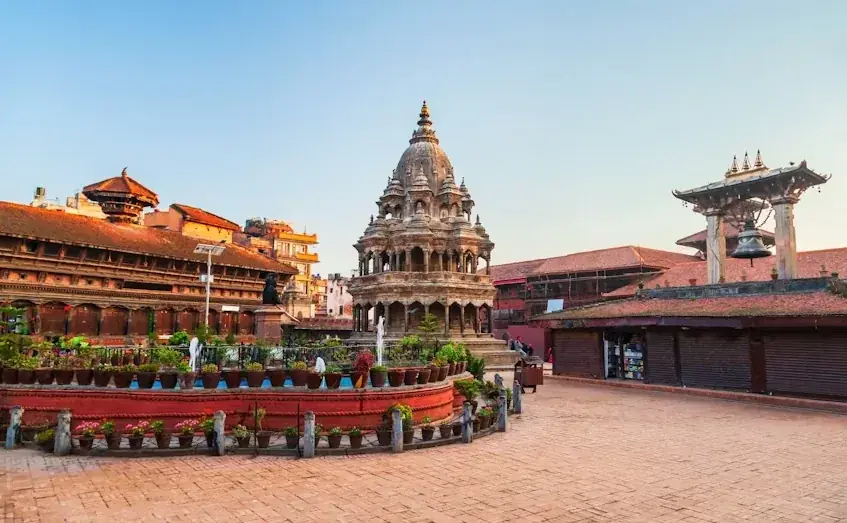
Bhaktapur Durbar Square is a complex of four connected plazas: the main square with the 55-Window Palace and the Golden Gate, Taumadhi Square with the Nyatapola Temple, Pottery Square with its working potters, and quiet Dattatreya Square. It is the best preserved of the valley's three royal squares and the natural starting point for any visit.
The main Durbar Square is dominated by the 55-Window Palace, a masterpiece of woodcarving built in the fifteenth century. The fifty-five windows, each with a different carved lattice, are a testament to the skill of Newari artisans and the wealth of the Malla kings who commissioned them. The palace now houses the National Art Gallery, which displays a collection of paubha scroll paintings, stone sculptures, and bronze work. The Golden Gate, the entrance to the palace's inner courtyard, is a gilded masterpiece of repousse metalwork, with intricate depictions of deities and mythical creatures.
The Vatsala Temple, with its distinctive stone bell, and the statue of King Bhupatindra Malla atop a stone column, are other highlights of the main square. The 2015 earthquake caused significant damage here, and several temples collapsed entirely. Reconstruction is ongoing, and the sight of traditional craftsmen rebuilding using centuries-old techniques is itself a fascinating part of the Bhaktapur experience.
Why Is Nyatapola Temple So Famous?
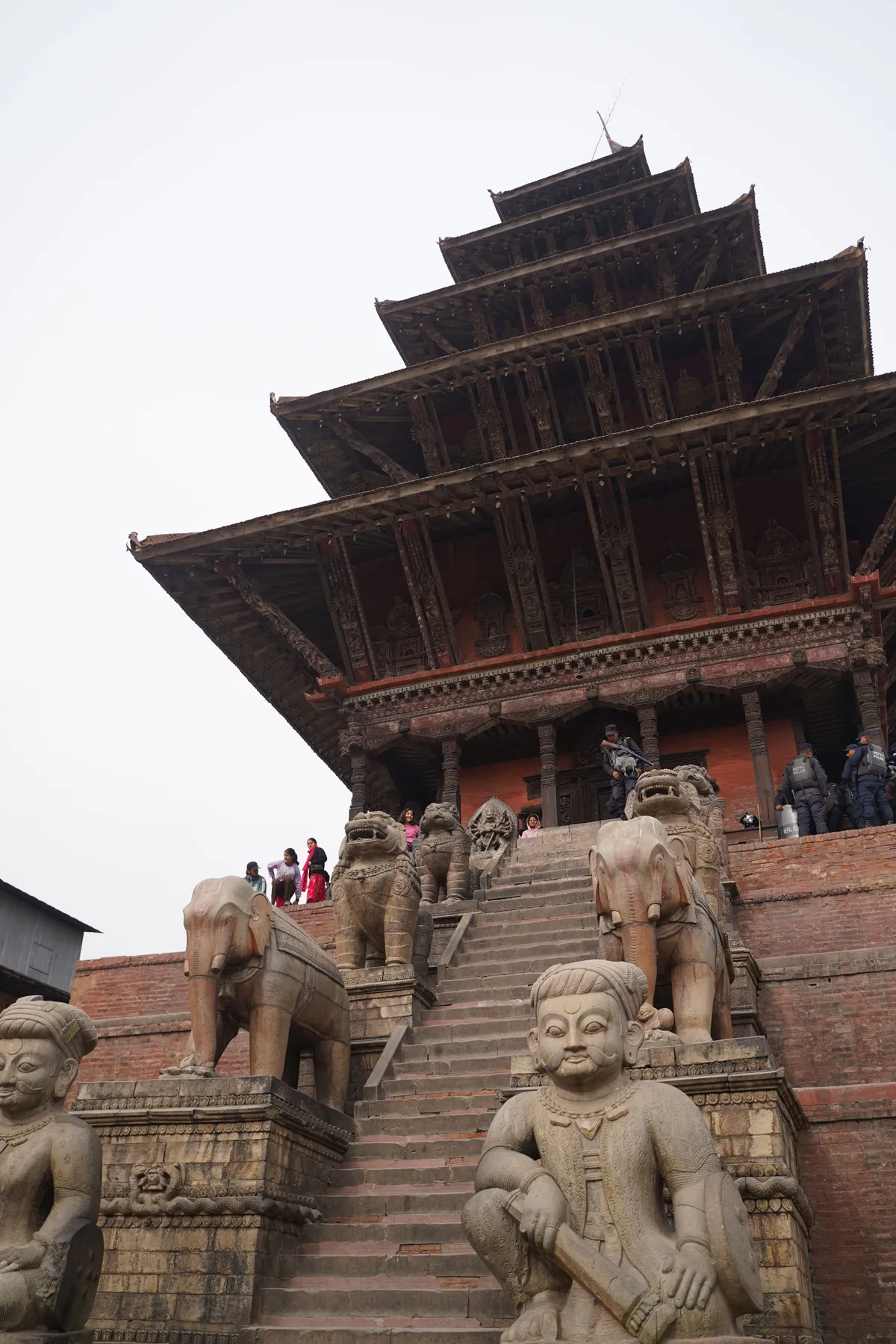
Nyatapola is famous as Nepal's tallest pagoda, a five-story temple completed in 1702 that survived the 2015 earthquake almost untouched. Its stairway is lined by stone guardians, legendary wrestlers to goddesses, each said to be ten times stronger than the figure below. Centuries-old seismic engineering still protects the structure today.
Just a short walk from the main square, Taumadhi Square is dominated by the Nyatapola Temple, a five-story pagoda that rises thirty meters above the city. Built in 1702, it is the tallest temple in Nepal and one of the most impressive examples of pagoda architecture in the world. The temple survived the 2015 earthquake with minimal damage, a testament to the engineering skill of its builders, who used a foundation of compacted clay and brick that absorbs seismic energy.
The temple is dedicated to Siddhi Lakshmi, a tantric goddess, and the interior is closed to non-Hindus. But the exterior is the main attraction. The five-tiered roof, each level slightly smaller than the one below, creates a sense of upward movement that draws the eye toward the sky. The staircase is flanked by stone guardians: legendary wrestlers, elephants, lions, griffins, and goddesses, each said to be ten times stronger than the figure below. Climbing the steps, past these silent sentinels, is one of the essential Bhaktapur experiences. The view from the top, across the tiled roofs of the city to the Himalayan foothills beyond, is worth the climb.
Where Can You Watch Potters at Work?
Pottery Square, a few minutes west of Taumadhi Square, is where Bhaktapur's potters still shape clay on kick-operated wheels and dry their vessels in the open sun. Visiting in the late afternoon, when the light is warm and the day's work is finishing, gives the most atmospheric view of this living craft.
A few minutes' walk from Taumadhi Square, Pottery Square is exactly what it sounds like: a public square where potters work at traditional wheels, shaping clay into vessels, lamps, and decorative items. The craft has been practiced here for centuries, and the methods have changed little. The clay is local, dug from fields outside the city. The wheels are kick-operated, powered by the potter's leg. The kilns are open fires, and the finished pots are laid out in the sun to dry before firing.
Pottery Square is not a tourist performance. The potters are working, and while they are accustomed to visitors and generally happy to be photographed, it is polite to ask first and to buy something if you take pictures. The small clay lamps, used for festivals and temple offerings, make excellent souvenirs: lightweight, inexpensive, and genuinely local. Watching a potter transform a lump of clay into a perfectly symmetrical vessel in minutes is a reminder of the skill that underlies all traditional crafts, and of the continuity that makes Bhaktapur special.
Where Is the Famous Peacock Window?
The Peacock Window hangs on the Pujari Math in Dattatreya Square, at the eastern end of the old city. This fifteenth-century woodcarving, a peacock framed by intricate geometric patterns, is considered the finest surviving example of Newari window carving and lies a short walk from the durbar square.
Dattatreya Square, at the eastern end of the old city, is the quietest of Bhaktapur's main squares and, for many visitors, the most atmospheric. The Dattatreya Temple, said to have been built from the timber of a single tree, is dedicated to a syncretic deity combining aspects of Brahma, Vishnu, and Shiva. The square is surrounded by traditional houses with elaborately carved windows, and the atmosphere is more residential than touristic.
The most famous window in Bhaktapur, and perhaps in all of Nepal, is the Peacock Window, located in the Pujari Math, a former priest's house adjacent to the square. The window is a masterpiece of woodcarving, depicting a peacock with an elaborate fan of tail feathers, surrounded by intricate geometric patterns. It dates to the fifteenth century and is considered the finest example of Newari window carving in existence. The Pujari Math also houses a woodcarving museum that displays tools, techniques, and examples of the craft.
What Should You Eat in Bhaktapur?
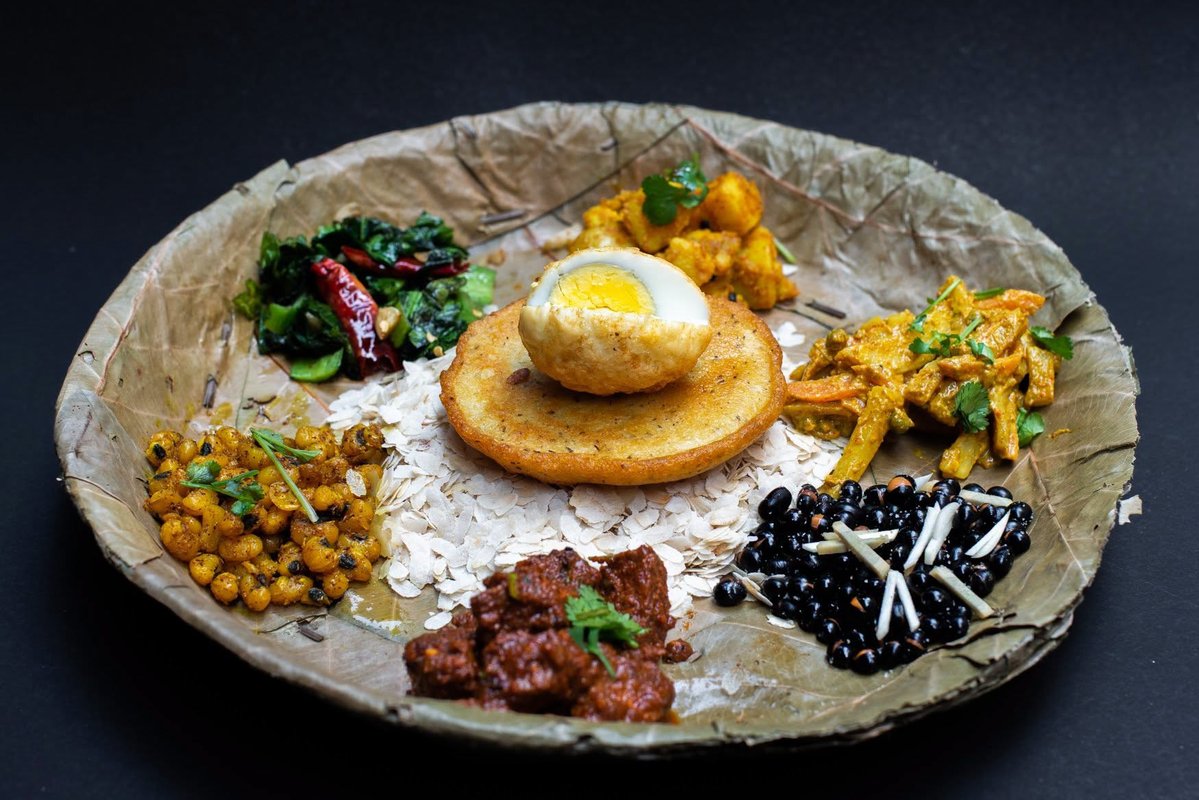
Start with juju dhau, the famous king yogurt set in traditional clay pots, then find a Newari restaurant for samay baji, a ritual platter of beaten rice, grilled meat, spiced potatoes, and soybeans. Bara lentil pancakes and chatamari rice crepes round out a meal that exists nowhere else in quite the same form.
Bhaktapur is famous for its food, and no day tour is complete without a proper Newari meal. The city's signature dish is juju dhau, literally "king yogurt," a rich, creamy yogurt made from buffalo milk and set in traditional clay pots. It is served everywhere, but the best is found in the shops around the durbar square. The texture is closer to Greek yogurt than the thin yogurt common in the West, and the flavor is tangy and slightly sweet.
For a full meal, seek out a Newari restaurant serving traditional dishes. Samay baji is a ritual platter of beaten rice, grilled buffalo meat, spiced potatoes, soybeans, boiled egg, and a fiery tomato achar. Bara, a lentil pancake often topped with egg or minced meat, is a popular snack. Chatamari, sometimes called Newari pizza, is a rice flour crepe topped with minced meat, egg, and spices. Wash it down with chiya, Nepali spiced milk tea, or with a glass of raksi, the local distilled spirit, if you are feeling adventurous. Several restaurants around the squares offer set Newari meals that let you sample a variety of dishes.
Hidden Courtyards and Backstreets
The major squares are essential, but Bhaktapur's soul lives in its backstreets. Leave the main squares behind and wander. The city is small enough that you cannot get seriously lost, and every alley leads somewhere interesting. You will find courtyards, called chowks, where community life unfolds: women washing clothes at a stone spout, children playing, old men playing cards in the sun. You will find small temples and shrines, some no larger than a cupboard, with offerings of flowers and vermilion powder. You will find workshops where woodcarvers, metalworkers, and painters practice crafts that have been passed down through generations.
The best approach is to put away the map and follow your curiosity. If an alley looks interesting, explore it. If you hear music or chanting, investigate. If a local invites you into a courtyard, accept, with respect and gratitude. These unscripted encounters are often the most memorable part of a Bhaktapur visit. The spiritual tour in Nepal guide explores the living religious traditions that animate these spaces.
When Is the Best Time to Visit Bhaktapur?
October through December is the best window: clear skies, comfortable temperatures, and golden post-monsoon light on the brick. Within any day, arrive before 9 AM for quiet squares and soft light, or after 3 PM when locals reclaim the plazas. Midday brings the tour buses and the thickest crowds.
Bhaktapur is beautiful year-round, but timing matters. The best months are October through December, when the skies are clear, the temperatures are comfortable, and the post-monsoon light is golden. March and April bring warm weather and blooming flowers but also more tourists. The monsoon months of June through August are wet, but the rain-washed streets are atmospheric and the crowds are thin. Winter, December through February, can be cold, particularly in the early morning and evening, but the low winter light is beautiful for photography.
Within a day, the best times are early morning, before 9 AM, and late afternoon, after 3 PM. The morning light is soft and the squares are quiet, with only locals going about their daily routines. The late afternoon light brings out the warm tones of the brick and wood, and the squares fill with locals socializing after the day's work. Midday, between 11 AM and 2 PM, is when the tour buses arrive, and the main squares can feel crowded. This is a good time to retreat to the backstreets, visit the museums, or enjoy a long lunch.
How Do You Photograph Bhaktapur at Its Best?
Photograph Bhaktapur in the early morning or late afternoon, when low sun rakes across the carved wood and brick and the squares are free of midday crowds. A wide-angle lens handles the tight plazas; a telephoto captures carving details and candid portraits from a respectful distance. Always ask before photographing people.
Bhaktapur is a photographer's dream, but a few guidelines will improve your results and your experience. The best light is in the early morning and late afternoon, when the low sun brings out the texture of carved wood and brick. The Nyatapola Temple is particularly photogenic in the morning, when the sun illuminates the eastern facade. Pottery Square is best in the late afternoon, when the potters are finishing their day's work and the light is warm.
A wide-angle lens is useful for the squares and temples, where you often cannot back up far enough to capture the full structure. A telephoto lens is useful for details of carvings and for candid portraits from a respectful distance. Always ask permission before photographing people up close. Most Bhaktapur residents are accustomed to cameras and are generally cooperative, but a smile and a gesture of inquiry go a long way. Some may ask for a small payment, particularly the potters and the sadhus who sometimes pose in the squares. A few rupees is a fair exchange for a portrait.
Can You Combine Bhaktapur With Other Destinations?
Yes. Changu Narayan, the oldest temple in the Kathmandu Valley, sits six kilometers further east and pairs naturally with a Bhaktapur morning. Ambitious walkers can continue on the classic Changu Narayan to Nagarkot ridge hike. Avoid squeezing Patan or Kathmandu Durbar Square into the same day, because each deserves unhurried time.
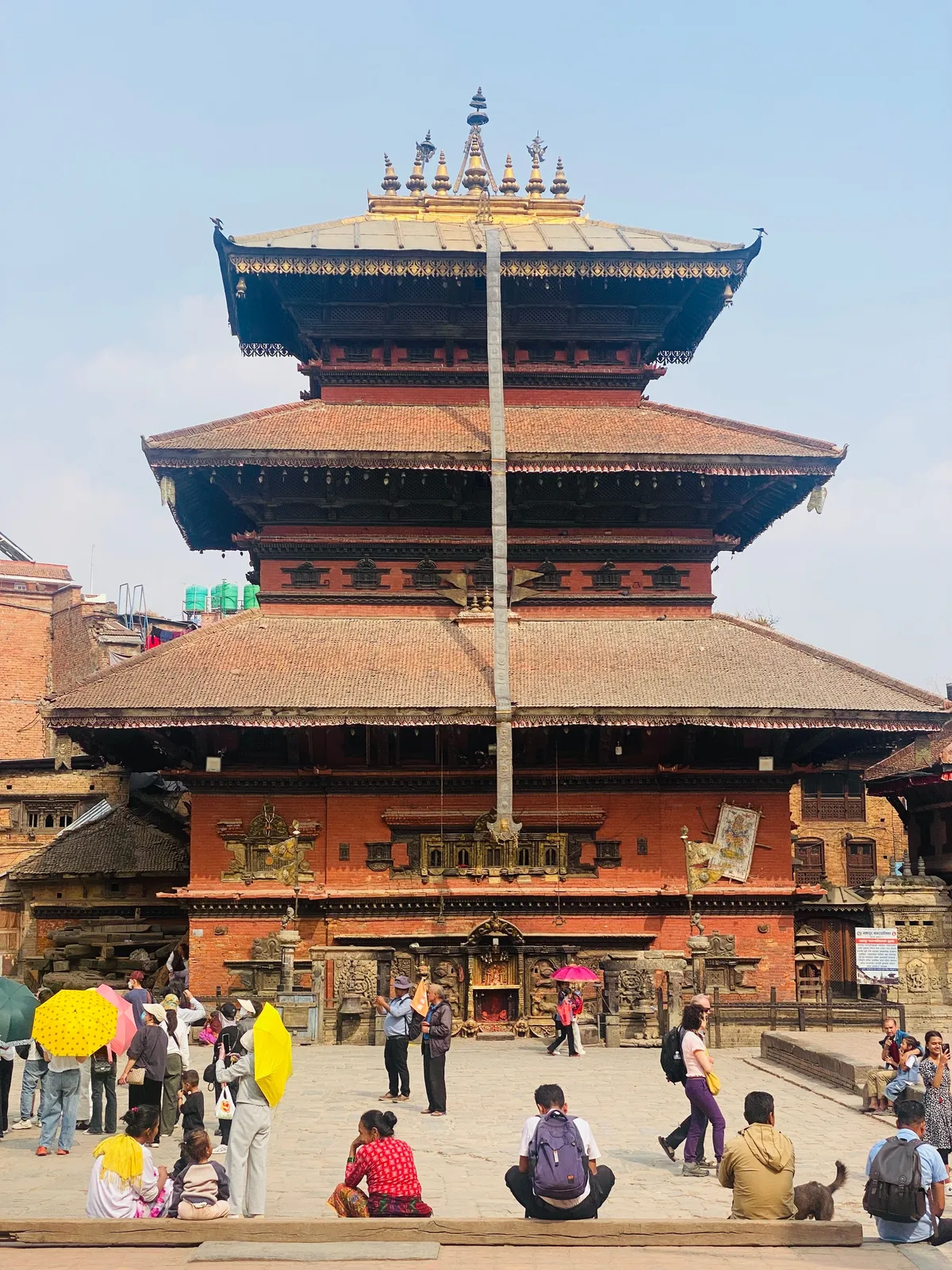
Bhaktapur works well as a standalone day trip, but it also combines naturally with other destinations. Changu Narayan, the oldest temple in the Kathmandu Valley, is only six kilometers further east and can be visited in the same day. The temple's stone inscriptions, dating to 464 AD, and its exquisite sculptures make it a worthy addition to a Bhaktapur itinerary. A taxi can take you from Bhaktapur to Changu Narayan in about twenty minutes. To string the valley's monuments together into a wider circuit, the Nepal cultural and heritage tour guide maps temples, squares, and living traditions across the country.
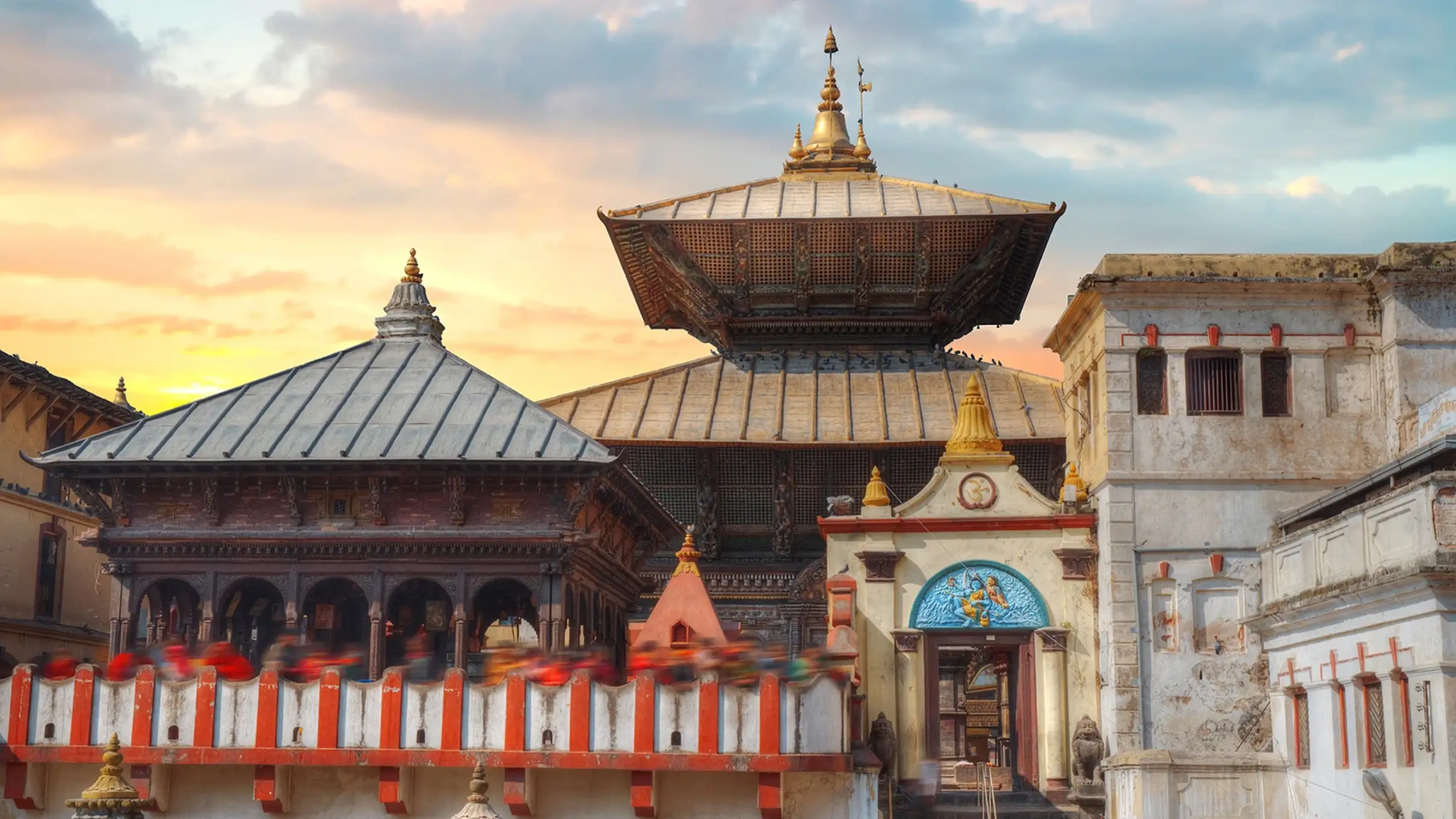
For travelers interested in trekking, the hike from Changu Narayan to Nagarkot is a classic valley rim walk, passing through traditional villages and forests with Himalayan views from the Nagarkot ridge. The complete guide to trekking in Nepal includes information on valley rim hikes. For a wellness-oriented approach, the 5-day yoga retreat with hiking combines daily yoga practice with guided hikes in the valley, including routes that pass through traditional Newari settlements.

If you are based in Kathmandu for a longer stay, consider visiting Bhaktapur on a separate day from the other UNESCO sites. The city deserves its own time, and trying to combine it with Patan or Kathmandu Durbar Square in a single day means shortchanging all of them. The spiritual tour in Nepal 2026 guide offers multi-day itineraries that give each site the time it deserves.
Practical Information
The entrance fee for Bhaktapur is NPR 1,500 for foreign visitors as of 2026, payable at the city gates. SAARC nationals pay NPR 500. The ticket is valid for the entire day, and you may be asked to show it if you leave and re-enter the core area. Keep it with you. The fee contributes to the preservation and maintenance of the city's heritage.
Guides are available at the entrance and are worth the investment, typically NPR 1,500 to NPR 2,500 for a half-day tour. A good guide will explain the history and symbolism of the monuments, take you to hidden corners you would miss on your own, and provide context for the rituals and traditions you observe. Booking the Bhaktapur day tour package bundles a licensed guide, transport, and entrance logistics into one reservation. If you prefer to explore independently, a good guidebook and a willingness to wander will serve you well.
Wear comfortable walking shoes. The brick streets are uneven, and you will be on your feet for hours. Dress modestly, covering shoulders and knees, particularly if you plan to enter temples. Bring water, sunscreen, and a hat, especially in the warmer months. There are plenty of cafes and restaurants in and around the squares, so you do not need to carry food.
Why Bhaktapur Stays With You
There is a reason travelers remember Bhaktapur long after other destinations have blurred together. It is not just the monuments, though they are extraordinary. It is the sense of stepping into a world that operates on a different rhythm. The potter at his wheel, the woman selling vegetables in a doorway, the children playing in a courtyard, the temple bells ringing at dusk: these are not performances for tourists. They are the fabric of daily life in a city that has maintained its identity through centuries of change.
Bhaktapur is not frozen in time. It has adapted, modernized, and recovered from disaster. But it has done so on its own terms, preserving what matters while accommodating what is necessary. A day here is not just sightseeing. It is a lesson in what a city can be when it values its heritage not as a commodity but as a living inheritance. The spiritual wellness travel guide explores how Nepal's living traditions, including those of Bhaktapur, offer healing and perspective for modern travelers.