 Nov 8 – Nov 8, 2026
Kathamandu
Laxmi Puja 2026 in Nepal: Tihar Festival Guide
Festival
1 Tag
Festival
Free
Kathamandu1 Tag
Event Details
Loading...
Event starts in
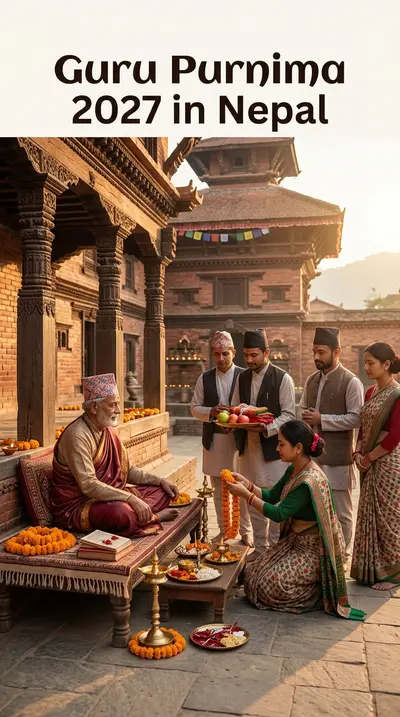
Guru Purnima 2026 in Nepal will be observed on Wednesday, July 29, 2026, corresponding to Shrawan 13, 2083 BS in the Nepali calendar. The day falls on the full moon and is traditionally dedicated to honoring teachers, spiritual guides, mentors, gurus, and the people who pass knowledge and wisdom from one generation to another. Nepal observes Guru Purnima through a mixture of religious devotion, educational activities, family traditions, spiritual gatherings, and teacher–student ceremonies. For many people, it is more than a religious date on the calendar. It is a day to pause and recognize the people whose guidance has influenced learning, character, discipline, and personal growth. In Nepal, this meaning becomes especially interesting because Hindu and Buddhist traditions exist closely together, creating different ways of understanding the relationship between a teacher and a student. The day can therefore be experienced through teacher worship, Guru Puja, meditation, monastery visits, prayers, educational programs, and cultural reflection. Travelers interested in Nepal's spiritual heritage can also use the occasion to explore Kathmandu's temples, Buddhist monasteries, sacred places, and meditation traditions while observing local customs respectfully.
The Guru Purnima 2026 date in Nepal is July 29, 2026, which falls on a Wednesday. Nepali calendar sources identify the day as Shrawan 13, 2083 BS, while the lunar observance is associated with the full moon of the Ashadha/Shukla Purnima period. The precise lunar naming can appear differently across calendar systems because the traditional Hindu lunar calendar and the Nepali civil calendar do not follow exactly the same month boundaries. For practical travel planning, July 29 is the relevant festival date for Nepal in 2026.
If you are planning a spiritual journey around the festival, it is useful to understand that Guru Purnima is not necessarily a single large public festival taking place at one fixed venue. Instead, celebrations can happen in schools, temples, monasteries, ashrams, spiritual communities, and homes. Students may visit teachers, offer flowers or other respectful gifts, receive blessings, and participate in special programs. Religious practitioners may attend Guru Puja, meditation sessions, teachings, or prayers. This decentralized character makes the festival different from large street celebrations such as Dashain in Nepal.
For visitors, the best experience is usually not simply finding a crowded festival ground. Instead, Guru Purnima can be understood through Nepal's living traditions. A visit to Kathmandu's sacred heritage, a Buddhist monastery, a Hindu temple, or a meditation center can provide useful cultural context for understanding why teachers and spiritual guides hold such an important place in Nepali society.
Guru Purnima is a traditional full-moon observance dedicated to expressing gratitude toward a guru or teacher. The Sanskrit word guru is traditionally interpreted in spiritual literature as referring to one who removes or dispels ignorance. The festival therefore centers on knowledge, guidance, discipline, learning, and the relationship between teacher and student.
The day is also commonly associated with Vyasa Purnima, connecting it with the revered sage Vyasa in Hindu tradition. Different traditions explain the importance of the day in different ways, so it is better to understand Guru Purnima as a broad teacher-honoring tradition rather than reducing it to one single story. In Nepal, the day can carry religious, educational, social, and cultural meanings at the same time.
The idea of honoring a teacher has a particularly deep place in South Asian culture. Knowledge was historically transmitted through teacher–student relationships, whether in religious learning, philosophy, music, literature, yoga, traditional arts, or practical skills. Guru Purnima provides a yearly opportunity to recognize that relationship.
In modern Nepal, the meaning has expanded beyond traditional spiritual gurus. School and university students may express appreciation toward teachers, while spiritual practitioners honor their teachers or lineages. This makes Guru Purnima relevant to both religious communities and the wider educational culture.
Travelers exploring Nepal can understand this tradition more deeply through Buddhist meditation in Nepal, where teacher–student relationships remain important in many Buddhist learning environments.
The importance of Guru Purnima in Nepal comes from its connection with knowledge, gratitude, discipline, spirituality, and education. Nepal's cultural landscape contains both Hindu and Buddhist traditions, and both have developed strong systems of learning in which teachers play an important role.
In Hindu traditions, a guru may be a spiritual teacher who guides a disciple through religious study, meditation, philosophy, yoga, or personal discipline. In Buddhist traditions, teachers and lineage holders can guide students through teachings, meditation practices, ethical training, and philosophical study. These traditions differ in doctrine and practice, but both demonstrate the importance placed on learning through guidance.
Guru Purnima also has an everyday social meaning. A student does not necessarily need to follow a spiritual guru to participate. A schoolteacher, university lecturer, music teacher, yoga instructor, traditional artist, or mentor may also represent someone whose knowledge deserves appreciation.
This broader meaning makes the festival particularly suitable for understanding Nepal beyond sightseeing. A traveler visiting Pashupatinath Temple may encounter Hindu religious traditions, while a visit to Buddhist areas around Boudhanath can provide a different perspective on spiritual education.
One of the most important ideas behind Guru Purnima is the traditional guru–shishya relationship, meaning the relationship between teacher and disciple or student. Historically, learning in South Asia was often based on direct interaction between a knowledgeable teacher and a student who gradually developed understanding through observation, practice, questioning, discipline, and service.
The relationship was not limited to academic information. In spiritual traditions, the teacher could also guide the student's behavior, meditation, ethical development, and understanding of religious teachings. In music and traditional arts, a teacher could pass techniques and knowledge that were difficult to learn from books alone.
Guru Purnima symbolically recognizes this transmission of knowledge. Students may therefore express gratitude through Guru Puja, respectful greetings, flowers, gifts, prayers, or simply spending time with their teachers.
For travelers interested in this aspect of Nepal, a spiritual tour in Nepal can provide a wider cultural background. Such journeys can connect temples, monasteries, meditation spaces, and pilgrimage destinations rather than treating each location as an isolated tourist attraction.
Guru Purnima is often called Vyasa Purnima because of its association with the sage Vyasa in Hindu tradition. Vyasa is traditionally connected with major Sanskrit literature, particularly the Mahabharata, and is revered as an important figure in the transmission and organization of sacred knowledge.
The association does not mean that every Guru Purnima celebration is specifically a ceremony for Vyasa alone. Rather, Vyasa represents the wider ideal of the teacher, scholar, and transmitter of knowledge.
In Nepal, Hindu communities may therefore remember Vyasa while also honoring their own teachers and spiritual guides. The emphasis is ultimately on gratitude toward knowledge and those who help others acquire it.
This theme can be understood alongside Nepal's broader Hindu pilgrimage traditions, where religious learning, ritual, pilgrimage, and teacher-guided practice have historically been interconnected.
Guru Purnima also has significance within Buddhist contexts, although Buddhist observance and terminology can differ by tradition and community. Nepal is particularly interesting in this regard because Hindu and Buddhist religious traditions have developed alongside each other for centuries.
Some Nepali Buddhist communities connect the full-moon period with teachings and the importance of spiritual teachers. Buddhist monasteries may observe special prayers, teachings, meditation, or devotional practices depending on their lineage and local calendar.
The broader principle of respecting a teacher is deeply relevant to Buddhist practice. Students may receive instruction in meditation, Buddhist philosophy, ethics, ritual, and contemplative methods from qualified teachers.
For travelers interested in this dimension, Buddhist meditation in Nepal offers a useful introduction to monastery-based learning and meditation traditions.
A visit to Lumbini, birthplace of Buddha can provide another perspective. Lumbini is an important Buddhist pilgrimage destination where visitors can explore monasteries and the Sacred Garden in a quieter environment.
There is no single nationwide ceremony that defines every Guru Purnima celebration. Customs differ according to family, school, religious community, spiritual lineage, and location.
One common practice is honoring teachers. Students may visit their teachers, offer flowers, gifts, sweets, garlands, or other respectful items, and receive blessings. Schools may organize special programs where students perform songs, speeches, cultural presentations, or appreciation ceremonies.
Religious communities may conduct Guru Puja, prayers, chanting, meditation, or spiritual teachings. Ashrams and monasteries can organize programs connected with their particular traditions.
In families, the festival can be relatively simple. A person may remember an important teacher, make an offering, send a message of gratitude, or visit a guru.
This variety is one of the most interesting parts of Guru Purnima. Unlike a festival defined primarily by public processions, the celebration often happens through personal relationships.
Guru Puja is one of the important practices associated with Guru Purnima. The exact form varies according to religious tradition and teacher lineage.
A traditional ceremony may include cleaning a sacred space, arranging flowers, lighting lamps or incense, offering food or other items, reciting prayers, and receiving blessings. In spiritual communities, students may gather together to honor their teacher or lineage.
The meaning of the offering is more important than its monetary value. Flowers, fruits, sweets, clothing, books, or other respectful gifts can symbolize gratitude.
Visitors should remember that a Guru Puja is a religious ceremony rather than a tourist performance. If you encounter one while traveling, watch quietly and follow instructions from participants.
This same principle applies when visiting Pashupatinath's sacred complex or Buddhist monasteries throughout Kathmandu.
Guru Purnima has a strong educational dimension in Nepal. Students may organize programs to thank teachers and recognize their contribution to education.
School celebrations can include speeches, cultural performances, songs, presentations, flowers, gifts, and appreciation ceremonies. The style varies from school to school.
For young people, the festival offers an opportunity to think about teachers who have influenced their education and personal development. For teachers, it can become a meaningful moment of connection with students.
This modern educational dimension means that Guru Purnima should not be understood only as a religious festival. It is also a cultural expression of respect for learning and educators.
Visitors interested in Nepal's cultural life can explore more celebrations through the country's events and festivals in Nepal.
Guru Purnima rituals vary, but several practices commonly appear across communities.
The central practice is showing respect and gratitude toward one's teacher or guru. This may happen through a visit, greeting, offering, prayer, or ceremony.
Students may offer flowers, garlands, fruits, sweets, clothing, books, or other meaningful gifts. The intention is generally appreciation rather than material exchange.
Students may seek blessings from teachers, particularly in spiritual and religious settings.
Spiritual communities may organize meditation sessions, chanting, lectures, or religious teachings.
Schools and educational institutions may organize cultural programs, speeches, student performances, and teacher appreciation activities.
Some people use Guru Purnima as a time to remember teachers who are no longer alive or who influenced an important stage of their lives.
These practices demonstrate that Guru Purnima can be both highly spiritual and deeply personal.
Kathmandu is one of the most practical places to experience the wider spiritual context of Guru Purnima. The valley contains Hindu temples, Buddhist stupas, monasteries, traditional courtyards, and meditation centers within a relatively compact area.
Kathmandu Valley heritage includes important religious locations such as Pashupatinath, Boudhanath, Swayambhunath, Patan, and Bhaktapur.
For a visitor interested in meditation and spiritual learning, meditation in Kathmandu can complement a Guru Purnima itinerary. Meditation centers and monasteries provide opportunities to understand Nepal's living spiritual traditions rather than simply photographing monuments.
A respectful day could include an early visit to a temple or stupa, a quiet meditation session, a cultural walk, and time learning about the teacher–student traditions associated with the festival.
Boudhanath is an important Buddhist landmark in Kathmandu and can be particularly meaningful for travelers interested in Buddhist learning and meditation.
The large white stupa is surrounded by monasteries, prayer wheels, Buddhist shops, restaurants, and residential areas. Pilgrims walk clockwise around the stupa while reciting prayers or mantras.
Visitors can combine a visit to Boudhanath's Buddhist atmosphere with reading about monastery stays in Nepal.
The important point is to treat Boudhanath as an active religious space rather than simply a landmark. Walk in the traditional direction around the stupa, avoid blocking pilgrims, dress appropriately, and ask before photographing people.
Swayambhunath, often called the Monkey Temple, is another important Buddhist site in Kathmandu. The hilltop stupa offers views across the valley and contains shrines, prayer wheels, monasteries, and other religious features.
Guru Purnima travelers interested in meditation can use the site as part of a broader spiritual itinerary. The purpose should not be to claim that Swayambhunath hosts one standardized Guru Purnima ceremony every year, because local observances can vary.
Instead, the site offers an opportunity to observe the relationship between pilgrimage, prayer, meditation, and Buddhist heritage.
For a more structured experience, travelers can explore yoga and meditation retreats before or after visiting the valley's religious sites.
Lumbini is especially relevant to travelers interested in Buddhist history and spiritual learning. It is recognized as the birthplace of Siddhartha Gautama, the Buddha, and is home to the Maya Devi Temple, sacred garden, Ashoka Pillar, and international monastic zone.
The connection with Guru Purnima is best understood through the broader Buddhist tradition of learning and transmission rather than assuming that every part of Lumbini follows a special Guru Purnima ceremony.
Travelers can spend time in the Lumbini Sacred Garden, visit monasteries, practice quiet reflection, or join an appropriate meditation session.
A dedicated Lumbini Buddhist pilgrimage can also be considered if the specific package is available and matches your travel dates.
Muktinath is another place where Hindu and Buddhist traditions meet. Located in Mustang at roughly 3,710 meters, the sacred site is revered by both communities and is known for its water spouts and natural flame.
Although Muktinath is not a specific Guru Purnima venue, it can form part of a wider spiritual journey through Nepal.
Travelers planning such a journey can read the Muktinath pilgrimage guide before traveling.
The high altitude also means that Muktinath requires more preparation than Kathmandu or Lumbini. Visitors should consider transportation, weather, altitude, clothing, health, and available time.
For travelers who prefer a shorter journey, the Muktinath sacred pilgrimage page provides additional background on the destination.
Meditation is a natural theme for Guru Purnima because many traditional teacher–student relationships involve some form of contemplative practice.
Nepal offers several different meditation environments. Kathmandu has Buddhist monasteries and meditation centers, while Lumbini provides a quieter pilgrimage environment. Mountain locations such as Namobuddha and monastery villages can offer another type of spiritual atmosphere.
The important point is that meditation traditions differ. Mindfulness, Vipassana, Tibetan Buddhist practices, mantra meditation, yoga-based practices, and other approaches are not interchangeable.
Travelers should therefore learn about the specific tradition before joining a session. The Buddhist meditation guide provides an introduction to different settings and practices.
Yoga and the guru tradition have a historical relationship in South Asian spiritual culture. Traditional yoga was often transmitted through teachers, with students learning practices progressively under guidance.
Modern yoga tourism in Nepal includes everything from short introductory sessions to longer residential retreats. Guru Purnima can therefore be a meaningful time for practitioners to reflect on their own teachers and learning journey.
Travelers interested in combining cultural exploration with practice can explore yoga retreats in Nepal.
However, it is important not to assume that every yoga retreat is specifically connected with Guru Purnima. The connection depends on the individual teacher or center.
Nepal has many destinations where travelers can learn about spiritual traditions connected with teachers and learning.
Kathmandu is convenient because of its concentration of temples, monasteries, stupas, and meditation centers. Boudhanath and Swayambhunath are particularly relevant to Buddhist traditions, while Pashupatinath provides insight into Hindu religious culture.
Lumbini offers an important Buddhist pilgrimage environment. Namobuddha provides a mountain monastery setting. Janakpur offers a strong Hindu cultural environment connected with Mithila traditions.
Muktinath provides a high-altitude pilgrimage experience shared by Hindu and Buddhist communities. Gosaikunda is another sacred destination associated with Hindu pilgrimage.
You can use the broader Nepal events calendar to identify other festivals that may overlap with your travel plans.
The most important rule for visitors is simple: Guru Purnima is a living religious and cultural tradition, not a performance created for tourists.
If you enter a temple, monastery, school ceremony, or spiritual gathering, observe before participating. Follow local instructions and avoid assuming that every ritual is open to visitors.
Dress modestly, especially at religious sites. Cover shoulders and knees where appropriate. Remove shoes when required. Speak quietly around prayer halls and ceremonies.
Photography also requires sensitivity. Ask permission before photographing teachers, monks, students, worshippers, or private ceremonies. Even when photography is technically allowed, avoid interrupting rituals.
At places such as Pashupatinath Temple, religious activities can be especially sensitive, so visitors should follow site-specific rules.
There is no special universal Guru Purnima dress code, but modest clothing is appropriate when visiting temples, monasteries, schools, or spiritual centers.
Light, comfortable clothing can work well in Kathmandu during summer, but visitors should carry an additional layer for changing weather.
For religious sites, avoid very short clothing or clothing that leaves shoulders exposed. A light scarf can be useful.
If traveling to high-altitude destinations such as Muktinath, clothing requirements are completely different. Warm layers, wind protection, comfortable footwear, and weather-appropriate equipment become essential.
For a spiritual journey combining different elevations, consult a Nepal spiritual tour guide before finalizing your packing list.
International travelers can experience the cultural side of Guru Purnima without needing to participate in religious rituals themselves.
A good approach is to spend time learning about the tradition, visit accessible cultural sites, and participate only when a teacher, monastery, or local host explicitly welcomes visitors.
Kathmandu is generally the easiest starting point. From there, travelers can continue toward Lumbini, Pokhara, Mustang, or other spiritual destinations depending on their interests.
A broader Nepal cultural journey can combine religious heritage with local food, architecture, museums, traditional neighborhoods, and natural landscapes.
The goal is not to collect photographs of ceremonies but to understand the values behind them.
Responsible tourism is especially important around spiritual festivals because visitors enter spaces that have personal and religious significance for local communities.
Avoid treating ceremonies as photo opportunities. Do not interrupt prayers. Do not touch sacred objects unless invited. Avoid entering restricted areas.
When visiting monasteries, remember that monks and students may be studying, praying, or meditating. A quiet visitor can observe without becoming disruptive.
Supporting local guides, cultural businesses, accommodation providers, and community activities can also help distribute tourism benefits.
For travelers interested in combining spiritual practice with responsible community tourism, Guru Purnima can become an opportunity to learn rather than simply consume a cultural experience.
Nepal observes several important full-moon festivals and religious observances throughout the year. Guru Purnima is specifically associated with teachers and spiritual guides.
Buddha Purnima, for example, is associated with the Buddha and is observed on Vaishakha Purnima. Guru Purnima occurs later in the lunar year and focuses primarily on teachers and gurus.
Janai Purnima is another major full-moon festival in Nepal, involving sacred threads and different regional traditions. It is distinct from Guru Purnima even though both are associated with Purnima.
Travelers can explore the broader festival calendar of Nepal to understand how different celebrations fit into the country's cultural year.
Guru Purnima fits naturally into Nepal's growing spiritual tourism landscape because the country contains living traditions rather than only historical monuments.
A spiritual journey can include temple visits, meditation, yoga, monastery experiences, pilgrimage, cultural walks, and quiet time in sacred landscapes.
The key is to recognize that spiritual tourism should not turn religious traditions into products detached from their communities.
A traveler interested in this approach can explore the spiritual tour in Nepal guide for broader planning ideas.
For people who want a more intensive experience, meditation retreats in Nepal provide another way to explore teacher-guided practice.
A short Guru Purnima-inspired itinerary can begin in Kathmandu. Spend the first day exploring the city's cultural heritage and visiting a suitable temple or monastery.
The next morning can focus on meditation or a Buddhist site. Meditation in Kathmandu can help travelers understand the different practice environments available in the valley.
A visit to Boudhanath can then be followed by Swayambhunath and other heritage areas. If time allows, a trip toward Namobuddha can provide a quieter mountain setting.
For a longer journey, continue to Lumbini and explore the monastic zone. Travelers with more time can consider Muktinath or other pilgrimage destinations.
This type of itinerary does not require visitors to participate in rituals. Simply learning, observing respectfully, and reflecting on the teacher–student relationship can be enough.
Guru Purnima has particular meaning for students because the festival provides a chance to recognize the people who have helped shape their education.
Students can write a thank-you message, visit a teacher, offer flowers, participate in school programs, or simply remember an important lesson.
The value of the day is not measured by the price of a gift. A sincere expression of gratitude can be more meaningful than an expensive object.
For students traveling in Nepal, the festival can also be an opportunity to explore the country's educational and spiritual heritage through museums, monasteries, traditional arts, and cultural sites.
The festival is also meaningful from the teacher's perspective. It can remind educators of the responsibility involved in passing knowledge to younger generations.
Teachers in Nepal may be honored by students through school programs and cultural activities. Spiritual teachers may receive offerings and participate in religious ceremonies according to their traditions.
The festival therefore creates a two-way relationship: students express gratitude, while teachers recognize the responsibility that comes with guiding others.
At its heart, Guru Purnima is about gratitude for knowledge.
The festival asks a simple but meaningful question: who helped you become the person you are today?
For one person, the answer may be a schoolteacher. For another, it may be a parent, spiritual guide, music teacher, coach, professor, monk, artist, or mentor.
The traditional guru represents someone who helps a student move from not knowing toward understanding. That idea remains relevant even in modern education.
This is why Guru Purnima continues to have meaning beyond religious ceremonies. It provides a cultural reminder that knowledge is rarely acquired entirely alone.
Traveling in Nepal around Guru Purnima can provide a different way to understand the country's spiritual identity.
Rather than focusing only on mountains and adventure, visitors can explore temples, monasteries, meditation centers, traditional communities, and pilgrimage sites.
Kathmandu offers cultural density. Lumbini offers Buddhist heritage. Muktinath offers a Hindu-Buddhist pilgrimage environment. Namobuddha offers a mountain monastery setting. Janakpur provides another perspective on Hindu and Mithila culture.
Travelers can combine these experiences with Nepal cultural tours when suitable specific packages are available.
The festival itself may be quiet compared with Nepal's largest public celebrations, but that quieter atmosphere can make it valuable for travelers interested in learning and reflection.
Plan your accommodation and transportation before traveling, particularly if you want to visit several destinations.
For Kathmandu, allow enough time for traffic when moving between temples and heritage areas. For Lumbini, consider staying overnight rather than rushing through the Sacred Garden.
If visiting Muktinath, pay attention to altitude and weather. The destination is dramatically different from Kathmandu in terms of climate and elevation.
Carry modest clothing, comfortable shoes, drinking water, sun protection, and any personal medication you need.
Most importantly, keep your expectations flexible. Guru Purnima is celebrated differently by different communities, so a ceremony you encounter may not look exactly like descriptions found online.
Photography can be a wonderful way to remember Nepal, but religious festivals require sensitivity.
Ask before photographing people, particularly teachers, monks, children, worshippers, and private ceremonies.
Avoid using flash during meditation or prayer sessions. Do not stand in front of people who are praying simply to get a better photograph.
At monasteries, follow posted rules and instructions from staff.
At temples, remain aware that some areas may be restricted to certain religious communities.
A respectful photograph is one that does not interfere with the experience of the person being photographed.
Nepal's cultural identity has been shaped by multiple religious and ethnic traditions. Hinduism and Buddhism have developed alongside numerous local traditions, creating a cultural landscape in which teachers, priests, monks, artists, elders, and community leaders can all have important roles.
Guru Purnima fits into this wider culture of respecting knowledge and elders.
The festival also demonstrates why Nepal's cultural tourism cannot be reduced to monuments. The meaning of a temple exists partly through the people who continue to pray there. A monastery is not simply architecture; it is also a place of study and practice.
This is why exploring Nepal's cultural heritage can be more rewarding when visitors take time to understand the communities behind the sites.
Guru Purnima 2026 in Nepal is a meaningful occasion centered on teachers, knowledge, gratitude, and spiritual guidance. Observed on July 29, 2026, the festival connects traditional religious ideas with modern educational life, allowing students, devotees, spiritual practitioners, and families to recognize the people who have helped guide their learning.
For travelers, Guru Purnima offers an opportunity to look at Nepal from a quieter perspective. Instead of focusing only on trekking routes, mountains, or famous monuments, visitors can explore the country's living traditions through temples, monasteries, meditation centers, schools, pilgrimage sites, and conversations with local communities.
A journey beginning in Kathmandu can connect the Hindu traditions of Pashupatinath with the Buddhist atmosphere of Boudhanath and Swayambhunath. A longer route can continue toward Lumbini, Namobuddha, Janakpur, or Muktinath, depending on the traveler's interests and available time.
The most important lesson of Guru Purnima is simple: knowledge is passed from person to person, and gratitude keeps that relationship alive. Whether your teacher is a school educator, spiritual guide, parent, artist, mentor, or someone who changed the direction of your life, the festival provides a meaningful opportunity to remember their contribution.
For travelers planning a spiritual or cultural journey in Nepal, Enticing Himalayas can be used as a starting point for exploring Nepal's destinations, events, activities, and relevant travel experiences.
Key experiences and features
Guru Purnima 2026 in Nepal
Guru Purnima
Guru Puja
Vyasa Purnima
Spirituality
Honoring teachers
Recommended packing list
Kathmandu, Kathmandu, Bagmati, Nepal
Got questions about this event?
Guru Purnima 2026 will be observed on Wednesday, July 29, 2026, corresponding to Shrawan 13, 2083 BS.
Guru Purnima is a full-moon observance dedicated to honoring teachers, gurus, spiritual guides, and the tradition of knowledge and learning.
People may honor teachers through Guru Puja, flowers, gifts, prayers, blessings, educational programs, spiritual gatherings, and meditation.
The festival represents gratitude and respect for teachers and recognizes their role in sharing knowledge, guidance, wisdom, and spiritual learning.
Yes. Visitors can observe suitable public celebrations and explore Nepal's temples, monasteries, and spiritual traditions while respecting local customs.
Jul 18, 2027
1 day
Quick Info
More festival experiences
Nov 8 – Nov 8, 2026Kathamandu
 Aug 17 – Sep 16, 2027
Godavari Kunda
 Jan 15 – Jan 16, 2027
Swayambhu Bhuikhhel