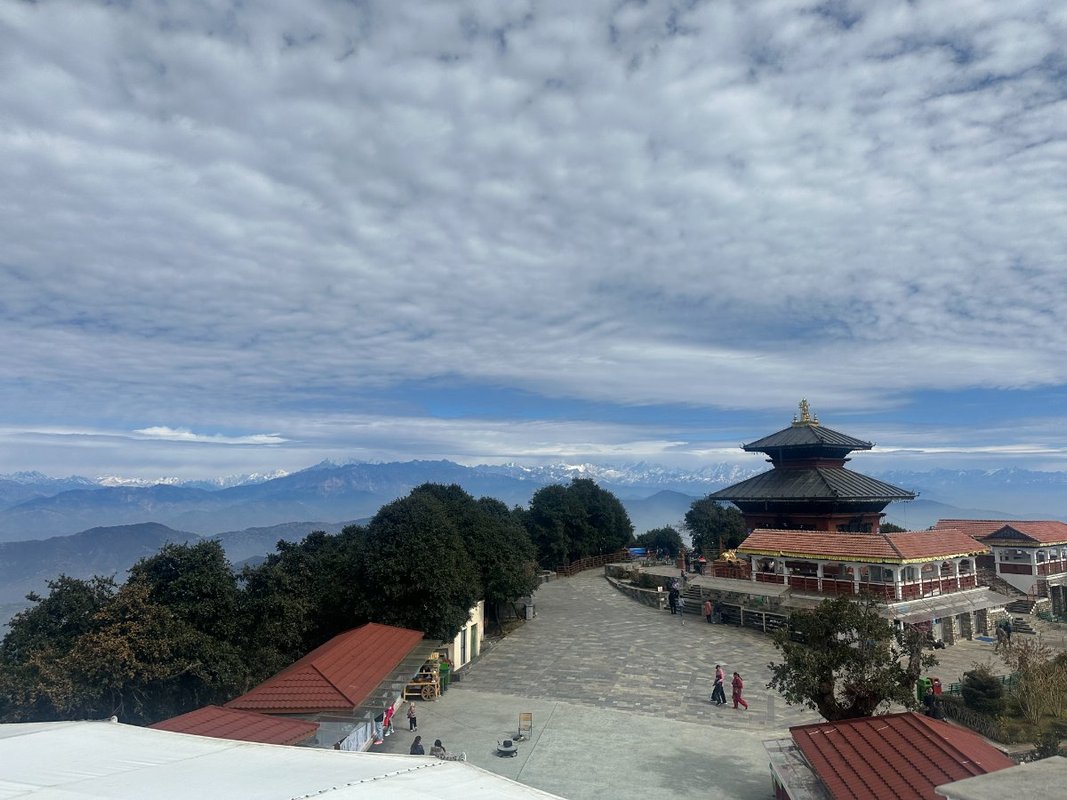
Chandragiri Cable Car and Monkey Temple Tour
Kathmandu Valley is ringed by hills that have held spiritual significance for millennia. Two of the most accessible and rewarding sacred summits sit just a short drive from the city center: Chandragiri Hill, reached by Nepal's newest cable car, and Swayambhunath, the ancient Monkey Temple that has watched over the valley for over 2,000 years. Together they make one of the finest day trips in the Kathmandu Valley, combining panoramic Himalayan views, Hindu pilgrimage, and Buddhist stupa architecture in a single unforgettable outing.
This guide covers everything you need to plan a Chandragiri cable car and Monkey Temple day tour: how to get there, what to see at each site, the best time to visit, what to pack, and how to combine both into a seamless spiritual day trip from Kathmandu. Whether you are a first-time visitor with a single day to spare or a returning traveler looking to go deeper into the valley's sacred geography, this route delivers.
Why Chandragiri and Swayambhunath Together?
At first glance, Chandragiri Hill and Swayambhunath Stupa might seem like an odd pairing. One is a modern cable car ride to a hilltop temple complex that opened to tourists only in 2016; the other is a UNESCO World Heritage Site whose origins trace back to the fifth century. But they share a deeper logic: both are sacred hilltops that offer commanding views of the Kathmandu Valley, both are dedicated to forms of Shiva and the Buddha respectively, and both sit on the valley's western rim, making them geographically efficient to visit in a single day.
Chandragiri gives you the thrill of ascent, the sweep of the Himalayas from Annapurna to Everest on a clear day, and the devotional energy of the Bhaleshwor Mahadev Temple. Swayambhunath gives you the ancient stupa, the all-seeing eyes of the Buddha, the resident monkey troops, and the layered history of Buddhist and Hindu coexistence that defines Nepal's spiritual culture. Together they tell the story of Kathmandu as a sacred valley, a place where the divine and the everyday have always met on the hilltops.
Chandragiri Hill: The Cable Car, the Temple, and the View
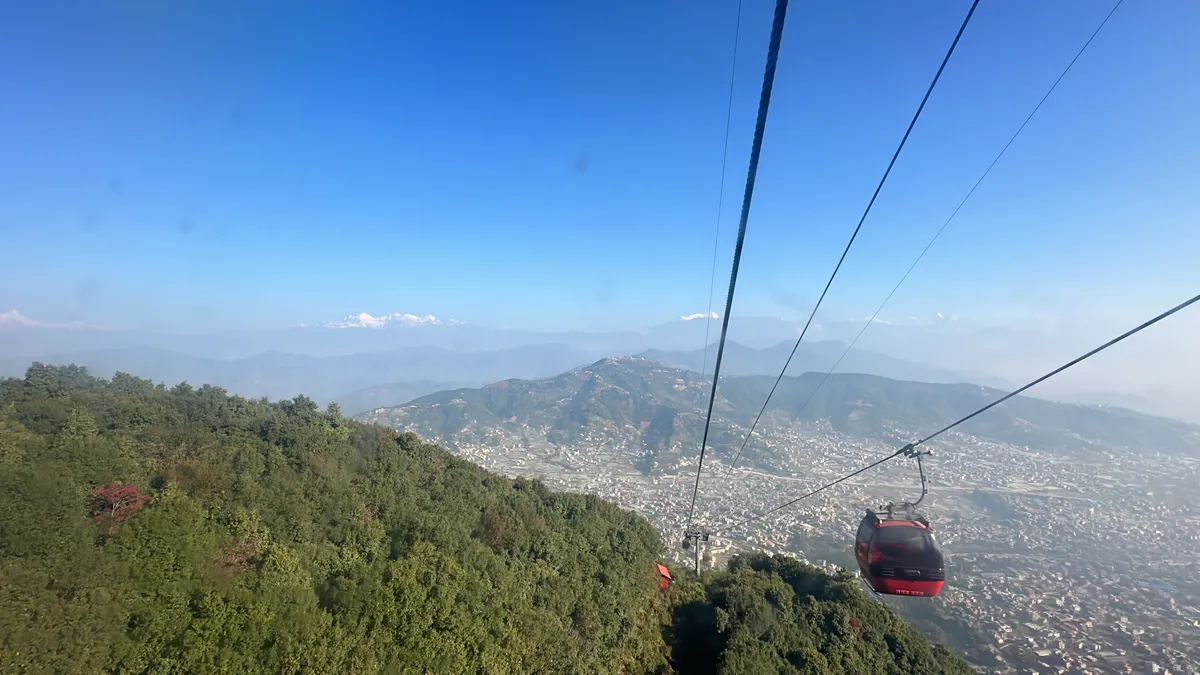
Chandragiri Hill rises to 2,551 meters (8,369 feet) on the southwestern edge of the Kathmandu Valley. For centuries it was a pilgrimage site reached only by foot, a steep climb through oak and rhododendron forest that tested the devotion of every visitor. The cable car, which opened in 2016, changed that. Today you can glide from the base station at Thankot to the summit in about 10 minutes, suspended above the forest canopy with the valley falling away behind you.
The Cable Car Experience
The Chandragiri Cable Car is Nepal's newest and most modern gondola system. Each cabin seats up to 8 passengers and the ride covers a distance of 2.5 kilometers with a vertical gain of over 1,000 meters. The views unfold in stages: first the terraced fields and red-brick villages of the valley floor, then the dense green of the Shivapuri and Chandragiri forests, and finally, as you crest the ridge, the full Himalayan panorama. On a clear morning between October and March, you can see the Annapurna range, Manaslu, Ganesh Himal, Langtang, and even Everest far to the east.
The base station at Thankot is about a 30-minute drive from Thamel. There is ample parking, a ticket counter, a cafe, and clean restrooms. Round-trip cable car tickets cost approximately NPR 1,000 for Nepali nationals and NPR 2,200 for foreign visitors (prices as of 2026). The cable car operates daily from 8:00 AM to 6:00 PM, with the last uphill ride at 5:00 PM.
Bhaleshwor Mahadev Temple
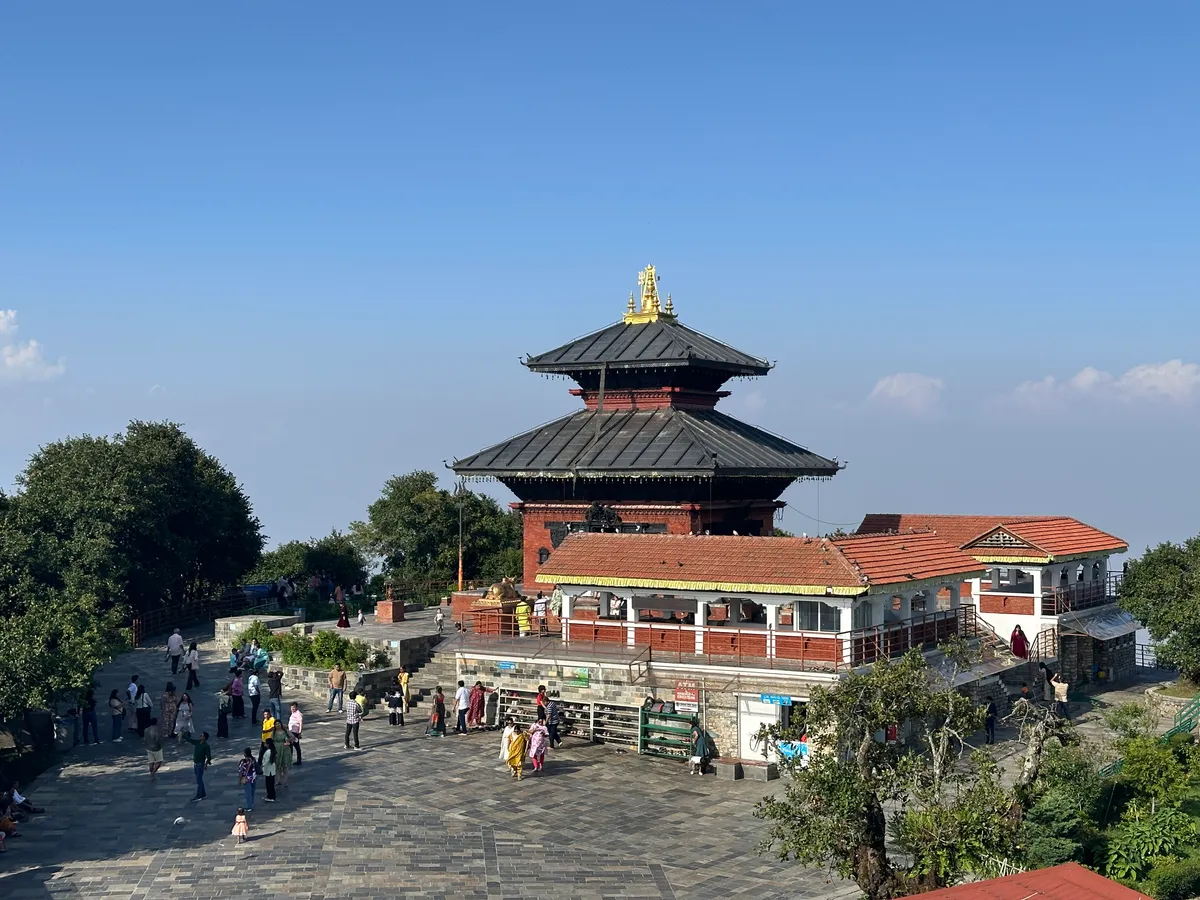
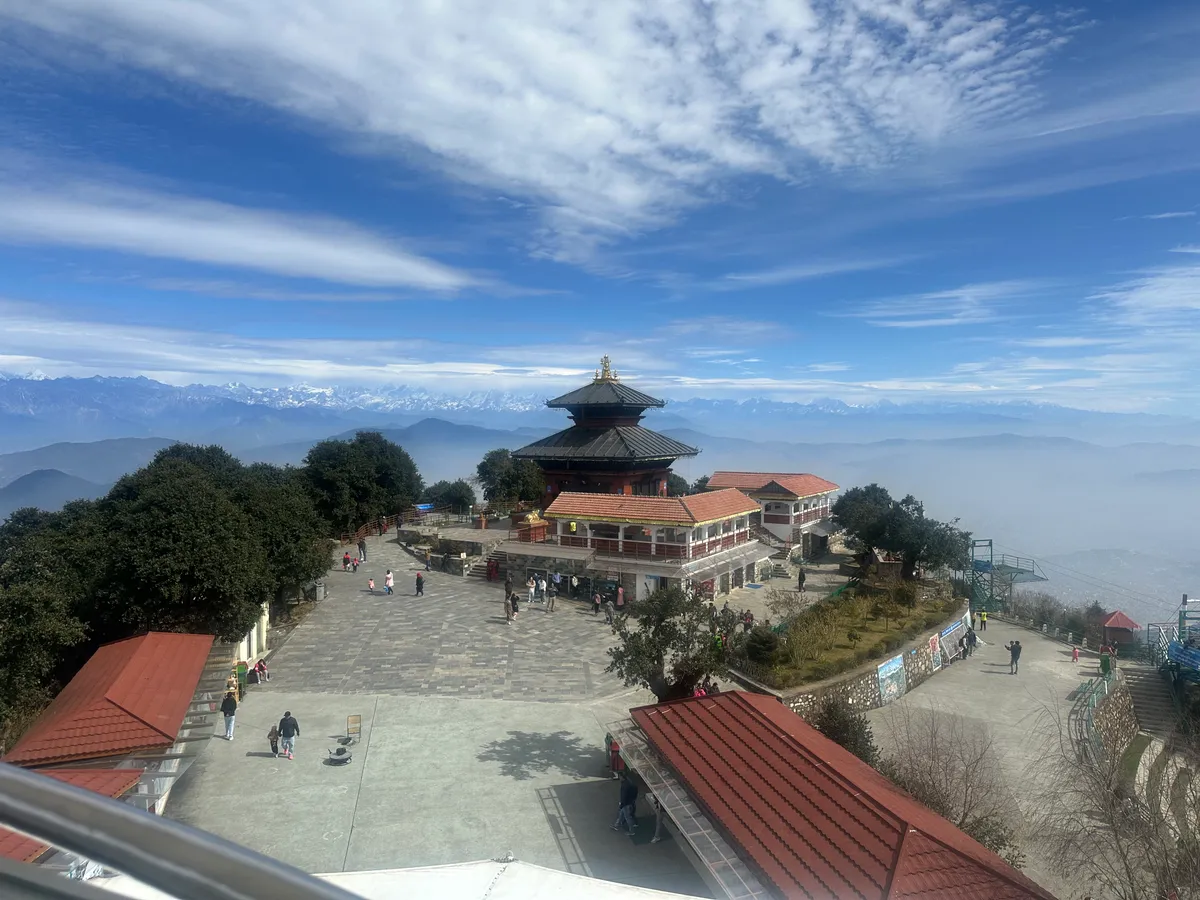
At the summit, the main attraction is the Bhaleshwor Mahadev Temple, a whitewashed shrine dedicated to Lord Shiva. According to legend, King Prithvi Narayan Shah, the unifier of modern Nepal, meditated on this very hilltop before his conquest of the Kathmandu Valley in 1768. He received a vision of Shiva here, and after his victory, he established the temple in gratitude. The current structure is a modern rebuild, but the lingam inside is ancient, and the devotional energy is genuine: you will see Hindu pilgrims from across Nepal making offerings of milk, flowers, and vermilion powder.
The temple complex also includes a viewing tower, a children's park, several restaurants, and a small amusement area. The viewing deck, a circular platform just below the temple, is the best spot for photographs. On a clear winter morning, the Himalayan chain stretches across the entire northern horizon, and the Kathmandu Valley spreads out below like a topographical map.
Practical Tips for Chandragiri
Go early. The cable car gets crowded by mid-morning, especially on Saturdays and public holidays. Aim to arrive at the base station by 8:30 AM for the clearest mountain views and the shortest queues. Bring a light jacket even in summer: the summit is significantly cooler than the valley floor. The restaurants at the top serve decent dal bhat, momos, and chai, but they are overpriced by Nepali standards. Consider packing a snack and eating a proper meal back in the city.
If you are feeling energetic, you can skip the cable car on the way down and hike the old pilgrim trail. The descent takes about 2 hours through beautiful forest and past small shrines. The trail is well-marked and safe, but wear proper shoes: the stone steps can be slippery after rain.
Swayambhunath: The Monkey Temple
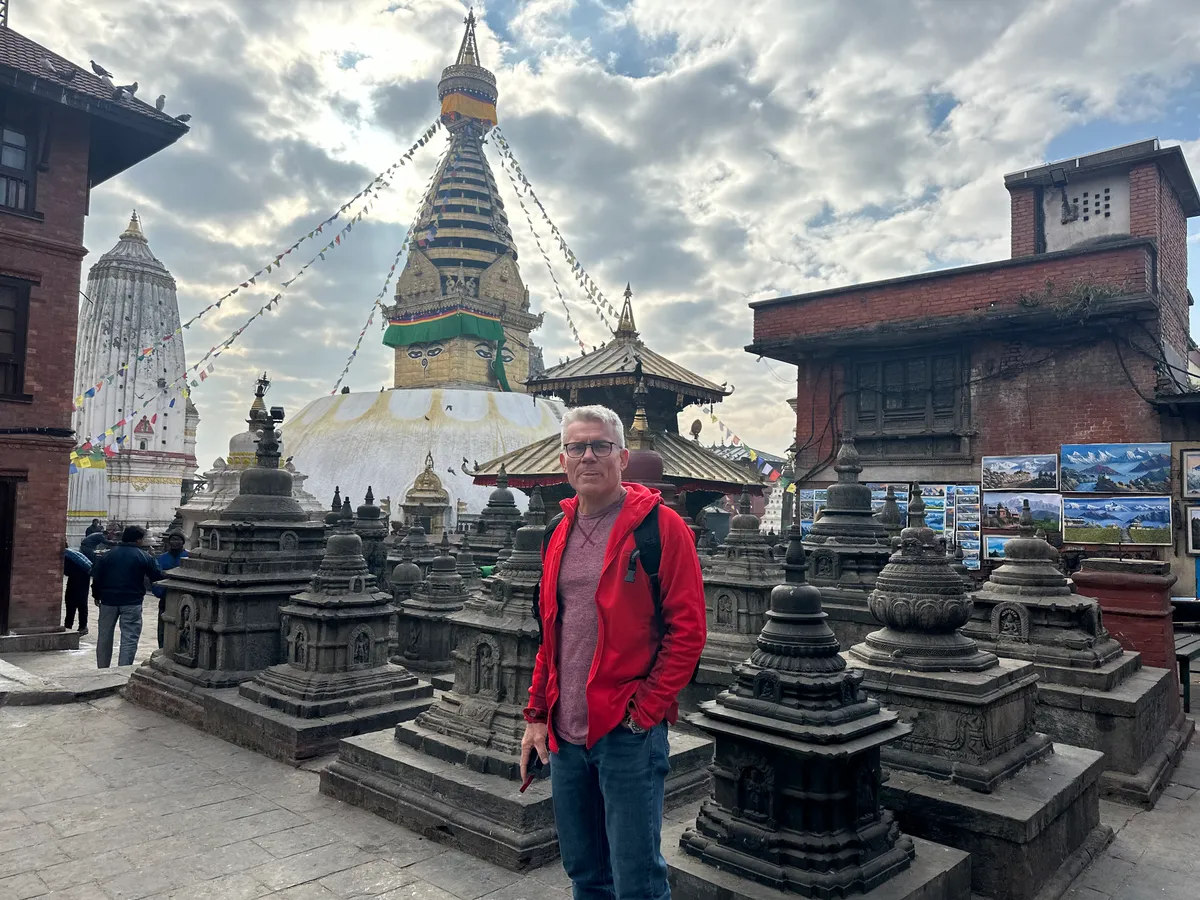
Swayambhunath Stupa, known to every traveler as the Monkey Temple, is one of the most iconic sights in Nepal. Perched on a hilltop 3 kilometers west of central Kathmandu, its white dome and gilded spire crowned with the all-seeing eyes of the Buddha have been a symbol of the valley for over two millennia. The name Swayambhu means "self-created" or "self-arisen" in Sanskrit, referring to the belief that the stupa emerged spontaneously from a lotus flower planted by a previous Buddha.
The Climb and the Stupa
The main approach to Swayambhunath is via a steep stone staircase of 365 steps, one for each day of the year, flanked by stone Buddha statues and prayer wheels. The climb is part of the pilgrimage: each step is an act of devotion, and the resident rhesus macaques, the "monkeys" that give the temple its nickname, watch from the railings and trees with the casual entitlement of creatures who have lived here for centuries.
At the top, the stupa dominates the complex. The white hemisphere represents the earth, the square harmika above it represents the thirteen stages to enlightenment, and the gilded spire represents the path to nirvana. The eyes painted on each side of the harmika are the eyes of the Adi-Buddha, the primordial Buddha, looking out in all four directions with a serene, all-knowing gaze. Between the eyes, the curly symbol that looks like a question mark is the Nepali numeral "one," symbolizing the unity of all things.
Around the main stupa, a ring of smaller shrines, temples, and monasteries creates a dense sacred geography. The Harati Temple, dedicated to the goddess of smallpox and children, is a two-tiered pagoda that predates the stupa itself. The Shantipur, or "Palace of Peace," is a locked chamber said to contain a living saint who has been meditating inside for over 1,500 years. The Tibetan monasteries on the western side of the complex hum with the sound of chanting monks and the deep resonance of long horns.
The Monkeys and the Meaning
The monkeys of Swayambhunath are not pets or performers. They are wild rhesus macaques who have lived on this hill for as long as anyone can remember. They are bold, curious, and opportunistic: they will snatch food, water bottles, sunglasses, and anything shiny if you are not careful. Keep your belongings close, do not make eye contact with aggressive individuals, and never feed them. Feeding the monkeys encourages aggressive behavior and harms their health.
In Buddhist mythology, the monkeys are said to be the descendants of lice that lived in Manjushri's hair. When the bodhisattva Manjushri drained the primordial lake that once filled the Kathmandu Valley, the lice transformed into monkeys and settled on the hill that became Swayambhunath. It is a strange and wonderful origin story, and it captures something essential about this place: the sacred and the mundane, the divine and the animal, have always coexisted here.
How to Combine Chandragiri and Swayambhunath in One Day
The most efficient route is to start with Chandragiri in the morning, when the mountain views are clearest, and then head to Swayambhunath in the afternoon, when the golden light makes the stupa glow. Here is a sample itinerary:
- 7:30 AM: Depart from Thamel or your hotel. Drive to Thankot (30 minutes).
- 8:00 AM: Arrive at Chandragiri base station. Buy tickets, board the cable car.
- 8:30 AM - 10:30 AM: Explore the summit: Bhaleshwor Mahadev Temple, viewing deck, photos. Have chai at the summit cafe.
- 10:30 AM: Cable car down (or hike down if you prefer, adding ~2 hours).
- 11:00 AM: Drive back toward Kathmandu. Stop for lunch at a local restaurant in Kalanki or Swayambhu.
- 1:00 PM: Arrive at Swayambhunath. Climb the 365 steps, circumambulate the stupa, visit the monasteries.
- 3:30 PM: Descend. Optional: visit the Natural History Museum at the base of the hill.
- 4:30 PM: Return to Thamel. Rest, then enjoy dinner in the city.
This itinerary works year-round, but the best months are October through March, when the skies are clearest and the mountain views from Chandragiri are at their most dramatic. In the monsoon months (June to September), the cable car still runs, but the Himalayas are often hidden behind clouds. Swayambhunath is atmospheric in any weather: the mist and rain give the stupa a moody, mystical quality that is beautiful in its own way.
The Spiritual Geography of Western Kathmandu
Chandragiri and Swayambhunath are not isolated sites. They are part of a larger sacred geography that stretches across the western rim of the Kathmandu Valley. To understand either site fully, you need to see them in context.
The valley's western hills have always been associated with Shiva and the Buddha. The ridge that runs from Chandragiri north toward Nagarjun Forest Reserve is dotted with small shrines, meditation caves, and hermitages. The entire area was once a dense forest where sadhus and Buddhist monks retreated for long periods of solitary practice. Even today, you can find small communities of nuns and monks living in monasteries tucked into the folds of these hills, continuing traditions that predate the modern city below.
Swayambhunath sits at the northern end of this sacred ridge, and its position is no accident. According to the Swayambhu Purana, the hill on which the stupa stands was the first piece of land to emerge when the bodhisattva Manjushri drained the primordial lake. The entire Kathmandu Valley was once a vast body of water called Nagdaha, the Serpent Lake, and Swayambhunath was the lotus at its center. When the waters receded, the lotus transformed into the stupa, and the valley became habitable. This origin story makes Swayambhunath not just a temple but the very birthplace of the Kathmandu Valley itself.
What to Pack for a Chandragiri and Swayambhunath Day Trip
A day trip to two hilltop sacred sites requires a bit of planning. Here is what you need:
- Comfortable walking shoes: You will climb 365 steps at Swayambhunath and walk on uneven stone paths at Chandragiri. Leave the flip-flops at the hotel.
- A light jacket or fleece: Chandragiri's summit is 2,551 meters high. Even on a warm Kathmandu day, the wind at the top can be chilly.
- Sunscreen and sunglasses: The sun at altitude is intense, and there is little shade on the Chandragiri viewing deck.
- A reusable water bottle: Stay hydrated. There are water refill stations at both sites.
- Cash in small denominations: For cable car tickets, temple offerings, and snacks. Credit cards are not widely accepted at these sites.
- A camera with a zoom lens: The Himalayan panorama from Chandragiri is worth capturing. A phone camera works, but a proper zoom lens will get you those crisp mountain shots.
- A scarf or shawl: Useful for covering shoulders when entering temples, and as an extra layer on the cable car.
- Hand sanitizer and tissues: The restrooms at both sites are basic.
Best Time to Visit Chandragiri and Swayambhunath
The best months for this day trip are October, November, December, February, and March. These are the post-monsoon and winter months when the air is dry and the mountain views are at their clearest. January can also be excellent, though the Chandragiri summit may be cold, with temperatures near freezing in the early morning.
April and May are the pre-monsoon months. The valley heats up, and haze begins to build, but the mornings are still clear enough for good views. The rhododendrons on Chandragiri bloom in March and April, adding splashes of red and pink to the forest below the cable car.
June through September is the monsoon. The cable car still operates, and Swayambhunath is beautiful in the rain, but the Himalayan panorama from Chandragiri is usually hidden behind clouds. If you visit during the monsoon, go early in the morning for the best chance of a view, and bring a rain jacket.
Chandragiri Beyond the Cable Car: Hiking and Adventure
If the cable car feels too easy, Chandragiri offers excellent hiking options. The old pilgrim trail from Thankot to the summit is a 2-3 hour climb through oak and rhododendron forest. The trail is stone-paved in sections and passes several small shrines and rest stops. It is steep but manageable for anyone with moderate fitness.
For a longer adventure, you can hike from Chandragiri to Chitlang, a historic Newari village in the next valley. This trail continues along the ridge from the summit and descends through terraced fields and traditional villages. Chitlang has homestays, a cheese factory, and a peaceful rural atmosphere that feels worlds away from Kathmandu. From Chitlang, you can continue to Markhu and the Indra Sarobar reservoir, making a 2-3 day trek that starts right at the Chandragiri cable car station.
For mountain bikers, the Chandragiri downhill trail is one of the best in the Kathmandu Valley. You can take your bike up on the cable car (there is a small surcharge) and ride down a purpose-built trail that winds through the forest. Several Kathmandu-based cycling companies offer guided downhill tours that include bike rental, helmet, and transport.
Swayambhunath at Different Times of Day
Swayambhunath changes character dramatically over the course of a day. Early morning, just after sunrise, is the most peaceful time. The tour buses have not yet arrived, the monkeys are still drowsy, and the only sounds are the chanting of monks from the monasteries and the flutter of prayer flags in the breeze. This is the best time for photography and quiet contemplation.
Mid-morning to early afternoon is the busiest period. Tour groups, school children, and pilgrims fill the complex. The energy is vibrant and chaotic, and you will see the full spectrum of Nepali spiritual life: Hindu devotees offering puja at the Harati Temple, Buddhist monks performing prostrations, Tibetan pilgrims spinning prayer wheels, and tourists snapping selfies with the monkeys.
Late afternoon, especially around sunset, is magical. The golden light illuminates the white dome of the stupa, and the valley below begins to twinkle with lights. The evening aarti ceremony, with oil lamps and chanting, is a deeply moving experience. If you can time your visit for sunset, you will see Swayambhunath at its most beautiful.
The Deeper Meaning: Why These Hilltops Matter
In a city as dense and chaotic as Kathmandu, the hilltop temples offer something essential: perspective. From Chandragiri, you see the valley as a whole, the ring of mountains that has protected and isolated it for millennia, the sprawl of the city contained by geography. From Swayambhunath, you see the layers of history and faith that have accumulated on this one hill for over 2,000 years.
Both sites remind you that Kathmandu is not just a capital city. It is a sacred valley, a mandala, a geographical expression of spiritual principles. The hills are not just viewpoints; they are thresholds between the earthly and the divine. To climb them is to participate in a tradition that predates every building in the city below.
For the traveler with a single day to spend in Kathmandu, the Chandragiri cable car and Swayambhunath day trip is one of the richest experiences available. It combines adventure, spirituality, history, and natural beauty in a route that is logistically simple and deeply rewarding. It is, in many ways, the perfect introduction to Nepal's sacred geography.



Our Services
About the Author
Enticing Himalayas is a licensed trekking and tour operator based in Kathmandu, Nepal, registered with the Nepal Tourism Board and the Trekking Agencies' Association of Nepal (TAAN). Our team of local guides and cultural experts has been designing spiritual journeys, cultural tours, and Himalayan treks since 2015. Every itinerary in this guide is based on firsthand experience and deep local knowledge.
Why Trust This Guide?
This guide was written by our Kathmandu-based cultural team, who have collectively guided over 500 day tours to Chandragiri and Swayambhunath. All practical information, including cable car prices, opening hours, and trail conditions, was verified in August 2026. We update our guides regularly to reflect current conditions.