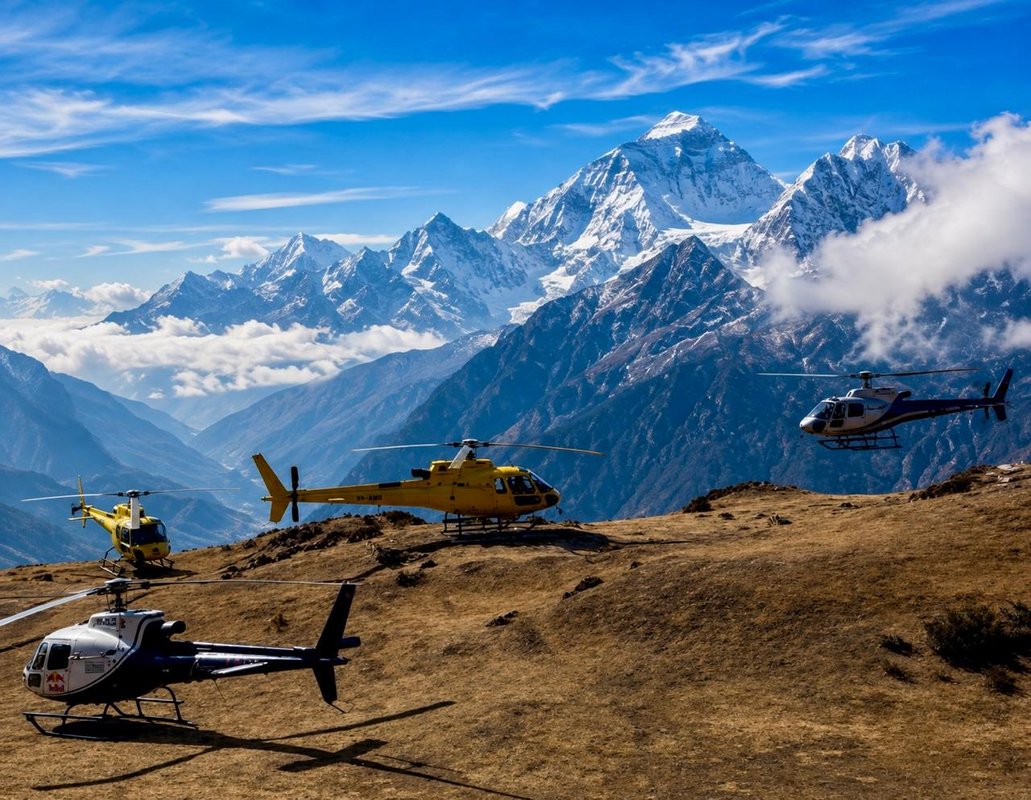
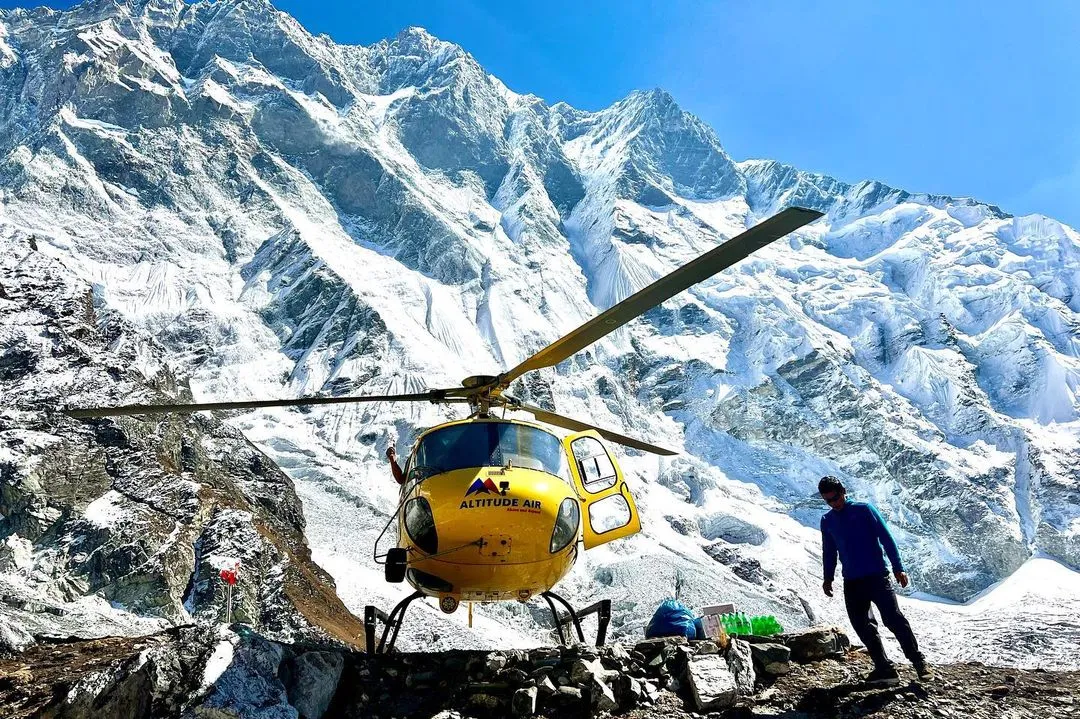
 You have decided to take a helicopter tour in Nepal. The next question is: should you book a shared flight or charter a private helicopter? It is the single biggest decision that shapes your budget, your experience, and the memories you bring home. A shared helicopter tour in Nepal can cost half as much as a private charter, but it also means sharing the cabin with strangers and following a fixed schedule. A private tour gives you total flexibility and an intimate experience, but the price tag is significantly higher.
This guide breaks down every factor that matters: real costs, cabin experience, route flexibility, photo opportunities, and which option delivers the best value for different types of travellers. By the end, you will know exactly which helicopter tour format is right for you.
What Is a Shared Helicopter Tour in Nepal?
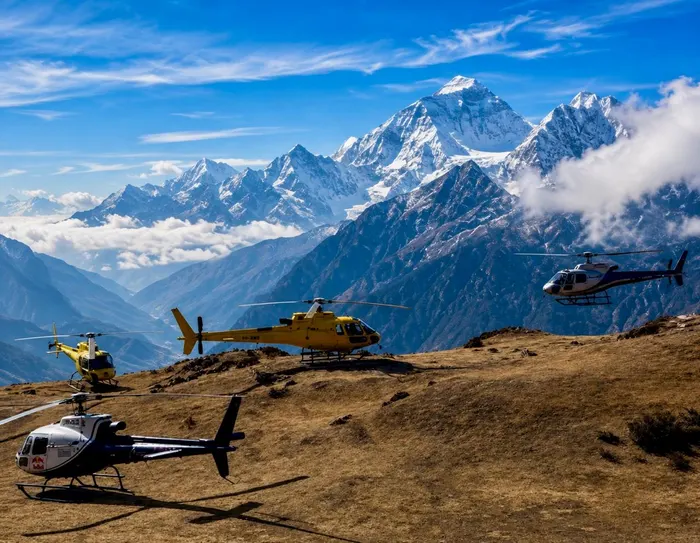
A shared helicopter tour is exactly what it sounds like: you book a seat on a helicopter that carries multiple passengers, typically 4 to 5 people plus the pilot. The operator fills the remaining seats with other travellers who booked the same route on the same date. You pay per seat rather than for the entire aircraft.
Shared tours are the most common format for popular routes like the Everest Base Camp helicopter tour with landing and the Annapurna Base Camp helicopter tour. Operators run these flights daily during peak seasons (March-May and October-November), and seats fill quickly. The key characteristics of a shared tour are:
- Fixed departure time: The operator sets the schedule, usually early morning (6:00-7:00 AM) when visibility is best. You cannot delay the flight by 30 minutes because you want better light.
- Fixed route: The itinerary is predetermined. On an Everest shared flight, you stop at Lukla for refuelling, fly to Kala Patthar or Everest Base Camp for the panorama, then land at Hotel Everest View for breakfast. There is no detouring to Gokyo or Ama Dablam Base Camp.
- Shared cabin: You sit alongside 3-4 other passengers. Window seats are not guaranteed unless you request one early. The middle seats have more limited views.
- Lower cost: You pay roughly USD 350-500 per seat on a shared Everest flight, compared to USD 3,500-5,000 for a full private charter of the same aircraft.
Shared tours work brilliantly for solo travellers, couples on a budget, and anyone who wants the core helicopter experience without the premium price. The trade-off is less control over timing, route, and who you share the cabin with.
What Is a Private Helicopter Tour in Nepal?
A private helicopter tour means you charter the entire aircraft for your group only. Whether you are a couple on a honeymoon, a family of four, or a solo traveller who values exclusivity, the helicopter is yours. No strangers, no fixed schedule, and full control over the experience.
Private charters are the standard for custom itineraries, special occasions, and travellers who want to combine multiple destinations in a single flight. The defining features are:
- Your schedule: You choose the departure time. Want to catch sunrise over the Himalayas from the air? Depart at 5:30 AM. Prefer a late-morning flight after a relaxed breakfast? That works too, weather permitting.
- Your route: You can customize the itinerary. Fly Everest Base Camp and add a detour over Gokyo Lakes. Combine Annapurna Base Camp with a landing at Muktinath. The pilot works with your plan.
- Your cabin: Every seat is yours. Both window seats are available for photography. You can move between seats at landing stops. No one blocks your view.
- Higher cost: You pay for the entire aircraft, typically USD 3,500-5,000 for an Everest private charter, depending on the helicopter model (AS350 B3e vs. Bell 407) and the route length.
Private tours are ideal for photographers who need unrestricted window access, families with young children, honeymooners seeking a romantic experience, and anyone who values privacy and flexibility above cost savings.
Cost Comparison: Shared vs Private Helicopter Tour in Nepal
Price is the most obvious difference between shared and private helicopter tours. Here is a realistic breakdown based on current 2026/27 rates for the most popular routes. For a deeper dive into pricing across all routes, see our complete helicopter tour cost guide.

| Route | Shared (per seat) | Private (full charter) | Savings (shared) |
|---|---|---|---|
| Everest Base Camp (with landing) | USD 350-500 | USD 3,500-5,000 | 60-70% |
| Annapurna Base Camp (with landing) | USD 300-450 | USD 3,000-4,200 | 55-65% |
| Gosaikunda Sacred Lake | USD 250-350 | USD 2,000-3,000 | 50-60% |
| Rara Lake | USD 400-550 | USD 4,000-5,500 | 55-65% |
| Muktinath Pilgrimage | USD 300-400 | USD 2,500-3,500 | 50-60% |
The savings on a shared tour are substantial: you pay roughly one-third to one-half of the private charter price. For a couple, two shared seats on an Everest flight cost USD 700-1,000 total, compared to USD 3,500-5,000 for a private charter. That is a difference of USD 2,500-4,000, which could fund an entire week of trekking in the Annapurna region.
However, the per-person math changes when your group size grows. A family of four on a shared Everest flight pays USD 1,400-2,000 total. At that point, the gap to a private charter narrows, and the added flexibility of a private flight starts to look more attractive. For groups of 4-5 people, a private charter often delivers better per-person value when you factor in the experience benefits.
Experience Comparison: Cabin, Views, and Photography
The cost difference is clear, but what about the actual experience inside the helicopter? This is where the shared vs private decision gets personal.
Cabin Comfort and Seating
Nepal helicopter tours typically use AS350 B3e (Ecureuil) or Bell 407 aircraft, both configured with 4-5 passenger seats plus the pilot. In a shared flight, you are assigned a seat by the operator. Window seats go to those who booked earliest or requested them specifically. The middle seats, particularly the rear middle, have obstructed views because the cabin pillars and other passengers block parts of the panorama.
On a private charter, every seat is yours. You can claim both window seats, switch sides mid-flight to capture different angles, and lean across the cabin without apologizing to a stranger. For photographers carrying a DSLR with a telephoto lens, this freedom is transformative. You are not elbowing a neighbour to frame the perfect shot of Ama Dablam.
Photography and Video
Helicopter photography in the Himalayas is challenging even in ideal conditions. You are shooting through curved plexiglass windows at 140 knots, dealing with glare, vibration, and rapidly changing light. On a shared flight, you have one window and limited time to compose shots before the aircraft banks and the angle shifts.
On a private flight, you can ask the pilot to make a gentle orbit around a peak so you get the light from the right direction. You can request a slightly higher or lower altitude for a specific composition. These small adjustments, impossible on a shared flight with a fixed flight plan, make the difference between a good photo and a portfolio shot. If photography is a primary goal of your helicopter tour, the private option pays for itself in image quality.
Landing Experience
Both shared and private tours include a landing stop, typically at Hotel Everest View (for Everest flights) or Annapurna Base Camp (for Annapurna flights). The difference is in the pace. On a shared flight, the landing stop runs on a tight schedule: 30-45 minutes for breakfast and photos, then back in the aircraft. On a private flight, you can linger. Spend an hour at Hotel Everest View. Have a second cup of coffee while watching the clouds roll over Nuptse. Take your time with family photos at the base camp marker.
Private charters also open up landing options that shared flights rarely offer. You can request a landing at Gokyo Lakes, at a high Himalayan meadow above 5,000 metres, or at a remote monastery that has no road access. These exclusive landings are the moments that turn a helicopter tour into a lifelong memory.
Which Option Suits Your Travel Style?
The shared vs private decision ultimately comes down to who you are as a traveller. Here is a practical guide based on common traveller profiles.
Solo Travellers
If you are travelling alone, a shared helicopter tour is almost always the better choice. You save 60-70% compared to chartering the entire aircraft, and you still get the full Himalayan panorama, the landing experience, and the breakfast at altitude. The only reason a solo traveller might choose private is for photography: if you are a professional photographer on assignment, the unrestricted window access and route flexibility justify the premium. For everyone else, shared is the smart pick.
Couples and Honeymooners
This is the grey zone where the decision gets interesting. Two shared seats on an Everest flight cost USD 700-1,000. A private charter costs USD 3,500-5,000. The price gap is significant, but so is the experience gap. On a shared flight, you might be seated across the aisle from each other, sharing the cabin with two strangers who are loudly narrating their own video. On a private flight, it is just the two of you, the pilot, and the mountains.
For a honeymoon or a once-in-a-lifetime anniversary trip, the private charter is worth the splurge. The intimacy of having the entire helicopter to yourselves, the ability to customize the route, and the unhurried landing stops create a romantic experience that a shared flight simply cannot match. For a regular couple's trip where the helicopter tour is one activity among many, shared seats deliver excellent value.
Families with Children
Families of 3-5 people are the strongest case for a private charter. Four shared seats on an Everest flight cost USD 1,400-2,000. A private charter costs USD 3,500-5,000. The per-person difference shrinks to roughly USD 500-750 per family member. For that premium, you get: guaranteed adjacent seating so parents can sit next to young children, the ability to adjust the pace for kids who need bathroom breaks or get altitude discomfort, and a cabin where a crying toddler does not ruin another passenger's USD 500 experience.
For families, the private charter is not a luxury; it is the practical choice. The flexibility to manage children's needs at 5,000 metres, without the pressure of a fixed schedule and strangers in the cabin, is worth every extra dollar.
Photographers and Content Creators
If you are carrying more than a smartphone, go private. The difference between a shared and private flight for photography is not marginal; it is categorical. On a shared flight, you get one window, fixed timing, and no ability to ask the pilot to adjust altitude or angle for a shot. On a private flight, you get both windows, the ability to orbit peaks, and a pilot who works with your shot list.
Professional photographers and videographers shooting for clients, stock libraries, or social media channels with large audiences should budget for a private charter as a production cost. The image quality difference will be visible in every frame.
Budget-Conscious Travellers
If your Nepal trip has a fixed budget and the helicopter tour is one line item among many (trekking permits, teahouse accommodation, guide fees, internal flights), the shared tour is the clear winner. You still see Everest, you still land at 3,880 metres for breakfast, and you still get the aerial perspective that no trek can provide. The USD 2,500-4,000 you save by going shared can fund a 10-day Annapurna Circuit trek with a guide and porter, or a week-long cultural and spiritual tour of Nepal through Kathmandu, Bhaktapur, and Lumbini.

The shared helicopter tour is not a compromised experience; it is a different experience. You trade flexibility and privacy for affordability, and for most travellers, that trade makes sense.
Best Routes for Shared vs Private Helicopter Tours
Not all helicopter routes in Nepal are equally suited to both formats. Some routes work better as shared flights because of high demand and standardized itineraries. Others shine as private charters because the experience benefits from customization.
Routes Best Suited for Shared Tours
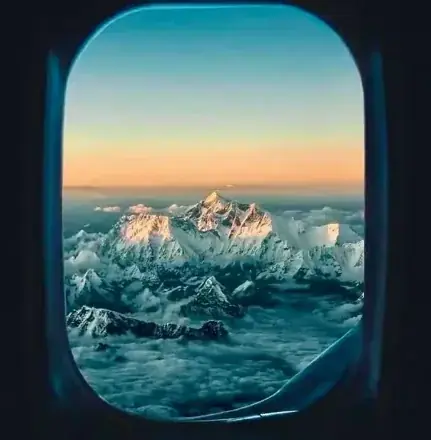
Everest Base Camp with Landing: This is the most popular helicopter route in Nepal, with daily departures during peak season. The high volume means operators can reliably fill shared flights, keeping per-seat prices low. The standardized itinerary (Lukla refuel, Kala Patthar panorama, Hotel Everest View breakfast) is well-optimized and delivers a consistently excellent experience regardless of who else is in the cabin. For a complete guide to the Everest helicopter experience, read our definitive Everest Base Camp helicopter tour guide.
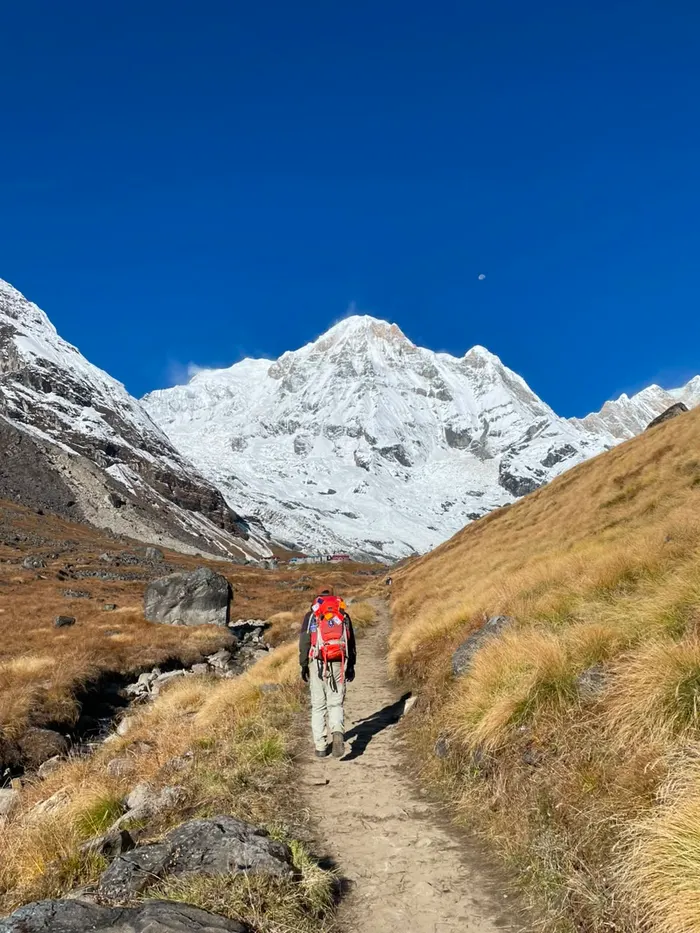
Annapurna Base Camp with Landing: Similar to Everest, the Annapurna route has enough demand to support regular shared departures. The flight from Pokhara or Kathmandu to the 4,130-metre Annapurna Sanctuary is shorter than Everest (roughly 90 minutes round-trip), which keeps shared seat prices in the USD 300-450 range.
Routes Best Suited for Private Charters
Rara Lake: The flight to Rara, Nepal's largest lake at 2,990 metres in the remote far-west, is a 4-hour round trip from Kathmandu. Shared departures are rare because demand is lower and the long flight time makes per-seat economics challenging. A private charter is the standard format, and the experience of landing beside the turquoise lake with no other tourists in sight justifies the cost.
Custom Multi-Destination Flights: If you want to combine Everest Base Camp, Gosaikunda Lake, and a landing at a remote monastery in a single day, you need a private charter. No shared flight offers multi-destination itineraries. These custom flights are where private charters truly earn their premium: you design the day, and the helicopter follows your plan.
Muktinath Pilgrimage: The Muktinath helicopter pilgrimage to the sacred temple at 3,710 metres in Mustang works well as both shared and private. Shared seats are available during peak pilgrimage seasons (especially around Dashain and Janai Purnima). A private charter lets you add a landing at Jomsom or a detour over the Kali Gandaki gorge, the deepest in the world.
How to Book a Shared or Private Helicopter Tour in Nepal
Booking a helicopter tour in Nepal requires more planning than booking a standard tour. Here is a step-by-step guide to securing your seat or charter.
Step 1: Decide Shared vs Private
Use the traveller profiles above to make your decision. If you are still unsure, contact the operator and ask for quotes on both options. The price difference will often clarify your priorities.
Step 2: Choose Your Route and Season
The best helicopter tour routes in Nepal are concentrated around Everest, Annapurna, Langtang, and the far-west. Peak seasons (March-May and October-November) offer the best visibility but also the highest demand. Book at least 2-4 weeks in advance for shared seats during peak season; private charters can often be arranged with 1-2 weeks' notice. For a detailed month-by-month guide to weather and visibility, see our best time for helicopter tour in Nepal guide.
Step 3: Verify the Operator
Not all helicopter operators in Nepal are equal. Look for operators with modern aircraft (AS350 B3e or Bell 407, not older B2 models), experienced high-altitude pilots with thousands of hours in the Himalayas, and transparent safety records. A reputable operator will share their Civil Aviation Authority of Nepal (CAAN) certification and insurance details without hesitation.
Step 4: Confirm What Is Included
Shared tour prices typically include the flight, the landing stop, breakfast at the mountain hotel, and airport transfers in Kathmandu. Private charter prices may or may not include these extras; confirm before booking. Also confirm the cancellation and weather policy: most operators offer a full refund or reschedule if weather grounds the flight, but the specific terms vary.
Step 5: Book Through a Licensed Agency
Booking through a licensed Nepali travel agency rather than directly with an operator gives you several advantages: the agency handles logistics, provides a single point of contact, and often negotiates better rates through volume relationships. As the best trekking agency in Nepal, we arrange both shared and private helicopter tours with vetted operators and transparent pricing. Contact us for a personalized quote.

Common Questions About Shared vs Private Helicopter Tours
Can I switch from shared to private after booking?
Most operators allow upgrades from shared to private, subject to aircraft availability. You pay the difference between the shared seat total and the private charter rate. Downgrading from private to shared is less common and may involve cancellation fees. Always confirm the upgrade policy at the time of booking.
What happens if the shared flight does not fill up?
Reputable operators guarantee departure even with only 2-3 passengers booked. They absorb the cost of empty seats rather than cancelling on paying customers. Less established operators may cancel or reschedule if the flight is underbooked. Ask about the minimum-passenger policy before booking a shared seat.
Are shared helicopter tours safe?
Yes. The safety standards for shared and private helicopter tours in Nepal are identical. The same aircraft, the same pilots, the same maintenance protocols, and the same CAAN oversight apply regardless of how many passengers are on board. The shared vs private decision affects cost and experience, not safety. For a detailed look at safety protocols, see our complete Nepal helicopter tours guide.
Can I request a window seat on a shared flight?
Yes, but it is a request, not a guarantee. Window seats are assigned based on booking order and weight distribution requirements. Book early and explicitly request a window seat. If photography is critical, consider a private charter where every seat is a window seat.
How many people are on a shared helicopter tour?
Typically 4-5 passengers plus the pilot. The AS350 B3e seats 5 passengers in a 2-3 configuration (two front, three rear). The Bell 407 seats 4-5 passengers. Operators rarely fill every seat to the maximum because weight limits at high altitude restrict payload. Expect 3-4 other passengers on a shared flight.
Related Helicopter Tour Guides
Deepen your knowledge with these related resources from our helicopter tour cluster:
- Helicopter Tour in Nepal Cost 2026/27 - complete price breakdown for every route
- Everest Base Camp Helicopter Tour 2026 - the definitive one-day Everest guide
- Best Time for Helicopter Tour in Nepal - weather, seasons, and visibility month by month
- Nepal Helicopter Tours: Everest, Annapurna and Gosaikunda - the complete aerial guide for 2026/27
- Helicopter Tour in Nepal - browse all helicopter tour activities and packages