Nepal for Families: Culture, Temples and Easy Himalayan Views
Nepal is one of the rare destinations where a single trip can hand your children a living history lesson, a spiritual encounter, and their first real glimpse of eight thousand metre peaks, all without a single strenuous trek. For parents who want the Himalaya without the altitude risk, the culture without the crowds pressure, and the wonder without the white knuckles, Nepal is built for families. This guide shows you exactly how to plan a Nepal family holiday around temples, festivals, gentle hill walks, and those postcard panoramas that make every child point and gasp.
We focus here on the easy, cultural, and scenic side of Nepal, the version of the country that works from toddlers to grandparents. If your family is ready for multi day treks, our companion pieces cover that separately. This is the trip you take when the goal is shared wonder, not summit badges.
Why Nepal works so well for families
Most parents worry about three things when they consider Nepal: safety, altitude, and logistics. The good news is that the classic family route, Kathmandu Valley plus a lakeside stop in Pokhara plus one gentle hill station, stays below 2,000 metres the entire time. That removes the acute altitude sickness risk that worries families heading to Everest or Annapurna base camps. You get the Himalaya as a backdrop, not a battlefield.
Culturally, Nepal is a playground for curious kids. Where else can a ten year old ring a temple bell older than their country, watch monks debate in red robes, feed pigeons at a stupa, and then eat momos for dinner? The sensory richness, the colours, the smells of incense and street food, keeps children engaged in a way that museums back home rarely manage. And Nepali hospitality toward children is genuine and warm; families travelling with kids are routinely greeted with extra care.
Logistically, Nepal has matured into an easy country to move around. Domestic flights, private cars with drivers, and short scenic drives connect the highlights. You do not need to be an expedition planner to give your family a smooth, memorable trip. Our complete cultural and spiritual tours guide lays out the fuller heritage picture, and our trekking agency guide explains how a licensed operator handles the practical side.
Best age to bring the kids
There is no single right age, but the experience changes by stage. Toddlers (2 to 4) love the animals, the monkeys at temples, the boat rides, and the open spaces, though they tire fast in crowded squares, so keep days short. Primary school children (5 to 11) are the sweet spot: old enough to walk gently, young enough to be dazzled by everything. Teenagers (12 plus) appreciate the story behind the temples, the photography, and the adventure elements like ziplines, paragliding viewings, and short hikes. Grandparents fit beautifully into this low altitude route, which is why multi generational family trips are one of our most requested formats.
Whatever the ages, the rule is the same: pace the trip for the youngest member, build in rest and play, and let the Himalaya do the heavy lifting.
Kathmandu Valley: the cultural heart for families
Start in the Kathmandu Valley UNESCO circuit, a gentle immersion into temples, squares, and living tradition. The valley holds seven UNESCO World Heritage sites, most of them flat, walkable, and endlessly fascinating for children.
Swayambhunath (the Monkey Temple)
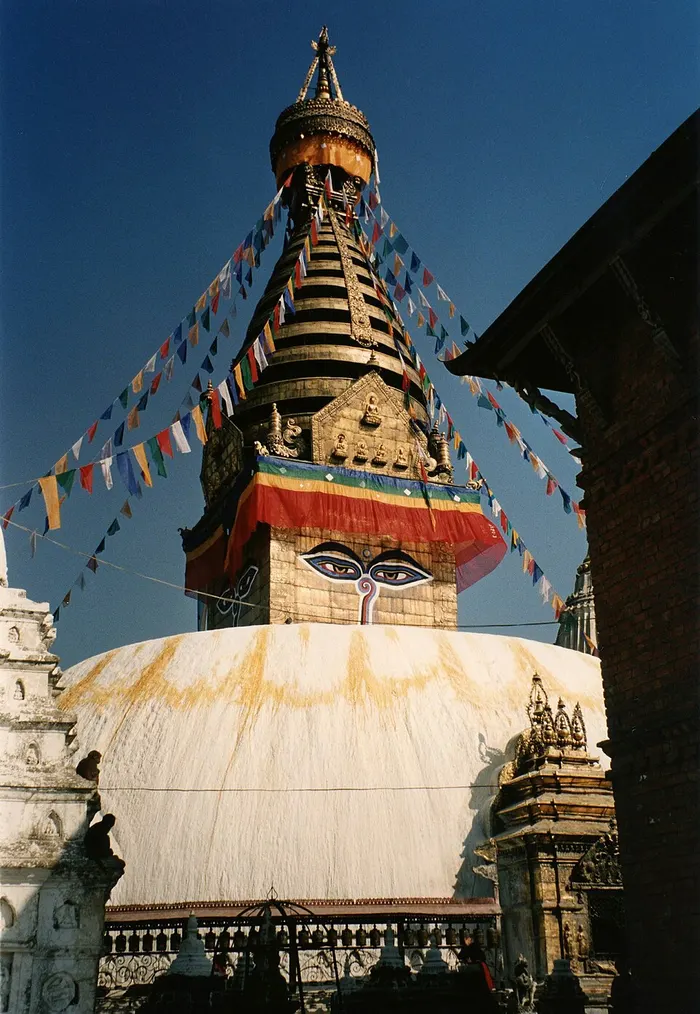
Perched on a hill west of the city, Swayambhunath is the stupa with the all seeing eyes and a lively troop of monkeys. The climb is a staircase, so for very small kids you can drive partway or take it slowly. The reward at the top is a 360 degree view over the entire valley, with the snow peaks glowing on clear mornings. Children love the painted eyes, the spinning prayer wheels, and the mischievous monkeys (keep snacks hidden). It pairs naturally with our Swayambhunath scenic hilltop tour.
Boudhanath Stupa
A short drive from the centre, Boudhanath is one of the largest spherical stupas on earth and a calm, circular space where families can walk hand in hand around the base, spin the giant prayer wheels, and watch Tibetan life unfold. The surrounding lanes are flat and full of bakeries perfect for a child friendly snack break. It is a highlight in our two day spiritual circuit.
Pashupatinath
The great Shiva temple on the Bagmati river is spiritually powerful but visually direct about death rituals, so it is best for older children who can be prepared beforehand. The spiritual circuit package includes it with a guide who frames it gently. For background reading, see our Pashupatinath temple guide.
Patan and Bhaktapur Durbar Squares
These are the legendary palace squares of the valley, full of carved wood, stone deities, and open courtyards where kids can run a little. Bhaktapur in particular moves at a slower, gentler pace and is famous for its yogurt (juju dhau), a reliable hit with children. Our Bhaktapur day tour is an easy half day built for families. The broader context sits in our cultural heritage tour guide.
Namobuddha: a gentle spiritual hill walk for all ages
For a taste of the hills without altitude worry, the Dhulikhel to Namobuddha spiritual hike is ideal. Starting from the ridge town of Dhulikhel, the walk to Namobuddha is a rolling, leafy trail through Tamang and Newar villages, with a famous Buddhist monastery at the end said to mark where a previous incarnation of the Buddha offered himself to a starving tigress and her cubs. The trail is manageable for children who walk regularly, and the ridgeline views of the Himalaya are stunning. Dhulikhel itself has lovely heritage lodges with pools, a blessing after a day on the trail.
This is the kind of half day hike that introduces families to the idea of walking in Nepal without committing to a multi day trek. If your children take to it, our trekking agency guide will help you scale up next time.
Panchase: easy Annapurna foothill views
Near Pokhara, the Panchase panorama trek is a short, family friendly hike through forest and ridge top viewpoints that open onto the Annapurna and Fishtail peaks. At modest elevation, it avoids altitude concerns while still delivering that "I can see the Himalaya" moment children remember for years. Panchase is a quieter alternative to the busy Poon Hill route, which means fewer early starts and more space for kids to enjoy the forest. It is a perfect first Himalayan walk.
Pokhara: lakeside calm and big views
Pokhara is the family favourite for good reason. Phewa Lake offers boat rides (always a child pleaser), the lakeside promenade is flat and stroller friendly, and the backdrop of Machapuchare, the fish tailed mountain, is unforgettable. A Pokhara lakeside getaway gives families comfortable bases with time to breathe. From Pokhara you also get easy day trips to waterfalls, caves, and the World Peace Pagoda, which you can reach partly by boat and partly by a gentle walk.
For a slower pace, our Pokhara yoga and wellness retreat lets the whole family reset, with gentle sessions suited even to beginners. Parents who want the deeper wellness angle can read our spiritual and wellness travel guide.
Bandipur: the car free hill town families love
Bandipur is a restored Newar trading town on a ridge between Kathmandu and Pokhara, and it is one of Nepal's most child friendly stops. Vehicles are largely kept out of the main bazaar, so kids can wander safely along stone streets, peek into temples, and look out over a vast stretch of the middle hills. Short walks from town lead to viewpoints and a cave. Families consistently rate Bandipur as the place their children relaxed most, precisely because it is pedestrian, peaceful, and human scaled. It pairs well with the Kathmandu to Pokhara cultural scenic tour.
Festivals: timing your family trip to the colour
If you can, plan around a festival. Dashain (autumn) brings family gatherings, flying kites, and swings across the hills. Tihar (just after) is the festival of lights, with homes decorated and the famous worship of dogs, cows, and crows, the kind of detail children adore. Holi (spring) is a joyful, chaotic colour throw that kids remember forever, though protect clothes and eyes. Indra Jatra in Kathmandu shows off living goddess processions and towering chariots. Our festivals of Nepal guide maps the whole calendar so you can pick your window.
Food: what children actually eat in Nepal
Nepali food is child friendly by nature: mild, carb heavy, and comforting. Dal bhat (lentil soup, rice, vegetables) is the staple and usually comes with a plain rice option. Momos (dumplings) are the universal child pleaser, available steamed or fried with veg or chicken. Thukpa (noodle soup) warms cold evenings. For the food loving family, our food and culture guide explains the regional thalis, and the Kathmandu food and culture tour turns eating into an adventure. Spice levels are easy to request mild, and bottled water plus peeled fruit keep tummies happy.
A sample 8 day family itinerary (low altitude)
This is a relaxed template we use for many families. Adjust by age and energy.
- Day 1: Arrive Kathmandu, easy evening, momo dinner.
- Day 2: Swayambhunath morning, Patan Durbar Square afternoon, bakery break.
- Day 3: Boudhanath and a heritage walk; optional Swayambhunath bike tour.
- Day 4: Drive to Dhulikhel, gentle Namobuddha hike, overnight ridge lodge.
- Day 5: Scenic drive to Bandipur, pedestrian bazaar wander, sunset viewpoint.
- Day 6: Continue to Pokhara, Phewa Lake boat ride, lakeside evening.
- Day 7: Panchase panorama walk for Annapurna views, World Peace Pagoda.
- Day 8: Fly or drive back to Kathmandu, depart.
That route never sleeps above roughly 1,600 metres, keeps daily activity light, and stacks temples, gentle walks, and big mountain views. For a longer cultural deep dive, the seven UNESCO wonders tour and the Kathmandu Nagarkot heritage experience are easy add ons.
Practical tips for travelling Nepal with children
- Health: Talk to a travel clinic about routine vaccines. Carry a small family first aid kit, rehydration salts, and any personal medication. Tap water is not for drinking; use sealed bottled or filtered water.
- Pace: One major sight per day with a long lunch. Children melt down when overscheduled, and Nepal rewards slowness.
- Transport: Private car with a driver is worth every rupee for families. It lets naps happen and bags stay put.
- Altitude: This family route stays low, but if you later add a higher stop, learn the basics in our trekking guide and watch children closely for headache or fatigue.
- Money: Carry some cash for small temples and snacks; cards work in hotels and bigger restaurants.
- Respect: Teach kids to ask before photographing monks or rituals. A simple smile opens most doors.
When to go
The two clean window seasons are autumn (October to November) and spring (March to April). Skies are clearest, views sharpest, and temperatures kind. Winter is cold but calm and great for low altitude walking if you dress warm. The summer monsoon (June to August) is green and quiet but the peaks hide behind cloud more often. Our month by month guide breaks it down further. If you are travelling with the whole extended family, a cultural scenic tour keeps everyone together comfortably.
Why book the family route with a local operator
A licensed Kathmandu based operator handles the moving parts: drivers who know mountain roads, guides who can explain a temple to a seven year old, and the flexibility to swap a plan when a child is tired. That is exactly the service Enticing Himalayas builds into every family program. You can read how we vet guides and design trips in our cultural tours guide and explore all options on our tours page.
FAQ
Is Nepal safe for a family holiday with young children?
Yes. The classic family route through the Kathmandu Valley, Bandipur, and Pokhara stays below about 2,000 metres, which avoids serious altitude risk, and the roads and hotels on this circuit are well established. Private cars with experienced local drivers, reputable family hotels, and a guide who manages the daily plan make the trip comfortable and safe for toddlers through grandparents.
What is the best age to take kids to Nepal?
Primary school children between roughly 5 and 11 are the sweet spot, old enough to walk gently and young enough to be dazzled by temples, monkeys, and mountain views. Toddlers enjoy the open spaces and boat rides if days stay short, while teenagers love the stories, photography, and adventure elements. The low altitude family route works for every age group.
Which places in Nepal are easiest for families with no trekking?
Kathmandu Valley temples such as Swayambhunath and Boudhanath, the pedestrian hill town of Bandipur, and lakeside Pokhara are the easiest and most rewarding. Short non trekking walks like the Dhulikhel to Namobuddha ridge trail and the Panchase foothill walk near Pokhara add gentle Himalaya views without altitude concern.
What food will children eat in Nepal?
Nepali food is mild and child friendly. Momos (dumplings), dal bhat with plain rice, thukpa noodle soup, and fresh flatbreads are reliable favourites. Spice can be requested mild, and bottled or filtered water plus peeled fruit keep stomachs settled. Bakeries in the tourist areas serve familiar snacks for picky eaters.
When is the best time to visit Nepal with family?
Autumn, from October to November, and spring, from March to April, give the clearest skies, sharpest mountain views, and the kindest temperatures for family walking. Winter is calm and good for low altitude trips with warm clothing, while the summer monsoon is green but clouds often hide the peaks.
How many days do I need for a Nepal family trip?
A relaxed eight day loop, Kathmandu, Dhulikhel and Namobuddha, Bandipur, and Pokhara, covers temples, gentle walks, and big Himalayan views without rushing. Families wanting more depth can add a UNESCO heritage tour or a Nagarkot sunrise extension. Keep one major sight per day so children stay happy.
About Enticing Himalayas

Enticing Himalayas (legal name Enticing Himalayas Travels) is a Kathmandu based, Nepal licensed travel operator under the brand Explore, Heal, Thrive. We run cultural tours, spiritual and pilgrimage journeys, heritage city experiences, wellness retreats, and trekking across Nepal.
Our services
- Cultural and heritage tours of the Kathmandu Valley and beyond
- Spiritual and pilgrimage journeys (Lumbini, Muktinath, Gosaikunda)
- Wellness and yoga retreats (Heal)
- Community exchange and responsible tourism trips
- Scenic flights and adventure experiences (Explore)
Accreditations


We are a recognized partner of the Nepal Tourism Board and list experiences through established global platforms. Every guide and porter we send guests with is insured, fairly paid, and vetted on our three standards: verifiable training, resident local knowledge, and a track record with international guests.
About the author
Written by the Enticing Himalayas editorial team in Kathmandu, with input from our resident guides and cultural partners. We update this guide as our programs develop.
Why trust Enticing Himalayas
We are based in Kathmandu and our guides run these routes every season. We vet every provider on three things: verifiable training, a resident qualified practitioner, and a track record with international guests. If a provider cannot clear that bar, we do not send you there.