 Nov 8 – Nov 8, 2026
Kathamandu
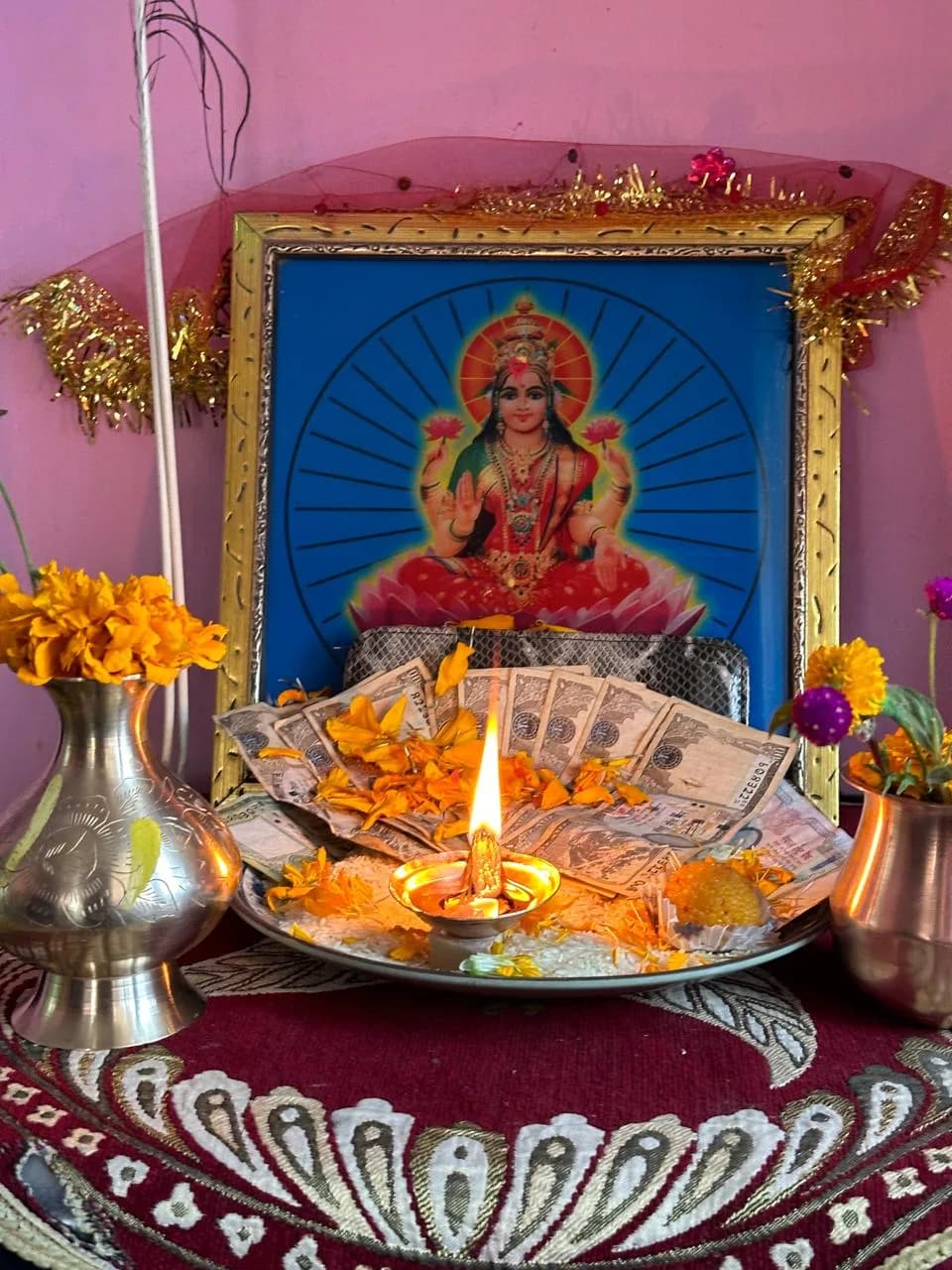
Laxmi Puja 2026 in Nepal: Tihar Festival Guide
Festival
1 Tag
Festival
Free
Kathamandu1 Tag
Event Details
Loading...
Event starts in
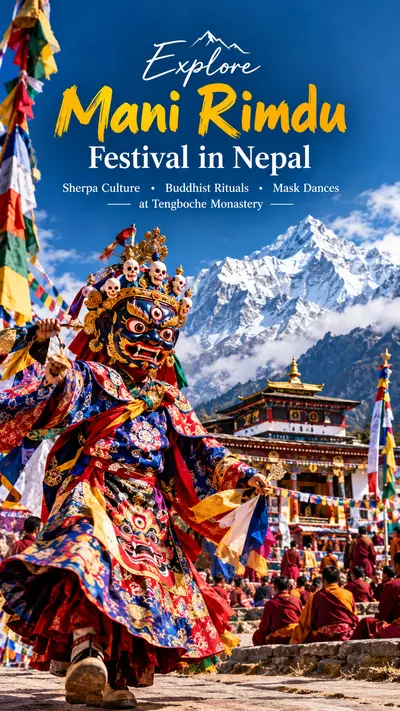
Mani Rimdu Festival is one of the most important Buddhist
celebrations of the Everest region of Nepal, bringing together Sherpa
communities, Buddhist monks, pilgrims, and travelers around a living tradition
of prayer, meditation, sacred rituals, masked dances, blessings, and community
gathering. The festival is particularly associated with Tengboche Monastery,
located at approximately 3,867 meters in the Khumbu region, where the public
celebration traditionally forms the spectacular conclusion of a longer cycle of
monastic practices. Rather than being simply a cultural performance for
visitors, Mani Rimdu is a deeply religious occasion connected with Tibetan
Buddhism, Sherpa identity, compassion, protection, and spiritual practice. For
travelers who want to understand the cultural landscape behind the Everest Base
Camp Trek, this festival provides an opportunity to experience the mountains
through religion and community rather than scenery alone. The wider Everest Region destination
provides the geographical setting for this remarkable Himalayan tradition.
The name Mani Rimdu is closely connected with Buddhist
prayers, sacred blessings, and the blessed pills distributed during the
festival. Different explanations of the name appear in travel and cultural
sources, but the tradition itself is strongly associated with the recitation of
Buddhist mantras, ritual empowerment, and the preparation of sacred substances.
The festival belongs to the Nyingma tradition of Tibetan Buddhism, an important
spiritual tradition among many Sherpa communities of the Khumbu. Understanding
its name therefore requires looking beyond the colorful costumes and dramatic
dances. Mani Rimdu represents a period when religious practice, community life,
meditation, artistic expression, and Himalayan culture come together. Visitors
interested in this spiritual dimension can also explore the broader subject
through Buddhist
Meditation in Nepal, where meditation traditions and monastery
experiences are discussed in greater detail.
The importance of Mani Rimdu in Nepal comes from the way it
connects religious practice with the everyday identity of Himalayan
communities. The Sherpa people of the Khumbu have maintained strong connections
with Tibetan Buddhist traditions for generations, and monasteries remain
important centers of prayer, education, ceremonies, and community gatherings.
Mani Rimdu gives this spiritual heritage a particularly visible expression
because monks undertake extensive preparation before the public ceremonies
begin. During the festival period, the monastery becomes a place where local
people return, visitors gather, and religious practices become part of a shared
community experience. Travelers should therefore approach Mani Rimdu with
respect and patience. It is not merely an attraction placed along a trekking
route. It is a religious celebration taking place within a living community.
The cultural setting can also be understood through Spiritual
Tour in Nepal, which explores how spirituality, pilgrimage, temples,
monasteries, and Himalayan landscapes connect throughout Nepal.
Tengboche Monastery is the most famous setting associated
with Mani Rimdu and one of the most important Buddhist monasteries in the
Khumbu. Situated on a ridge surrounded by spectacular Himalayan scenery, the
monastery provides a dramatic setting for the festival, with mountains such as Ama
Dablam, Everest, Lhotse, and Nuptse forming part of the wider landscape.
Enticing Himalayas describes Tengboche as a major spiritual center of the
Khumbu and places it along the classic Everest trekking route. The monastery
was founded in the early twentieth century and has played an important role in
the religious life of the region. The combination of high-altitude scenery and
sacred architecture makes the journey meaningful even outside festival dates.
Travelers following the Everest Base
Camp Trek itinerary normally reach Tengboche after passing through
Namche Bazaar and walking along the Dudh Koshi valley.
The Everest Region, locally known as Khumbu, is much more
than the location of Mount Everest. It is a cultural landscape containing
Sherpa villages, Buddhist monasteries, prayer wheels, mani walls, chortens,
suspension bridges, alpine forests, glaciers, and high mountain settlements.
Mani Rimdu becomes especially meaningful when understood within this landscape.
A visitor approaching Tengboche from Lukla does not suddenly arrive at a
festival venue; instead, the trail gradually introduces the traveler to the
religious and cultural environment of the Khumbu. Villages such as Phakding,
Monjo, Namche Bazaar, and Pangboche provide different perspectives on mountain
life. The Everest
Region Guide: Lukla to Kalapatthar provides useful background on
this broader geographical journey and explains how the major trekking routes
connect.
The religious purpose of Mani Rimdu Festival is connected
with Buddhist teachings, blessings, spiritual protection, and the cultivation
of compassion and wisdom. The festival tradition honors Guru Rinpoche,
Padmasambhava, a central figure in Tibetan Buddhism who is traditionally
associated with the establishment and spread of Buddhism in Tibet. The
ceremonies also symbolically address negative forces and obstacles through
prayers, rituals, sacred dances, and fire offerings. For Sherpa communities,
the festival has both religious and cultural importance because it reinforces
traditions that have shaped community life in the Himalayas. Travelers may see
colorful costumes and elaborate masks, but these visual elements have symbolic
meaning within the religious context. Understanding that distinction is important
because it changes the way a visitor experiences the celebration: instead of
watching a staged show, the traveler is observing a living spiritual tradition.
A broader introduction to Buddhist pilgrimage can be found in Buddhist
Pilgrimage Tour in Nepal.
One of the most interesting aspects of Mani Rimdu is that
the colorful public ceremonies represent only the visible conclusion of a much
longer ritual process. The traditional festival cycle is commonly described as
lasting nineteen days, with many activities taking place privately inside the
monastery before the public celebration. Monks engage in prayers, meditation,
ritual preparations, mandala construction, and other religious practices before
visitors gather for the major public days. The exact structure and calendar can
vary, and travelers should confirm dates with reliable local sources before
planning international flights or trekking schedules. This longer preparation
reminds visitors that the festival cannot be understood only through the final
masked dances. The public ceremonies are the culmination of sustained religious
preparation. For travelers interested in combining spiritual experiences with
trekking, Meditation
Retreats in Nepal offers another perspective on the country's
contemplative traditions.
The creation of a sand mandala is one of the most visually
fascinating parts of the Mani Rimdu tradition. A mandala is not simply
decorative artwork. Within Buddhist practice, it represents a sacred symbolic
universe and is created through careful concentration, ritual intention, and
spiritual discipline. Monks use colored sand to build intricate geometric
designs over an extended period, requiring patience and remarkable precision.
The completed mandala eventually becomes part of the ritual process rather than
a permanent museum object. Its temporary nature can also be understood as a
reflection on impermanence, an important theme in Buddhist philosophy. For
visitors, watching the process can be a reminder that Himalayan culture is not
only about mountains, adventure, and physical endurance. It also includes
sophisticated traditions of meditation, symbolism, and religious art. Travelers
exploring this side of Nepal may also find Buddhist
Meditation in Nepal: Monastery Stays and Daily Practice useful for
understanding the wider spiritual environment.
During Mani Rimdu, prayer and meditation are fundamental
rather than secondary activities. The monks' preparation creates an atmosphere
that is very different from a conventional public festival. Chanting, ritual
instruments, sacred objects, offerings, and periods of concentration all
contribute to the ceremony. Visitors may not understand every prayer or ritual
sequence, but they can still appreciate the discipline and community meaning
behind them. This is one reason why travelers should avoid treating the event
as a simple photography opportunity. Listening quietly, observing respectfully,
and allowing the ceremony to unfold naturally provides a deeper experience.
Nepal's wider Buddhist heritage stretches from the Kathmandu Valley to high
Himalayan monasteries, and Lumbini,
Boudhanath and Tengboche Buddhist pilgrimage experiences show how
different geographical environments can contain connected spiritual traditions.
The public celebration includes important blessing
ceremonies, often described using the term Wong, in which participants receive
religious blessings connected with the festival. The blessing is significant
because Mani Rimdu is not simply a celebration watched from outside; community
members and visitors may participate within the appropriate boundaries
established by the monastery. The experience can be deeply personal for those
who approach it with genuine respect. Travelers should follow the instructions
of monks, guides, and local residents regarding where to stand, when
photography is allowed, and how to move around the ceremonial area. Cultural
sensitivity matters especially in a monastery environment. A traveler who takes
time to understand these customs will generally experience the festival
differently from someone who arrives only looking for dramatic photographs.
Similar principles apply when visiting Kapan
Monastery and other Buddhist sites in Kathmandu.
The Cham masked dances are probably the most recognizable
public feature of Mani Rimdu. Monks wear elaborate costumes and masks
representing deities and symbolic figures while performing carefully choreographed
movements accompanied by traditional music and ritual sounds. To an outside
observer, the performance may look like colorful Himalayan theater, but within
the religious context it carries symbolic meaning related to Buddhist teachings
and the overcoming of negative forces. The masks, movements, music, and
costumes therefore work together as part of a sacred ceremony. Visitors should
remember that the dances are religious practices rather than entertainment
created specifically for tourists. The atmosphere can be energetic and visually
dramatic, yet it remains important to maintain appropriate behavior. The
broader Everest
trekking experience helps place the dances within the cultural
landscape of the Khumbu.
The symbolism of the Mani Rimdu dances can be understood
through the broader Buddhist idea of transforming harmful or negative forces
through wisdom, compassion, and spiritual discipline. Characters represented
through masks are not simply fictional figures performing a story for
entertainment. They belong to a religious symbolic system that has developed
through Tibetan Buddhist traditions. This is why visitors may notice
differences between Mani Rimdu and ordinary Nepali cultural dances performed at
tourism events. The festival's movements, masks, costumes, and music are
embedded within a religious sequence. Learning even a little about this
background can make the experience more meaningful. Travelers can continue
exploring Nepal's spiritual traditions through Spiritual
Tours in Nepal, where Hindu and Buddhist pilgrimage traditions are
considered together.
The festival's concluding rituals include a fire puja,
commonly known as Jinsak, which has an important symbolic role. Fire offerings
are used within Tibetan Buddhist ritual traditions to address obstacles,
negativity, and spiritual concerns. The closing ceremony therefore provides a
powerful contrast to the energetic public dances. The festival moves from
colorful movement and communal gathering toward a more concentrated ritual
conclusion. Visitors should understand that each stage forms part of a larger
religious sequence rather than treating individual moments as separate performances.
The final fire ritual also illustrates how Buddhist ceremonies can combine
visual symbolism with prayer, offerings, meditation, and community
participation. Similar ritual traditions can be encountered in other parts of
Nepal, particularly around major Buddhist and Hindu pilgrimage sites. A broader
overview appears in Spiritual
Tour in Nepal 2026, which explores the relationship between sacred
landscapes and travel.
Another distinctive part of Mani Rimdu is the preparation
and distribution of blessed pills, commonly called rilbu in descriptions of the
tradition. These small sacred objects are associated with the blessings
generated through the festival's religious practices. Their significance should
be understood within the Buddhist context rather than as a souvenir or ordinary
object. Receiving a blessing from the monastery can be meaningful for devotees
and participants who understand the religious tradition. Travelers should
therefore treat such objects respectfully and follow local instructions about
receiving, carrying, or consuming them. The presence of these blessed materials
demonstrates how Mani Rimdu connects physical objects with prayer and ritual
practice. This relationship between material culture and spirituality can also
be explored through Nepal's monasteries and pilgrimage destinations, including Tengboche in
the high Himalayas.
Guru Rinpoche, also known as Padmasambhava, occupies an
important place in Tibetan Buddhist history and tradition. Mani Rimdu is
associated with teachings and rituals connected to his spiritual legacy. For
Sherpa communities, this connection gives the festival a deeper historical and
religious dimension because Buddhism in the Himalayas developed through
centuries of movement, teaching, monastery building, and cultural exchange
between Tibet and Himalayan communities. Understanding Guru Rinpoche therefore
helps travelers understand why Buddhist monasteries remain so important in
mountain communities. Visitors interested in this subject can broaden their
journey beyond the Everest region by exploring sacred locations such as Pharping,
Boudhanath, Kopan, and Lumbini. The Buddhist
pilgrimage circuit from Lumbini to Boudhanath provides a useful
connection between lowland pilgrimage sites and the high-altitude monastery
culture of Tengboche.
The Sherpa culture of Nepal is inseparable from the story
of the Khumbu. While international audiences often associate Sherpas mainly
with mountaineering, their cultural identity is much broader. Religion, family
networks, agriculture, trade, monasteries, architecture, festivals, language,
hospitality, and community traditions all contribute to Sherpa life. Mani Rimdu
is particularly valuable because it allows travelers to encounter Sherpa
culture through its religious traditions. Instead of seeing the Khumbu only as
a route toward Everest Base Camp, visitors can understand it as a homeland with
its own social and spiritual history. This perspective makes the journey more
respectful and less focused solely on adventure. The Solukhumbu destination guide
offers another useful starting point for understanding the district where much
of this Himalayan cultural landscape is located.
For many travelers attending Mani Rimdu at Tengboche, the
journey passes through Namche Bazaar, the major trading and acclimatization
center of the Khumbu. Namche sits at approximately 3,440 meters and is normally
reached after walking from Lukla through villages such as Phakding and Monjo.
The town provides an important transition between the lower valleys and the
higher Himalayan settlements. Travelers often spend an acclimatization day in
Namche before continuing toward Tengboche. This is not only useful for altitude
adaptation but also gives visitors time to understand the local environment
before entering the monastery region. The route is described in detail in the Everest Base
Camp Trek day-by-day guide, including the approach from Lukla to
Namche and onward to Tengboche.
The classic approach to Mani Rimdu begins with the journey
toward Lukla, followed by trekking through the Dudh Koshi valley. From Lukla,
travelers generally walk toward Phakding and continue to Monjo before climbing
toward Namche Bazaar. After acclimatization, the route continues along forested
trails toward Phunki Tenga and then climbs toward Tengboche. This gradual
journey is important because the festival is not an isolated event that can be
separated from the landscape. Every village, bridge, forest, mani wall, prayer
flag, and mountain view contributes to the cultural experience. The Lukla to
Kalapatthar Everest Region Guide explains this wider route and the
different trekking possibilities available in the Khumbu.
One reason Mani Rimdu and Everest Base Camp Trek combine
naturally is that Tengboche is already a major stop on the classic trekking
route. Travelers do not necessarily need to create a completely separate
expedition to experience the festival. Instead, they can design their trekking
itinerary so that they arrive at Tengboche during the public festival period.
However, accommodation and transport arrangements need careful planning because
the festival attracts local participants and travelers. The timing of the Tibetan
lunar calendar also means the festival date changes from year to year. Enticing
Himalayas' Best Time for
Everest Base Camp Trek 2026 specifically notes that Mani Rimdu is an
important autumn cultural highlight and that travelers should build their
trekking itinerary around announced festival dates.
One of the most important practical points for anyone
planning a Mani Rimdu Festival trip is that the dates do not remain fixed
according to the Gregorian calendar. The festival follows the Tibetan lunar
calendar, so the public ceremonies can occur in October or November depending
on the year. Published 2026 sources currently identify late October as the
principal Tengboche public celebration period, but some sources list slightly
different dates, which is a reminder that travelers should verify the final
monastery schedule before booking non-refundable flights. The 2026 festival is
widely reported as occurring around the final week of October. Because lunar
dates can create differences between published calendars, confirmation from
local organizers or the monastery should be treated as essential. This is
particularly important when connecting the festival with an Everest Base Camp Trek package.
Autumn in Nepal is one of the most popular periods for
trekking because the post-monsoon environment often provides clear mountain
views and relatively stable conditions. This is also when Mani Rimdu takes
place, making the festival particularly attractive to cultural travelers who
want to combine Himalayan trekking and Buddhist culture. The lower sections of
the trail can still contain pleasant forest landscapes while higher sections
provide dramatic mountain scenery. However, the popularity of autumn means that
accommodation can become busy, particularly around major trekking villages.
Planning early is therefore sensible. The Best Time for
Everest Base Camp Trek explains the seasonal characteristics of the
Everest region and why October and November are important trekking months.
Attending Mani Rimdu requires more than cultural
preparation because Tengboche sits at high altitude. Travelers coming from
Kathmandu or lower elevations need time to adapt to thinner air. Headache,
fatigue, reduced appetite, and sleeping difficulties can occur as altitude increases,
and the risk should not be underestimated simply because the destination is a
monastery rather than a mountain summit. A sensible itinerary includes gradual
elevation gains and appropriate acclimatization. Travelers should also discuss
medical concerns with qualified professionals before high-altitude travel and
follow their guide's safety recommendations. Enticing Himalayas' detailed Altitude
Sickness and Acclimatization Guide explains why gradual ascent
matters on Everest and Annapurna routes.
Visitors attending a Buddhist festival in Nepal should
dress for both the weather and the religious environment. At Tengboche,
temperatures can be cold, especially during mornings, evenings, and the later
autumn period. Warm layers, gloves, a hat, a wind-resistant outer layer, and
comfortable trekking footwear are useful. At the same time, visitors should
avoid clothing that is unnecessarily revealing inside a religious setting.
Practical mountain clothing can easily be respectful when combined with
awareness of local customs. Travelers should also carry protection against
sunlight because ultraviolet exposure becomes stronger at altitude. The aim is
not to dress formally but to balance comfort, warmth, modesty, and respect. For
a broader approach to preparation, the Everest
trekking itinerary guide provides additional information about
walking conditions, altitude, and the progression toward Tengboche.
The Mani Rimdu Festival offers extraordinary photography
opportunities, from mountain scenery and monastery architecture to costumes,
masks, prayer flags, and community gatherings. However, photography should
always come after respect for the ceremony. Visitors should watch how local
people behave and follow any restrictions announced by monastery authorities.
Flash photography can be distracting during sacred ceremonies, and some ritual
moments may not be appropriate to photograph. Instead of trying to document
every movement, travelers can spend part of the ceremony simply observing. This
creates a more balanced experience and reduces the temptation to turn a
religious celebration into a personal photo session. The same principle applies
at other sacred places such as Boudhanath, Swayambhunath, Kopan, Lumbini, and Namobuddha,
all discussed through the wider Buddhist
pilgrimage experience in Nepal.
Food plays an important social role during Himalayan
festivals, although Mani Rimdu should not be reduced to a culinary event.
Travelers may encounter familiar Sherpa and Tibetan-influenced foods, including
tsampa, noodles, soups, rice, tea, and other simple mountain meals depending on
the local setting. During the festival, community gathering and hospitality
become particularly visible. Eating in local lodges or teahouses can also
provide travelers with opportunities to learn about everyday life in the
Khumbu. Visitors should remember that high-altitude trekking affects appetite
and digestion, so simple, warm meals and adequate hydration are useful.
Travelers interested in broader community-based experiences can also explore Panauti community experiences in
Nepal, showing that cultural travel in Nepal extends far beyond the
Everest trail.
Monasteries are essential to understanding Khumbu culture.
They function not only as places for prayer but also as centers of religious
learning, ceremony, community identity, and cultural continuity. Tengboche is
the best-known example, but the wider region contains other monasteries and
sacred places associated with Sherpa communities. A journey through the Khumbu
therefore becomes a cultural route as much as a mountain trek. Prayer flags and
mani walls appear throughout the landscape, reminding travelers that spiritual
practice is integrated into ordinary movement through the mountains. The Buddhist
Pilgrimage Tour in Nepal places Tengboche alongside Kathmandu Valley
and Lumbini sites, helping visitors see the connection between high-altitude
and lowland Buddhist traditions.
Although Tengboche is the most internationally recognized
location, Mani Rimdu traditions are also associated with other monasteries,
including Thame and Chiwong in the wider Solu-Khumbu area. The exact timing and
form can differ between monasteries. This variation is important because Himalayan
festivals are often community-based rather than standardized national events
with one single official schedule. Travelers who want to explore Mani Rimdu
beyond the main Tengboche celebration should therefore research the particular
monastery and local calendar carefully. This can also provide a different
cultural experience, especially for travelers who prefer smaller communities to
the busiest trekking routes. The Solukhumbu destination
provides a broader geographical starting point for understanding the district
in which these communities are located.
For many international travelers, the most natural way to
experience the festival is to combine it with the Everest Base Camp Trek. The
journey allows visitors to experience the cultural landscape before and after
the festival while continuing toward the world's highest mountain. A carefully
designed itinerary can include acclimatization at Namche, time at Tengboche,
the public festival, and onward travel through Dingboche, Lobuche, Gorak Shep,
and Everest Base Camp. However, the festival date should drive the itinerary
rather than being added as an afterthought. The 14-Day
Everest Base Camp Trek itinerary shows how Tengboche fits naturally
into a standard route, with the village reached after Namche and before
Dingboche.
Travelers do not have to choose only between a traditional
Everest Base Camp route and a festival experience. The Gokyo Lakes Trek
provides another way to explore the Everest region, although connecting it
directly with Mani Rimdu requires careful itinerary planning because the routes
differ. Gokyo is famous for its high-altitude glacial lakes, mountain scenery,
and Gokyo Ri viewpoint. A traveler with sufficient time may consider a route
that includes both cultural and natural highlights of the Khumbu, but altitude
management remains essential. The Gokyo Lakes
Trek Guide 2026 explains the route, its high-altitude environment,
and how it branches from the Everest Base Camp trail around Namche.
A normal Everest trek can be planned primarily around
scenery, walking distance, altitude, and mountain viewpoints. A Mani Rimdu
journey has another layer because the schedule must also respond to the
monastery calendar. This changes the rhythm of travel. Instead of simply asking
how many kilometers can be covered each day, travelers need to ask when they
must arrive at Tengboche, how long they should remain there, and how much
flexibility should be built into the itinerary. This is especially important
when weather affects flights to Lukla or when accommodation becomes busy. The
cultural objective changes the trip from a simple point-to-point trek into a
journey organized around a specific community event. The Everest
Region travel guide is useful for understanding these route-planning
considerations.
Responsible tourism in Nepal means recognizing that
cultural celebrations belong first to the communities that practice them.
Travelers should avoid behavior that interrupts ceremonies, blocks pathways,
enters restricted spaces, or treats sacred objects as props. Buying locally
made products, staying in local lodges, hiring local guides, and respecting
monastery rules can help ensure tourism contributes positively to the region.
Visitors should also avoid making assumptions about religious practices based
only on what they see in photographs. Asking a guide for context can be much
more useful than interpreting a ritual independently. Responsible travel also
means being careful with waste because high-altitude communities face
significant logistical challenges when managing rubbish. The broader philosophy
of responsible Himalayan travel is reflected in the Nepal travel experiences offered by
Enticing Himalayas, where trekking, culture, spirituality, and
community-based experiences can be combined.
One of the greatest values of Mani Rimdu Festival Nepal is
its ability to turn a trekking journey into a cultural learning experience.
Travelers who arrive with curiosity can learn about Sherpa history, Tibetan
Buddhism, Himalayan architecture, traditional music, religious symbolism,
monastery life, and the relationship between people and mountains. Even
visitors who are not Buddhist can appreciate the discipline and cultural
continuity represented by the festival. The experience becomes especially
meaningful when travelers take time to learn before arriving. Reading about
Buddhist traditions, understanding basic monastery etiquette, and learning a
few respectful phrases can make interactions more comfortable. The Meditation
Retreats in Nepal guide is another useful resource for travelers
interested in the contemplative side of Himalayan culture.
A Mani Rimdu journey often begins in Kathmandu, where
travelers prepare equipment, permits, flights, guides, and accommodation before
heading toward the mountains. Kathmandu itself provides an important cultural
introduction through sites such as Boudhanath, Swayambhunath, Pashupatinath,
and the historic squares of the Kathmandu Valley. From there, the landscape
gradually changes as travelers move toward Lukla and then walk into the Khumbu.
This geographical transition is part of what makes the journey special. Within
days, visitors move from busy urban streets into forests, Sherpa villages,
alpine valleys, and finally the high-altitude monastery environment of
Tengboche. Travelers who want to understand the capital before heading toward
Mani Rimdu can explore the Kathmandu
Valley destination guide as part of their pre-trek cultural
preparation.
Travelers with additional time can make the journey more
culturally complete by visiting Buddhist sites in Kathmandu before heading
toward the Everest region. Boudhanath Stupa is one of the most important
Tibetan Buddhist sites in Kathmandu and provides an accessible introduction to
prayer wheels, monasteries, ritual movement, and Buddhist architecture. Kopan
Monastery offers another important connection to Tibetan Buddhist practice,
while Swayambhunath provides a broader historical and religious perspective.
These lower-altitude experiences can help travelers understand some of the
spiritual ideas they later encounter in the Khumbu. The Buddhist
Pilgrimage Tour in Nepal connects these sites with Tengboche and
other Buddhist destinations throughout Nepal.
For travelers interested in Buddhist culture in Nepal, Mani
Rimdu can also become part of a much wider pilgrimage journey that includes Lumbini,
the Birthplace of Gautama Buddha. Lumbini offers a very different environment
from Tengboche: the sacred landscape lies in the southern plains rather than
the high Himalayas. Yet both destinations demonstrate how Buddhist traditions
are experienced through living religious communities, monasteries, prayer,
ritual, and pilgrimage. A journey connecting Lumbini, Kathmandu, and Tengboche
would therefore move through several geographical and cultural layers of Nepal.
The Buddhist
Pilgrimage Circuit from Lumbini to Boudhanath provides a useful
framework for travelers who want to explore this connection rather than
treating Mani Rimdu as an isolated event.
There is something distinctive about experiencing religious
festivals in the Himalayas because the surrounding environment naturally shapes
the atmosphere. At Tengboche, prayer flags move in the mountain wind, snow
peaks dominate the horizon, and the sound of chanting can contrast with the
silence of the surrounding valleys. Yet the spiritual meaning does not come
from scenery alone. It comes from the people who maintain the traditions and
the monks who dedicate time to the rituals. The mountains provide the setting,
but the community gives the festival its living character. This is why
travelers should resist the temptation to describe Mani Rimdu only as a
beautiful spectacle. It is better understood as a meeting point between Sherpa
heritage, Tibetan Buddhism, Himalayan geography, and community life.
Accommodation is an important part of planning a Mani Rimdu
trek because Tengboche has limited lodging capacity compared with Kathmandu or
Pokhara. During festival periods, demand can rise as local participants and
trekkers arrive at the same time. Travelers may need to consider staying in
nearby Deboche or adjusting the itinerary around the festival schedule when
Tengboche rooms are limited. Planning ahead is particularly important for
travelers who have fixed international flight dates. The festival itself is
also weather-sensitive because reaching the Khumbu often involves flights to
Lukla or alternative routing through Ramechhap and Manthali during busy
seasons. The Everest Base
Camp Trek itinerary discusses these transport and accommodation
considerations in relation to the wider Everest route.
A Mani Rimdu trip generally involves the same broader Everest
trekking logistics as other journeys into the Khumbu. Travelers should verify
the permits, local entry requirements, transportation arrangements, insurance
coverage, accommodation, guide services, and emergency planning applicable to
their itinerary. Requirements can change, so information should be checked
close to departure rather than relying on an old blog post. A professional
trekking operator can also help coordinate flight schedules, acclimatization
days, and festival timing. Travelers should remember that the festival itself
does not remove the normal risks associated with high-altitude trekking. The Everest
Region Guide is useful for understanding the broader route, seasonal
conditions, and trekking structure before arranging the trip.
A traveler does not necessarily need to be focused on
reaching Everest Base Camp to appreciate Mani Rimdu. For some visitors, the
cultural experience at Tengboche may be the main objective. Such travelers can
design a shorter Khumbu journey that focuses on Namche, Tengboche, monasteries,
mountain landscapes, and the festival itself rather than continuing all the way
to Base Camp. This can be especially attractive for travelers whose primary
interests are Buddhist culture, Sherpa heritage, photography, nature, and
spiritual travel. The exact route still needs to respect altitude and
acclimatization requirements. A shorter itinerary should not mean an
unnecessarily rapid ascent. Instead, it should be designed around safe pacing
and enough time to appreciate the environment.
For photographers, writers, and cultural storytellers, Mani
Rimdu offers a rare opportunity to document the relationship between religion
and Himalayan community life. The strongest stories often go beyond the
dramatic masks and mountain backgrounds. They can include the quiet preparation
of monks, the construction of sacred objects, the movement of local families
toward the monastery, the architecture of Tengboche, and the ordinary life
surrounding the festival. Ethical storytelling is especially important when
photographing religious ceremonies. Visitors should ask permission when
appropriate and avoid presenting sacred practices as exotic entertainment.
Combining festival photography with a broader route through the Khumbu can
create a more complete story of the region. The Gokyo Lakes
trekking experience and Everest
trekking route offer additional landscapes for travelers who want to
explore beyond Tengboche.
A major difference between attending Mani Rimdu and
visiting a normal tourist attraction is the distinction between tourism and
pilgrimage. A tourist may arrive primarily to see something, photograph it, and
move on. A pilgrim arrives with religious intention. Mani Rimdu contains
elements of both because travelers can visit as observers while local
communities and Buddhist practitioners may participate for spiritual reasons.
Recognizing this difference helps visitors behave appropriately. It also
encourages travelers to approach the festival with humility. Even when someone
does not share the same beliefs, they can respect the importance of those
beliefs to others. Nepal's many sacred destinations, including Lumbini,
Boudhanath, Muktinath, Pashupatinath, and Tengboche, demonstrate how travel can
cross the boundary between cultural observation and spiritual experience.
Nepal has a remarkably diverse festival calendar, and Mani
Rimdu is one part of a much larger cultural landscape. Different communities
across the country celebrate festivals according to religious calendars, local
traditions, agricultural cycles, and seasonal rhythms. In the Kathmandu Valley,
visitors may experience festivals such as Indra Jatra, Bisket Jatra, Yomari
Punhi, and other Newar celebrations. In the high Himalayas, festivals such as
Mani Rimdu and Dumji provide different expressions of Buddhist and Sherpa
heritage. Comparing these celebrations demonstrates why Nepal cannot be
understood through one festival or one region alone. Travelers interested in
exploring Nepal's cultural calendar can use the Nepal travel stories and cultural
guides to discover additional topics related to festivals,
destinations, spirituality, and trekking.
The continuation of Mani Rimdu Festival demonstrates how
religious traditions can remain important even while Himalayan communities become
increasingly connected with global tourism. The Khumbu receives visitors from
around the world, yet the festival continues to be rooted in local religious
practice. This continuity is important because cultural heritage is strongest
when communities remain active participants rather than when traditions exist
only for visitors. Tourism can provide opportunities for cultural exchange and
local income, but the festival's religious purpose should remain central.
Travelers contribute positively when they show interest without demanding
changes to the ceremony. Respecting local schedules, monastery rules, community
spaces, and religious practices helps create a healthier relationship between
tourism and heritage.
For many travelers, Mani Rimdu in Tengboche becomes
memorable because it combines several dimensions of Nepal in one journey. There
is the physical challenge of walking at altitude, the visual drama of the
Himalayas, the warmth of Sherpa hospitality, the architecture of the monastery,
the sound of Buddhist chanting, the movement of masked dancers, and the quiet
atmosphere of the surrounding mountains. Yet the most important element is
perhaps the opportunity to see the Khumbu as a living cultural landscape rather
than simply a route to Everest. The festival encourages travelers to slow down
and observe. It reminds visitors that the Himalayas are not empty wilderness
but a home shaped by people, belief, history, and community.
A carefully planned Mani Rimdu Festival tour in Nepal can
begin in Kathmandu with Buddhist heritage sites, continue through the cultural
landscape of the Khumbu, arrive at Tengboche for the public ceremonies, and
then continue toward Everest Base Camp or return through Namche. Travelers with
more time can combine the experience with other spiritual destinations such as
Lumbini or Namobuddha. Others may prefer to focus entirely on the Everest
region. The most suitable itinerary depends on available time, trekking
experience, altitude tolerance, preferred pace, and cultural interests. For
travelers considering organized journeys, the Nepal tour collection
provides a starting point for exploring trekking, cultural, spiritual, and
Himalayan travel options.
Mani Rimdu Festival Nepal deserves attention not because it
is simply colorful or visually spectacular, but because it offers a genuine
connection to Sherpa Buddhist heritage. The festival demonstrates how religion,
community, landscape, and cultural identity can remain interconnected in a
rapidly changing world. A journey to Tengboche during Mani Rimdu gives
travelers the chance to witness sacred dances, prayers, blessings, mandala
traditions.
Key experiences and features
Mani Rimdu Festival
Tengboche Monastery
Himalayan communities
Padmasambhava
Yomari Punhi
Bisket Jatra
Everest Base Camp
Recommended packing list
Khumjung, Solukhumbu, Koshi Province, Nepal
Got questions about this event?
Mani Rimdu is a major Buddhist festival of the Sherpa community in the Khumbu region. It features prayers, blessings, sacred rituals, masked Cham dances, and other religious ceremonies.
The festival is associated with monasteries in the Khumbu and Solu regions, including Tengboche, Thame, and Chiwang. Tengboche Monastery is the best-known venue for the festival.
The festival follows the Tibetan lunar calendar, so the dates vary each year. The public celebrations at Tengboche generally take place over three days, usually in October or November.
Cham are sacred ritual dances performed by monks wearing elaborate masks and costumes. They form one of the main public features of Mani Rimdu and represent Buddhist religious stories and spiritual teachings.
Visitors can attend the public celebrations, but Mani Rimdu is a religious ceremony rather than simply a cultural show. Travelers should follow monastery rules, respect local customs, and observe ceremonies quietly.
Nov 5 – Nov 7, 2027
2 days
Quick Info
More festival experiences
Nov 8 – Nov 8, 2026Kathamandu
 Aug 17 – Sep 16, 2027
Godavari Kunda
 Jan 15 – Jan 16, 2027
Swayambhu Bhuikhhel