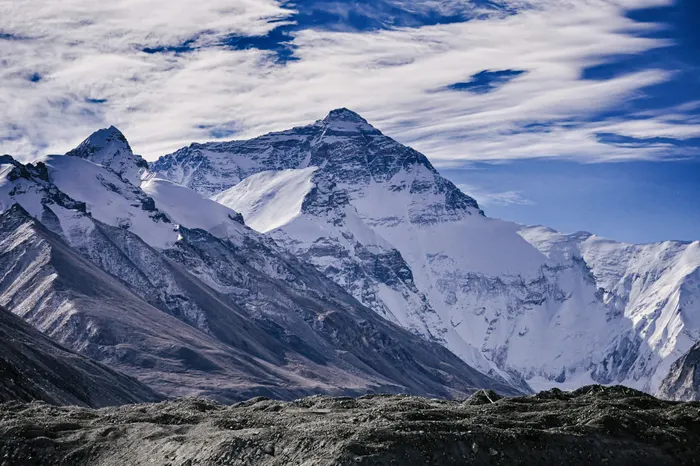
Most Everest Base Camp trekkers stand at 5,364 meters, look up at the 6,000 meter peaks ringing the Khumbu, and feel a quiet pull upward. Island Peak climbing with Everest Base Camp is the answer to that pull: one 17-day expedition that walks the classic trail through Solukhumbu to the foot of the world's highest mountain, then goes one step further and puts you on a real Himalayan summit, Island Peak, at 6,189 meters. This guide explains what the climb involves, what training and gear you need, what it costs, and how the trek and the climb fit together into a single journey. For the cultural backdrop of travel in Nepal, start with our complete guide to cultural and spiritual tours in Nepal.


What Is Island Peak (Imja Tse)?
Island Peak, officially named Imja Tse, is a 6,189 meter mountain in the upper Imja Valley of the Everest region, rising directly above the village of Chukhung and a short distance east of the main Everest Base Camp trail. The English name dates from the 1951 Everest reconnaissance led by Eric Shipton, whose team thought the mountain looked like an island floating in a sea of ice when viewed from Dingboche. The peak first stood on the summit map in 1953, when climbers preparing for the first ascent of Everest itself, a party that included Tenzing Norgay, used it as a rehearsal mountain. That history is fitting, because it is still exactly how most modern climbers use it: as the mountain where ordinary trekkers become summiters.
Geographically, Island Peak is the southern extension of the Lhotse Shar ridge, the long arm of Lhotse that separates the Imja Glacier from the main Khumbu valley. The standard route climbs from a base camp at about 5,200 meters across the Imja Glacier to a steep headwall below the summit ridge. It is a genuine mountaineering route, with crampons, ropes and fixed lines, but it is compact and accessible enough that first-time climbers with no previous experience finish it safely every season. That combination, real climbing without requiring years of alpine background, is why Island Peak has become Nepal's most popular trekking peak.
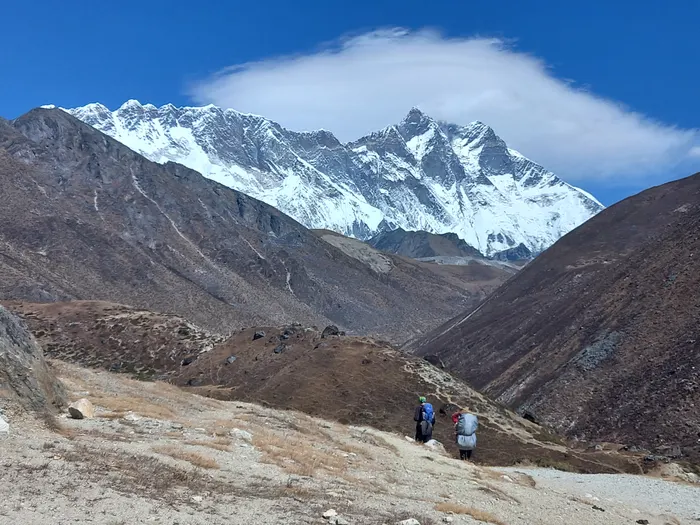
The setting is the real luxury. From the summit at dawn you stand surrounded by 8,000 meter giants, with the walls of Lhotse and Nuptse close enough to read like a map, Makalu rising to the east, and the whole Khumbu glacier system spread below. Our Everest region guide covers the wider valley; this page focuses on the climb itself.
Why Combine the Climb with Everest Base Camp?
The two objectives solve each other's problems. Everest Base Camp alone is a superb trek, our 14-day itinerary guide covers it in full, but many strong trekkers finish it feeling they had more to give. Island Peak alone, flown into and out of quickly, would skip the acclimatization that makes the summit safe. Combined, the trek becomes the physical preparation for the climb: two weeks of walking uphill through Namche, Tengboche and Dingboche gradually builds the red blood cells the summit push will burn.
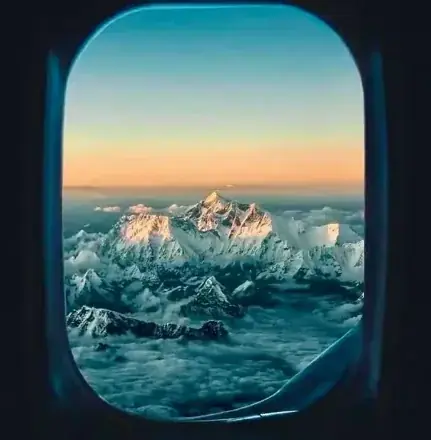
The sequencing is the medical logic of the itinerary. The standard 17-day route reaches Everest Base Camp and Kala Patthar first, at 5,364 and 5,545 meters, which drives acclimatization to its trek-level peak. It then descends back to Dingboche, drops into the Imja Valley to Chukhung, and climbs Island Peak from a base camp at 5,200 meters. Because your body has already lived above 5,000 meters for days, the jump from base camp to 6,189 meters, while still a serious effort, is well within the acclimatization envelope the trek built. That is why combined expeditions consistently post better summit success than fast, standalone climbing attempts.
There is a third, quieter reason. Climbing Island Peak after walking to Everest Base Camp means you experience the Khumbu twice: once as a trekker moving through Sherpa villages and monastery courtyards, and once as a climber moving through the blue hours of a midnight start, roped to a small team under a headlamp-lit glacier. Very few trips offer both in one departure, and travelers who have done both usually say the second half is what they remember most.
How Hard Is the Island Peak Climb, Really?
Honest grading matters more here than on any trek page. The Everest Base Camp trek is a demanding but non-technical walk, and our honest EBC difficulty assessment ranks it as strenuous walking with an altitude problem. Island Peak is a grade beyond that: a true entry-level mountaineering climb. You will wear crampons on a glacier, cross crevasses while roped to your team, and climb a roughly 100 meter headwall on fixed lines over snow and ice at 45 to 50 degrees. None of it requires prior technical skill, but all of it requires you to be comfortable moving on steep ground with equipment, at altitude, in the dark.
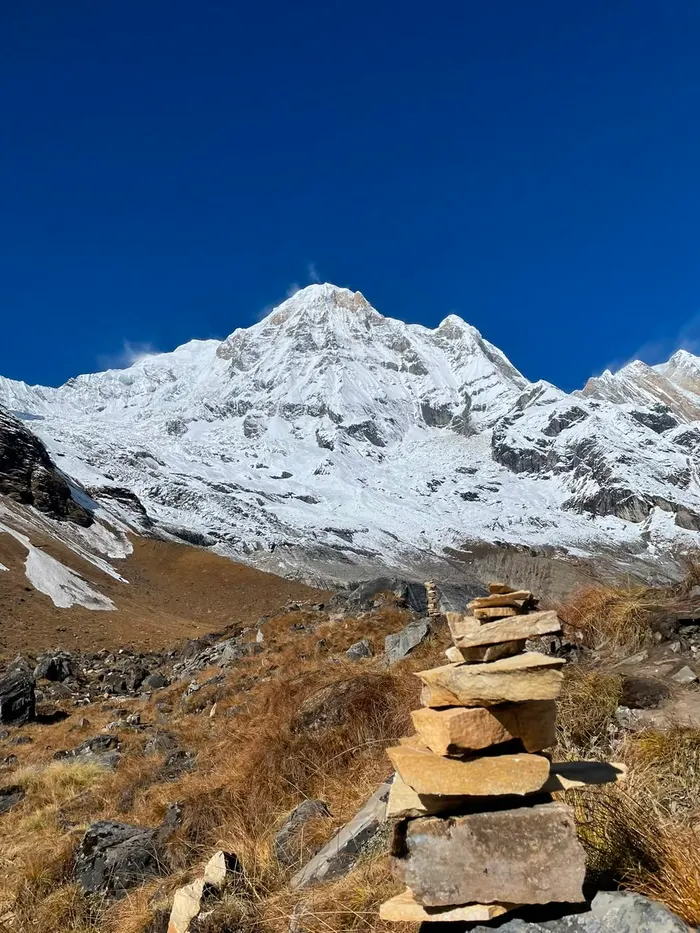
The comparison that helps most is with what you already know. If Everest Base Camp is the hardest thing you have ever done, Island Peak is meaningfully harder on summit day and noticeably more committing: after base camp you sleep in a tent rather than a teahouse, you start climbing around one in the morning, and you cannot simply turn around at any point and walk back to a lodge in an hour. Turnaround is always possible and always respected, but the day is structured as a summit push, not a stroll. Trekkers who found the EBC trail challenging but manageable, and who want a genuine step up, are exactly the audience for this climb.
What softens the difficulty is the support structure. Guided combined expeditions run with one certified climbing Sherpa for every two to three climbers, fixed ropes installed on the headwall, a full skills course at base camp before the push, and a portable altitude chamber carried with the team. Roughly 70 percent of well-prepared climbers standing at Island Peak base camp go on to tag the summit. The mountain rewards preparation, not talent.
If you are still calibrating between Himalayan objectives of different weight, our Annapurna versus Everest comparison is a good place to see how the regions differ before you commit to the biggest one.
Do You Need Climbing Experience to Climb Island Peak?
No, and this is the most important fact on this page. Island Peak is designed as a first summit. The combined expedition format includes a mountaineering course at Island Peak base camp on the afternoon before summit day: your climbing Sherpas teach crampon technique on ice, ice axe self-arrest, harness and jumar ascender use on fixed lines, and roped glacier travel. The equipment list on our Island Peak plus Everest Base Camp expedition includes every technical item, harness, crampons, ice axe, helmet, ascender and carabiners, carried in by the team so you bring only your personal clothing and boots.
What you do need is time on your feet and patience with altitude. The training that predicts summit success is not gym climbing but long endurance walking, months of it, hills if you have them, plus a slow, disciplined trek-in that respects the acclimatization schedule. Climbers who treat the two trek weeks as a race to base camp routinely arrive depleted. Climbers who walk the itinerary as written, resting in Namche and Dingboche on the built-in days, arrive at 5,200 meters ready to learn.
The guided question is settled in this region regardless: a licensed guide is mandatory for trekking in the Everest region, and on a climbing permit the guide must be an NMA-licensed climbing Sherpa. The only real decision is whether to join a fixed group departure or book a private climb, a choice our solo versus guided Everest trek discussion walks through for the trekking half; on the climbing half, group expeditions with a low climber-to-Sherpa ratio are the norm and the better bargain for first-timers.
What Does the 17-Day Itinerary Look Like?
The standard combined expedition runs 17 days door to door, an arrival day, two weeks of trekking and climbing, and a summit certificate dinner in Kathmandu. The shape is a deliberate ascent staircase: arrive at 1,400 meters, fly to Lukla at 2,840 meters, and from there each stage gains only a few hundred sleeping meters while the acclimatization days, one in Namche at 3,440 meters and one in Dingboche at 4,410 meters, let the body consolidate. Lodging on the trek half is teahouses, the same lodges our Everest teahouse and lodge guide describes; the climbing half adds one night of full-service tented camping at Island Peak base camp.
In outline, the days run: arrival and expedition briefing in Kathmandu; fly to Lukla and walk down to Phakding at 2,610 meters; climb to Namche Bazaar; acclimatize in Namche with a hike to the Everest View Hotel at 3,880 meters; trek to Tengboche at 3,860 meters for the monastery and afternoon prayers; on to Dingboche at 4,410 meters; acclimatize in Dingboche with an optional walk up Nangkartshang at 5,083 meters; then the high trek week, Lobuche at 4,940 meters, Everest Base Camp at 5,364 meters with the night at Gorak Shep 5,140 meters, sunrise on Kala Patthar at 5,545 meters, and the long descent back to Dingboche.
The climb half is shorter and steeper. From Dingboche the route turns east up the Imja Valley to Chukhung at 4,730 meters, where the climbing Sherpa team arrives and gear fitting happens. The next day is a three to four hour walk to Island Peak base camp at 5,200 meters, with the afternoon given over to the skills course. Summit day starts around one in the morning and returns to Chukhung by evening; the descent then retraces Tengboche and Namche back to Lukla for the flight to Kathmandu. Timing the whole journey to the seasons is covered below, and the month-by-month detail lives in our best time for Everest Base Camp guide.
What Happens on Summit Day?
Summit day is the expedition in miniature: a cold, dark, thrilling start that ends with sunrise on top of the world's most famous mountain neighborhood. The day begins around one in the morning, when the climbing Sherpas wake the team at base camp, serve hot tea and a light breakfast, and everyone dresses for the coldest hours. Headlamps on, harnesses on, and the column moves up the rocky gullies above camp by headlamp light, a steady walking pace that the Sherpas set deliberately slow, because on summit day slow is fast.
At the top of the gullies the route steps onto the Imja Glacier and the character changes. The team ropes up here, because the glacier is crevassed, and the crossing is a slow procession of fixed footprints, everyone clipped to the same moving rope. Above the glacier the route climbs steadily to the base of the headwall, a roughly 100 meter wall of snow and ice at 45 to 50 degrees, where fixed lines are already installed. You clip your jumar to the fixed rope and climb it one arm-stroke at a time, feet in crampons front-pointing into the slope, the Sherpa behind you watching every placement. For most first-time climbers this is the most intense hour of the trip, and also the moment they realize they are actually doing this.
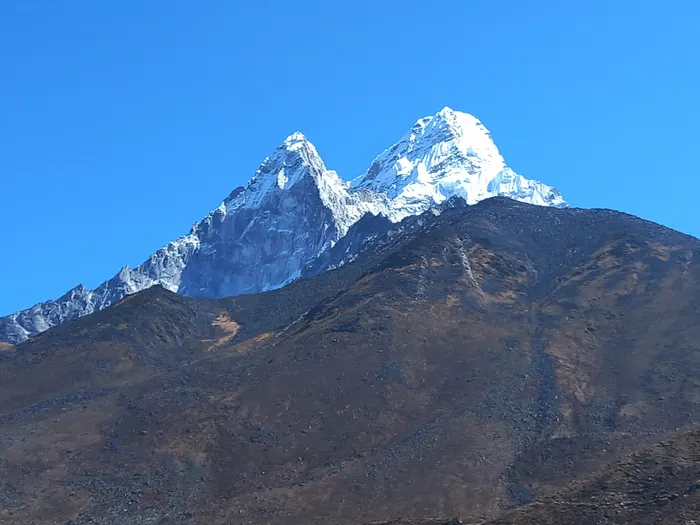
The headwall tops out onto the summit ridge, a narrow but straightforward snow arete that finishes at the summit plateau. The payoff arrives with the light: dawn from 6,189 meters with Lhotse's wall directly above you, Makalu to the east, Baruntse and Ama Dablam closer, and the whole Imja Glacier below. Teams spend twenty to thirty minutes on top, photographing, hugging, and then the long descent begins, down the fixed lines, across the glacier, and back to base camp by late morning and Chukhung by evening. Weather, not fitness, is the main decider on the day; the Sherpas read the sky all night, and if it turns, the mountain will still be there next season.
Gear and Clothing for the Expedition
The equipment list divides into what the expedition provides and what you carry. On the provided side, every technical item is included: harness, crampons, ice axe, helmet, jumar ascender and carabiners, all carried in by the team. You need mountaineering boots rated B2 or B3 for the crampon work and a minus 20 degree sleeping bag for the camping night; both rent well in Kathmandu, so do not buy for one trip unless you plan to keep climbing. A headlamp with spare batteries is non-negotiable, because the day starts in the dark. Glacier sunglasses rated category 4 and ski goggles protect your eyes at altitude, where UV exposure is fierce and snow blindness is a real trip-ender.
The clothing system is the standard high-altitude layering kit: expedition-weight thermals, an insulated down jacket, summit gloves and mittens, and sturdy trekking clothing for the two trek weeks. Our Everest Base Camp packing list covers the trekking wardrobe season by season; the only additions the climb asks for are the mountaineering boots, the warmer sleep setup and the climbing-specific items above. One administrative item matters as much as any sock: mountaineering travel insurance that covers climbing to 6,500 meters is mandatory, because standard trekking policies exclude roped climbing, and a helicopter evacuation from the Imja Valley is exactly the scenario insurance exists for.
Permits and Paperwork for the Climb
The Everest region stacks several permits, and the climb adds one more. Every trekker in the Khumbu carries the Sagarmatha National Park entry permit, NPR 3,000 plus VAT for foreign visitors, about USD 30, with a reduced NPR 1,500 rate for SAARC nationals, plus the Khumbu Pasang Lhamu Rural Municipality permit at NPR 2,000, both described in our Everest region permits guide. Trekkers' TIMS registration, about USD 20 through a licensed agency, completes the trekking stack, which together runs roughly USD 70 to 90. How that compares with other regions, including the ACAP and restricted-area systems, is laid out in our Annapurna permits explained guide.
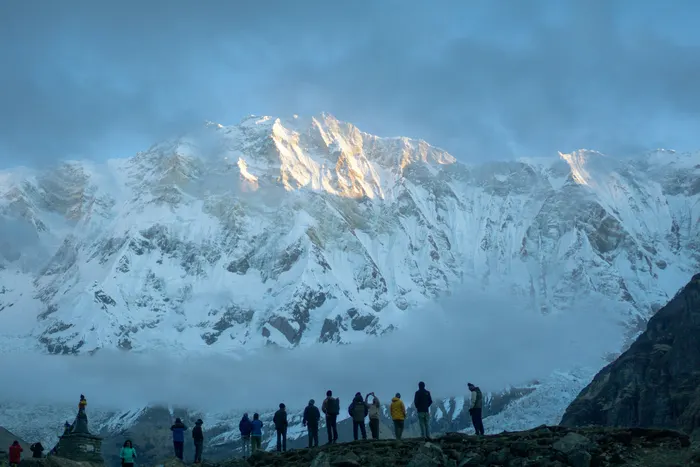
Island Peak itself requires a climbing permit issued by the Nepal Mountaineering Association, the trekking-peak authority, in addition to the trekking permits. On the combined expedition this is handled for you: the package price includes the NMA climbing permit together with the Sagarmatha National Park entry and the Pasang Lhamu local permit, so the only paperwork you personally manage is your passport, visa, and insurance documents. That is one of the quiet arguments for booking the climb as a package rather than assembling it yourself; permit logistics in Kathmandu are a half-day of queueing if you do not know the offices, and the climbing permit in particular is easiest left to the operator.
Training Before You Fly
The climbers who summit are the ones who arrived with the trek fitness already banked. Start training three to six months out: long walking sessions, four to eight hours on weekends if your landscape allows, building to a heavy-pack day at trek pace, plus two or three weekly sessions of leg strength and steady cardio. Hill stair work translates almost perfectly to Khumbu grades. If you live flat, a stair machine with a loaded daypack is the honest substitute, and weekend long walks on the flat still build the endurance engine the altitude will tax.
Two specific muscles matter on summit day that trekkers often skip: the calves and the shoulders, because front-pointing crampons on the headwall is calf work, and jumaring a fixed line for an hour is shoulder and arm work. Calf raises, step-ups and a few weeks of light upper-body pulling prepare both. None of this needs to be complicated or gym-perfect; it needs to be consistent. The trip itself is the final block of training: walk the acclimatization days fully, sleep at every scheduled altitude, hydrate obsessively, and arrive at base camp with the tank full. Our complete trekking preparation guide collects the full planning picture, from flights to fitness to insurance, in one place.
How Does the Expedition Manage Altitude and Safety?
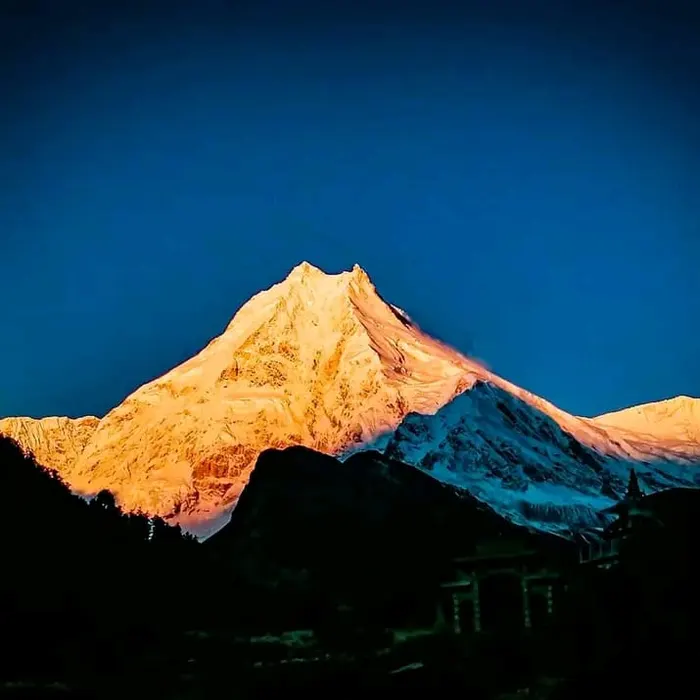
Altitude is the real summit obstacle, and the 17-day design is the first safety measure: the itinerary's staircase of sleeping heights and its two dedicated acclimatization days exist precisely to prevent altitude illness, a discipline our altitude sickness prevention guide explains in ACAPS guideline detail. The climb adds its own protections: a portable Gamow bag, the fabric altitude chamber that buys critical hours in an emergency, travels with the team, as does a full medical kit. The one-climber-per-two-to-three ratio on the mountain itself is a safety standard, not a luxury, because your climbing Sherpa is watching your pace, your breathing and your answers for early symptoms all night.
Know the honest odds as you plan. Roughly 70 percent of well-prepared climbers who reach Island Peak base camp on this itinerary stand on the summit, which means the most likely failure mode is weather or altitude, not technique. The turnaround culture is explicit and worth internalizing before you fly: the summit is optional, the descent is mandatory, and turning around at the glacier or even the headwall with your health intact is a successful expedition by any sane measure. If you want the deeper medical background, our guide to altitude sickness prevention and acclimatization on the big Nepal treks covers the physiology every Everest traveler should understand before booking anything at 6,000 meters.
When Is the Best Time to Climb Island Peak?
The climb inherits the Everest region's two prime windows, April to May and October to November. Spring is the classic climbing season: longer days, warming temperatures, and the Everest scene at full energy, with expedition teams moving through the valley toward the bigger walls. Autumn is the more stable window, with post-monsoon air at its clearest, the driest trail conditions of the year, and summit dawns that photographers chase. Both months book out first, and expedition support, climbing Sherpas and fixed lines, is easiest to arrange when the season is running at full strength.
The shoulder seasons are for flexible travelers. Late September can deliver stunning clarity right after the monsoon breaks but carries a residual avalanche and rockfall risk on the gullies. Winter, December to February, is quiet and spectacularly cold: the mountain is climbable on a stable-weather week, but the nights at 5,200 meters are brutal and most operators pause their programs, so private climbs only. The monsoon, June to early September, is the one period to cross off entirely for this objective. Month-by-month weather logic for the region lives in our Everest weather by month guide, and the same seasonal judgment applies to booking your flights in, which our Lukla flight schedule guide covers in detail.
How Much Does the Expedition Cost?
The combined 17-day Island Peak with Everest Base Camp expedition is priced from USD 4,215 per person. Reading that number fairly requires knowing what it bundles: round-trip Kathmandu to Lukla flights, two hotel nights in Kathmandu with airport transfers, thirteen nights of teahouse lodging on the trek and one fully serviced camping night at Island Peak base camp, all meals on the trek and climb, the licensed trekking guide, a certified NMA climbing Sherpa at a ratio of one to every two or three climbers, the complete technical climbing kit, the NMA climbing permit together with the Sagarmatha National Park and Pasang Lhamu permits, porter support at one porter per two trekkers, the Gamow bag and medical kit, welcome and farewell dinners, your summit certificate, and all government taxes. The main costs left on your side are the international flight, your climbing insurance, personal gear and rentals, and tips.
For comparison, a pure Everest Base Camp trek without the climb typically lands in the USD 1,300 to 3,300 band depending on season and comfort level, a range our Everest Base Camp cost breakdown itemizes line by line. The climb premium buys the climbing Sherpa, the mountaineering equipment, the base-camp camping operation and the summit permit, which is why the step from trekking to climbing is priced as a genuine category change rather than an add-on. Trekkers watching the budget can also read how the whole cost picture compares across regions in the complete Nepal trekking planning guide.
If Island Peak Is a Step Too Far This Year
The honest alternative is not a lesser trip, only a different one. Strong trekkers who want high drama without ropes have two standout options in the same valley: the Everest Three Passes circuit, the Khumbu's toughest pure trek at three 5,000 meter-plus passes in 18 days, and the Gokyo Lakes and Gokyo Ri guide, the quieter western arm with the finest single viewpoint in the region. Both deliver 5,300-plus meter high points, glacier travel on foot, and a legitimate summit feel without a single fixed line.
If altitude rather than climbing is the worry, the graduated Everest menu is the answer: start with the Everest View short trek, five days to the classic Namche panorama, or the Everest comfort trek, ten days at a moderate pace with upgraded lodges. Travelers who want the full base-camp experience with softer edges can move straight to the Everest Base Camp luxury lodge trek. And if you simply want to see the high Khumbu without sleeping in it, a mountain flight over Everest or one of the region's helicopter tours delivers the wall of giants in a single morning. Island Peak will keep; it has been waiting since 1953.
Is the Combined Expedition Right for You?
Say yes if you have trekking mileage in your legs, the idea of a rope and crampons excites rather than frightens you, and your calendar can hold 17 days plus weather buffer. This trip was built for the Everest Base Camp graduate who wants the next step, and for the fit first-timer who knows they will regret stopping at base camp. The profile that thrives: comfortable with long days, disciplined about slow acclimatization, honest about turning around, and able to train for months beforehand.
Say not yet if you have never trekked at altitude, if your available training window is a few weeks, or if the midnight start reads as misery rather than adventure. Start with the classic trek, our 14-day Everest Base Camp itinerary is the natural first chapter, and keep Island Peak as the sequel goal. The mountain is genuinely forgiving of timing; it rewards the climber who arrives ready, whenever that is. Walking the trail through Sagarmatha National Park first, and understanding the teahouse and lodge culture you will live in for two weeks, is a fine way to spend the year before you clip into a fixed line at 6,100 meters.
Island Peak is where trekking becomes mountaineering, and the combined expedition is the most complete introduction to the high Everest world on offer: two weeks of Sherpa villages and monasteries, the foot of Everest itself, and then a roped midnight push up a 6,189 meter summit with 8,000 meter giants on every horizon. The mountain has been the first summit of choice since the men who first climbed Everest used it to rehearse, and the reason has not changed. If 2026 or 2027 is your year to stand on top, talk to our team, or browse every Nepal tour and trek package on the site and build up to it your way.